10 Star Trek: Deep Space Nine Episodes That Were Almost Completely Different
These classic episodes were beset with rewrites, revisions and sometimes all out restarts.

The first show in the franchise to be made without the direct input of mastermind Gene Roddenberry, Star Trek: Deep Space Nine had the deck stacked against it from the start in terms of fan expectation. Following the incredible success of The Original Series and The Next Generation, creators Rick Berman and Michael Piller took the well established formula of the sci-fi institution and boldly took it into places never seen before.
Gone were the idyllic voyages from upliftingly utopian Federation crews, to be replaced by a treacherous space station filled with underhanded dealings, dark political intrigue and all out war.
Whilst not as widely regarded as its predecessors, the gamble paid off as the show is now seen by many die-hard fans as the unsung hero of the Star Trek Universe, owing in part to its weightier storylines and long form storytelling.
Many of these stories would go on to be some of the best the series had to offer but the journey to get them there was often one beset with rewrites, revisions and sometimes all out restarts.
10. Emissary (Season 1 Episode 1)

What better place to start than where it all began.
Tasked by Starfleet with facilitating Bajor’s acceptance into The Federation following the end of the Cardassian Occupation, Commander Benjamin Sisko reluctantly takes on command of the station and immediately clashes with his Bajoran liaison and First Officer: Major Kira Nerys. Having endured the brutal Cardassian rule for her whole life, Kira’s time in the Bajoran Resistance has left her with a unflappable determination to see Bajor freed, and the presence of The Federation after so many years of struggle strikes her as nothing more than interfering colonisation when her planet finally has a chance to stand on its own two feet.
Whilst Sisko and Kira’s antagonism and eventual camaraderie would go on to form a major part of the show, this was not always the plan. From the beginning, writers wanted to bring along the recurring Next Generation Bajoran character Ro Laren for the role of liaison. Despite the promise this could bring, actress Michelle Forbes did not want to sign on for a six season arc, so the role was hastily rewritten for Major Kira.
Whilst we can’t help but wonder what sort of dynamic Ro would have brought to the show, with her conflicting duties to Bajor and the Federation, as well as her combative attitude to authority, to have her would have robbed the audiences of one of Star Trek’s best characters in Kira. With her emotional journey and post-colonial ties, Kira’s stories are some of the most engaging in the entire series and, thanks to the outstanding work of actress Nana Visitor, the show would not have been the same without her.
9. Wrongs Darker Than Death Or Night (Season 6 Episode 17)
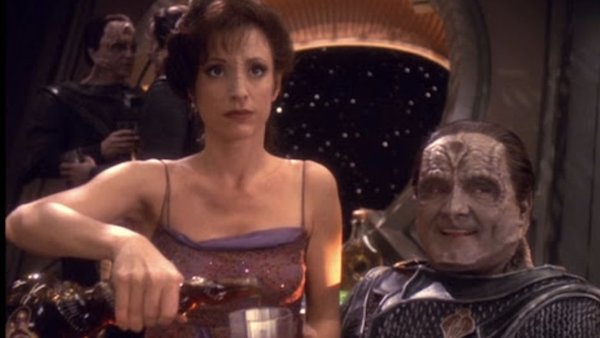
Of all of the relationships in DS9’s seven year run, few are as interesting as that of Kira Nerys and Gul Dukat. Frequently combative, occasionally understanding and always ambiguous, the former overlord and terrorist are at odds as often as they are allied.
Going through several shifts in its gestation period, season six’s ‘Wrongs Darker Than Death of Night’ would push this relationship to breaking point when Kira peers back in time after Dukat smugly reveals that he and her mother had been lovers.
Wildly different in its origins, the episode’s original impetus bizarrely concerned the ghosts of time displaced Bajoran children and a Cardassian analogue of the Nazi scientist Josef Mengele, before being almost completely thrown out save for the time displacement and refocusing on Kira and Dukat. The original script also had Kira forgiving her mother for the transgression, realising she was doing it to provide for her family, before being rewritten again to leave the moral position much more ambiguous.
Whilst not amongst DS9’s best, the episode served as another knife twist in Dukat’s inexorable link to Kira, and another opportunity for DS9 to explore the moral complexity of this post-colonial world.
8. The Collaborator (Season 2 Episode 24)
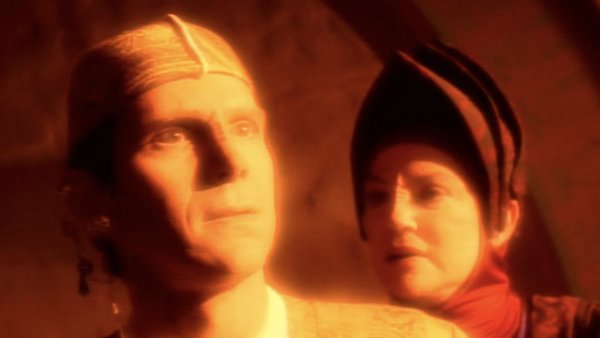
For all of its many achievements, DS9 was never short of engaging villains across its run, and few proved to be a bigger thorn in the station’s side than the ruthless and power hunger Winn Adami.
Played with delicious cunning by Louise Fletcher, there was nothing that Winn wouldn’t do in her pursuit of power and control, including assassination attempts and planting explosives in a school. Sure enough, in Season Two episode The Collaborator, Winn achieves her ambitions and is elected Kai; the supreme religious leader of Bajor.
Winn’s ascension comes at the expense of her rival and Kira’s lover Vedek Bareil Antos, who is implicated as collaborating with the Cardassians during the occupation. Although it is later revealed that he is in fact covering for the real collaborator, the wheels are set in motion and Winn is named Kai.
Original versions of the script, however, differed greatly from the end result. The original collaborator would actually have been an elderly man, whose daughter was responsible for the death of Kira’s father and who is covering for her similarly to Bareill.
For some time previous to this the writers had intended for Bareill to become Kai instead of Winn, but they changed their minds after realising how much storyline potential there was by placing the menacing monk in such a key position (including a major role in the series grand finale). Sure enough the episode was adapted to facilitate Winn’s election, and we got even more of that smiling viper we loved to hate.
7. It’s Only A Paper Moon (Season 7 Episode 10)
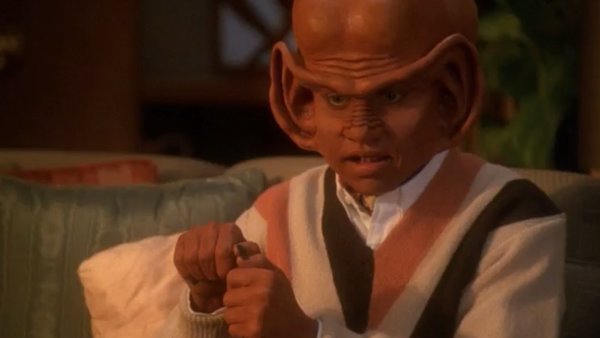
Largely fodder for some comic relief in the increasingly dark world of DS9, Ferengi episodes rarely feature much in the way of emotional depth. Nevertheless, as the series inched closer to its finale, it was time for one of these large lobed latinum lovers to get the true dramatic treatment.
The episode centres on Ensign Nog, Starfleet’s first Ferengi, and his recovery after losing his leg to Dominion phaser fire during the siege of AR-558. Clearly in the grip of PTSD, Nog experiences psychosomatic pain despite his fully functional bio-synthetic prosthetic, and retreats to the comfort of Vic’s Lounge, a 1960s Vegas style holosuite program overseen by the eponymous and self aware lounge singing hologram.
The concept was originally from a years old pitch set in the more familiar Quark’s Bar, with the working title ‘Everybody Comes To Quark’s’. Charting a full day at the establishment, the episode would focus on one dramatic and two comedic stories as the various characters would come and go throughout the day.
As writing progressed, Nog’s dramatic story held such dramatic weight for the characters that the comic subplots were dropped entirely. With the locale moving to the holosuite, Nog could truly escape reality as he wanted, the ambitious and bright eyed boy we met in season one completely losing himself after his first brush with mortality, and given the narrative space such a subject deserves.
6. Waltz (Season 6 Episode 11)

Owing in part to a perfectly nuanced portrayal by Marc Alaimo, the disgraced Cardassian despot Gul Dukat is one of DS9’s most well received and morally complex characters. Ethically malleable in earlier seasons, Dukat’s descent into madness following the death of his daughter and the embarrassing defeat of Operation Return would mark the beginning of his fall into abject savagery, and sixth season episode Waltz is one of many putting the nail into the coffin of his possible redemption.
On the way to a war crimes trial, Sisko and Dukat’s ship is shot down by a Cardassian battle cruiser, and the two find themselves stranded on an alien planet, awaiting rescue without knowing which side will be the one coming to their aid. Ever the lover of his own voice, Dukat takes the opportunity to engage Sisko in a dialogue on morality and his role in the Occupation, despite suffering hallucinations of Kira, fellow Cardassian Damar and Dominion liaison Weyoun.
The episode was always intended to truly establish Dukat’s villainy, as he admits to himself for the first time just how much he despises the Bajorans, and affirms his intention to turn the planet into a graveyard. In the original draft however, the episode would have taken place entirely in Dukat’s head with other characters representing his personality, as he relives key moments from the Occupation whilst catatonic in hospital.
The decision to drag it into the real world gave much more weight to Dukat and Sisko’s dichotomous relationship, and set the stage for the series climactic conclusion when Dukat surrendered to his darkest desires and became the Emissary of the Pah-wraiths.
5. Second Skin (Season 3 Episode 5)
Prior to the onset of the genre defining Dominion War, the overarching narrative of DS9 was the fallout from Cardassia’s dictatorial 50 year occupation of the planet Bajor.
During this time, both the Cardassian occupiers and the Bajoran Resistance were involved in numerous schemes and efforts to see the other defeated once and for all. Alongside the obvious military skirmishes, intrigue and espionage were also key weapons in the arsenal of Cardassia’s Obsidian Order, and such efforts form the core of third season episode Second Skin.
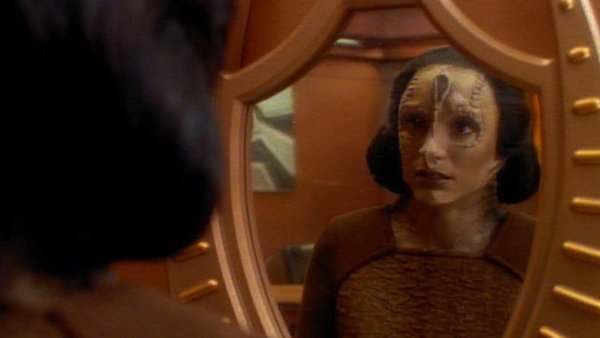
Discovering evidence of an incarceration she does not remember, Kira travels to Bajor to unravel the mystery of her past, only to be kidnapped en route and wake up with the face of a Cardassian. In the home of Ghemor, a Cardassian claiming to be her father, Kira is told she is actually an undercover agent of the Order, who underwent reconstructive surgery and memory alteration so that she could infiltrate the Resistance. The situation is eventually revealed to be a ruse however, set up by the Order to ensnare Ghemor and expose his ties with the Cardassian Dissident Movement.
Although the concept remained the same, the original draft of the episode cast Chief O’Brien in the central role, continuing the series’ tradition of ‘O’Brien must suffer’ episodes. Whilst the move to Kira made more sense from a continuity point of view, O’Brien being the father of a human child for one thing, a line leaving Kira’s race ambiguous also didn’t make it to the final cut. Whilst no reason for this omission has been stated, it certainly would have put a massive spin on this already deeply conflicted character.
4. Far Beyond The Stars (Season 6 Episode 13)

Continuing Star Trek’s history of taking real world issues and bringing them to a sci-fi world, the sixth season’s ‘Far Beyond The Stars’ started its life as just another tiresome ‘hallucination/time travel episode’, but some tinkering behind the scenes turned it into one of DS9’s most celebrated and important moments.
Despondent at the increasingly hopeless Dominion War, Sisko begins hallucinating before waking up as a completely different man. Now living in 1950s New York, sci-fi writer Benny Russell struggles against racial discrimination as he tries to publish a story about a black commander of a space station: Captain Benjamin Sisko.
The episode originally starred Sisko’s son Jake, and saw him travelling back to the 1950s in a hallucination, created by aliens wishing to discover something about humanity. Feeling that the story was too gimmicky, but enjoying the 1950s premise, the producers reframed the episode as a vision from The Bajoran Prophets, god like extra-dimensional beings, and included the racial themes to turn this into an episode rich in meaning and depth.
Sisko’s time in the past reaffirms his resolve to win the war, and Avery Brooks would later reprise the role of Benny in future visions, turning what could’ve been a throwaway episode into a narrative necessity.
3. The Wire (Season 2 Episode 22)
In a show stuffed to the airlocks with fan favourites, few have such rabid appreciation as the enigmatic Cardassian spy tailor Elim Garak.
Having been exiled from Cardassia ‘due to unpaid taxes’, Garak spent the first two seasons entertaining himself and peaking the interest of Dr Bashir with a litany of half truths and allusions to his past on Cardassia. Garak took a leading role in the season two episode The Wire, when a cranial implant designed to release endorphins and resist torture malfunctions.
It is revealed that he had been using it constantly to escape the misery of his exile, and its malfunction puts him through a harrowing ordeal of near fatal withdrawal. As the drugs wear off, Garak descends into blind rage and panic, babbling contradictory backstories as Bashir attempts to help the man who has gradually become a dear friend.
In the episode’s original form, it was meant to be Major Kira who would take on the central role, having become addicted to battle stimulants during the occupation. However, the writers did not want to anchor themselves to such a character altering concept for later stories, so the role fell to Garak.
This change of course proved to be for the best, as The Wire stands up as one of DS9’s finest episodes, largely thanks to Andrew Robinson’s performance as the previously unflappable and jovial anti-villain. Indeed, had Kira been the one in withdrawal we would have lost one of DS9’s most memorable quotes.
In the episode’s finale, when asked by Bashir which of the stories were true or lies following his ordeal, Garak smiles and responds “My dear doctor, they’re all true, especially the lies”.
2. In The Pale Moonlight (Season 6 Episode 19)

Another fan favourite, In The Pale Moonlight is told by Sisko through his Captain’s log in a series of flashbacks, as he unfolds the story of the lengths he would go to in the name of ending the seemingly unwinnable Dominion War.
Facing insurmountable odds, the Federation’s last hope in the war is an alliance with the Romulans, who remain neutral in a position where their enemies will likely destroy one another. Desperate to convince Romulus that they will be the Dominon’s next target once the Federation falls, Sisko enlists the ethically manoeuvrable Garak to manufacture evidence to be found by a visiting Romulan diplomat. Despite the destruction of all of Sisko’s moral lines, and the death of the aforementioned diplomat, the Romulans do indeed join the war, and Sisko deletes his entire log entry.
Avery Brooks’ narrative monologue is one of the defining moments of DS9’s run, so the fact that the episode originated as Jake investigating Bajoran First Minister Shakaar seems baffling. Shakaar was later dropped from the script when Sisko and Garak’s collusion was established, before Jake was written out entirely as the writers could not convincingly create conflict between such a loving father and son. As interesting as a ‘space Watergate’ episode would be in any other circumstance, it has to be said that it would not have held a candle to the finished product.
1. Rejoined (Season 4 Episode 6)

Of all the things Star Trek is famous for, one of its most well known accomplishments was the 1968 kiss between Captain Kirk and Lt. Uhura, being a very early example of an interracial kiss on television when such things were still seen as controversial. Nearly 30 years later, Star Trek would go on to break the mould again.
Centring around the Trill Lt Jadzia Dax, the fourth season episode ‘Rejoined’ was one of many examining the society of the Trill, a race who include those ‘joined’ with a sentient symbiont, allowing them to share the memories and experiences of generations of their kind. The episode sees Dax meet Lenara Khan, a fellow joined Trill, whose host had previously been married to a former host of the Dax symbiont. Whilst there is a strict taboo within Trill society of forming relationships with the partners of previous hosts, Dax and Khan find themselves instinctively drawn to one another.
Not satisfied with just upsetting the taboos of Trill society, the episode marked an early example of a lesbian kiss on national television. Originally written as a man, the decision to cast Khan as a woman was a controversial move at the time.
Despite a predictable backlash, Rejoined has gone on to become on of Star Trek’s most well regarded episodes, with many members of the LGBTQ community later thanking actress Terry Farrell for making them feel less alone. Many late game rewrites may have saved storylines, but it’s not beyond the realms of possibility that this change may have saved lives.