10 Star Trek Episodes That Are Beyond Words
Sokath, his eyes opened! When words fail, Star Trek finds other ways to connect.
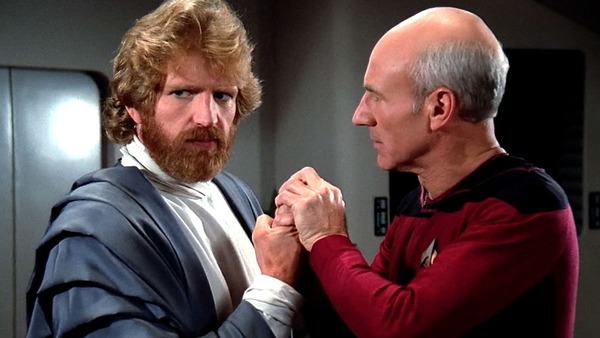
Star Trek has been telling stories about friendship, cooperation and communication for decades. It's a core pillar of everything the franchise stands for. So it's not unusual for them to deliver an episode that's all about overcoming the obstacles that stand in the way of understanding each other.
The Universal Translator is a miracle, but it's by no means foolproof. What happens when a language is so unique it can't be translated? How does it handle metaphors and colloquialisms that go beyond the literal meaning of the words? How many critical nuances are literally lost in translation?
A beautiful line from the play Translations by Brian Friel explains the intricate layers of understanding that we depend on:
I'd always be an outsider here, wouldn't I? I may learn the password but the language of the tribe will always elude me, won't it? The private core will always be...hermetic, won't it?
So much of our connection depends on more than words. And Star Trek has perfected the art of writing stories about overcoming those real-world boundaries. The only problem here was narrowing them down to just ten.
So whether it's communicating without speech, navigating missing context or opening our minds to new ways of connecting, these are the Star Trek stories that go far beyond words.
10. Pitch Perfect Uhura
No, we're not talking about that musical episode.
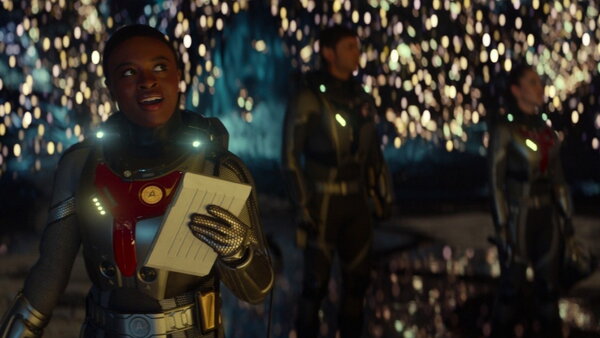
Children of the Comet sees Cadet Uhura weaving the musical magic we know she'll serenade the crew with in years to come. Trapped on a comet by a mysterious forcefield, Uhura's away team is running out of time to rescue the planet in its path. The problem is, they have no way to interact with the ancient technology that's holding them hostage.
Until Uhura starts to hum while decoding markings on the biggest Fabergé egg you've ever seen. It finally provokes a reaction, and as Uhura sings a little more, it's clear the machinery is responding to the music.
We've always used music as a form of communication. You learn it, read it, play it and repeat it. The way a composer orchestrates a phrase tells a story. The way instruments and dynamics are used stirs emotion. So to see it used as a form of language in this story is really quite beautiful.
As Spock and Uhura unite their voices in harmony, the ancient mechanism chirps and chimes a delicate melody of its own. When Uhura sings it back, the forcefield is finally lowered, and the away team is rescued. There's something oddly poetic about Uhura and the comet needing to be in tune to finally understand each other.
In a fitting coda, Uhura translates the music into coordinates and becomes convinced that the comet was trying to assure them it had no intention of hitting the planet. It quite literally was sending a song of peace.