10 Star Trek Episodes That Are Beyond Words
Sokath, his eyes opened! When words fail, Star Trek finds other ways to connect.
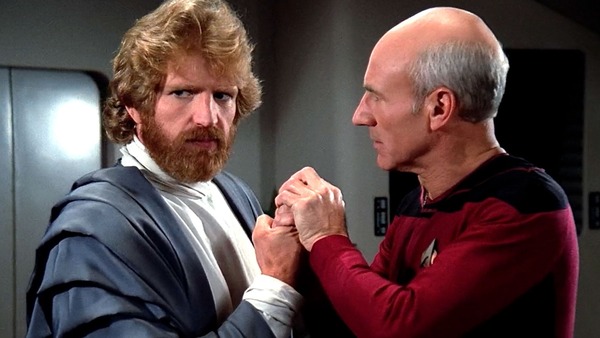
Star Trek has been telling stories about friendship, cooperation and communication for decades. It's a core pillar of everything the franchise stands for. So it's not unusual for them to deliver an episode that's all about overcoming the obstacles that stand in the way of understanding each other.
The Universal Translator is a miracle, but it's by no means foolproof. What happens when a language is so unique it can't be translated? How does it handle metaphors and colloquialisms that go beyond the literal meaning of the words? How many critical nuances are literally lost in translation?
A beautiful line from the play Translations by Brian Friel explains the intricate layers of understanding that we depend on:
I'd always be an outsider here, wouldn't I? I may learn the password but the language of the tribe will always elude me, won't it? The private core will always be...hermetic, won't it?
So much of our connection depends on more than words. And Star Trek has perfected the art of writing stories about overcoming those real-world boundaries. The only problem here was narrowing them down to just ten.
So whether it's communicating without speech, navigating missing context or opening our minds to new ways of connecting, these are the Star Trek stories that go far beyond words.
10. Pitch Perfect Uhura

No, we're not talking about that musical episode.
Children of the Comet sees Cadet Uhura weaving the musical magic we know she'll serenade the crew with in years to come. Trapped on a comet by a mysterious forcefield, Uhura's away team is running out of time to rescue the planet in its path. The problem is, they have no way to interact with the ancient technology that's holding them hostage.
Until Uhura starts to hum while decoding markings on the biggest Fabergé egg you've ever seen. It finally provokes a reaction, and as Uhura sings a little more, it's clear the machinery is responding to the music.
We've always used music as a form of communication. You learn it, read it, play it and repeat it. The way a composer orchestrates a phrase tells a story. The way instruments and dynamics are used stirs emotion. So to see it used as a form of language in this story is really quite beautiful.
As Spock and Uhura unite their voices in harmony, the ancient mechanism chirps and chimes a delicate melody of its own. When Uhura sings it back, the forcefield is finally lowered, and the away team is rescued. There's something oddly poetic about Uhura and the comet needing to be in tune to finally understand each other.
In a fitting coda, Uhura translates the music into coordinates and becomes convinced that the comet was trying to assure them it had no intention of hitting the planet. It quite literally was sending a song of peace.
9. One Moon Circles
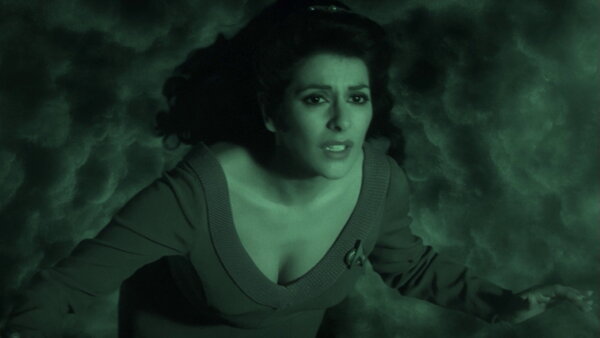
It's never going to go well when Deanna Troi watches a drifting starship with that look on her face.
When an away team investigates the USS Brattain in the episode Night Terrors, they find the crew dead...think The Naked Now, but without the fun bits. And lo and behold, it's not long before the Enterprise starts behaving like a ghost ship.
Phantom voices, hallucinations, memory loss, paranoia...that nightmare-inducing scene where Crusher is surrounded by risen corpses. All in all, you don't want to watch this episode before bedtime.
With engines offline, there's no escape. It's up to Troi to discover the meaning of her recurring dream before it's too late: floating through a murky vortex, surrounded by voices droning 'eyes in the dark' and 'one moon circles'. But finally she realises...it's a call for help. Well, more precisely, it's a call for hydrogen.
The concept works so well because it isn't just some words to decode. It's a kaleidoscope of imagery, instinct and voices that she has to bring into focus. Now, it's not the most reliable or efficient means of communication, but the idea of using dreams to convey messages is truly intriguing. We all like to muse on what our dreams might mean, and Night Terrors plays on our intuition that even our nightmares might be trying to tell us something.
8. The Importance Of Body Language
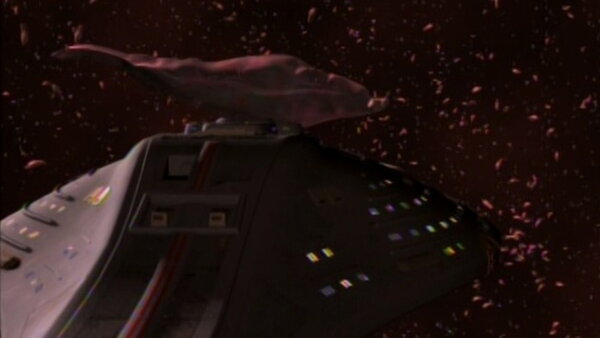
Voyager got more than she bargained for when she winked a nacelle at some passing space whales in Elogium. When a swarm of dubious looking lifeforms take a fancy to the ship, she's pulled in by their sheer magnetism. Quite literally.
With no way of communicating, the crew find themselves in trouble as the creatures nuzzle up to Voyager and start draining energy, causing ship-wide system failures. And things only get worse when an even bigger version rocks up to see what all the fuss is about.
Doing their best to understand the behaviour on display, they realise they're caught up in some kind of mating ritual that they want absolutely no part of. And more worryingly, the newcomer sees them as a rival.
Janeway is forced to try and escape without causing harm. Easier said than done when an entire swarm takes a shine to your subspace signature. Eventually, she tries to push back against the unwanted rival...until Chakotay steps in with the astute observation that matching its aggression is only escalating its behaviour.
He suggests they try and mimic the submissive mannerisms of the swarm, and sure enough, when the ship rolls over and shows its belly, the smaller creatures lose interest and flock to the superior space whale.
Elogium is a fascinating (if somewhat quirky) foray into the importance of basic non-verbal communication, even in the 24th century. Reading the swarm's body language and primal instincts saved the entire ship... and, more importantly, gave us the now-infamous Tuvok line:
It appears we have lost our sex appeal.
7. The Sound Of Silence
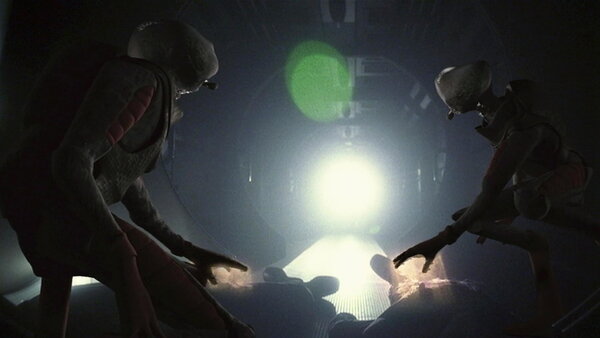
How do you make peace with a species that keeps giving you the silent treatment?
Given Archer's position as Earth's pathfinder in the stars, it's a wonder he didn't have more trouble communicating with new friends and foes. But the Silent Enemy proved to be one of his most challenging first contacts.
An unknown vessel takes interest in the Enterprise, then flies away without responding to Archer's hail...and their return visit isn't any more successful. Archer's greeting is met with deafening silence...until an ear-piercing screech blares over the comm, followed by an unannounced scan of the ship.
Things take a legitimately creepy turn when the aliens get braver, boarding the vessel and stalking the dark corridors before attacking and scanning two crew members. Even when confronted, they remain silent, barely reacting when they're shot.
It spooks Archer enough to finally get the ship's cannons working, and he's forced to use them when the strangers return with a spliced recording of him in the galaxy's worst deepfake, demanding he surrender.
And that's that. The aliens skedaddle pretty sharpish after a couple of shots, and the crew get absolutely no answers.
But it's strangely fitting for Enterprise. No matter how unsettling the encounter is, it's just the tip of the iceberg for what awaits in the final frontier. Not all attempts to offer a hand of friendship will be successful, no matter how much they want to make it work.
There are some things in the great unknown that will remain...well...unknown. For the time being, at least. The important thing was that they tried, even when unnerved...and came out of it mostly unscathed.
6. The Language Of Compassion

The Empath represents one of Star Trek's earliest deep dives into communication beyond speech. And that's pretty relevant for a ship that's constantly making first contact with aliens who could have any number of conceivable (and inconceivable) ways to communicate.
Kirk, Spock and McCoy are abducted by a mysterious force during an away mission. They discover an unknown lifeform (a woman who looks remarkably human, complete with a cute 60s hairdo), but she is entirely silent. Nevertheless, her feelings shine through with her expressive face and almost balletic movements.
Gem, as Bones calls her, not only shows her developing empathy through compassion, but also by taking their wounds as her own...despite the danger to herself. But most touching is the bond that develops between Gem and the away team, even without words. A bond that becomes so meaningful that she is willing to give her own life to save McCoy's.
The choice to use such expressive body movement to replace her speech adds a sense of artistry to Gem's silent story. And her ability to offer Spock support with a touch to the shoulder and a kind expression, or to mourn McCoy's fate with a single tear, reminds us that our capacity for empathy and connection with others, even relative strangers, transcends words.
5. Agree...Disagree...
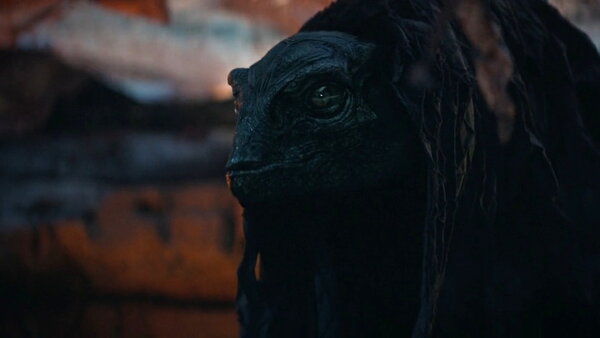
The Ortegas episode we'd all been waiting for left the ace pilot marooned with nothing but a broken shuttle, her ingenuity and a Gorn sidekick.
Context is key for Terrarium. Previously on Strange New Worlds, Ortegas barely survived a brutal encounter with the Gorn and battled trauma in the aftermath. So being stranded with a Gorn was the last thing she needed or wanted.
But rather than descend into a battle of survival between the human and Gorn, the story is about overcoming barriers and finding companionship in the most inhospitable of places. Sure, it doesn't start well, with the Gorn using Ortegas as bait to capture dinner. And she's understandably confused when the Gorn offers to share dinner with her rather than make her the second course.
Slowly, they start to build trust through action and behaviour. And when the Gorn saves her life, it opens Ortegas' eyes to the living, breathing person behind the scales. It gives her the first building block needed to reach out...empathy.
Ortegas manages to rig up a device to understand yes and no, and their bond deepens through the limited communication. Treating wounds, sharing meals, even playing games.
The rub comes when Ortegas realises her new comrade has no wish to leave injured, knowing the fate that awaits her. And that's our first inkling that the story might not end well for the unlikely Gorn bestie, no matter how much Ortegas implores her not to give up.
Terrarium is about far more than the struggle to communicate with another species. It's about moving beyond speech and into compassion and cultural understanding. In connecting with this nameless Gorn, Ortegas faced her demon and became its friend.
4. When The Chorus Falls Silent
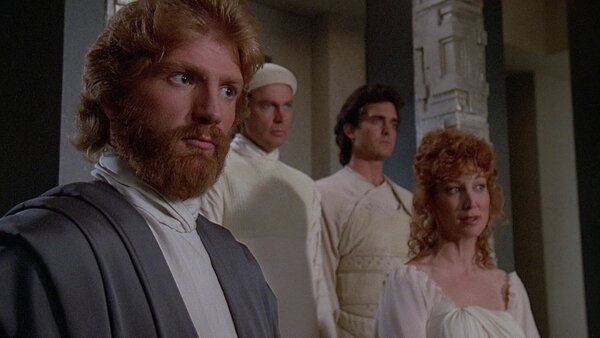
Loud As A Whisper is a poignant exploration of communication, diplomacy and disability. Picard is tasked with transporting a telepathic and deaf mediator, Riva, to a negotiation. Three companions speak for Riva, representing different parts of his soul. To all intents and purposes, they serve as his chorus, representing both his words and his feelings.
When his chorus is killed, he's left in turmoil, unable to fully communicate. Data learns his sign language, but it doesn't offer the same depth of expression he's accustomed to.
There are some beautiful moments along the way. Picard's initial mistake in addressing the interpreters rather than Riva, and the swift correction. Riva's discussion with Geordi, comparing his chorus with his visor, and their agreement that it's a blessing to understand that they're special, each in their own way. Seeing Riva and Deanna connecting without his chorus, relying on sign language instead.
When Riva's left devastated after the death of his chorus, he explains that he not only lost his friends; he lost a part of himself. The idea that it's the crew's responsibility to find a way to reach him rather than the other way around was especially forward-thinking. Even the fact that Riva is played by Howie Seago, a deaf actor, is significant, considering we still struggle today to represent disabled characters with actors who share their lived experience.
But it's the ending that weaves all these threads together. Riva realises he can bring peace to the warring factions by teaching them sign language. By learning to communicate with him, they'll learn how to understand and cooperate. Not bad for an episode of television from the 1980s.
3. The Shape Of Trust
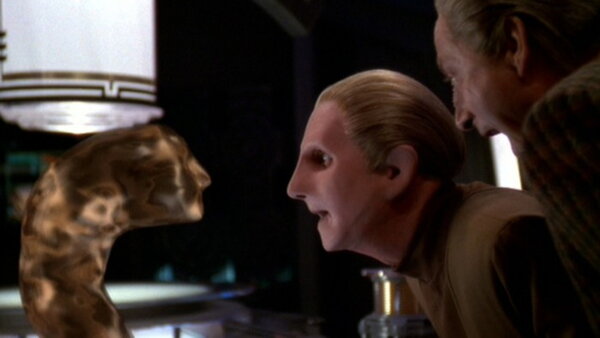
When Odo embarks on a mission to nurture a baby changeling, he brings a whole new meaning to the phrase 'shaping a child in his own image'.
The Begotten offers a wonderful story of duality. While Odo is forced to adjust to life as a solid, he has to teach an infant how to be a changeling. And as he confronts the invasive experiments of his own infancy at the hands of Dr Mora, he resolves to bring up the child with patience and compassion instead.
His quest is complicated when Dr Mora shows up to 'help', and he's torn between utilising his expertise and protecting the child from his scientific methods. In the end, Odo allows him to stay as an observer only, but things don't go to plan.
All of Odo's efforts to elicit a response or any sign of understanding are met with nothing. Careful introductions to different shapes, reassuring explanations, patience and understanding- all fruitless. It leads to a reckoning between the doctor and protégé; Odo calling Mora out for the brutal methods he'd inflicted on him, and Mora claiming he'd been under immense pressure for results.
Under threat of Federation interference, Odo relents and allows the doctor to help. But this time, Mora's methods are tempered by Odo's empathy and care, and the changeling finally moves. To Odo's delight, the child reaches out by mimicking his face. A far more advanced result than Mora's previous 'spare the rod, spoil the child' approach.
The Begotten offers a unique take on the struggle to form trust and impart wisdom without an open dialogue. But just as importantly, it allows Odo to come to terms with his upbringing and find some understanding for the man he had resented for so many years...an insight he never could have achieved through a shouting match alone.
2. My Mind To Your Mind
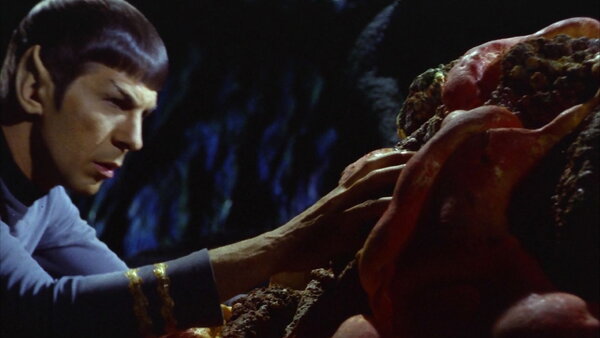
When The Devil in the Dark opens with a mining facility being terrorised by some kind of creature lurking in the caverns, it seems like we're in for a straightforward monster mash. However, this is more than the usual 'catch it, kill it' story of classic sci-fi.
The monster continues to sabotage mining operations and kills anyone who tries to stop it. Spock can only detect one such creature nearby, warning Kirk that killing it may mean extinction; a crime against science. But Kirk remains resolute in his shoot-to-kill campaign.
Now, it's time to address the elephant in the room. Or rather, the person crawling under a rug in the room. We promise, if you can look past the dated effects, there is a truly touching story to be had.
Because despite Kirk's survival instinct to kill it before it can cause more harm, logical Spock considers the consequences of taking a life without understanding its behaviour and motives. But when Kirk aims a phaser at it, its fearful reaction makes him realise it understands...and he shows it mercy.
Spock initiates a mind meld, discovering it's an intelligent being known as a Horta. More, it's just a mother, the last of her kind, trying to protect her eggs. Kirk is finally able to explain to the miners (now ready to club the poor thing to death) that she had been content to live alongside them until they started destroying her eggs. Spock's perseverance in reaching out brings peace to both sides and ushers in a new era of cooperation.
It's a thoughtful and all too relevant story, even all these years on. It shows the danger of Kirk's assumption regarding mindless aggression versus Spock's open-mindedness to the Horta's motivations. Just because another lifeform doesn't speak, it doesn't mean it isn't intelligent or doesn't feel. Treating all living creatures with the respect they deserve is a basic principle of compassion, and persistence in communication is what brings opposing forces together.
1. Darmok and Jalad At Tanagra
Possibly one of the most famous Star Trek stories about the challenge of understanding each other comes in the episode Darmok. And it's easy to see why this one captured the imagination of so many fans.
Picard brought the entire escapade upon himself when he confidently declared that communication is a matter of patience and imagination, and they had those qualities in sufficient measure. Cue an unfathomable meeting with The Children of Tama, the abduction of Picard and his entrapment on a planet with the Tamarian captain.
The problem is, although the translator is able to relay the literal words spoken, the Tamarians speak entirely through mythological and historical metaphor. Without understanding those stories, their language is incomprehensible.
Picard initially thinks the captain wants to fight and refuses by throwing the presented knife away. As they settle to sleep, the Tamarian seems entirely peaceful, content to chatter by his roaring fire while Picard fails to get one going. The Tamarian's offer of a burning branch to help Picard's puny embers provides the first step towards comprehension; the recognition of a gift.
When his 'captor' implores him to take up his knife to defend against a native creature, that spark of understanding grows into cooperation. And when Picard finally realises he's citing examples to suggest a strategy, the Child of Tama exclaims 'Sokath, his eyes uncovered!' in sheer joy.
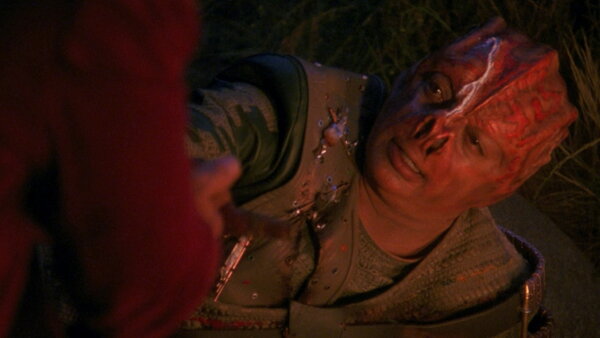
Their bond strengthens after the alien captain is injured, and what follows is one of the most understated yet compelling Star Trek scenes. Picard painstakingly deciphers the meaning behind one of his metaphors and realises that the Tamarian devised a scenario to bring them together...by facing danger side by side. Finally grasping the power of stories, Picard relates the tale of Gilgamesh while the captain passes away; a sacrifice willingly paid to kindle an understanding between their people.
Not only does this tearjerker capture the true power of language and shared cultural connection, but it's also about how far one brave soul will go to offer the hand of friendship. Darmok itself provides the perfect metaphor for the idea that greater understanding doesn't come from a dictionary, but from shared experience and stories.