10 Times Doctor Who Got History Totally Wrong
Hey, BBC, how about opening a History text book now and then?
You can't have a time travel show without a few anachronisms. For years, fans of Doctor Who have devoted themselves to picking over every single scene of the show, looking for errors in continuity, cast and crew mistakes and, of course, historical inaccuracies. However, fifty years after the show first aired the number of anachronisms is actually surprisingly low. Ok, so episodes have included the occasional 19th Century television aerial or light switch. Characters also occasionally behave oddly when you actually stop and consider their native time period, or use figures of speech that are much too modern for them to know. But most of these mistakes are easily overlooked, and won't even register on a casual viewing.
And then there are the other errors. The great big glaring mistakes that anyone with even a casual knowledge of history should be able to spot. Dates and times that you thought everyone over the age of eight would know. Factual errors on events that are common knowledge, and so widely accepted that you begin to question the intelligence of the writers. In some cases, these simple incorrect facts can be enough to ruin an entire episode or serial by making it impossible to suspend your disbelief in the face of such a silly mistake.
Surprisingly, the NuWho episodes seem to have more errors than the Classic series. This can be put down to a shift in focus. When Doctor Who originally aired in 1964 it was intended as an educational show teaching kids about both science and history. It was in the show's interest to be as factually accurate as possible. The program quickly moved away from this, and the historical episodes quickly became pseudo-histories, with the Doctor fighting to preserve human history against meddling aliens and time travelers. With the focus more on entertainment that education, the writers have become less and less concerned with historical accuracy. We've looked through the past fifty years of Doctor Who to find the ten most painful historical errors in the show's long history.

The eighth episode of Doctor Who's second season, The Chase is remembered by most fans as the final appearance of the Doctor's original companions Ian and Barbara, as well as the first instance of Dalek time travel. The serial's titular chase sees the Doctor and his companions pursued through time and space by the Daleks. Among the other locations visited in this serial are the Empire State Building and the Mary Celeste. In addition to visiting a variety of locales, the episode also introduced the Time Space Visualiser, which allows viewers to see events that have occurred in the past.
The show's major historical blunder occurs when each member of the TARDIS crew get a chance to view a different historical period through the Time Space Visualiser. Barbara asks to see the court of Queen Elizabeth I, and subsequently observes the Tudor monarch in audience with Shakespeare. The Queen can be heard say; "You are aware of the concern your character of Falstaff has caused to Sir John Oldcastle". In reality, Sir John Oldcastle died almost two hundred years before Shakespeare was writing his plays. Any literature student will tell you that Shakespeare did indeed base his famous comic knight on Oldcastle. However, it was one of Oldcastle's descendants who, furious at Shakespeare's unflattering depiction of their illustrious ancestor, forced him to change the character's name to Sir John Falstaff.
9. The Silver Nemesis

8. Pyramids of Mars
7. The Empty Child / The Doctor Dances
6. The Shakespeare Code
5. Daleks In Manhattan
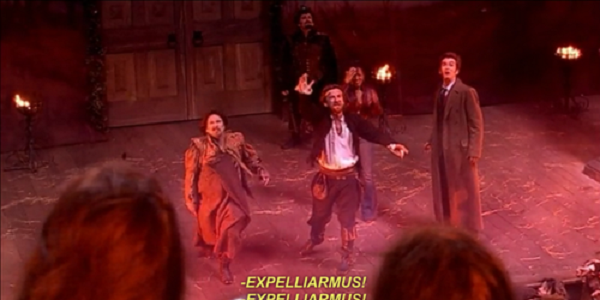
The Shakespeare Code wasn't the only anachronistic adventure for the Tenth Doctor and Martha. In Daleks In Manhattan the pair visited New York City in 1930. Set in the Great Depression, the episode included the construction of the Empire State Building, a settlement of homeless people, and Daleks once again trying to enslave humanity. As far as historical accuracy goes, the story is pretty shoddy. It is true that there was a homeless community living in Central Park. However, the real Hooverville wasn't established until 1931. Likewise, the mast of the Empire State Building is said to be "1,472 feet above New York", but the building didn't reach that height until the 1950s, when the radio antenna was added to the top. One of the biggest errors, however, comes in the New York skyline. Over the course of the episode, the 1930 Statue of Liberty is clearly visible, complete with the iconic golden torch. However, the Statue's torch only became gold in 1986, when the statue was extensively repaired to mark its 100th anniversary. The original flame, which would still have been in place in 1930, was constructed from of panes of yellow-tinted glass which were mounted on a copper frame.4. Four To Doomsday

3. Fires of Pompeii
2. Marco Polo
Marco Polo was one of the earliest serials in the original run of Doctor Who, and the second story to be set in the past. While visiting China in 1289, the Doctor and his companions met both the Venetian merchant-explorer Marco Polo and Mongolian Emperor Kublai Khan. Following its original remit as an educational program, the story focuses on the historical period and context and avoids science fiction elements beyond establishing the Doctor and his companions's means of travelling to the past. While mostly accurate, especially considering the show's limited budget, the story's major error comes in its use of terminology. Characters- both European and Asian- frequently refer to the city of "Peking" as the serial progresses. However, as the story is set in the late 13th century, the city we now call Beijing was known as "Dadu" to the Chinese. Meanwhile, the Mongolian characters would have referred to it as "Daidu," and the Europeans would have called it "Khanbaliq." Even the Doctor's companions wouldn't have called the city "Peking." The Chinese Government began using the transliteration Beijing in 1949. The use of this name increased as China started to enforce its official name on all flights, sea routes and official documents in the following years. Because the Doctor's companions, Ian Chesterton and Barbara Wright, were natives of 1960s England, they would have known the city by this newer transliteration. As a result none of the characters, regardless of their country of origin or the translation powers of the TARDIS, would have referred to the city as "Peking."1. The Pandorica Opens
