10 Ways To Make A Great Star Trek TV Show
 Star Trek: Enterprise bid farewell to its dwindling and wholly unsatisfied audience in 2005, since then there has been no concerted effort made to bring the ground-breaking Sci-Fi serial back to the air-waves. If nothing else, Star Trek (2009) proved that today's audiences still wanted a healthy dose of warp-drive in their Sci-fi. It was a hit across the board with audiences and critics, the first in a long while for the Star Trek Brand, and re-energized (pun not intended) the franchise after years of stagnation. That was on the big-screen though, with the J.J Abrams sequel due next year, the small screen the story is a little different. No one seems to be pushing for a new ship and crew to boldly go... where the other series left off. Whether it be the bad taste Enterprise left in network's minds or the networks thinking that it has all been done or that it is rare that a Sci-Fi show that grabs the ratings strongly. Whatever the reason I believe it can be done, Star Trek is too ingrained into Popculture to have it end on the small screen with Enterprise. So no more introductions, let's all see how Trek can grace the air-waves once again for the next generations and beyond.
10. Grittier Trek Through the Stars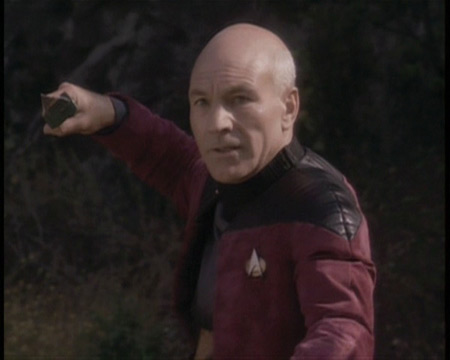 In all the incarnations of Trek the ships, crews and missions may be different, be one of the things that have been constant is that it is all very "clean". What I mean is that everything is in pristine working condition. Uniforms always pressed and tailored, hardly anything is ever in disrepair (For very long), the crews are always well-mannered and courteous towards one another. Roddenberry's "Wagon Train to the Stars" never looked so streamlined as in the numerous series he created. In other words we need to get grittier with space travel. As with Firefly, its feature film Serenity and the Battlestar Galactica reboot have shown living in Space is anything but "Clean". Those Sci-Fi shows feel real because of the wear and tear present on both the ships and their crews. Show that the ships have been into space, show that the tech has been used before and show the actually rigors of traversing through the final frontier.
9. Stay In The 24th century Time-Line
I think some people would opt for going further into time or back in time from the Next Generation's era, to keep things, I don't know "fresh". Why, bother? The three Next-Gen series have established a large developed and engrossing galaxy of human and alien races alike. As seen with series "Enterprise" establishing a new-time line takes a lot of effort and time to do properly (something gravely missing on the aforementioned Enterprise), SciFi shows rarely get one season to establish its setting, characters and general plot (Here's looking at you Firefly). Changing from the time-line established in The Next Generation, DS9 and Voyager would require too many exposition and establishing episodes in order to set the series up right. So why don't we pick-up right where Voyager left off, or threw us onto broken and bleeding, depending on how well you liked Voyager. You were all just glad that Voyager was over, right?8. A Cold-War in the Alpha Quadrate
 Throughout the Franchise it has been noted several times that there has never been a major conflict within the Federation of Planets since its inception, it was part of the founding principles to settle matters between the numerous species diplomatically. However, since the founding, times have decidedly changed with many intersteller conflicts arising between non-federation members. The latest Dominion War ravaged the Federation for over two years, but the other major powers in the Alpha Quadrate were also greatly affected. The Klingon Empire has suffered mightily due to numerous wars, civil and foreign. The Romulans also took major hits being a part of the alliance against the Dominion, but weren't nearly as damaged in the war. It goes without saying that the aggressors of the war will never be the same, Breen and Cardassian as they recoup their losses. For those not well versed in great-war aftermath politics this all spells a recipe for even worse conflicts in its wake. Taking the implied after-events of Nemesis out of consideration (It's best to forget it ever happened, like most fans have...or tried desperately), this leds to Romulan and Federation jockeying for prime postion. Indeed it could be an all out war of territory between the most powerful remaining former allies.
7. Internal Rifts Within The Federation
The Dominion War may have created many interstellar problems; however, the most devastating affects may be closer to home. The casualties from the two-year conflict could be estimated in the hundreds of millions to whole Billions. The Maquis movement showed that not everyone in the Federation agrees with the majority, so now imagine Earth, the heart of federation, after the sheer amount of dead and injured from a great conflict far from home. With Anti-war groups demonizing the Federation for starting wars instead of avoiding them. Full-on separatist groups may start to form from the Anti-War groups, those that believe that the federation has veered far from its mandate. Not unlike rabid Rodenbberry fans criticizing episodes of TNG and DS9 for over militarizing the Federation. Full-on political rifts could tear the federation apart, making the Maquis look like nothing in comparison. Thus, this Utopian Society may be as hollow and imaginary as a "true" Utopian Society.6. Delegate Some Series Time For Earth And Life In The 24th Century
 In all the series Earth takes a back-seat to Bodley Going where no man has gone before. We've gotten glimpses of life in the 24th century, but it hasn't really been explored. Now making a series based on earth would kind of defeat the purpose of the whole 'Wagon Train to the Stars' theme, so how about splitting time between the rigors of space and normal life 500 years from now. Contrasting the two career paths available to people would provide insight into the status-quo of this bright future. What choices are attractive to those who decide not to serve in Star-Fleet? How exactly is Star-Fleet perceived by the general public? What is the aftermath like after an interstellar conflict the scope of the Dominion War? These are all questions that are just waiting to be explored in the Trek Universe. Perhaps by means of family members that choose to stay terrestrial can we finally see all of what the Trek future has to offer to those outside of the service.
5. The Captain or Commanding Officer Is Of An Alien Race.
 Might seem like a small detail in the grand scheme of things but it is an important one. Through TOS to Enterprise, we have had all types in command, an All-American man, a British French man, a person of African-American decent, Katherine Hepburn a woman of American descent and even an insane "we can't be afraid of the wind...when there is no wind in space!" man have sat in the Captain's chair. It is high-time that the chair be occupied by an extra-terrestrial. The most obvious choice would be to make a Vulcan take command, serving as a call-back to the original series with Mr. Spock. We've seen how captain's of different races, genders and mental capacities (Looking at you again Archer...) handle their mostly Human crews. Now let's see how an alien non-native to earth and the human race entirely earns the respect of his/her crew. Especially that of a Vulcan trying to come to terms with dealing with an emotional crew around him/her. The Prejudices, integrating, and prospectives on humanity would be invaluable, continuing the themes of the franchise.
4. The C.O And Most Of The Crew Are War Veterans
 This would seemingly be a no-brainer; however, Gene Rodenbberry created Star Trek at the height of cold-war tensions in the late sixties, serving as a hopeful vision where all races work together for the common cause of discovery and increasing the knowledge of the human race. There are no longer prejudices, generalizations nor unfounded beliefs within the human race. Some fans have felt that the Dominion war arc completely destroys that idea of Gene's peaceful coexistence. Well, we finally got racial bias' settled eventually, but now it's no longer just different races but different species? Well that often would lead to conflict. Even TOS had Romulans to deal with, serving as an allegory to the cold-war. Now, with arguable the greatest war in the history of the galaxy only just ending, how do the people that signed up for exploration handling the aftermath? This would help to serve as an allegory for the combat veterans returning from the second Gulf-War and Afghanistan. Showing that no matter the century or combatants, war is hell, the aftermath may be even more so...
3. No More Malfunctioning Holodeck Episodes...
Some people would say no more time-travel ones either; however, time-travel really doesn't get old (no pun intended) in my opinion and this Star Trek we're talking about. We need at least some consistant conventions through the series. This one is pretty self-explanatory, those episodes where the plot generator Holodeck breaks and the crew battle -insert here- to fix it before it's too late. It has been done to death, let's all bury it once and for all. This is more of a case being made for this show to go in completely different directions than its predecessors than a real problem with broken holodeck episodes; nonetheless, no more!2. Bring Back Ronald D. Moore to Oversee Production
 It was under Moore's watch and writing that TNG and DS9 both hit their strides creatively and ratings-wise. The man knows good Sci-Fi, from Star Trek to the Battlestar Galactica, he produced some great Sci-Fi shows and spin-offs. It can be argued that had he not had a falling out with Brannon Braga with Voyager that the show would've been the show we were all promised in the beginning. A new creative path for the franchise needs an old face who understood what made it all work from the very beginning.