11 Things Doctor Who Wants You To Forget

Sometimes it's just easier to forget.
Doctor Who is a great TV programme but even the most loved shows have elements that are far from perfect. Looking back on over 50 years of televised stories, there are certain moments and ideas that the creators would undoubtedly prefer the viewers forget... forever.. In fact, with so many episodes under its belt, Doctor Who can be forgiven for its occasional poor taste (oh, those costumes in The Twin Dilemma), dumb ideas (let's face it, the Kandy Man from The Happiness Patrol, apologists notwithstanding) and general monster costumes with seams plainly visible on the backs (looking at you, original Silurians!). In the spirit of fairness, though, let's not dwell on the usual items used to castigate the showrunners, such as burping wheelie bins, wobbling sets, Daleks blundering into cameras and the problems caused by limited budgets. Instead, fans should view this series through the prism of genuine affection. Also, let's avoid things that became silly only with the passage of years. At the time of its original broadcast, for example, the green bubble wrap coated arm in Ark in Space was scary - it was only with the subsequent growth in popularity of bubble wrap that the material came to look commonplace and ridiculously out of place masquerading as transmogrifying flesh on an actor's arm. The makers of Doctor Who can hardly be critiqued, though, for not guessing how that material would come to be so popular in the future... So, let's instead focus on the worst things that the creators should have known wouldn't work. Here are the 10 most egregious aspects from NuWho and the Classic Series that the creators would no doubt prefer were swept under the carpet to be never mentioned again. Let's begin!

11. Who Said "Silence Will Fall"?

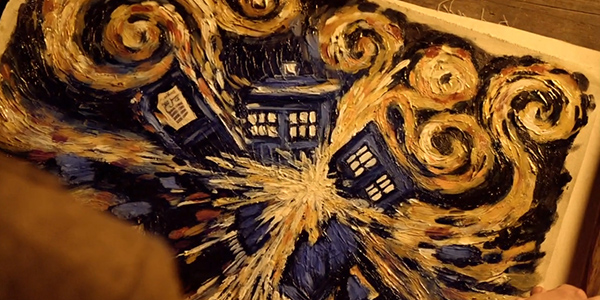
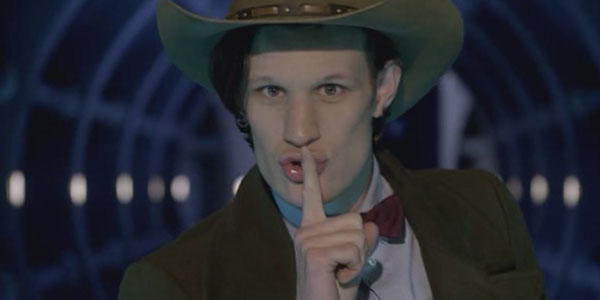
At the conclusion of The Pandorica Opens, the penultimate episode of Series 5 of NuWho, just as River Song pulls open the doors of the TARDIS to reveal a rock face blocking her escape and mere seconds before the TARDIS explodes, a hoarse, evil sounding voice intones, "Silence will fall!" As one, the viewing audience thought, "Ooh, a mystery that will surely be explained in the next episode or, at the very least, the next series." The audience was wrong. Never one to produce scripts that merely pander to audience expectations, Moffat instead elected to take the story in an entirely different direction, only explaining later that the origin and owner of the voice were not important. It was sufficient, apparently, to know that the Silence were somehow the culprits, even though they don't sound like that voice and even though viewers were never shown how they managed to destroy the TARDIS. The old adage of showing, not telling, was never so far from consideration in the mind of the Moff. Strangely, though, the voice in the TARDIS sounds a little like Prisoner Zero from Matt Smith's opening episode, The Eleventh Hour. But that's probably just coincidence. Curiously enough, the back story of Prisoner Zero, as well as how it knew about "silence will fall" in the first place, was also never explained. Let's raise our collective hands in exasperation, cry out, "Oh well, I guess Prisoner Zero was just really well informed and blowing up the TARDIS is so easy that anyone can do it..." before fetching our metaphorical brushes and lifting up the edge of that carpet. Because the show will never mention that plot point again, let alone actually show viewers what really happened, since showing viewers what happens isn't generally the norm in a visual medium like television.

10. Danny Pink's Incredible Jump

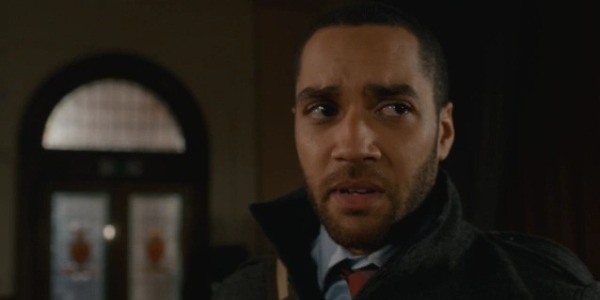
This entry serves to represent all those moments in which the audience have gasped out loud, "Oh, come on! Are you serious?!", and no other recent point was that feeling more in evidence than when Danny Pink performed his miraculous, superhuman feat in an episode from Series 8, The Caretaker. In case you have since blotted this unforgivably over-the-top moment out of your memory, here's a reminder: Danny Pink is standing face to face with the Skovox Blitzer in Coal Hill School. He draws the robot's fire by acting as a decoy, but then finds he needs to get past the killer robot. So he takes a run up and... jumps clear over the top of it, doing a midair flip in the process. As filmed, the unassisted jump is clearly beyond his ability and possibly beyond the ability of any human. As such, the thin veneer of the audience's willing suspension of disbelief is immediately torn to shreds. Saying that, there is fierce competition for the prize of worst "As if!" moment in Series 8. The moon being a giant space chicken egg in Kill the Moon was a step way too far for many fans. The moon being an egg is also something guaranteed to never be mentioned in the show again, which is somewhat of a relief anyway. For a science fiction/fantasy series, Doctor Who has a lot of wriggle room in the realm of "willing suspension of disbelief". The premise of the show is fantastical for a start and the tone of the show deliberately shifts with each episode (and sometimes within an episode), meaning the viewers are often happy to forgive enormously unlikely events that would never pass muster in another programme. When the storytelling rules established at the beginning of an episode are broken within that episode, however, the audience is justified in objecting. And that's what happened with Danny Pink's gravity-defying jump, and the space chicken egg, and... oh, this could be a long list. Let's move on.

9. The Universe Was Created By Terminus, No Wait...

Terminus2 Again, this list uses a single instance of an issue to represent a recurring issue as a whole. This time, the thing the producers want viewers to forget is that the same massively important historical event happens multiple times in Doctor Who, usually in seasons only a couple of years apart, and each time the same event has a different cause. The audience often has a short collective memory, yes, but these faux pas will make you wonder whether the writers even cared. The most breathtaking example of this sin is the creation of the universe itself. As all fans know, the Big Bang was caused by the spaceship exploding in the four-part story, Terminus, featuring Peter Davison as the Fifth Doctor. Except... wait... no, the universe was created by a different spaceship exploding in the radio adventure Slipback, just two years later with Colin Baker as the Sixth Doctor. This continuity error wasn't the only reason the radio show was panned. In the case of Slipback, perhaps most of the story itself should be collectively erased from memory, too. Surely the Big Bang has been the only example of this historical double dipping? Well, no. Atlantis has been destroyed multiple times in Doctor Who. We see Atlantis destroyed in the Second Doctor story The Underwater Menace before, forgivably, perhaps, its fate is presented in a different way in the later Third Doctor story. Then, just the very next year, in another Third Doctor story, The Time Monster, fans witness Atlantis being destroyed again. But that's not all. Moving into the world of prose fiction, the Torchwood novel, The Undertaker's Gift, also provides an explanation for Atlantis's destruction and, while various other audio stories and books have attempted to stitch all these versions of events together, it's still enough to make a fan's head spin. Let us never speak of Atlantis or the Big Bang again.

8. Gallifrey Was Frozen In A Moment Of Time
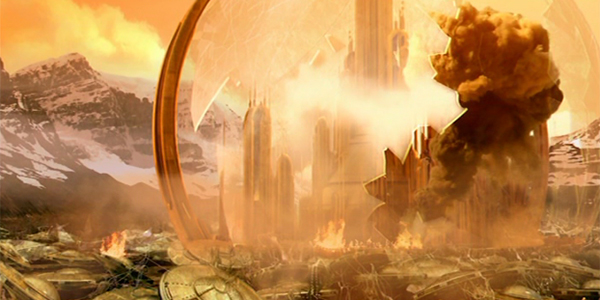
In the 50th nniversary story The Day of the Doctor, the Doctor's home planet of Gallifrey was frozen in an instant of time, effectively causing it to drop out of the regular flow of time in the universe and be saved from imminent destruction at the protuberances of the Daleks. Viewers know this because the fate of Gallifrey is very clearly explained in that episode. There's no room left for doubt, and there's no possibility allowed for misunderstanding. Except, in the following episode, The Time of the Doctor, viewers are told Gallifrey was actually trapped in another dimension or something (it's a bit vague). Presumably, this detail was changed so the Time Lords on Gallifrey could intercede in the Doctor's plight on the planet Christmas and offer him a new regenerative cycle. But no explanation for the change in Gallifrey's condition was offered. Plainly, the producers thought, "No one will notice, right?", but, at least if online forums are any guide, pretty much every last viewer did notice, and they roundly mocked the show for immediately contradicting an established "fact" without so much as a by-your-leave. Don't worry, though, because if the finale of Series 8, Death in Heaven, is anything to go by, the Doctor is now searching for Gallifrey in regular space, simply by flying to coordinates supplied by Missy, opening the TARDIS doors, and taking a quick look. Frozen moment of time, another dimension... nah, the Doctor will find Gallifrey simply by checking under the broccoli on his dinner plate. The whole "Gallifrey is frozen in time" plot point was brushed under the carpet because of its inconvenience to subsequent stories. After all, frozen Time Lords can't act as deus ex machina plot devices. What makes the ret-conning hard to swallow (other than its breathtaking rapidity and the sheer disrespect to viewers) is the fact that the same writer wrote the original cause of Gallifrey's disappearance and the retroactively inserted reason. In a sense, changing a plot point is better than simply ignoring that the point was ever made. The classic example of a plot point that was promptly deleted wholesale from continuity has to be the Doctor being "half human on mother's side", to quote the 1996 TV movie. This revelation was excised because the creators of the revived show simply... didn't care for it. Only a tiny handful of fans objected.

7. Reapers Will Eat You Up When Time Is Changed
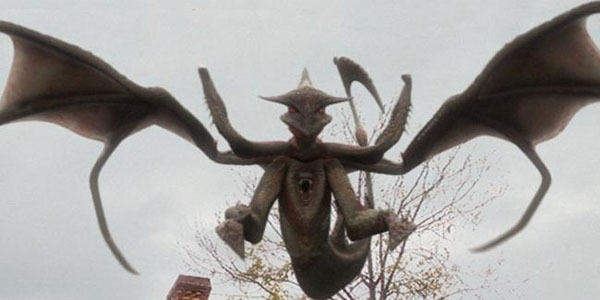
Remember how, in Series 1's heart-wrenching episode Father's Day, the Reapers appeared out of thin air to eat us all up when time was altered? They were scary, effectively realised and a great reason for not tampering with established history. Yup, Reapers will eat you up when history is changed... except when, for no readily discernible reason, they won't. In every subsequent story wherein time has been mangled, the Reapers have conspicuously failed to appear. In fact, the Doctor has never so much as mentioned them again. The Reapers are another example of an inconvenient element being erased, because Reapers appearing each and every time history is damaged is unworkable in a show where history is rewritten in practically every episode. While on the subject of Father's Day, how stupid was the Doctor in that story? That's a special kind of thick, letting Rose get that close to her father as he's about to die. Definitely no scope for something to go wrong there. Again, let's lift up the edge of that carpet and blissfully sweep away.

6. Enter The Myrka

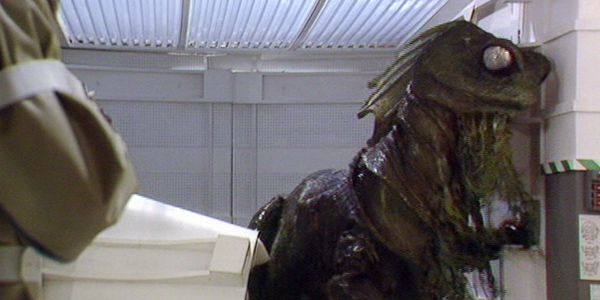
This list has carefully avoided poking fun at unconvincing monster costumes because it just isn't fair. Given the real world constraints of producing Doctor Who, there are bound to be monsters that don't work quite as well as was originally hoped. Sometimes, though, the results are so disastrous and they make a mockery of the entire episode as a result. When thinking of the most awful monsters, the Myrka is the first that springs to mind. This monster "starred" in a couple of episodes of the four-part serial Warriors of the Deep, which had to be completed in less than the usual time causing much strain throughout the production team. Keen to keep viewers happy after the successful 20th anniversary year, producer John Nathan-Turner wanted a season opener with both the Silurians and the Sea Devils. The story, rather ambitiously, also called for a third type of monster: the Myrka. This third monster proved to be a monster too far, stretching the capabilities of the visual effects and costumes teams beyond their limits. When filming began, the paint on the Myrka costume was literally still wet (some of it got on the series regulars during shooting) and the costume operators (famously, the pair who operated the pantomime horse, Dobbin, in Rentaghost) hadn't had time for a proper fitting. The costume was so cumbersome the operators could barely move and one of them was dangerously close to getting high on the paint and glue fumes. It is hardly surprising, then, that the Myrka was slow and unthreatening. Worse, the lighting of the set was so bright that every defect in the costume was ruthlessly exposed to the viewers. The nadir of this poor prehistoric beast was its entrance into the seabase, pushing down doors that were obviously polystyrene. In some cases an effect is so bad, it's good. Not this time, though.

5. How Many Alien Races Have Manipulated Humans Since The Dawn Of Time?

Whether it's called "manipulating", "guiding", "protecting", or "influencing", an incredible number of alien races can claim to have affected the development of the human race. The very evolution, as well as the technological development, of Mankind has, in Doctor Who, been seen to be interfered with time and time again. The history of our species must be very crowded with aliens indeed. It's a wonder they've avoided blundering into each other. In recent seasons, viewers have been told that the Silence guided technological advances on Earth for millennia and that the Ardens (In the Forest of the Night) protected Man and the Earth for geological ages. Venturing back to the Classic Series, its daemons and fendahl that lay claim to similar manipulations. Hell, even the Silurians stated they had experimented on early descendants of humans. In the spin off book universe of the Virgin Publishing New Adventures, it's even claimed that the Time Lords had adjusted humanity's genetic code to make our species an early warning system for detecting vampires in the universe. It probably made sense at the time. Before the advent of VCRs, DVDs and on-demand viewing, the repetition of this concept was forgiven and, ultimately, forgotten. A degree of audience amnesia regarding earlier plots had to be assumed, which also helped writers come up with new, exciting plots. However, in this day and age, the plots of previous stories are bound to be remembered, so it would be better if writers could therefore find a new trope for future stories. That way, viewers wouldn't need to forget every other claim to aliens guiding Man's development before being spoon fed yet another dose of that same old medicine.

4. Farting Slitheen

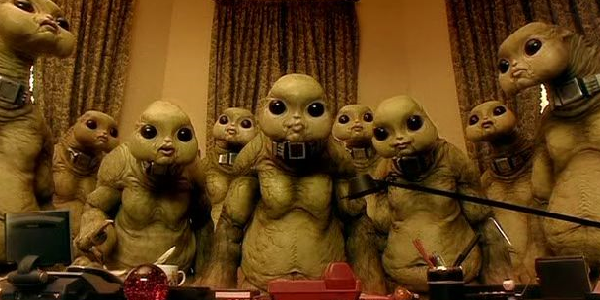
With this entry on the countdown, it is not the design or execution of the creature effect that's being mocked, but rather the choice to have the Slitheen pass gas. At the risk of intruding on private grief, it's enough to say that it's difficult to explain the appeal and value of Doctor Who to a non-fan when the aliens in the episode spend all their farting. Rather surprisingly, the Slitheen who later appeared in the Sarah Jane Adventures passed wind much less frequently, and that was in a show aimed squarely at kids. This entry was a rare instance of bad taste from showrunner, Russell T Davies.

3. The Entire Human Race Changed Into The Master

In the Tenth Doctor swansong story The End of Time, Part 2, the entire population of the Earth (sans Donna Noble, the Doctor, and a couple of spiky aliens) are transformed into copies of the Master. And not a single human character has mentioned it since. Viewers might be forgiven for thinking that such a profound, widespread transformation would be the cause of some longstanding consternation and trauma among the human population. In the real world, of course, such an event would be psychologically devastating, but this is the Doctor Who universe and so these events must be wiped from the ongoing narrative because, once again, they are inconvenient to all subsequent stories.

2. The Mystical Power Of Love Saves The Day... Every Time
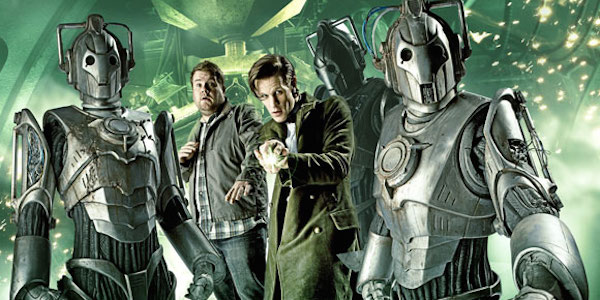
In a distressingly large number of episodes of NuWho, the villains have been defeated by nothing more than the power of love. If an example is needed, consider the end of Closing Time in which Craig overcomes Cyber-conversion by thinking of his wife and daughter. Any cop-out resolution that lame deserves to be blotted out by collective amnesia. It is nothing less than a failure of imagination. Having agreed to forget this overused plot device, can the creators of Doctor Who pledge to think of more original and interesting endings?

1. Everything Now Happens In A Universe Made By The Doctor
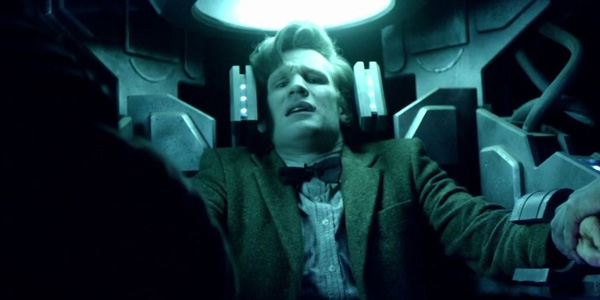
Here is one that is guaranteed to never, ever, ever be mentioned again by any future showrunner on Doctor Who. In the episode The Big Bang, the Eleventh Doctor (Matt Smith) re-created the entire universe by engineering a second Big Bang. All of which means, every subsequent episode of Doctor Who takes place in a new universe created by the Doctor. What's more, viewers aren't even certain how many of the previous adventures still exist in this new reality. It seems par for the course that with such a massive, literally universe-changing event, Steven Moffat has chosen to leave most of the details vague. Only one thing is certain, though, and that's that Doctor Who wants us to forget that it ever happened. What do you think of the list? Are there any other aspects of Doctor Who you'd rather forget? Leave your thoughts in the comments.

Contributor
Contributor

Mike has lived in the UK, Japan and the USA. Currently, he is based in Iowa with his wife and 2 young children. After working for many years as a writer and editor for a large corporation, he is now a freelancer. He has been fortunate enough to contribute to many books on Doctor Who over the last 20 years and is now concentrating on original sci-fi & fantasy short stories, with recent sales including Flame Tree, Uffda, and The Martian Wave. Also, look for his contribution on Blake's 7 to "You and Who Else", a charity anthology to be released later this year. You can find him on Tumblr at https://www.tumblr.com/blog/culttvmike