8 Excellent TV Series & Characters That Ceased To Exist In 2013

We mourn for those shows and characters we lost this year.

For better or for worse, 2013 is almost completely in the rear view mirror now. The year brought us many cultural highlights (such as the fine television series House of Cards, Enlightened, and Parks and Recreation) and far more lowlights (Miley Cyrus's infamous twerking spectacle with Robin Thicke at the MTV Video Music Awards immediately comes to mind). But before the year becomes history, stop for a moment, won't you, and consider all of the fantastic entertainment that 2013 offered us for the final time. Herewith is an extended analysis of eight excellent series, characters and people that for various reasons (cancellation, retirement or death) ended their runs in 2013. Important Disclaimer: Obviously, SPOILERS ABOUND in the following piece by its very nature, so if you haven't caught up with any of these fine, fine listings (and why not?) please go out and buy all the CD's, DVD's or BluRays necessary in order to properly support all these talented peoples hard work, order a large pizza and open a nice bottle of wine, and consume them all in a marathon session, then come back to this article. It's fine, I'll wait for you. Still waiting. All ready? OK, here we go.

8. Fringe

Beloved cult series Fringe bowed out in early 2013 after maintaining 5 years of being the best SF show on television that no one was watching. It didn't help matters that it was unceremoniously dumped in the unglamorous time slot of 8 P.M. on Friday night, which is traditionally as the Internets like to call it, the "death slot", for its final season. (Other science fiction shows that met an untimely demise on FOX Fridays: Dark Angel, Terminator, Dollhouse, and, sigh, Firefly.) But for those loyal few that were watching on Fridays, they got to see a complex and satisfying resolution of Fringe's final story arc concerning the mysterious (and bald) Observers, which was set up by the fine Season 4 episode "Letters of Transit" wherein we see Olivia's future daughter Etta for the first time. Season 5 was set in a dystopian future 2036, where Observers have assumed control of humanity through their considerable powers of mind control and are relentlessly polluting the environment in order to create an atmosphere in which they can breathe, since the future they come from was incredibly contaminated....by them, in the past, which is our present. Still with me? The Fringe team is thawed from amber by Olivia's daughter and her team of counter revolutionaries known as the Resistance, and set to work fighting to regain their world from the base of Walter's excavated laboratory under Harvard. The plot device of Walter leaving himself videotapes frozen in amber that contain directions for building the machine that will stop the Observers was an ingenious engine to drive the story forward, and having the team of Peter, Olivia, Walter and Astrid meet their parallel universe counterparts one final time was a lovely gift for longtime fans of the show. Unlike fellow FOX sci-fi travelers The X-Files, which lost its way with convoluted and unresolved story lines in its twilight years, Fringe maintained a strong control over its diverse mythology and remained solid through the end of its run.

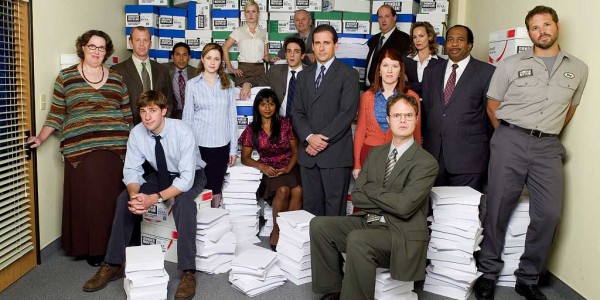
7. The Office (American Version)

A long way both geographically and emotionally from the scabrously black tone and sensibility of the British original, the American version of Ricky Gervais's legendary comedy/pseudo-documentary series The Office still managed to carve out a distinct place for itself. The ninth and final season of the NBC sitcom mostly managed to right the ship from the disastrous 8th season, and by the season's end was firing on all cylinders again. Lessons learned: stunt casting (Will Ferrell, James Spader, Catherine Tate) doesn't work, but focusing on story and character development does. The finale episode resolved all the character's story lines in satisfying fashion, with the grossly incompetent employees moving on to better things, like Kevin buying a bar, Nellie becoming a mother to Ryan and Kelly's abandoned love child, and longtime slacker Stanley enjoying his long-awaited retirement in Florida. The long-rumored and denied appearance of former Dunder-Mifflin boss (Scranton Branch) Michael Scott actually happened, showing up at Dwight's wedding to office shrew Angela Martin unexpectedly. His appearance was short but certainly sweet, with Pam's remark that he bought multiple phones to carry all the pictures of his kid being both completely in character and genuinely touching. It's not entirely untrue that the natural conclusion of this version of the show was when Steve Carell left, but at the end The Office had turned into a completely different program all together, focusing on the low-key day to day lives of office sweethearts Jim and Pam Halpert and their baby Cece,, rather than the chaos induced by Michael Scott. And that program was certainly a fine one, no matter how far it had strayed from the original template.

6. Breaking Bad

2013 found Breaking Bad's last season finally getting the recognition in terms of ratings that it had long deserved, becoming AMC's highest rated program and even trouncing the on-the-decline Mad Men. Its final episode brought about fevered media coverage and myriad speculation about just how the tale of former suburban science teacher turned meth chef and brutal drug kingpin Walter White, and his eternally put-upon cohort in crime Jesse Pinkman, would conclude. As it turned out, the answer involved a very large gun and an even larger pile of corpses, with Walter aka "Heisenberg" mortally wounded from his own weapon and dying on the floor of his enemy's meth lab. Many unanswered questions still existed after the finale aired (What happened to Brock? Where did Walter's money end up? And most importantly, did poor Huell ever leave that safe house?), but it was so well crafted and executed you didn't care, with the moment the camera pulls back in Skyler's kitchen to reveal Walter has been standing there the entire time his wife has been talking to her sister on the phone being particularly well done and goosebump-inducing. And as with all good finales, speculation didn't cease after the episode aired, with speculation that the events of the final episode were merely the product of Walter's wish-fullfillment, as he dies in that Volvo in New Hampshire. Whether this was Vince Gilligan's intention or not, a sign of a timeless work is its ability to withstand multiple interpretations. Viewers certainly could have done without AMC's decision to split the final season into two parts for maximum profitability, but the final eight episodes were the finest television of the year, bar none, and also gave us a final meme-worthy catch phrase in Walter's veiled threat to his brother in law and DEA Agent Hank Schroeder: "Tread lightly".

5. 30 Rock

Tina Fey, once best known for her spot-on impression of Alaskan half-term governor Sarah Palin, is now in charge of her own media empire. She's had successes in the fields of literature (the bestseller "Bossypants"), movie producing and acting, and somehow she even found the time to drop a guest verse on fellow NBC star Donald Glover aka Childish Gambino's last rap mixtape "Royalty". But her first vehicle after departing the cast of SNL, 30 Rock, exited 2013 with aplomb, rebounding in a similar Office-like fashion from the previous lackluster season with a masterful ending. It also followed in Fringe's footsteps by having its final outing reduced to 13 episodes, which increased the writer's attention to the final block of episodes, helping the series to regain its witty edge. Over the course of the season, perpetually frazzled Liz Lemon finally finds true love, has a baby, and watches her beloved little comedy show The Girlie Show come to an end. And in a clever future epilogue that is itself a brilliant homage to the finale of beloved 80's series St. Elsewhere, it's revealed that the eternally loyal network page is an immortal being who now controls the entire network, and the final scene is him listening to Liz Lemon's great-granddaughter's pitch for a show based on the insane stories that she fondly remembers her grandmother telling her, giving a strong sense of closure to the entire series. NBC realized with the success of 30 Rock that perhaps it was a good idea to continue to give smart, funny women their own show, and current hit Parks and Recreation, driven by the always hilarious Amy Pohler continues proudly in that vein.

4. Matt Smith's Tenure As The Doctor In Doctor Who

Matt Smith's four-year tenure as the Doctor, initiated in the final minutes of "The End Of Time" as he regenerates from David Tennant in an out-of-control TARDIS that crashes into young Amelia Pond's garden, comes to its inevitable conclusion Dec. 25 on the planet Trenzalore. Yes, after this Christmas episode entitled "The Time Of The Doctor" airs, we shall sadly never hear the Doctor say "Fezzes/Bowties/Stetsons are cool!" or "Geronimo!" ever again. Series runner Steven Moffat promises fans that they will witness the Eleventh (or is it the Twelfth?) Doctor's final moments play out in an epic battle involving Weeping Angels, Daleks, Cybermen, and the Silence. And yes, the trailer assures us, in this episode we finally really see what "Silence Will Fall" means. It's also been promised that the many loose plot threads left dangling over the course of the last four years (like, who was trying to build a pseudo-Tardis inside Craig's flat in "The Lodger"? And didn't the Tardis itself explode at some point? And, is River Song really gone for good?) will at last be tied up with a holiday ribbon and bow, a fantastic Christmas present for continuity-obsessed Whovians. It's also the first-ever Christmas episode of the rebooted series to feature the regeneration of a Doctor, which current companion Clara Oswald aka "The Impossible Girl" will be witness to in the episode's final moments. Peter Capaldi's new version of the Doctor, set to debut in August 2014, from all indication seems to be a throwback to Third Doctor Jon Pertwee personality wise- i.e, older, dignified and somewhat flinty. So, fans should savor this final taste of Smith's manic, flailing Doctor (whose persona was perfectly nailed by John Hurt's War Doctor: "Are you capable of speaking without flapping your hands about?") while they still can.

3. Hershel Greene, "The Walking Dead"

In a show with such a massively high body count as The Walking Dead, it's kind of amazing that an elderly, slow-moving one legged man managed to survive for the two and a half seasons that he did. But his luck only lasted until the end of the fall finale episode "Too Far Gone" where he was decapitated by the Governor as Rick watches, as punishment for Rick's refusal to follow the Governor's orders. Hershel's purpose in the show was to function as the voice of reason and calm in contrast to Rick's insanity and Merle's blood-thirstiness, a slot previously occupied by Dale, who died at the end of Season 2. We first encounter him as the owner of the farmland that Rick's party encounters after escaping Atlanta and the CDC compound. He attempts to save a bullet-wounded Carl and although the operation is ultimately successful, tensions grow between him and Rick's group, culminating in the members of his family that have been changed into walkers (along with the missing Sophia) being slaughtered. Hershel realizes he has been mistaken about the nature of the zombie threat and begins to trust Rick and his group from this point on. When the group moves to the prison in Season 3, Hershel is bitten by a walker and is forced to have his leg amputated. However, he manages to survive the process and becomes the resident prison doctor, selflessly risking his own life by tending to the victims of the airborne zombie infection at the beginning of Season 4. Hershel was a man with a strong and inflexible moral code, and perhaps that was part of the reason for his demise. Despite his belief that no one is "too far gone" to be saved, The Governor certainly was, and had no compunction about sacrificing him. Brutally.

2. The Governor, "The Walking Dead"

The first big-bad villain of The Walking Dead, The Governor as portrayed by David Morrissey, met his final demise in the episode "Too Far Gone", as his final all-out plan to assault the prison and reclaim it for his group backfires in his face and he's unceremoniously shot by girlfriend Lily, after being stabbed in the back by Michonne as retribution for him kidnapping Glenn and Maggie and murdering Andrea at the finale of Season 3. The Governor is a character that has attracted some controversy from fans of the original comic series: as depicted on the program, many rough edges have been removed, such as his brutal rape of Michonne. As well, in the original book, her retribution on him also includes him losing an arm as well as his testicles. Many fans were concerned that Morrissey seemed too "nice" to play such a twisted and evil character. His character also seemed to vacillate between a nice guy and a total lunatic. To the show's credit, this was addressed in the fourth season, which devoted two episodes to fleshing out the character and detailing what happened to the Governor after the assault on his town of Woodbury: after burning down the town's remnants and wandering aimlessly for a time, he encounters and befriends a family including a little girl, Meghan, who reminds him of his dead daughter Penny. He develops a strong attachment to her, and tries to lead the family to safety. Despite his attempt to be a better person, his old personality begins to manifest itself as they encounter a camp led by Martinez, part of his old group from Woodbury. He quickly murders Martinez when he perceives him as showing weakness by throwing him into a pit of zombies, and also killing another member of the group, Pete. He assumes control of the survivors and heads towards the prison with a tank and assault weapons to seize control of the prison, after capturing Michonne and Hershel as bargaining chips. However, when Meghan is attacked by a walker and killed, this sends him completely over the edge. He ignores Rick's pleas that the two groups can co-exist, slaughters Hershel and sends the tank through the retaining fence, unleashing a swarm of zombies inside the prison walls, ironically rendering the prison uninhabitable. The Governor's hubris led to his ultimate fall: he was completely convinced of his own self-righteousness and belief that the ends justify the means. That belief left him dead on a battleground in a futile war that he started, ultimately alone and forgotten.

1. Futurama

Matt Groening's second attempt to strike comedy gold after the enormous success of the Simpsons, Futurama was the program that somehow managed to avoid cancellation not once but twice: first from its original home of FOX in 2003 after having its timeslot and airing dates indifferently reshuffled by the network, and more recently by Comedy Central. It could not avoid the final decision to remove it from the air however, and after the final episode "Meanwhile" aired on September 4th, the show about future life in the 31st century was truly history, leaving six seasons and four direct-to-video movies behind as its legacy. Futurama was truly a show where anything you could imagine could happen, where the preserved head of Richard Nixon could have a conversation with a drunken, thieving, cynical robot, where an alien squid could be a member of an interstellar delivery service, where convenient suicide booths can be found on any city street, or where sewer-dwelling mutants could protest for (and receive) equal rights as surface dwellers. The story starts in 1999, where unremarkable pizza delivery boy Philip J. Fry accidentally cryogenically freezes himself on New Year's Eve and is thawed out a thousand years later, to a bizarre version of his hometown, New New York. His day-to-day life doesn't really change as much as you might think: he still has a delivery job (albeit for Planet Express), a roommate, stogie-smoking robot Bender B. Rodriguez, and friends, including Jamaican accountants, rich girls from Mars and his own future descendant). He still has an unrequited crush on a beautiful girl, though that beautiful girl is a one-eyed sewer mutant named Turanga Leela. The on-again, off-again quality of Fry and Leela's relationship was a thread that passed through the entire series, culminating in the final episode with Fry's marriage proposal (which she accepts). And in the end, the show proved the old adage that no matter how things change, they remain the same, with the bizarre setting taking a back seat to friendship and romance. That's what I think. What other series and characters that ended in 2013 will you miss? Leave your picks in the comments section below.

Contributor

Hi there, What Culture-ers! I'm William Graff, a 40-year old freelance writer from the wilds of Capitol Hill in beautiful Denver, Colorado. I enjoy many things such as beer, Doctor Who, The Simpsons, record collecting, stand-up comedy, long aimless walks, and of course the Broncos, which is required by law if you live here. I appreciate all feedback for my writing, but I prefer cash and/or deleted Smiths singles in lieu of praise. Rock on!