8 Most Overused Words In Doctor Who Fandom

It's like a whole other language.

Every fandom quickly develops its own in-house lingo, common sayings and phrases that reinforce belonging. Much of them are benign and part of developing a shared identity - but, not always. Sometimes disingenuous words and phrases can pop up and be normalised. Doctor Who fans are no different from any other group in that respect. But unlike other fan bases, there is still much dispute as to what Doctor Who fans should even be called. For Star Trek there are the Trekkies, for Twilight, the Twihards and for Glee, the Gleeks. But what of Doctor Who? Some are quite happy with Whovian (usually Stateside) but others remember the past negative connotations of that word and are strongly averse to its use. It€™s easy to forget that the word Christian was initially a derogatory term, from the early church€™s opponents. And every group has to have a name, right? Or does it? Whatever fans elect to call themselves, there seems to be a few words within the Doctor Who subculture that have been overused and misused. Is it time to bid adieu to some of them? Here are 8 of the most cringeworthy words that ought to be consigned to the scrapheap.

8. Canon

OK, let€™s get the elephant in the room out of the way first. In an entirely different world the esteemed New Testament scholar Marcus Borg sadly passed away earlier this year. When Borg was ordained as a canon in his church, he was well and truly put in his place when his wife informed him that the word €œcanon€ means €œbig shot". It is a word that has travelled into Doctor Who fandom to become the cause of many heated debates. It is tempting to argue that fans sometimes use it to claim superior knowledge and to big up their status of €œtrue fan". When it comes to a body of work, traditionally, establishing a canon does three things. It condemns certain works to a lesser position or even heretical status. It controls the reader/viewer as to what they can regard as gospel. And it closes the book so to speak, stopping any further work from being added to the mythology it seeks to contain. When you look at it like this, applying it to Doctor Who is immediately problematical. Doctor Who is a continuing narrative. The BBC have not closed the book. In the TV series, anything previously considered to be non canonical, can with one line become part of the official narrative. Time Heist is a great example. As soon as his face appears on that screen, Abslom Daak from the world of the comics is suddenly reassessed by those who had contested the canonical status of the Dalek killer. Similarly, some of the Big Finish companions of the Eighth Doctor are mentioned in The Night of the Doctor. In The Pandorica Opens/The Big Bang, the Chelonians from the New Adventures novel by Gareth Roberts get a thumbs up. That means that anything is possible and nothing can be dismissed as heretical, not even unofficial fan made material and theories. The problems don€™t stop there. Many of the authors of Doctor Who are still alive and will sometimes add interpretation to their works. Is the mysterious woman in The End of Time supposed to be the Doctor€™s mother? It doesn€™t say anything of the sort in the episodes, but should it be regarded as canon because Russell T Davies said as much in his book The Writer's Tale? And take the nature of the beast, all that timey-wimey (yes, that's probably the ninth most overused word/saying!) stuff. Doctor Who is uniquely placed to be able to allow discontinuity to exist because of alternative universes and time travel. Every time something is added to an artificial canon in Doctor Who, it is in effect being made a fixed point in time. Should the discerning fan regard that choice as canon? It€™s time to get shot of the big shot word.

7. Squee

At the heart of every €œfangasm€ is an almighty climax accompanied by the squee. It often involves coffee being spilt on keyboards or the falling off of chairs, and yet strangely the victim is still able to casually type up this information. Some Doctor Who fans can have multiple climaxes and the intensity of each can be marked by the number of e's added to the end of this bizarre word. A squeeeeeeeeeeeeeeee, therefore, denotes the best orgasm ever. Steven Moffat orchestrates the first group squee when he writes the squee into the script of Dark Water/Death In Heaven. It would not be a surprise if several fans posted "squee" when Seb squeed on screen. For some fans the squee is remarkably easy to achieve. Mention of a returning foe or character last seen a few weeks ago can be enough for the lucky fan to emit a triple squeee. Even a returning prop might press all the right buttons. There is, of course, nothing wrong with being enthusiastic about a programme that's so loved and treasured. Sadly, though, the squee is often all too premature and the poor fan is left disheartened, having realised their mistake post squee. The voice in the trailer for Series 8 was not Davros, but Rusty. That was, for many, one wasted climax. Perhaps to save face, the keyboard and various parts of the anatomy, the squee should be replaced by a pensive squeak. Just in case that person in the shadows on the set report photo turns out to have been Bob the clapperboard operator and not John Simm. Or if a person must squee, then at least keep it private, behind closed doors.

6. NuWho

When Doctor Who returned in 2005, the producers could have taken a similar approach to Battlestar Galactica and rebooted the show from scratch. But truth be told, despite being off screen for so long, Doctor Who was far from coming out of hibernation. It had continued an unbroken run through the Virgin New Adventures and Eighth Doctor novels and other iterations of the programme had popped up from time to time too, online, on the radio and in special TV events. When Russell T Davies was first approached with a view to bringing back Doctor Who to the television, he feared the worst. "I€™ll be a nightmare. It wont have the money, they€™ll want an ironic or nostalgic or retro version, it€™ll be banished to BBC Three. Or worst of all, it€™ll be a reboot. No thanks"... Instead, Davies set about reimagining Doctor Who for a new, post-Buffy generation whilst remaining faithful to the long history of the show. Quite rightly, Davies recently declined the opportunity to be involved in some kind of special tribute episode for the 10th anniversary of the new series, arguing that in reality it's actually the 52nd anniversary and the 50th has just been celebrated so magnificently. Is the series post 2005 different enough from its past to warrant its own name? There have in fact been many distinctive eras of the show, largely defined by its many producers and the style of storytelling each have preferred. 2005 is arguably closer to 1970 Who than 1979 Who was. There are noticeable differences between Russell T Davies€™ and Steven Moffat€™s versions of the show and yet both producers have mined the full past of its mythology, bringing back old foes and companions. They have ensured that Doctor Who remains a single yet diverse entity. So why does the world of fandom like to create a divide between so called classic Who and NuWho? Shouldn€™t every single story be judged on its own merits instead of being written of for belonging to one or the other time periods? Is it not simply part of a tribalistic instinct, the human propensity to want to take sides by placing artificial walls in between two things that actually belong together.

5. Omnirumour

If canon exists in other fandoms, omnirumour is unique to Doctor Who. Many of the early 60s episodes remain missing but recently Phil Morris, as a small part of his wider work with TIEA, has been scouring foreign archives in the hope of recovering lost British TV shows, Doctor Who included. Rumours about a significant find first surfaced on the internet several months before the recoveries of The Enemy of the World and The Web of Fear were announced. If some of these rumours are to be believed, the number of recovered episodes is far greater than those two stories. As rumours were added to rumours, enter the novel phrase the 'omnirumour'. Given the time that has passed since that announcement, explanations as to the reason for the delay in further returns have become part of the beast that is the omnirumour. It is impossible to know which elements of the omnirumour are based on genuine sources and which are figments of the imagination, or more shockingly deliberate wind ups and underhand attempts to flush out the truth. Even those parts of it that can be traced to a genuine source could be complete nonsense, misunderstanding or presumption. The sad thing about this word is that it seems to have cut short the wider discussion of the issues. Over the years recoveries have come from many and varied sources and other potential leads are still there to be explored. The word also wrongly implies the rumours have a life of their own but without tongues wagging or keys pressing, it would be lifeless. It is in the interests of some to maintain the omnirumour, however dead in the water it appears to be. Is there such a thing as the omnirumour? In short, no. It is a false construct, completely meaningless. Perhaps it should be better rephrased as a collective noun - an omni of rumours. Or better still, an omni or rumourmongers. Forget about it, chill out, enjoy the massive existing corpus of Doctor Who and let the episode hunters do their job.

4. Humans, Always Seeing Patterns In Things That Aren't There
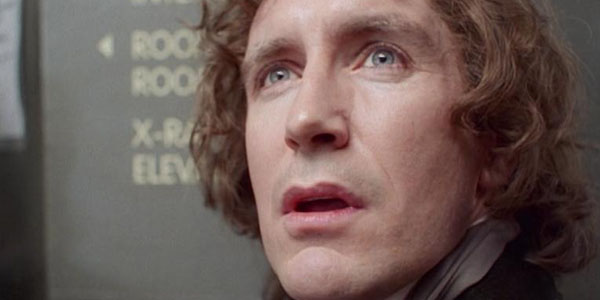
Ever since the internet enabled fans to express their opinions publicly, this line from the Eighth Doctor in the TV Movie is commonly used as a slight against another€™s theories or observations. Is it coincidence that the first two words get dropped from the quote? Like the tendency to make faces out of clouds or other random patterns, making connections, seeing links between one thing and another, is part of what makes us human. It is how the mind works, making order out of chaos. Sometimes a person recognises a pattern that has been intended by another, and other times one can create the pattern either from scratch or from what was already created unconsciously. And yes, sometimes, when speculating about where the Doctor Who team is leading us, fans can get it spectacularly wrong. What€™s really going on here a lot of the time is that the person who appeals to this quote is simply jealous that he/she has not come up with it themselves. And in any case, even if they are right and the pattern is somewhat contrived, what is the point of simply stating a fact? Yes, everybody sees patterns in things. And quite right too! There is something similar here to the dogmatic claim that different peoples believe in different gods, an idea depended on the belief that one is true and the other is false. Compare this to the interfaith idea that everybody looks at the same elephant from a different perspective. Part of the fun of talking to other fans is that of learning new viewpoints and making new connections but it is the same world they are exploring together - the fictional universe of Doctor Who. Some fans are pleased as punch with this quote that they can even apply it to non Doctor Who conversations about all manner of things, both frivolous or deeply serious. Why is it that the quote is only ever used as a negative slight? If fans are to use it, why not see it as a positive? Celebrate our creativity and quest for meaning! After all, what were those first two words? "I love".

3. Agenda

If some fans are to be believed, the people that run Doctor Who are governed by hidden agendas, scheming with secret political, religious or moralistic aims to manipulate the viewer into their way of thinking. In reality, though the only agenda, other than the desire to produce a quality show that entertains and remains high in the ratings, is one that everybody has to live by. The need to earn a living. The word is clearly overused in fandom when you consider the wider general audience. The lesbian, interspecies kiss in Deep Breath appalled some sections of fandom with the angry cry of a gay agenda or of bringing sex into Doctor Who, as if not only the Doctor but everyone in the series should be asexual. But how many complaints did the BBC receive? A grand total of six. Even this small protest was taken seriously by the BBC who had also received a handful of unwarranted complaints about promoting an overall gay bias. Just as with criticisms that the Beeb displays left wing tendencies, it is of course always those who disagree with a certain position who complain about its overexposure. What is really meant is that they would rather not see their own opinions challenged. In the world of Doctor Who, other agendas have been detected. These include a pro-life stance (Kill The Moon), putting children into Doctor Who (Steven Moffat€™s era as a whole), making the Doctor a Christ-like figure (Last of the Time Lords) and even putting certain ethnic groups into the show. In every instance, the agenda is not that of the showrunner or his team, but that of the complainant. It is not a new phenomenon. Back in the 70s, Mary Whitehouse campaigned vociferously against what she argued was an agenda of violence in Doctor Who. But, like the members of Christian Voice who protested when David Tennant€™s Tenth Doctor rose from the dead like a Messiah in the Series 3 finale, the entrenched positions and desire to control actually come from those that are making the complaints. There is no other way of explaining why the same episodes can come under fire from opposite ends of a spectrum. Series 8 has been criticised by some as being anti-military and by others as being pro-military.

2. Deus Ex Machina

The fact that this technical term is a Greek transliteration seems to make it particularly appealing to those who like to appear informed and critically aware. Sadly, it is a word all too quickly misused simply to trash a writer or a story that the so called critic doesn€™t like. There is nothing wrong with not liking an episode. Doctor Who is so diverse that IT would be strange if every single episode always hit the spot. But very often the criticism comes down to a matter of subjective individual taste than it does objective technical evaluation. Over the years there have been some notable fails in the technical department, with certain episodes poorly realised for a variety of reasons (Hello Underworld and The Time Monster). If it is to strive for excellence then the show has to learn from its mistakes, and by and large it does. But is it fair to bad mouth the writer, using the clever term deus ex machina? Scripts should be evaluated for their consistency and other areas such as pacing, characterisation and length. But deus ex machine? Let€™s take a look at what it actually means. Deus ex machina literally translates as "god in the machine". It denotes an unexpected resolution to a seemingly insurmountable problem. Done badly, it can make the viewer feel cheated, coming across as a quick fix to a problem that a whole drama might have been focused upon. But it is not a negative phrase. It can bring surprise, add comedy and take the direction of a story to a whole new, unexpected place. In the hands of a competent writer, it is an excellent plot device. In Doctor Who fandom, the phrase appears to be exclusively used to dish the dirt on a story or/and its writer. The sonic screwdriver and psychic paper are often singled out as unsatisfactory quick fix solutions. But are Russell T Davies and Steven Moffat€™s stories filled with unsatisfactory examples of deus ex machina? Well, take a look at that most maligned of cheats - the dream. Steven Moffat has presided over episodes in which the dream sequence is used in a creatively new way (Amy€™s Choice and Last Christmas). In neither case is the dream a cheap way out, instead it is central to the drama and used to disorientate and challenge the audience€™s expectations. Perhaps the ultimate deus ex machina available to writers of Doctor Who is the TARDIS, hence the lengths they sometimes go to separate the Doctor from his magic box. In short, the writer is damned if he does and damned if he doesn€™t. The question €œwhy didn€™t they just use the TARDIS?€ often rears its head post transmission. Sometimes people are driven to look for holes and areas to criticise.

1. The Not-We

The 'not-we' is a particularly obnoxious phrase and it sits in the same family as the likes of 'fanboy', 'fangirl' and 'uberfan'. If ever anyone suspected that for some Doctor Who is a cult, then the use of such language is a pointer that they are not that far from the truth. Doctor Who is a show that stars an otherworldly alien entering our worlds and challenging the way humans approach life, the universe and everything within it. It is constantly challenging the false distinctions made between outsiders and insiders and who belongs and who doesn€™t. The term €œnot-we€ has a sinister undertone that completely undermines this important ethic of the show. The defence will no doubt be that it is meant to distinguish the general audience from the fan in a non value laden manner. But is a fan of Doctor Who not also a member of the general audience? And what determines when a person can be considered a fan and not a casual viewer? Is there a citizen of the Doctor Who universe test? Is there a checklist that a person signs up to in order to engage in a Doctor Who forum or group? Of course not. When it comes to Doctor Who, people watch for different reasons and would consider themselves fans of certain aspects of the show if not the whole caboodle. David Tennant fans watch Ten because they love David Tennant. Fair play to them. Science fantasy fans watch because they love fantasy. Fair play to them. Richard Curtis fans may have watched Vincent and the Doctor because they love Richard Curtis. Fair play to them. The list goes on. How derogatory to call any of these people the €œnot-we€ just because they cannot tell their Ogrons from their Draconians? The self professed Doctor Who fan should be absolutely delighted that the show they love is watched by millions of others around the worlds for a whole variety of reasons, even if just because they don€™t like the X Factor. The more the merrier and the greater the chance that Doctor Who will live on for another 50 years. What did you think of this list? Are there any other overused words in the Doctor Who fandom that should have been included? Let us know in the comments section below.

In this post: 
Doctor Who
 
Posted On: 
Contributor
Contributor

Paul Driscoll is a freelance writer and author across a range of subjects from Cult TV to religion and social policy. He is a passionate Doctor Who fan and January 2017 will see the publication of his first extended study of the series (based on Toby Whithouse's series six episode, The God Complex) in the critically acclaimed Black Archive range by Obverse Books. He is a regular writer for the fan site Doctor Who Worldwide and has contributed several essays to Watching Books' You and Who range. Recently he has branched out into fiction writing, with two short stories in the charity Doctor Who anthology Seasons of War (Chinbeard Books). Paul's work will also feature in the forthcoming Iris Wildthyme collection (A Clockwork Iris, Obverse Books) and Chinbeard Books' collection of drabbles, A Time Lord for Change.