Doctor Who: 10 Qualities That Made Peter Capaldi's Doctor Great
10 facets of the Doctor we'll miss when Capaldi hangs up his Doc Martens.

The Twelfth Doctor spent much of his first series pondering whether or not he was a good man. Three years on and with Peter Capaldi having announced his departure, the jury is well and truly out as to whether or not he was a good Doctor.
Last week was open season for the anti-Moffat brigade bemoaning the fall in ratings and the fact that the latest version of the show was not to their taste, and yet the same critics almost universally absolve Capaldi of any blame. ‘The greatest actor to play the Doctor,’ they say, ‘tragically let down by poor material’. Feeling robbed of the opportunity to see Chris Chibnall transform Capaldi into the best ever Doctor, some have already written off Series 10.
But hold your horses everyone, we still have adventures to come, plenty of time for Moffat to add fresh nuances and twists to the character.
The Twelfth Doctor is already one of the most complex, hardest to pin down of incarnations, with Series 8 and 9 offering quite distinctive takes and exploiting Capaldi’s full acting range in the process. Other Doctors by contrast can be easily stereotyped and described in a sentence. Perhaps that’s why Capaldi’s version remains something of an enigma. But it’s also why, when the dust has settled and Series 10 has fleshed out his character more, his Doctor will possibly be recognised as one of the greatest.
10. The Flawless Magician

Over the years the Doctor hasn’t been averse to dazzling an audience with his conjuring tricks and entertainment act. He’s not always been very good at it, with the Fourth Doctor and the Seventh Doctor ultimately failing to impress the crowd in Robot and The Greatest Show in the Galaxy.
The Twelfth Doctor on the other hand is quite adept at the old sleight of hand and will use it in the most surprising of situations, from making himself a cup of tea in Davros’ chair (The Witch’s Familiar) to producing a cup of water from his magician’s pocket in The Return of Doctor Mysterio. He even sports a range of costumes that riff on the classic magician’s outfit, especially the showman-like polka dot shirt. Unlike his predecessor’s fez, with its evocation of the great Tommy Cooper, these are the real deal and not worn just because they look ‘cool’.
Of all the revived series Doctors, despite Capaldi having his own Lego minifigure and a starring role in Lego Dimensions, the Twelfth Doctor merchandise has failed to capture the toy market. It’s a wonder nobody thought to make a Doctor Who magic set, or even a new version of The Doctor Who Quiz Book of Magic (first published during Peter Davison’s time in 1983).
9. The Vulnerable Hero

There is an air of authority about the Twelfth Doctor that makes even the powerful stand to attention in his company. He might occasionally use the psychic paper as a time saver (e.g. Under the Lake), but he doesn’t really need the gimmick to command influence over others. He is even temporarily installed as the President of Earth (Death in Heaven) and finds himself frequently the object of admiration.
Such a persona was probably to be expected when Capaldi was first announced, but behind his bravado and dismissiveness of mere mortals like us, the Twelfth Doctor exhibited a surprising degree of vulnerability. Even in his first adventure, Deep Breath, he needs reassurance from Clara. In one of the series’ most touching scenes, the Eleventh Doctor calls Clara from Trenzalore, and tells her that his successor is scared and that he needs her as much if not more than she needs him.
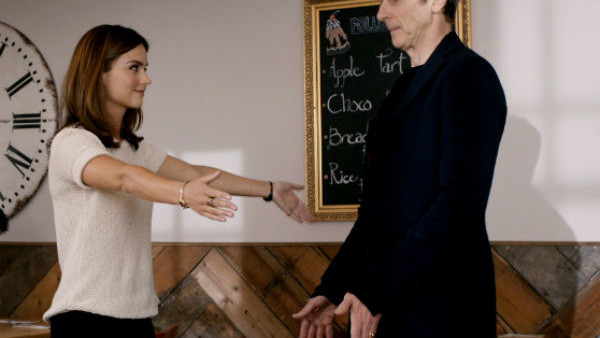
The Twelfth Doctor, unsure of who he really is, begs Clara to look at him and see him. At this point the hug is a step too far, but by the end of the series the Doctor makes himself vulnerable again by accepting that hug.
The Doctor’s fears are a recurrent theme in the Twelfth Doctor’s first series, especially in the stand out episode, Listen. And that vulnerability resurfaces in different ways in series 9, culminating in the heart-breaking scene in Hell Bent where the Doctor cannot remember Clara. He expresses his loss and channels her presence by playing Murray Gold’s Clara’s Theme on the electric guitar.
8. The Spikey Satirist

The Twelfth Doctor is a master of the one-line put downs,
the best of which are laced in intentional irony or satire. It’s by no means a
unique quality of the Twelfth Doctor, but Capaldi is able to carry it off with
a cutting edge that arguably only Christopher Eccleston came close to.
The Twelfth Doctor uses his cutting wit to boldly confront his enemies and to express his disdain for the military:
“You don’t need to be liked, you’ve got all the guns.” (Into the Dalek).
Quite a few of his one-liners are at the expense of the entire human race, the pudding brains as he calls us. Occasionally a specific group are written off with his acerbic tongue:
“We don’t want Americans bobbing around the place. They’ll only start praying!” (Death in Heaven)
Even the odd, hapless individual is shown no mercy from a Doctor who most certainly doesn’t suffer fools gladly:
“It’s okay. I understand. You’re an idiot.” (Under the Lake)
The Doctor might have been proud of his ‘attack eyebrows’ but for him, the proverbial tongue that is mightier than the sword is his weapon of choice. With the odd exception, it’s a quality last seen in Colin Baker’s sixth Doctor. For many Colin’s Doctor just came across as nasty, but the fact that the Twelfth Doctor’s insults are laced with sardonic humour and delivered by Capaldi with perfect comic-timing, makes us laugh with him – even if at times we are also laughing at ourselves.
7. The Voice From The Past

Judging from the fallout following his departure announcement, Peter Capaldi is destined to be remembered as one of the fans’ favourites, even by those who do not rate the Steven Moffat era. Much of this has to do with his affinity with the fan base, for like David Tennant, he has always been a passionate fan himself. As an ambassador for the show he has been a revelation, showing a warmth and generosity towards the audience (including those unofficial location reporters) and going the extra mile when it comes to all the extra-curriculum activities.
Capaldi’s knowledge of his predecessors was immediately clear when he was unveiled as the Doctor in spectacular fashion on a live BBC show. Looking somewhat embarrassed by all the over-the-top attention, he found the coolest thing to do with his nervous hands - clutching his lapels ala William Hartnell, the First Doctor. The moment was not lost on Steven Moffat who found plenty of ways for Capaldi to channel other Doctors.
Each incarnation of the Doctor is inevitably compared to his predecessors, and sometimes the point is slightly forced. Occasionally the script specifically suggests it, as in Peter Davison’s debut episode, Castrovalva, or the Matt Smith two-parter, The Rebel Flesh/The Almost People. But Peter Capaldi’s run is littered with direct and indirect references, most notably to Tom Baker, and he carries them off with an uncanny accuracy.
6. The Grumpy Old Man
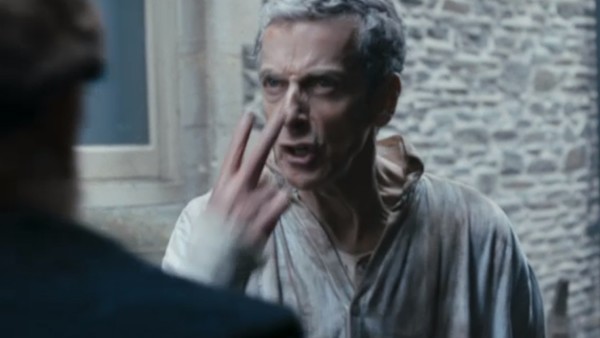
Matt Smith was not hugely different in style to David Tennant, many of his speeches would have worked equally well on the lips of the Tenth Doctor. Not so, Capaldi’s Twelfth Doctor. The contrast with the Eleventh Doctor is huge. Both Doctors are uncomfortable with human interaction, but for the Eleventh it’s not for want of trying. His was the Doctor who wanted to be cool and with-it, who wanted to be one of the lads kicking a football in the park. He had a particular affinity with children, sharing their curiosity and sense of play. The Twelfth Doctor is neither a fan of banter or of little people.
The children the Twelfth Doctor warms tend to be the misunderstood and the different – Maebh (In the Forest of the Night), and Ashildr (The Girl Who Died). He becomes a pal of Grant Gordon, but only because of his own irresponsibility in giving the boy superpowers (The Return of Doctor Mysterio). This Doctor is more often than not rude, abrupt and standoffish.
This dour side of the Doctor’s personality is partly facilitated by the stereotypical Scotsman:
“Oooooh... It's good I'm Scottish. I'm Scottish. I am Scottish. I can complain about things. I can really complain about things now.”
But it’s also fair to say that his previous high profile role as Malcolm Tucker has been deliberately bled into the Twelfth Doctor, rather like Peter Davison’s Tristian Farnham had with the Fifth Doctor. In place of the swearing we have “Shuttity, shut up up,” but this is Tucker for a family audience.
5. The Style Icon

After Peter Capaldi’s first Doctor Who costume was revealed, a poll in British newspaper The Mirror rated David Tennant as the best dressed Time Lord, with Capaldi a distant second. But really - suit and trainers? Or sandshoes as the War Doctor wryly observed? If it was a style contest, the Twelfth Doctor must surely win hands down.
Minus the frilly seventies shirts, Capaldi’s costume is closest to the debonair and dandy Third Doctor as played by Jon Pertwee. He is certainly dressed like he means business, with a licence to kill, even if as it turns out his weapon of choice is once again the sonic screwdriver (oh and those ‘attack eyebrows’).
Fashion designer Anna Fielding describes his outfit thus:
"It’s about being clean and well-turned out, but also quite hard.”
With his Crombie and Doc Martens the Twelfth Doctor is decked out like a seventies mod, the working class antithesis of the hippy peace and love movement. And yet instead of a skin-head he gradually sports his own Pertwee-like bouffant, perhaps reflecting the fact that his incarnation softened over time. Like most of his predecessors, the Twelfth Doctor has been highly selective about what he wears, but this time it’s a perfect match to his personality. The image driving it is that of the non-conformist, counter-cultural cynic.
4. The Impassioned Preacher

Pretty much all of the Doctors have had their defining soliloquys, but the Doctor as rhetorician has been a distinctive hallmark of Steven Moffat’s era. Peter Capaldi’s Twelfth Doctor might lack the massive audiences of the Eleventh Doctor’s Pandorica and Trenzalore speeches, but nonetheless when he does cross into preacher mode he certainly pulls no punches.
The best written Twelfth Doctor episode to date might very well be Listen, but as a showcase for Peter Capaldi’s acting range the single-hander Heaven Sent is the stand out story. Here he gets to talk to himself for the whole forty-five minutes, in contemplation, in confession and even at the end by preaching at the confession dial:
“The hybrid is not half Dalek. Nothing is half Dalek. The Daleks would never allow that. The Hybrid destined to conquer Gallifrey and stands in its ruins … is me.”
It is one of the most extraordinary performances ever seen in Doctor Who.
But the Doctor who apparently doesn’t care, gives his most powerful and passionate speech in The Zygon Inversion, when drawing from his experiences in the Time War he advocates peace between humans and Zygons:
“And do you know what you do with all that pain? Shall I tell you where you put it? You hold it tight till it burns your hand, and you say this. No one else will ever have to live like this. No one else will have to feel this pain. Not on my watch!”
3. The Carefree Musician

BBC America have promoted Peter Capaldi’s Twelfth Doctor as the ‘rock and roll’ Doctor, perhaps because in his younger days he played in a band alongside The Late, Late Show host and Doctor Who fan, Craig Ferguson. Troughton had his recorder, McCoy the spoons, and Capaldi his Yamaha SVG 500 electric guitar.
Capaldi recalls first mentioning it as a joke, but to his delight the producers went along with the idea of bringing his real-world guitar skills to the Doctor. Loathe it or love it, the Twelfth Doctor standing on a tank and playing the guitar to a 12th century audience will forever be one of his most iconic images.
Often dismissed as a gimmick, the electric guitar is an important character defining quality. This is a Doctor who uses his music to convey the fact that he doesn’t really give a stuff when it comes to honouring the laws of time as laid down by his people.
But the Twelfth Doctor is not a one trick pony when it comes to his musical tastes and expression, he also uses the guitar to contemplate with the earworm of Clara’s Song (Hell Bent) and to illustrate with a riff on Beethoven’s Fifth (Before the Flood). The guitar is the rule breaker; literally, in the mixing up of musical styles and the breaking of the fourth wall, but also symbolically, when it is used to convey the Doctor’s freedom.
2. The Optimistic Chancer

Among the many layers of the Twelfth Doctor’s character, his willingness to recklessly go into the unknown is perhaps the most overlooked.
In Flatline, the Doctor is positively brimming with excitement when faced with the unfamiliar challenge of the shrinking TARDIS, and berates Clara for attempting to spoil the fun:
“Could you not just let me enjoy this moment of not knowing something? I mean it happens so rarely.”
That thirst for the unknown continues into the next series. In Under the Lake when the Doctor is confronted by the impossible ghosts, Clara asks him what they are, expecting a scientific explanation. But he replies jubilantly:
“I haven’t a clue. Isn’t that exciting?”
Even after the Twelfth Doctor has worked out out the whats and the whys, he gets a kick out of those rare moments when he is not in control and when he doesn’t have a plan (much to Nardole’s concern in The Return of Doctor Mysterio). Forget the superficial grumpiness, it is this aspect of his character that is most reminiscent of William Hartnell’s First Doctor: adventuring for the sake of adventuring and deliberately putting himself and those around him into dangerous situations.
Jenna Coleman called it best when she described him as “a total adrenaline junkie.” Comparing him to the Eleventh Doctor she argues, “He’s a lot fiercer, bolder, darker, but he’s got this curiosity, this mad curiosity… He’ll keep pushing the line further and further into danger to try and satisfy his curiosity, to try and find things out.”
1. The Great Pretender
The Ninth Doctor was up front about his role in the Time War, and the Tenth Doctor openly embraced his Messiah Complex. The Eleventh Doctor was the first to lie as a matter of course. It wasn’t so much of a character trait as a plot device to wrong foot the audience: he lied because Steven Moffat lied.
The Twelfth Doctor is the only one who could rightly be described as the Great Pretender. It is this feature of his character that makes him the most complex. Only the best of actors can reveal and conceal at the same time, it takes an extraordinary subtlety of voice and expression. Capaldi pulls it off time and time again, for example when hugging Clara as he pretends to have found Gallifrey, whilst hiding his pain at Missy’s cruel deception (Death in Heaven).
Last time we saw the Doctor, we learnt that after spending twenty four years with River Song on Darillium, he had been manically rushing around the universe saving worlds, filling up his time to avoid coming to terms with losing River Song.
At the end of the episode, Nardole gives us a little hint as to the Doctor’s state of mind in series 10, confirming that he will continue to be the multifaceted, complex character that has been so brilliantly captured by Peter Capaldi.
“He’s the Doctor. He’s very brave and he’s very silly. And I think, for a time, he’s going to be very sad. But I promise in the end he’ll be alright. I’ll make sure of it.”
What did you make of Capaldi's Doctor? Let us know down in the comments.