Doctor Who: 4 Reasons to Love "Four to Doomsday"
 The other day I happened to be reading through Doctor Who Magazine's Mighty 200 poll done back in 2009 and I noticed that the Fifth Doctor story Four to Doomsday came 173rd out of the 200 episodes. It's understandable that regular classics such as Blink and The Deadly Assassin bumped it down the list, but I feel that this episode isn't nearly as appreciated as much as it deserves to be. True, it doesn't quite live up to the haunting beauty of Enlightenment or the Burton-esque eeriness of Kinda Elsewhere in the Fifth Doctor's tenure but equally it isn't as bad as others I could mention (cough, Timelash, cough). There is still much to be enjoyed in this four-part serial, so here is my defence for an episode that, like so many others in the Doctor Who series, is actually not as bad as some people may think...
4. The Storyline
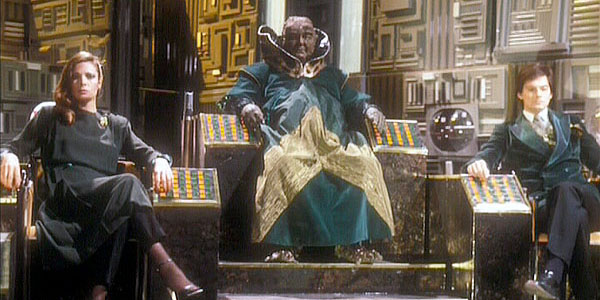 You may have thought that The Big Bang had one of the most ambitious plots, but Four to Doomsday takes the Jammie Dodger when it comes to unusual story lines. In short, three Urbankan aliens are on a large spaceship which has been visiting Earth every few thousand years. On each visit they take human representatives and convert them into androids, whose only real purpose is to provide musical entertainment (clearly DVDs and Scrabble have not yet been invented on their planet). Monarch, the leader, has a plot to take over Earth and mine its resources to improve the ship's capabilities. His plan is to travel faster than light (which seems somewhat ambitious for a ship that size) in order to time travel back to the beginning of the universe and meet himself there as God, though how he came to hold this belief in the first place is beyond me. And that's just the abridged version! It's hard not to admire its sheer boldness if nothing else, and it's one of the reasons why I fell in love with this episode in the first place. It's totally bonkers, but lovable in its sincerity. There should definitely be more stories like this.
3. The Sets and Special Effects
 Okay, so the froggy Urbankans weren't all that convincing and the space helmets were bulky and impractical, but Four to Doomsday makes up for it with some pretty impressive set design. The story kicks off with a credible model shot of the Urbankan ship flying through space, and whilst it wouldn't compare to the CGI magic you see so often in Doctor Who nowadays it's impressive for its time. Circuit panels decorate the walls, with a variety of coloured lights being used cleverly to provide the impression of different rooms and giving the feeling that we really are looking inside a gigantic spaceship. The shot of the Doctor floating through space to reach the TARDIS is a memorable one and actually doesn't look all that bad, if a little staged. There are glass processing chambers complete with sliding doors, plus a brilliant two-layer recreation room with a balcony. Apologies if I sound like an overenthusiastic interior decorator but I think this has to be one of the most aesthetically appealing episodes of the 80's era. If I were a froggy alien, this is exactly how I'd want my craft to look. Monarch is one stylish villain.
2. Tegan vs. Adric
 Let's face it, even with this being the second story of the season this scene was long overdue. From his casual sexism in part one to his insistent siding with the Monarch until part four, Adric has been positively begging for someone to throttle him right from the start. He's being even more of a know-all than usual, showing off his grasp of the theory of relativity and happily telling the bad guy everything he wants to know. Of course by this time everyone else has worked out that Monarch is not to be trusted, but despite his intelligence Adric is being incredibly stupid and even invites him to take a look around the TARDIS, though luckily someone has remembered to lock the door for once. The Doctor comes close by calling him a "young idiot" but Tegan manages to go one better in part three. By this time she's just about had enough of the whole thing (a plot like that would give anyone a headache) and has decided to get the hell back to the TARDIS as any sane soul would. No one sympathises with her so she's pretty cross, and although he should know by now not to stand in her way when that's the case, he manages to infuriate her further and in her anger she shoves him into a table and knocks him senseless (though not wholly intentionally) before storming out of the room. Don't worry, he's fine, but you can't say he didn't have it coming to him and I can't help but applaud whenever I watch this scene. And the end of episode score: Tegan one, Adric nil.
1. Peter Davison
 As this story is the first of the series that was filmed (they were recorded out of order; Castrovalva was actually the fourth) it features Peter Davison's first real performance as the Doctor. You can sense he's trying to find his feet in a part that will ultimately make him a part of Doctor Who history, but this doesn't appear to daunt him as he wanders down corridors and fiddles with TARDIS controls like a true pro. Before I bought this DVD I hadn't seen much of the Fifth Doctor's adventures but it didn't take long to convince me. He'd won me over long before the episode had finished, but there was one scene which fully secured his place for me as role of the Doctor. In part four Monarch accuses him of meddling with his surveillance equipment. In truth the Time Lord has indeed been putting them out of action ever since he's discovered his Dastardly Plan, but he replies, "I wouldn't dream of interfering with your monopticons" without so much as an eyelid batted. In my opinion any man who can say a line like that with a straight face and manage to retain even a bit of dignity is nothing short of Time Lord material, and it's worth watching Four to Doomsday just for that line. And having said that, I hope I've persuaded some cautious individuals that it really isn't all that bad. There's something to be enjoyed in any episode if you pay enough attention. Hmm, now where did I put my copy of Timelash...?