Doctor Who: 7 Underrated Episodes
 When I recently began watching Doctor Who, I, like all good children of the internet, took to Google to fulfill my desperate need to read, talk about, and weep with other Whovians. In my internet scavenging, I began to notice a trend: there are some really excellent episodes of Doctor Who which garner a great deal of attention. You know the ones I'm referring to before I even list them: "Blink," "The Empty Child/The Doctor Dances," "The Waters of Mars," "The Eleventh Hour," and "Silence in the Library/Forest of the Dead," to name but a few. These titles (and a few others) show up on just about every "Top 10" or "Must Watch" list, and for good reason. But as I pored over these endless lists, I found myself wondering why certain fantastic episodes didn't receive the same level of if any! - attention and discussion. In some cases, really great episodes are noticed purely for their problems, and promptly ignored for their strengths. Other fantastic episodes are mere blips on the IMDb rating scale, or gifs abandoned to the bowels of Tumblr. Thus in an attempt to give props to moments of brilliance in the Nu Who canon, and to fulfill my own need to wax poetic about some of my favourite episodes, I present my top 7 Underrated Episodes of Doctor Who.
7. "The Lodger"
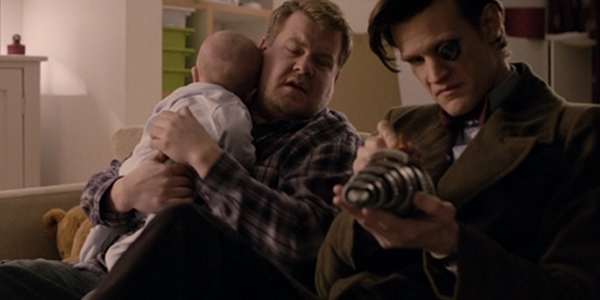 "The Lodger" gets its fair share of dialogue in the Who community. However, the episode's ridiculous villain and lackluster (and I'm being generous with this adjective) ending often bump it out of the running for best episode. The thing about this episode is that the first three-quarters are so good, I'm willing to forgive the sappy ending. The real triumph of "The Lodger" is we get to see the alienness of the Doctor. When removed from his element that is to say, controlling the TARDIS while flying all over the universe the Doctor is super weird. Watching a Time Lord try to seamlessly blend in with humans is a treat the audience is not often given. The balance between Matt Smith and James Corden as his roommate, Craig, is a match made in acting heaven. Their dynamic is frustrating, believable, and absolutely hilarious.
6. "Turn Left"
 "Turn Left" is generally recognized as a quality episode. But for me, it's the most genuinely creepy episode of Doctor Who. The show so often deals with the past and the future, but it rarely delves into the territory of "what might have been." The narrative that results is interesting, frightening, and staggering in its possibilities. Donna Noble is my favourite companion, and while she excels as the humorous and unrefined best friend, Catherine Tate brings Donna to a whole new level in "Turn Left." The contrast between the Donna we know made resilient and confident through her friendship with the Doctor, we see a woman of great potential who is downtrodden and struggling. This episode reveals like no other, the symbiotic relationship between the Doctor and his companions.
5. "A Christmas Carol"
 No one's denying that the 2010 Doctor Who Christmas Special is a great episode. But unlike those that came before, and better than those that follow, "A Christmas Carol" is a stand-alone festive episode like no other. In writing this special, Steven Moffat succeeds in revamping the well-worn Dickens holiday trope into a story worthy of the Doctor. "A Christmas Carol" is thoroughly enjoyable because it plays to every strength of both the show and Matt Smith's Doctor: the repercussions of changing the past through time travel, the stark contrast between the Doctor's carefree whimsy and manipulative brilliance, and the deeply emotional conflict that arises from moral dilemmas. This episode also gives us some of the Doctor's best lines: the hilarious quip "Finally, a lie too big" when his psychic paper cannot verify him as a mature and responsible adult; sighing that "Human beings. You always manage to find the boring alternative, don't you?"; and the oft-quoted "Do you know, in 900 years of time and space, I've never met anyone who wasn't important before." While there is undeniably a dark thread in the story's plotline, as a whole the episode is pure fun. What I like most about Matt Smith's Doctor is his childlike curiosity and the unadulterated joy he finds in the unusual. These qualities are foregrounded during Christmas, and delightfully enhanced with a compelling child companion. "A Christmas Carol" is a funny, suspenseful, and ultimately heartwarming episode - all the ingredients for an incredible Doctor Who Christmas special.
4. "The God Complex"
 This episode is so frightening I almost couldn't finish watching it. "The God Complex" is a psychological thriller unlike any other in the Doctor Who canon. A hotel which constantly rearranges its layout, rooms that lure you to experience your deepest, darkest fear, and a beast who brainwashes his prey to chant "praise him"? I'm quaking just writing that sentence. What's particularly brilliant about this episode is the way it approaches the concept of faith. Since the Doctor is himself a (Time) Lord, there is little room for discussion of other deities. The Doctor as a object of worship is often implied but never openly explored in the show, so acknowledging that his role as a demigod is fascinating. "The God Complex" also finally brings to light the concept that had first laid roots in "The Waters of Mars" and continued to grow throughout the next series and half: the Doctor as the infallible genius. Supported by three-dimensional secondary characters, this episode is a stand-out in every way.
3. "Gridlock"
 When I bring up the episode "Gridlock" to other Whovians, I'm frequently met by a widening of the eyes an emphatic exclamation of "Oh yeah! I forgot about that one! It's great!" This episode might be the best most forgotten about episode of Doctor Who. "Gridlock" may slip so many viewers' minds because there's a lot of stuff going on: mood patches, an underground highway, gigantic alien crabs, the death of the Face of Boe, a cat dressed as a nun, and a seemingly endless cast of eccentric New Earth inhabitants. What holds all of it together, though, is well-paced storytelling, likeable characters, and a touching resolution. This episode also showcases, for the first time, Martha's gumption, which in turn exposes a sentimental nostalgia previously unseen from the Doctor. He gives us a description of Gallifrey before the hell of the Time War, and we see him soften a bit, remembering a long-lost love for his home planet. It's a beautiful moment to conclude a solid, well-rounded episode.
2. "Dinosaurs On A Spaceship"
 When not completely ignored, "Dinosaurs on a Spaceship" gets its share of criticism from the Who community. Written by Chris Chibnall, author of ho-hum episodes such as "The Hungry Earth" and "42," fans have pointed out the episode's weak points: outlandish plot holes (even too much for a Whovian to suspend their disbelief), a complex and slightly nonsensical cast of characters, and the rapid, ridiculous resolution. But to all the criticisms I say: so what? "Dinosaurs on a Spaceship" is one of my favourites because it is probably the most fun episode in all of Nu Who. Sure, the plot is outlandish Queen Nefertiti squaring off with emotionally sensitive robots and Rory's dad flying a spaceship away from a nuclear bomb while still nursing his bewilderment at the Doctor, all while the Doctor rides on a Triceratops. But this insanity is precisely why it works. This filler episode is lighthearted, silly, and a jolly good romp through time and space with the Time Lord. Both Rory and Amy are given brilliant moments, revealing their ability to take control in complex situations, and Matt Smith's Doctor is allowed, perhaps for the first time since his regeneration, to spend the entire adventure in a state of whimsical, childlike play. The dialogue in this episode is superb, making it one of, if not the funniest episode in the Who canon. Add an all-star guest cast to a great script and it truly becomes one of the most enjoyable 42 minutes of Doctor Who.
1. "Planet Of The Ood"
 If you have ever watched "Planet of the Ood" and not cried or at the very least fought back a lump in your throat then you need to check yourself for a soul. The introduction of the Ood in previous episodes of Doctor Who suggests that they might be a more complex alien race than simply born servants, and "Planet of the Ood" finally reveals them to be bred slaves who are oppressed across the galaxy. The Ood are a beautiful, gentle race, born with their brains in their hands, and their song of unity is both sad and uplifting. This episode features some heavy social commentary, drawing parallels to marginalization and enslavement of people throughout history and to present day. There is a telling moment when the Doctor implores Solana, the employee of the Ood's oppressors, to join him and Donna to free the Ood. She hesitates, considering the Doctor's statement that she knows what's happening is wrong, and turns them over to the authorities. Solana is clearly conflicted in her moral judgment, giving her character a profound level of depth. However, "Planet of the Ood" is the perhaps the most underrated episode of Doctor Who not only for it's complex and deeply emotional plotline, but also for it's vital role in foreshadowing the 10th Doctor's epic conclusion by introducing us to the DoctorDonna. What seems like a throwaway name comes to have immense significance later; these little tidbits ensure that the story not only has weight in its immediate viewing, but also carries a heavy impact throughout the larger story arc.