Doctor Who: 8 Spin Off Characters Who Became Canon

The ultimate promotion.

The so-called "Wilderness Years" of Doctor Who, between its 1989 cancellation and its revival 16 years later, may be one of the show's greatest periods creatively. Whilst TV outings were sparse and often disappointing (Dimensions in Time and the TV Movie to name but a few), writers who had grown up with the show took up pens, microphones and video cameras to keep the show alive. But with so many great original characters, monsters and concepts born offscreen, their canonicity in the revived series is usually dubious... until it's not. Doctor Who canon is a marvellous and frustrating beast. Unlike franchises such as Star Trek and Alien, the creative teams take no official stance on what's canon and what isn't, even when the BBC licenses a lot of this spin off material. After more than 50 years of stories, you really need to make up your own mind about what really "happened" and what didn't. Some fans say that everything is canon and have fun thinking up ways to reconcile all the problems, others say only what's shown on television is definitely canon, whilst others think that only what's shown in the parent show counts and ignore even the TV spin offs. It's a tough crowd. But most people pick and choose, and though even televised continuity is by no means sacred, it's generally agreed that something definitely exists in the Whoniverse if it has appeared in Doctor Who itself. So here is a list some of the characters originated in spin offs who, by appearance or direct reference, have graduated to the TV canon.


8. The Children Of Time

During the Russell T Davies era, Doctor Who took an approach that fans would see Marvel repeat several years later. Two spin off shows were created taking place in the Whoniverse that contained elements that would crossover and interconnect. One was the kid-friendly CBBC series The Sarah Jane Adventures and the other was a gritty adult drama and BBC Three's flagship show Torchwood. Whilst the respective lead character of each show - Sarah Jane Smith and Captain Jack Harkness - had been originated in the parent show, they were surrounded by a supporting cast of original characters like Sarah Jane's son Luke and Jack's coffee-making beau Ianto Jones. With both shows being entirely Earth-based (and the Doctor having often-homesick human companions), it was inevitable that they would all meet on the neutral ground of the parent show, given their obverse target audiences, before long. As well as Luke and Ianto, fellow Torchwood member Gwen Cooper and Sarah Jane's alien supercomputer Mr Smith also appeared in the main show during the Series 4 finale. Being referenced by name, you could also add Gwen's boyfriend Rhys, fellow Torchwooder Owen Harper and Luke's schoolchums Maria and Clyde to the list. Toshiko was also mentioned but she had started in the main show all the way back in Series 1's Aliens of London. There was a third spin off, the short-lived 2009 series K-9, which was originally produced in Australia and broadcast in the UK by Disney after a short stretch in development hell. Since legal constraints meant that references to the BBC show were limited, there was never any direct crossover except the title character. Anyone who's aware of it probably doesn't worry about it too much as far as canon goes. On a related note, while no characters from that pilot ever made it to Doctor Who, the fact that the Doctor had given K-9 Mark III to Sarah Jane in the 1981 spin-off K-9 and Company was addressed in the 20th anniversary special The Five Doctors. When Sarah Jane returned again in 2006, she was still in possession of the K-9 model that had since broken down.

7. Technicolour Daleks

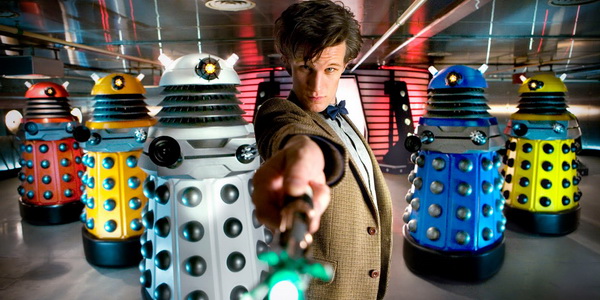
At the height of Dalekmania in the mid-60w, the BBC and Dalek creator Terry Nation licensed Amicus Productions to produce up to three feature-length films based on Doctor Who using Nation's Daleks. The two films that were produced took their names and story from televised Dalek serials of the William Hartnell era - Dr. Who and the Daleks (1965) and Daleks' Invasion Earth 2150 A.D. (1966) - but otherwise took place separately from the main show. Taking advantage of the ability to film in colour and the bigger budget, both these films used upgraded Dalek props of different hues including blue, red and black. The props themselves would go on to be used in the show proper during the Classic Series run. 45 years later, the main show was undergoing a makeover with a new Doctor, companion, TARDIS console room and sonic screwdriver design. Steven Moffat, who was also newly-appointed executive producer, decided that the redesign should also extend to the most iconic monsters in Who history. Mark Gatiss penned Victory of the Daleks in which they were reborn as the New Dalek Paradigm, a race of "pure" Daleks free of the human factor they'd used to rebuild their numbers after the Time War. The new look was almost immediately ridiculed for making the Doctor's deadliest enemies look like a twee range of Power Rangers style colour-coded kid's toys and, while not entirely dropped, has been toned down and largely ignored since. Whilst they're not the same individual Daleks who faced off against Peter Cushing's Dr. Who, with a completely different origin, Moffat took inspiration for the multispectral Dalek design from the Amicus films.

6. 'Human Nature' Characters

Remember the thing about personal canon when it comes to Doctor Who? Well, the Paul Cornell story Human Nature is possibly the best example of why this is the least brain-aching approach to take. Originally released in 1995 as a Seventh Doctor novel for the Virgin New Adventures series, the story was so popular that it was adapted for the modern show under the Tenth Doctor. While the story contains some major differences, like the Seventh Doctor turning human via alien technology he'd acquired whereas the Tenth Doctor had the means aboard the TARDIS already, some of the lucky novel's characters also made the transition. There's the Doctor's human alter-ego John Smith, of course, and Nurse Joan Redfern, played on television by Jessica Hynes, also crosses over from the novel to the television story. She's practically identical to her televised successor, too, as she is widowed before falling in love with Smith. Similarly, a boy in the novel called Timothy Dean, who finds a device holding the Doctor's biodata and starts exhibiting Time Lord abilities, is obviously the basis for Timothy Latimer in the Human Nature/Family of Blood two-parter. There's also Mr Rocastle, the school's headmaster, and the creepy girl with the red balloon. Again, they're not the same characters in any contiguous sense, but Cornell reworked the characters and concepts for a TV audience and made them definitive canon. It's up to your own judgement if these two suspiciously similar events took place twice in the Doctor's life, just once... or not at all. If you want the "better" version in your personal canon, you'll have a hard time deciding which one that is. Because of the limitations in each format, both have comparatively stronger and weaker elements, whilst major plot deviations and the fact that they both have the same writer makes it hard to determine which is the objectively superior version. So take your pick.

5. Captain John Hart

Despite several crossovers, people still debate the canonicity of Doctor Who's television spin offs. This list has already addressed the characters from Torchwood and The Sarah Jane Adventures who have been seen and mentioned in the parent show, thereby making them canon in the eyes of these fans. So it was nice to see another Torchwood alum getting a shout out elsewhere in the Whoniverse, even if it was just in the form of a passing image. James Marsters originally played Captain John Hart - Jack's erstwhile partner (in every sense) and originally an antagonist to the team - in the Torchwood series two premiere Kiss Kiss, Bang Bang. After being kicked out of the time zone by Jack, he returned later in the series as the apparent captor of Jack's long-lost brother, later revealed to actually be captee. As a former Time Agent with access to a functioning vortex manipulator, he's been knocking about time and space causing mischief, mayhem and murder (he even went to rehab for it, but it obviously didn't take). Over on Doctor Who, a photo parade of some of the galaxy's most wanted included a picture of Captain John Hart in the 2014 episode Time Heist, making one of the most prolific actors in the sci-fi and fantasy genres incontrovertibly part of the Whoniverse. Speaking of Time Heist...

4. Abslom Daak

In the same photo parade that gave us Captain John Hart, an even more obscure character from the Whoniverse got in a cameo. Abslom Daak... Dalek Killer! Originated in the eponymous comic story in Doctor Who Weekly back in 1980, Daak was sentenced to exile as a Dalek Killer after being found guilty of "twenty-three charges of murder, pillage, piracy, massacre and other crimes too horrible to bring to the public attention". Wielding a chainsword as his main weapon of choice, this 26th Century badass travelled the Universe hunting down Daleks, initially driven by legal-mandate but later out for revenge over the death of his lover at the hands of the pepper-pot psychopaths. In all, the character made 5 comic appearances and showed up in two short stories and one novel as an ally to the Doctor in the same vein as Sabalom Glitz. Daak was last seen in 1993 for the Seventh Doctor comic Emperor of the Daleks and the Virgin New Adventures novel Deceit. Like Captain Hart, Daak made a fleeting appearance in the Time Heist line-up using an image from his first appearance drawn by Steve Dillon. Interesting to think that, with Daleks believed extinct(ish), he went back to being a rogue. Welcome to the canon, Daak.

3. The Eighth Doctor's Companions

Between the 1996 TV Movie and Paul McGann's second TV appearance 17 years later, the Eighth Doctor became the most utilised incarnation in spin off media. Just as the War Doctor is now (with a charity anthology being published this weekend), McGann's Doctor was a completely blank slate and many spin off writers jumped on the chance to tell Doctor Who stories about an incarnation with no established characterisation, quirks or companions. In particular, McGann reprised his role in 2001 for Storm Warning, the first Eighth Doctor audio adventure by Big Finish. McGann has made dozens of Big Finish audio appearances in Doctor Who media since then, with a roster of companions that would rival the constantly rotating cast of the Tenth Doctor era. Steven Moffat, who penned The Night of the Doctor in which McGann regenerates into John Hurt's War Doctor, had the Eighth Doctor utter the names of his companions from the Big Finish audios shortly before drinking the elixir that would end his life and turn him into a warrior. Thereby making Charley, C'rizz, Lucie, Tamsin and Molly canon in the televised series and, by implication, bringing the spin off audio adventures into stronger standing within the Whoniverse. Hurrah!

2. Kate Stewart

In an age that gave us Kickstarter and cheaper digital recording equipment, making a decent fan film is easier than ever. Back in the 90s, though, it required a certain level of fan devotion to produce an unlicensed movie based on your favourite sci-fi franchise. Kate Stewart, daughter of the Doctor's Classic Series ally Brigadier Sir Alistair Gordon Lethbridge-Stewart, first appeared in Downtime, a straight-to-video film produced by Reeltime Pictures in 1995. As the production was not licensed by the BBC, Reeltime Pictures couldn't feature or even mention the Doctor but was able to use other characters from the series, such as the Brigadier, Sarah Jane Smith and Victoria Waterfield (all of whom appeared) and enlisted the original actors to reprise their roles. Kate, as portrayed by Beverley Cressman, was introduced here and made one other on screen appearance under Reeltime Pictures as the lead character in 2004's Dæmos Rising. In 2012, about 18 months after the Brigadier's actor Nicholas Courtney passed away, the Eleventh Doctor story The Power of Three aired and made the first canonical acknowledgement of Reeltime Pictures in the BBC series. Kate, now played Jemma Redgrave, visited the Eleventh Doctor in the home of his companions to enlist his help. She subsequently appeared in the 50th anniversary and then again in the Series 8 finale alongside Peter Capaldi's Twelfth Doctor and an implied Cyberman resurrection of her father.

1. The Curator

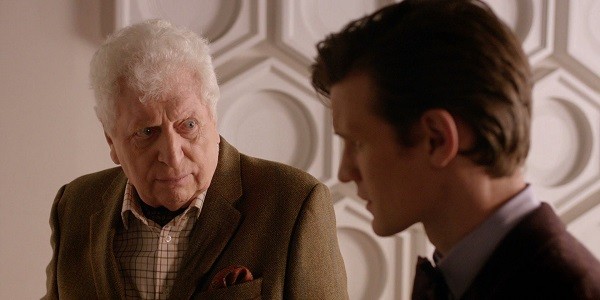
In 1999, an evening of Who-themed programming - aptly known as Doctor Who Night - took place on BBC Two with sketches, documentaries and rebroadcasts of episodes. Tom Baker, as an enigmatic figure with the appearance of an older Fourth Doctor, oversaw proceedings from within a chamber aboard the TARDIS and presented links between each item. The identity of this man is never explicitly revealed and at first he refers to the Doctor in the third person. But, over the course of the evening, he reminisces about meeting Cleopatra, mentions his dilemma from Genesis of the Daleks and finally, when introducing the TV movie, says he's "called Paul McGann in this one." Fourteen years later, the fandom let out a collective squee as a familiar voice called out to Matt Smith's Eleventh Doctor during the 50th Anniversary special. Tom Baker played an enigmatic figure - referred to as the Curator - with the appearance of an older Fourth Doctor. His conversation with the Doctor is deliberately oblique but the implication is that he is, was or could be the Doctor in some form. As such, the similarities between the Curator and Baker's role from the Doctor Who Night idents are too tantalising to overlook. Naturally, the brevity of this fan service cameo in The Day of the Doctor meant there was no time (or reason) to explicitly make a link between this character and the similar one he'd played for a series of obscure idents well over a decade ago. If Moffat even knew about this role, he probably didn't intend it to be connected or think that anyone else would remember the idents either. How wrong he was. So this is where personal canon really comes into its own. You may choose to believe that the two are the same character, that they're linked somehow or you can just ignore them altogether. Reconciling their appearances, while it may not matter to the show as a whole (and the worst kind of fans are those who believe their canon is the only correct one), it's certainly a lot of fun. As the Curator himself said, "Perhaps I was you. Perhaps you are me. Or perhaps it doesn't matter either way." What did you think of this lis? Are there any other spin off characters that have become canon that should've been included? Join the conversation in the comments section below.

In this post: 
Doctor Who
 
Posted On: 
Contributor
Contributor

I'm a freelance technology journalist with an unhealthy obsession for Doctor Who.