Doctor Who: Every Doctor's WORST Episode
The Doctor's had many lives spread across many episodes, and not all of them are good...

We all have bad days, and given their multi-millennia life cycles, Time Lords probably have more than most. The Doctor has had at least 14 very bad days in the form of the worst episodes of Doctor Who for each of their incarnations.
What makes a Doctor Who episode the worst of a particular era? Well, it could be that it doesn't live up to the high standards maintained elsewhere in a Doctor's tenure. Whether that's down to a flawed script, poor execution, bad acting or a mix of all three.
Before we delve into which Doctor Who episodes are the worst of their respective eras, it's worth outlining who we won't be including in the line-up. John Hurt won't be included seeing as he's only in The Day of the Doctor - an episode that can't be counted as the worst of anything.
As he's only ever led in one full-length Doctor Who episode, we won't count Paul McGann's TV Movie - both the best and worst of his era, depending on how you look at it. We're also going to avoid ranking the Fugitive Doctor's cameo appearances between 2020 and 2025, given that she's yet to lead her own episode of Doctor Who.
14. The Sensorites (The First Doctor)
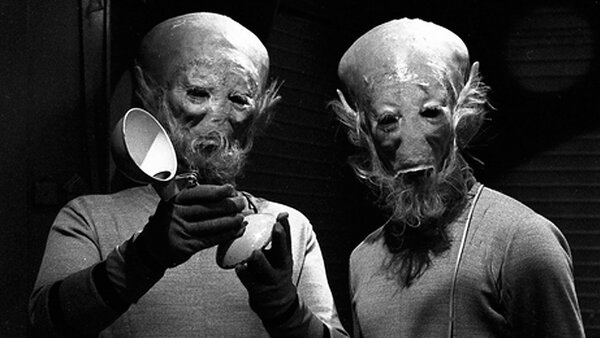
People often point to The Web Planet as the worst Doctor Who story of the William Hartnell era. But for all the incessant insect chirruping and bumblebee ballerinas, you cannot fault the production's ambition. After all, isn't being boring the biggest crime a Doctor Who story can commit?
Which brings us to The Sensorites, a story that has some genuinely weird-looking aliens and a solid handle on atmosphere, but one that very quickly outstays its welcome. The problem with The Sensorites is that it's so utterly forgettable, due in part to the poorly-developed human characters, and a massively elongated runtime.
We all might remember The Sensorites more fondly if it was a tight four-parter, that finally gives us more insight into the character of Susan Foreman. Instead it's a handful of good ideas and story beats that are drowned out by a lot of bland talking in rooms.
13. The Krotons (The Second Doctor)

Robert Holmes is rightly hailed as the greatest writer of the classic era, but you wouldn't know it by looking at his debut story, 1968's The Krotons.
It's a fairly dreary sci-fi story about a colony at the mercy of the dreaded crystalline Krotons. The creature design doesn't quite live up to the ambition of Holmes' ideas, but that's far from the story's greatest sin.
The biggest issue with The Krotons is the impenetrable alien society in which the Doctor, Jamie and Zoe find themselves in. Holmes will later give us some richly-drawn alien planets – look at Carnival of Monsters or The Sunmakers! But here, it's the sort of bland, academic society that wouldn't be out of place in one of the more earnest episodes of Star Trek.
The plot itself is almost too dull to put into words, consisting of the Doctor and friends running around quarries for a bit until the bad guys are blown up.
All of which would make it the worst episode of the Troughton era, but the involvement of Robert Holmes, who's yet to add his trademark wit and humour, makes it unforgivable. Maybe he was just a bit tired when he wrote these scripts?
12. The Monster Of Peladon (The Third Doctor)
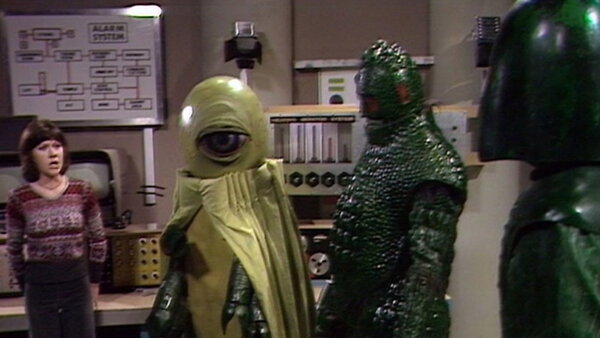
The Curse of Peladon was a tight political thriller that challenged the Doctor's prejudices and added new layers to Troughton-era villains, the Ice Warriors.
Its sequel, however, is often mind-numbingly dull, and sort of undoes many of Curse's innovations.
The Ice Warriors are once again featured in Monster of Peladon, slightly undoing the lesson that the Third Doctor had previously learned. Where Curse was a decent stab at exploring the debate about the European Economic Community, Monster is an over-earnest, slightly muddled take on the miner's strike that feels incredibly simplistic with the benefit of hindsight.
Even Pertwee himself lacks some of that effervescent charm, perhaps due to the fact that he's on his way out of the show. Everything in Monster of Peladon feels a little bit tired, a bit dusty, not unlike the fictional kingdom itself.
Thankfully, the following serial Planet of the Spiders ensured the Third Doctor era would go out on a high.
11. Underworld (The Fourth Doctor)

The behind-the-scenes story of Underworld is far more interesting than the finished episodes themselves.
Budgetary constraints forced producer Graham Williams and the team to create the story via excessive use of bluescreen, and needless to say it does not look good.
Williams' dedication to realising Underworld in spite of the limitations is laudable, but you can't help but wonder why he bothered. The quest for the Minyan race banks is just as intangible as the virtual sets, lacking any real dramatic weight. The characters themselves are woefully under-realised, with only Alan Lake's Herrick standing out in the middle of an incredibly bland cavalcade of Minyans, Trogs and Seers.
Tom Baker became visibly tired of playing the Doctor towards the end of his run and didn’t exactly go out on a high note three years later. It wouldn’t be too controversial to point to this story as the beginning of the end for him.
10. Time-Flight (The Fifth Doctor)

On paper, Time-Flight sounds amazing. The Master is hijacking Concorde jets and landing them on an alien planet as part of a nefarious scheme. It's like a lost Pertwee serial!
In reality, it goes out at the arse end of the season when the money's all spent. As a result, this high-concept story of stolen planes and stranded passengers ends up looking really cheap, even by classic Who standards.
The location footage filmed at Heathrow elevates it a little bit, but there's no escaping the fact that the Plasmaton aliens look like really unhealthy dog turds.
And then there's the Master's absolutely insane disguise, which exists for no reason other than to surprise the audience. It makes no story sense for Anthony Ainley to be dressed like a problematic racial stereotype, and that's just the start of the issues with Peter Grimwade's script.
Even the Fifth Doctor himself Peter Davison regards Time-Flight as the very worst of his tenure, calling it "a pile of crap". Fair enough.
9. The Twin Dilemma (The Sixth Doctor)

The variety week-on-week is one of Doctor Who's strongest selling points, but it's remarkable that one of the show's very best and very worst stories were broadcast just one week apart!
Following The Caves of Androzani was always a thankless task, but did The Twin Dilemma have to drop the ball so badly?
It was a huge risk to make the Doctor so unpredictable and unlikable, but the problem is that, aside from Peri, there's nobody even remotely likable to counteract this. Twins Romulus and Remus are appalling, and Mestor is such a rubbish villain that he almost certainly inspired Ricky Gervais' Doctor Who spoof in Extras.
None of the many flaws with The Twin Dilemma are the fault of Colin Baker, who gives nothing less than his very best. It's just massively unfortunate that he wasn't given material worthy of his talents.
As Russell T Davies himself later put it, The Twin Dilemma is a train wreck that was "the beginning of the end" for classic Doctor Who.
8. Time And The Rani (The Seventh Doctor)

Time and the Rani definitely isn't as irredeemable as some fans would have you believe. However, in a run as consistent as Andrew Cartmel and Sylvester McCoy's Seventh Doctor era, its flaws really stand out.
There's a good reason for this, of course. Due to the slightly chaotic exit of his predecessor, script editor Cartmel only had one workable script for the Seventh Doctor's debut story – courtesy of Rani creators Pip and Jane Baker – and it wasn't in line with his vision for Doctor Who.
A lot of the Bakers' worst excesses are on show throughout Time and the Rani, from their overwrought dialogue to a diabolical scheme that doesn't stand up to scrutiny. The greatest minds in all of time and space funneled into a giant brain? An asteroid made of strange matter? Combined to create a Time Manipulator? Sure, why not?
Meanwhile, McCoy is still finding his feet and leans a bit too far into clowning, which does provide some irritation. Kate O'Mara's hilarious Bonnie Langford impression and some genuinely impressive 1980s visual effects make this worth watching, but it's still the low point of the McCoy era.
7. The Long Game (The Ninth Doctor)

It feels harsh to call The Long Game the "worst" of the Ninth Doctor's era, due to how consistent it is in terms of quality. However there's no escaping the weaknesses of the story.
What begins as a fun sci-fi satire of rolling news gives way to a slightly tedious plot about the worst Doctor Who companion ever trying to gain advanced technology. Thematically, the stories don't dovetail in a satisfying way, instead just acting as a means to endanger the Doctor and Rose. And then there's the rather tiresome RTD trope of the heroic sacrifice thrown in for good measure.
The Long Game is frustrating because of the strength of the other elements, including Anna Maxwell-Martin's vengeful Suki, and Simon Pegg's slimy Editor. There's a good story in there, but unlike the rest of that first year, The Long Game doesn't form a coherent whole.
6. Fear Her (The Tenth Doctor)

Despite its penchant for daftness, Doctor Who can often go to some very dark places. Managing potential tonal clashes is such an important part of the show that they have designated Tone Meetings ahead of production. Despite this, some stories can still fall foul of them.
Take Fear Her for example, a story about loneliness and domestic violence set within the celebratory atmosphere of the 2012 Olympics. The first issue is that we've already done something very similar a few weeks earlier in The Idiot's Lantern. That story had some memorable iconography – evil televisions, the Wire, and the Doctor on top of Alexandra Palace. Fear Her has some drawings and a scribble monster.
The other issue is that the story of Chloe Webber is pretty dark, but every scene is shot in glorious daylight, reducing what little atmosphere the script is building up. The general feeling is that of a daytime soap or an episode of Tracy Beaker, completely flattening the edges of Matthew Graham's script.
The episode has more than once been voted as the second-worst ever behind The Twin Dilemma, which is a bit harsh, but is indicative of its overall quality.
5. Nightmare In Silver (The Eleventh Doctor)

Tom Baker has often been criticised for going too far with his performance as the Doctor – kissing Erato's tentacle, that kind of thing.
However, Matt Smith trumps him with his Nightmare in Silver performance, a masterclass in the overblown. Smith is a terrific actor, but you wouldn't know that to watch Nightmare in Silver, where he yells and purrs and overacts as Mr. Clever.
If that weren't bad enough, there's tedious tag-alongs Angie and Artie who embody almost every child actor stereotype going. Add to that Neil Gaiman's twee fairytale soldiers and you have the makings of an absolutely insufferable episode of Doctor Who.
And we haven't even talked about the Cybermen who, like the Daleks before them, get a jazzy upgrade that completely misses the point of what they represent.
The Cybermen in Nightmare in Silver are just invincible robot soldiers. They didn't need to be Cybermen. And isn't that the biggest crime of any Cybermen story?
4. In The Forest Of The Night (The Twelfth Doctor)

TREES!
While Series 8 has some highlights and is a big improvement on Series 7, it's still a mixed bag. For every Listen or Deep Breath, there's a frustrating episode like In The Forest of The Night.
Written by accomplished screenwriter Frank Cottrell-Boyce, its ham-fisted environmental message is a perfect example of what happens when you sacrifice plot for the sake of a moral lesson, even if that lesson is a valuable one. It doesn't hold up to a lick of scrutiny, and the threat to the Earth doesn't even feel real, partly due to the fact that we're two weeks away from the series finale!
And then there's the kids, the tedious rivalry between the Doctor and Danny Pink, and a strange subplot involving a missing teenager hiding in a bush.
Aside from a beautifully-directed TARDIS scene and some striking imagery of London under a sprawling green canopy, the story itself doesn't amount to much. In fact, it's so forgettable that – according to the Doctor – even the characters are destined to eventually forget the events of the story.
3. The Battle Of Ranskoor Av-Kolos (The Thirteenth Doctor)

When pitching his Doctor Who revival in 2003, Russell T Davies famously said that he couldn't "give a toss" about the people of Planet Zog. What he meant is that it would be difficult to get audiences to care about random goings-on on random alien worlds, without sufficient heart, depth, and character drama.
15 years later, Chris Chibnall delivered a story that asked us to do just that.
The Battle of Ranskoor Av-Kolos is like the most tedious episode of Star Trek: The Next Generation you've ever seen. An alien masquerading as a god, tricking some alien holy people into doing their bidding. The alien holy people are very boring indeed, the planet itself is the greyest of grey quarries, and while she tries her best, Jodie Whittaker can't raise this from being Doctor Who by numbers.
There's a reason for that too. Chris Chibnall later admitted that the finale was a first draft, rushed into production due to delays elsewhere. It shows, particularly in the climax where Tim Shaw targets Earth and we don't jump back to see Yaz's family in danger. Or anyone in danger, for that matter.
It's an outline for a decent Doctor Who story, but it's in dire need of proper fleshing out.
2. The Star Beast (The Fourteenth Doctor)

There was a lot riding on The Star Beast. It was based on a beloved Fourth Doctor comic strip, it reunited David Tennant and Catherine Tate, and it had to mark 60 years of Doctor Who. And it's by no means bad, it's easily the weakest of the three anniversary specials.
The biggest issue with The Star Beast is the reams of exposition required to remind casual viewers of what happened over a decade earlier. The Doctor and Donna's horrendous expository monologuing at the start was almost as off-putting as Paul McGann's speech at the top of the TV Movie. Especially as dialogue in the episode repeatedly reminded you that Donna couldn't be allowed to remember the Doctor, ever. Ever ever EVER.
This big dramatic throughline (Donna's Metacrisis and how to fix it) was completely undermined by the blasé way in which she and her daughter Rose just guffed out some golden light and lived happily ever after. What were we all so worried about?!
Still, it's got enough classic RTD1 kitchen sink hijinks to make it enjoyable throughout, plus a brilliantly-realised villain (spoilers) in Beep the Meep.
1. Space Babies (The Fifteenth Doctor)
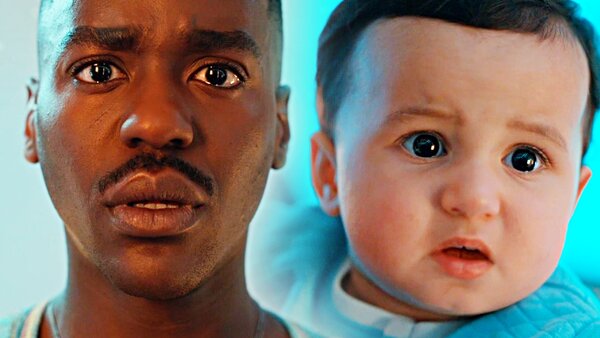
Does any more need to be said?
Weird CGI talking baby mouths. A 'hilarious' farting spaceship. Literal bogeys as the villain.
It's incredibly childish and silly at the worst possible time, when Doctor Who was trying to grow up on a global stage.
Space Babies killed the most ambitious era of Doctor Who in history, so it simply has to be the worst of Fifteen's adventures.