Doctor Who Robot Of Sherwood: 8 Continuity References You Might Have Missed

Mark Gatiss delivers another episode full of Classic Who references...
We like to think that when Mark Gatiss sits down to write a Doctor Who script, he plays a little game with himself called €œHow many Classic Who references can I write in this time?€ One of the trademarks of a Mark Gatiss script is at least half a dozen nods to Old Who lovingly slipped in for the audience to pick up on. And his latest romp Robot Of Sherwood is no exception with a healthy number of continuity references sprinkled across the episode. And as well as the references written in ahead of time, the episode includes a few bits and pieces from Classic Who that are absent from the script. Which means that Peter Capaldi and Steven Moffat might have had a hand in chucking a few in as well. Because for such colossal fanboys like Gatiss, Capaldi, and Moffat it€™s not just work. It€™s living the dream. Give a fan control over their favourite universe and you can be sure they€™ll be stuffing in meta-humour and references to their favourite moments until they€™re told to stop. While conspicuous continuity references are thin on the ground in Robot Of Sherwood (we only counted one when the Doctor suggests going to the Ice Warrior hives of Mars €“ which is a story just begging to be made), it€™s packed with subtler nods. And these are eight that we spotted...

8. Patrick Troughton

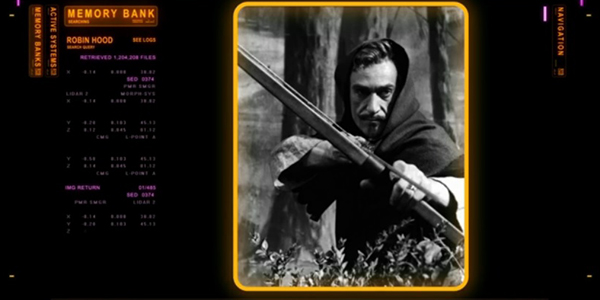
Almost every Doctor has met a doppelganger of themselves at some point, with the First and Second Doctors both having to do battle an enemy that bore an uncanny resemblance to themselves. But now, thanks to a clever bit of meta-humour, there€™s a third person running around with the Second Doctor€™s face: Patrick Troughton. In a blink and you€™ll miss it moment (that will melt fans€™ brains if they try to reconcile it with established canon too much); the Robot Knights' databanks on Robin Hood contain an image of Patrick Troughton as Hood, dating back to the 1950s when Troughton became the first actor to play the legendary outlaw on television. While on the surface it€™s simply a completely inconsequential joke, you could argue that it runs deeper than just that and being a way for Mark Gatiss to sneak another Classic Who reference in under the radar. The acknowledgement of Patrick Troughton playing Robin Hood is a wonderfully subtle way of foreshadowing the eventual comparison of Robin Hood and the Doctor, and tying them together even more as British cultural legends. Though knowing the way Gatiss does things, it€™s surprising we didn€™t get an offhand remark from the Doctor that the image is actually of him just to make the connection even stronger.

7. The Time Warrior Mk.2?

While only Mark Gatiss would be able to confirm whether or not this was intentional, Robot Of Sherwood certainly feels like it draws a lot of inspiration from The Time Warrior (1974); a Third Doctor story set in the Middle Ages that introduced Sarah Jane Smith and the Sontarans. While both stories are independently their own beasts with their own individual plot points and idiosyncrasies, the broad similarities are definitely there. The Tardis lands in a forest in the Middle Ages where a starship has crashed and a local robber baron has forged an alliance with the occupants. The spaceship is inside the baron€™s castle, will cause massive damage if it takes off, and the Doctor joins forces with a skilled archer who kills the villain and saves the day. Oh and there€™s at least one robotic knight thrown into the mix. Though the knight in The Time Warrior is an easily defeatable remote-controlled contraption rigged together as payment for robber baron Irongron rather than much more impressive robots faced by the Doctor and Robin Hood. While the similarities are noticeable to those who have watched The Time Warrior, they don€™t drag down the story since (if they are intentional), the inspiration taken from it is very broad and forms only a few building blocks of what is very much an original story.

6. The Sheriff And Tobias Vaughn

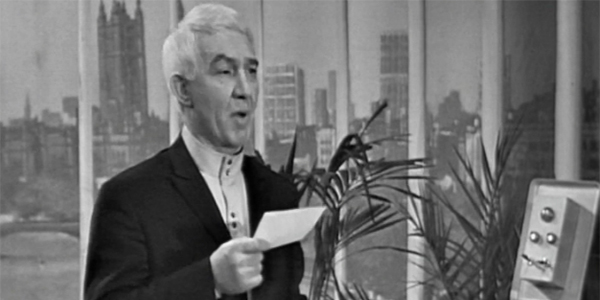
While it looks the Series 8 finale will be paying tribute to the 1968 Cyberman story The Invasion in several ways, it would seem that Mark Gatiss got there nine episodes early with Robot Of Sherwood€™s portrayal of the Sheriff Of Nottingham being uncannily like Tobias Vaughn (Kevin Stoney); a human ally of the Cybermen who assists their invasion of Earth. As well as Stoney and Ben Miller both hamming up their villainous characters for all it's worth, the Sheriff and Vaughn are alike in many ways. Largely that they are both helping the agenda of robotic life-forms in order to rule Earth with alien technology but also that their bargain with the robots leaves them with a cybernetic body. Though the Sheriff€™s is a necessity since the Robot Knights crashed their ship on top of him while Vaughn€™s new body is a voluntary upgrade. And if we consider the cut scene where the Sheriff is decapitated by Robin Hood; only to reattach his head and treat what would ordinarily be a fatal injury as a mild inconvenience, then the similarities go one step further as this was also the way that Vaughn was revealed to be a cyborg - being shot in the chest several times and giving it little to no consideration. Maybe a robot body is a standard perk in the €œsell humanity out to robotic species€ contract.

5. Arrow To The Door

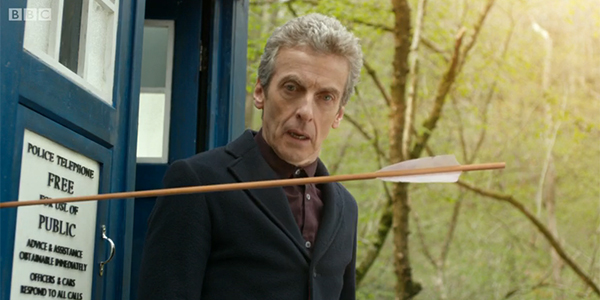
Is the Tardis€™s broken Chameleon Circuit making it look like a great big archery target to anyone armed with a bow? Because this is the third time that the old girl€™s ended up being shot by an archer. The climax of The Shakespeare Code (2007) saw a guard accompanying a very miffed Elizabeth the 1st (preparing for the world€™s most violent divorce) fire an arrow at the fleeing Tenth Doctor only to miss and hit the right-hand door. The arrow was resilient enough to survive a trip to the year 5 billion and we see the Doctor casually pulling it out and throwing it away at the start of the next episode Gridlock. While nineteen years earlier in the 25th Anniversary story Silver Nemesis, 17th century sorceress Lady Peinforte also tried to turn the Doctor into a makeshift kebab but missed and hit the door. And as with The Shakespeare Code, the arrow survives a short hop through time and the Doctor pulls it out shortly after landing. If nothing else, then the people who go after the Doctor with longbows really need to work on their aim. To miss once is unfortunate, twice is downright careless, and thrice means that if you€™re going to kill the Doctor, then you need to choose a different weapon.

4. We're In A Miniscope

http://youtube.com/watch?v=zuw9YDFFGuw Mark Gatiss being born in 1966 would seem to indicate that Jon Pertwee is his Doctor. An assumption borne out by him casting himself as Pertwee in scenes ultimately cut from An Adventure In Space And Time, and the number of Third Doctor references in Robot Of Sherwood. As well as the episode having a lot in common with The Time Warrior and the Doctor breaking out some Venusian Aikido moves (which we€™ll come to later), we get a brief nod to the 1973 story Carnival Of Monsters. After first meeting the Merry Men and his assumptions about them not being real being stumped by every test he performs on them (whilst assessing that Alan A-Dale has six months to live), the Doctor assumes that the Tardis must have materialised inside a Miniscope. The Miniscope is an illegal device that works as a sideshow attraction by taking intelligent life-forms, making them seventy-two times smaller, and sealing them inside the Miniscope in a controlled environment that replicates the being€™s natural habitat. The Miniscope€™s only onscreen appearance so far was in Carnival Of Monsters where the Doctor and Jo were trapped in alien showman Vorg€™s (the only person in the universe with less dress sense than the Sixth Doctor) Miniscope which also contained Orgrons, Cybermen, and what Vorg claimed to be the only humans in captivity. Which means that the Doctor€™s guess at being in a Miniscope wouldn€™t make much sense since it would require a real Robin Hood to be held captive in the first place. And on that note, we now invite you to have paranoid nightmares at the idea that somewhere out there is an alien with a device like a Miniscope and that we€™re all trapped inside it.

3. Richard The Lionheart

The Doctor€™s spoon-on-sword duel with Robin Hood packs in a lot of very fast comedy moments. In the space of just over a minute we get an almost d*ck joke, the Doctor subtly flipping off Robin as he puts on his glove, and some trademark namedropping as the Doctor claims to have trained with Cyrano de Bergerac, Richard The Lionheart, and Errol Flynn. The challenge here is spot the odd one out. Because while the good Doctor has yet to meet Bergerac and Flynn (take notes, Moffat), he has encountered Richard The Lionheart. In the partly missing First Doctor story The Crusade (1965), the Tardis lands in Palestine in 1190 AD just as Richard The Lionheart is being attacked by a group of Saracen (a contemporary term for Muslim) warriors, and the Doctor and Ian end up helping to fight them off. We don€™t see the Doctor sparring with King Richard at any point during this story but he does have a tendency to both make friends with and tick off historical figures in equal measure so it€™s more than likely that they crossed paths again at some point. The Doctor has also encountered Richard€™s younger brother John shortly before the signing of the Magna Carta. Well, sort of. A shape-shifting robot imposter controlled by the Master still counts, right?

2. The Spaceship Leaves

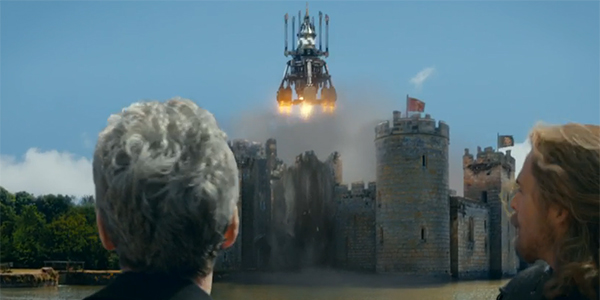
Thanks to television being a visual medium, writers and directors are spoilt for choice in how they can reference other works; with the two most common ways being a reference in dialogue, and a visual homage like including an old prop in the background or replicating a certain shot. Or alternatively, incorporating a story element of what you€™re paying homage to into your own narrative. And for the climax of Robot Of Sherwood, Mark Gatiss outdoes himself by combining the latter two into one sequence. The Robot Knights€™ ship is disguised as part of the Sheriff Of Nottingham€™s castle, detaches from the main structure on takeoff, and explodes after it reaches orbit thanks to the Doctor, Clara, and Robin giving it a little power boost with the golden arrow from the archery tournament. A visual and plot point lifted from the Fourth Doctor story State Of Decay (1980). At the climax of Part Four; the Doctor modifies the Vampires€™ ship (disguised as part of the landscape) so that it takes off and then crashes to the ground, killing the last true Great Vampire before it can be unleashed. Which is a lucky consequence of the Vampires having a rocket with a massive spire on the nosecone. A plot point and visual repurposed very efficiently and at no cost to the overall story. Though thankfully the Robot Knights€™ ship managed to make it to orbit before blowing up. Another exploding castle caused by the Doctor would have been a pretty big dent in history.

1. Venusian Aikido

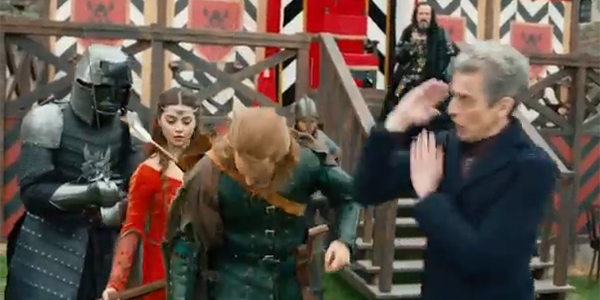
While the Tenth Doctor popularised the idea of the Doctor as an absolute pacifist, Classic Who has plenty of evidence to the contrary. Mostly from the Third Doctor who was never one to shy away from giving his enemies a good kicking; bonking an Ogron over the head with a bottle of wine, having an impromptu swordfight with the Master, and beating up all and sundry thanks to his mastery of Venusian Aikido. A trait which (thanks to Mark Gatiss) seems to have now passed over to the Twelfth Doctor. At the Sheriff€™s archery tournament after constantly trying to outdo each other, the Robot Knights are revealed and Robin Hood decides to be the bigger man and defend the Doctor. But the Doctor has other plans. Planning to use his go-to approach of getting captured to get close to the villain, the Doctor disarms Robin so that they can surrender before Robin gets them disintegrated. But swords are too wimpy for the Doctor. Instead; he adopts a Venusian Aikido stance and unleashes the Third Doctor€™s trademark battle cry of €œHai!€, and then knocks Robin€™s sword out of his hands in an instant with little to no effort. Which makes you wonder just how bad at close-quarter combat those robots must be if Robin is able to dismember one but gets a sword knocked out his hands that easily. What did you think of Robot Of Sherwood's continuity references? Have you spotted any that we missed? Let us know in the comments section below..

Contributor
Contributor

JG Moore is a writer and filmmaker from the south of England. He also works as an editor and VFX artist, and has a BA in Media Production from the University Of Winchester.