Doctor Who: The Story & The Engine Review - 8 Ups & 2 Downs
A trip to the barber gives Doctor Who Season 2 its freshest cut yet.

A wise man once observed that "we're all stories in the end", and this week's Doctor Who is a celebration of just how powerful those stories can be. It's also an episode that feels more magical and mythical than anything we've seen so far in Russell T Davies' pantheon of the gods era.
But more importantly, it's a Doctor Who story that feels fresh and original, something that's been lacking in a series that has largely seemed content to play some of RTD's greatest hits.
Playwright and poet Inua Ellams makes his Doctor Who debut with an atmospheric chamber piece set inside a Nigerian barber shop. Ellams' script draws on his previous stage work, and brings a fresh perspective to the Doctor that really clicks with Ncuti Gatwa's interpretation of the role.
As well as subtly invoking the Pertwee era, Ellams' script also recalls The Mind Robber in its focus on an exhausted storyteller as the villain of the piece. And yet despite all this, the episode's Nigerian perspective makes everything old new again, ensuring that the neverending story of Doctor Who will continue.
10. UP - Inua Ellams

Inua Ellams is a welcome addition to the Whoniverse, delivering a story that – for the first time this year – doesn't feel like a Doctor Who episode we've seen before. Obviously, it shares DNA (and some cast members) with Ellams' 2019 play Barber Shop Chronicles, as The Story & the Engine also places the safe space of the barber shop at the centre of stories and storytelling.
Ellams seamlessly adapts his original play into something more Doctor Who-y, using sci-fi and mythic tropes to explore how stories can be appropriated and weaponised.
As well as being a playwright, Ellams is also a poet, and he brings this to bear in the dialogue. Look at how beautifully he sums up of the story of Doctor Who in six words:
"I'm born. I die. I'm born."
The poetry of Ellams' script gives us a Doctor Who that feels more mythical than anything we've seen so far in these supposedly mythic struggles between the lord of time and the gods of games, music, death or light.
9. UP - Ncuti Gatwa
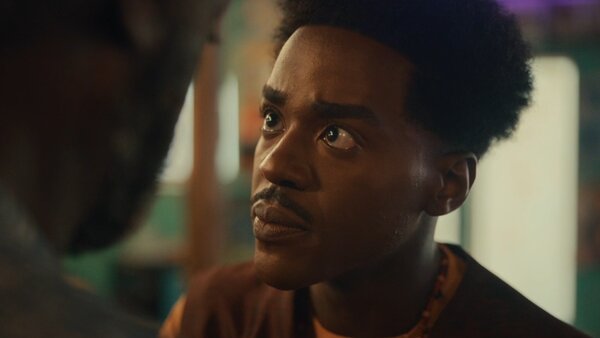
Has Ncuti Gatwa ever been as good as the Doctor as he is here? From his explanation of why he goes to a barber shop when the TARDIS does his hair(!) all the way to Omo's betrayal and everything beyond, Gatwa navigates the Doctor's arc impeccably.
If there's a defining characterisitic of the Doctor – regardless of the incarnation – it's an ability to laugh in the face of his enemies. Gatwa gets an amazing moment like that here, puncturing the Barber's moody monologue about being a god of stories. The Doctor's full-throated laugh breaks the tension and instantly reduces the villain to something smaller, not a storytelling god but a traveling storyteller. It's a joy to behold.
When he was cast as the Doctor, Gatwa reflected on how he too had left his home and fled a genocide. "I am the Doctor and the Doctor is me" he said. That's not always been in evidence across his era, but he seems so comfortable in the role here. It's clear that he's relishing the chance to sink his teeth into a script that portrays the Doctor as a rounded individual rather than a two-dimensional hero.
8. UP - The Barber

This is the second week in a row where we have a cracking villain, in this case, the Barber, played by Ariyon Bakare. With his magic clippers and barber's smock, he's that great thing – a Doctor Who villain who takes the everyday and makes it magical and terrifying. It's also the second week in a row in which the Doctor is forced to confront a villain who believes they're owed something.
The Barber believes he's owed the credit for all the work he did spreading the myths and legends of Anansi, Loki, and the other storytelling gods. To the Barber, the gods don't exist without him, and if they won't give him the recognition for his hard work in keeping their stories alive, he'll burn them down.
In an episode all about the power of community and shared mythology, it's tempting to view the Barber as an allegory for entitled fandom. There's a particular type of toxic fan who viciously rounds on their favourite franchise on social media when it's perceived to have rejected them through a casting or storyline choice.
You know the type – the "fans" that want the show to be cancelled to prove that they were right all along...
7. UP - The Spider And The Web
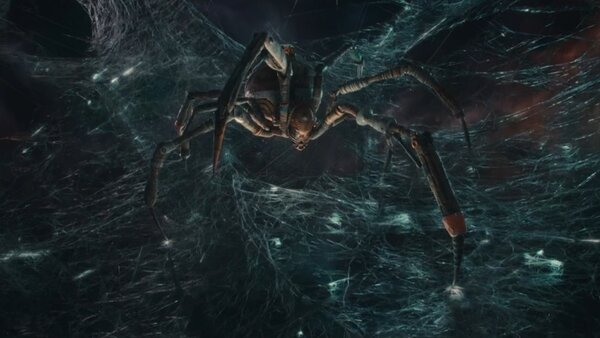
Unsurprisingly, Inua Ellams has a real gift for a poetic metaphor, and the most striking one is the Barber's Nexus or World Wide Web. It's an ideal visual shorthand for the idea of how we're all connected by our shared stories. As viewers we instantly understand what's at stake because we know that to cut the gods out of the web will cause the whole thing to collapse.
But Ellams goes one step further, adding the poetic flourish of the web being spun from the blood of a god, growing outward from a small wooden box as the connections to the myths and legends of the gods grew stronger. It's a beautiful depiction of the power of stories, and how they bind us together, each story being a strand of webbing that connects us to someone else.
And then there's the spider at the heart of it, carrying a Nigerian barber shop on its back. Truly there's no other TV show like Doctor Who. It's a striking visual that almost makes up for the lack of exciting location filming...
6. DOWN - "Lagos"
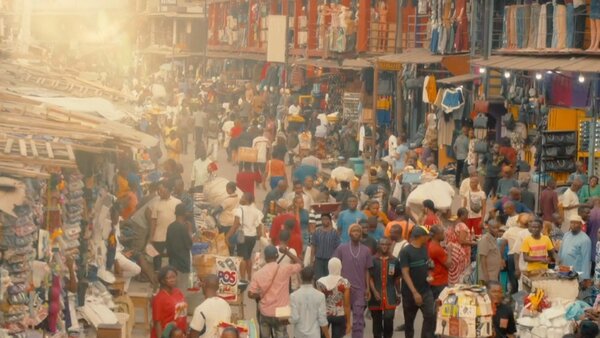
Having previously filmed in South Africa during the Jodie Whittaker era, there's something slightly regressive about realising the hustle and bustle of a West African city in... er... South Wales. What's the Disney money for if not to send our cast out on location?
This artificiality accidentally undercuts the mystery of Omo's barbershop because, from the outside, it doesn't feel like a real life location. It's therefore no surprise when it turns out to be a front for the Barber's nefarious scheme.
Director Makalla McPherson does her best with the set, though, tapping into the uncanny nature of this Nigerian barbershop augmented with strange otherworldly steampunky tech.
The scenes of Ncuti Gatwa moving through the market in Lagos are great; it feels like we've never seen the Doctor do this kind of thing before. However, there's a nagging sense of disappointment that all of this is taking place on a soundstage at Bad Wolf Studios.
Sure, making do is all part of Doctor Who's indefinable magic, but there's a feeling that The Story & the Engine deserved proper location work that was as fresh and vibrant as the script.
5. UP - The Map In The Braids
For all that The Story & the Engine deals with the myths and legends of multiple cultures, the episode's climax is rooted in another folk memory that's more down to Earth.
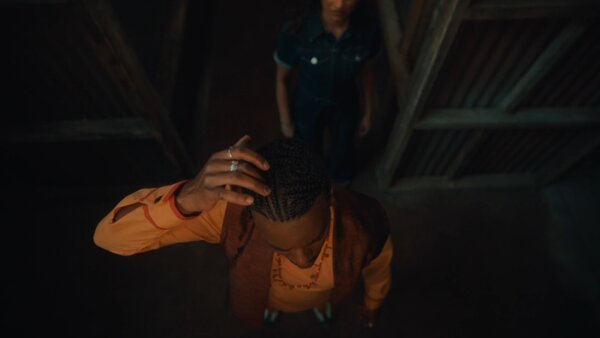
Once Abena discovers the Barber's true plans, she plots to give the Doctor the information he needs to access the Story Engine. What follows is a stunning sequence, aided by evocative black and white animation that tells a story of freed slaves who hid maps and other geographical pointers within their braided hair.
There is truth to this story, with a well documented case of braiding hidden messages in 16th century Colombia. And so Abena braids the Doctor's hair to resemble a map to the story engine at the heart of the barbershop.
It's also worth mentioning that the braids, and Ncuti's outfit, are a great look for the Fifteenth Doctor – possibly the best iteration of the Doctor's outfit being determined by the story's setting.
The braid map is the kind of more diverse cultural history that the Chris Chibnall era made a concerted effort to showcase, pushing Doctor Who's educational remit beyond the White European-centric curriculum taught in schools. And speaking of the Chibnall era...
4. DOWN - The Fugitive Doctor
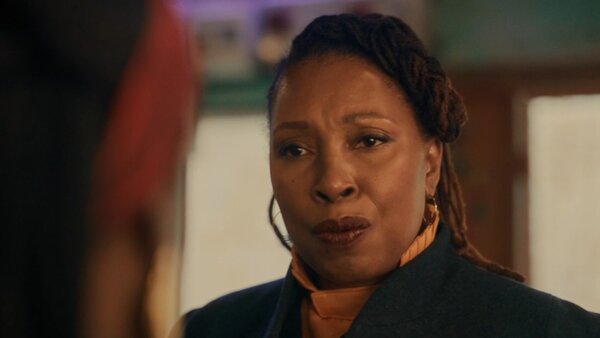
The surprise revelation that Abena was engaged to Jo Martin's Fugitive Doctor – and not Ncuti Gatwa's Fifteenth – is a nice touch. The cameo honours Martin's position as the first person of colour to play an incarnation of the Doctor by placing her within African folklore. Sadly, however, it follows the unfortunate pattern of all of Martin's appearances post-Fugitive of the Judoon.
Just like the Matrix vision, the splinter on planet Time and the hologram in The Power of the Doctor, this isn't Jo Martin playing the Fugitive Doctor for real, she's playing an echo. It's really Ncuti Gatwa's Fifteenth Doctor who's apologising (but not really apologising) to Abena, rather than the incarnation who actually jilted her.
The "other story" of the Fugitive Doctor "might be finished one day", but these cameos by hallucinations, specters and holograms don't do anything to build the mystery. All of which begs the question of why bring the actress in at all? Is it simply to demonstrate how long it's been since the Doctor left Abena, or is there something much bigger at play for the upcoming finale?
3. UP - The Story Windows
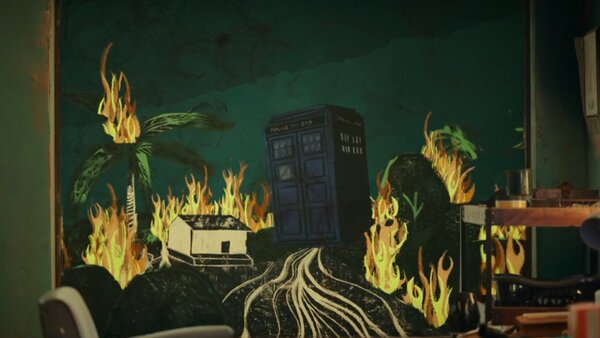
Due to the confines of the barber shop, there's a concern that The Story & the Engine could be too constrained by its setting. However, the inclusion of the story window hints at a more fantastical world beyond the four walls of Omo's shop. The hand-drawn animation sequences recalls the story of Zellin and Rakaya from Can You Hear Me?
While that scene was a beautiful and unique way to deliver exposition, the animated sequences in The Story & the Engine feel more fluid and in-keeping with the episode's themes of mythology and cultural history. It's also striking when the animation that illustrates Abena's story leaps out of the story window on to our TV screen, because she is a god and demands our attention.
More interesting still is the fact that the episode's opening titles begin within this story window. This is another example of Doctor Who the TV show playing out within the fiction of an episode, as is the Doctor's story playing like a hospital drama.
What this means is anyone's guess at this point, but it might be telling that Mrs Flood appears within the Doctor's story about Belinda...
2. UP - "Nothing More Vivid Than Ordinary Life"
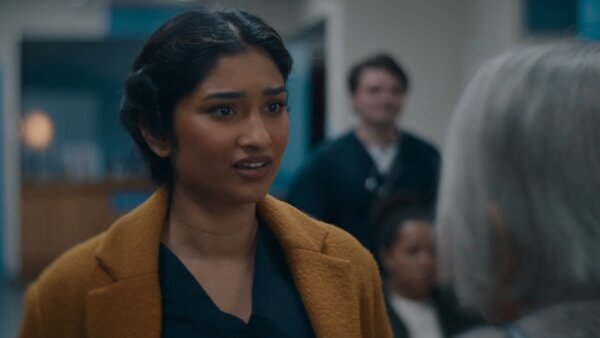
The Doctor's everyday story of Belinda's dedication to her patients is notable for two reasons. Firstly, it's an economical way to demonstrate that the Doctor and his companion have been sharing stories of their own in the gaps between adventures. Given the reduced episode count and brisk pace of the episodes, it can often be hard to feel that Belinda and the Doctor are a solid team, particularly as she spends a large chunk of this episode separated from him.
However, the Doctor's admiration for Belinda shines through as he tells the story of how Belinda saved a patient's life by spotting the signs of Addisonian crisis. This bond between the pair is further emphasised by his joy when she finally makes her way to through the door.
The story of an "ordinary life" is also notable because it feels like a celebration of RTD's vision for Doctor Who. No matter how fantastical his stories, he always has his feet resolutely on the ground with relatable human characters and a believable domestic reality. The Doctor choosing a story from Belinda's nursing career over an adventure with Weeping Angels and Ice Warriors in a magical barbershop is a perfect example of this approach.
1. UP - The Neverending Story
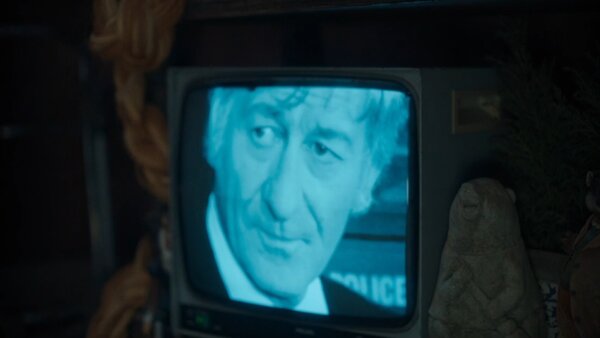
The title of this week's episode, The Story & the Engine, may as well refer to Doctor Who itself. For over 60 years, Doctor Who has been like Omo's barber shop, welcoming in storytellers and powering its engine with their tales of adventures across space and time. Doctor Who's voracious appetite for story hasn't been confined to TV, either.
There is now an endless stream of novels, comic strips and audio dramas that tell the story of the Doctor while they're not on the telly. As the Barber rightly points out, the Doctor is a neverending story. In this metaphor where Doctor Who is the barber shop, it's easy to see Russell T Davies as the Doctor, lured back so that he can tell more stories and keep the engine running for a few more years.
However, if Doctor Who is to truly remain as a neverending story, it needs new storytellers. With that in mind, Inua Ellams' dazzling debut script is a compelling argument for looking further afield for new voices.
Although the characters in the barber shop worry that they've run out of stories, The Story & the Engine proves that Doctor Who still has many more to tell.