Spaced: 10 Things To Love About Edgar Wright's Hidden Gem
Before The Big Bang Theory ruined the concept, Edgar Wright gave us a wonderful geek-centric sitcom.

We’ve all heard of the Cornetto Trilogy; those three fantastic films made by Edgar Wright, Simon Pegg and Nick Frost for the sake of getting free ice cream.
Between Shaun of the Dead, Hot Fuzz, and The World’s End, these movies parodied their respective film genres in wonderfully intelligent and insightful ways. That’s to say nothing of the quality of the movies themselves, whose camerawork and editing gave Edgar Wright’s unique filmmaking style the chance to display its full potential.
It didn’t start here though, and if you were fortunate enough to come across it before, you might recognise these things from a certain sitcom of the late 90’s.
Spaced was a TV series that aired in 1999, written by Simon Pegg and Jessica Stevenson, and directed by Wright. It follows the two writers as a pair of unemployed creatives in London, their struggle to stay above the poverty line and still find fulfillment in life.
With a talented and colourful supporting cast, this series set the expectation for the later films that Pegg and Wright would pen together. Surreal, hilarious, with a surprising capacity for emotional turmoil and an ultimately heartfelt tone, Spaced is a hidden gem bursting with merit and worthy of recognition.
10. Pegg And Frost

The relationship between Simon Pegg and Nick Frost is as iconic as it is adorable.
With a near unique dynamic between two men in modern showbusiness, their mutual affection is a lesson in platonic fulfillment.
In Hot Fuzz, Nicholas Angel and Danny Butterman showed us how friends can learn from each other and grow to be better people whilst overcoming tremendous odds. In Shaun of the Dead, Shaun and Ed's friendship was a clear weight that held back personal growth, but through sacrifice and struggle the two of them ultimately got what they wanted most. In World's End, pushing through adversity and pain together helped reconcile long-held grudges, and the two most disparate of people came back together, even if they necessarily shouldn't have.
It all started here though, with the friendship between Tim and Mike displaying an early form of the character interactions we see later in their careers. A close childhood friendship with a dynamic that, though flawed, is nevertheless heartfelt and rooted in care for one another. A lack of fear around physical contact and an abundance of mutual support, even a little jealousy, these two make a heartwarming pair that really do complete each other.
9. Painfully 90's
The 90's were an ... interesting time to be alive. In history's list of drunken episodes, this was the night that ends with waking up in a strange apartment, shoes missing and shirt covered in regurgitated kebab.
Released just before the turn of the millennium, Spaced will take you back to the wretched hive of scum and villainy that was London in this decade. Between the oversized cargo trousers, the prominence of The Phantom Menace, and the existence of typewriters beyond just hipsters, there's no doubt of when this series is set.
Viewers of UK television from this era will also recognise the appearance of Robot Wars, from its geek-ish excitement to the excessive efforts people took to win it, up to and including explosives.
The UK rave scene is another surprising inclusion, with an atmosphere and music set that quite simply could not fit in at any other point in history. The universe just wouldn't allow it.
As a series engaging with geek culture before the widespread use of the internet, not to mention the struggles of job hunting and finding a home, Spaced bleeds the 90's as much as it bleeds film references.
8. Deeply Flawed, Genuinely Endearing Characters
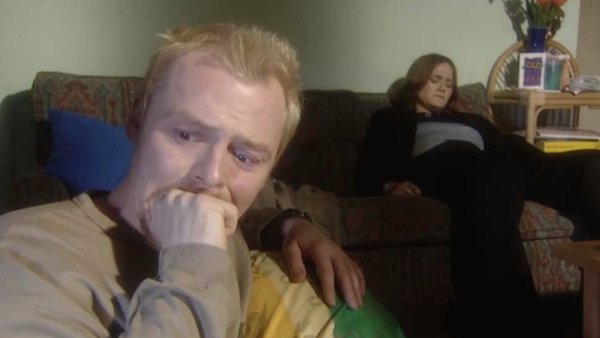
The characters of Spaced follow the same approach to many of our other favourite rogues. From Bojack Horseman to Rick Sanchez, we have a well proven tendency to gravitate towards deeply flawed individuals in our entertainment.
There is nothing hiding this, and from the outset each character gives us a personality rife with flaws. With Marsha's alcoholism, Twist's blatant manipulation of people, Brian's lack of spine, Mike's penchant for violence, Tim's short fuse and Daisy's total lack of self control, no one gets away clean.
The only one spared is Colin, yet even he has flexible loyalties. Et tu, doggo?
Despite this, the characters remain endearing throughout. Human imperfection is a quality we can't help but relate to.
As the series nears its end we see change, each character overcoming their flaws (except for the alcoholism) and trying to improve. Whether long-lasting or not, and we can speculate endlessly about how permanent such changes might be, it doesn't detract from what are genuine acts of good.
When the cast attempt to fix the harm they have caused their efforts feel real and heartfelt. Considering how much of the series starts out in deception, this honesty shows a personal growth that feels human.
7. Geek Culture Galore

As per their usual work, Wright, Pegg and Stevenson filled Spaced to the brim with every film, comic, game and other geek reference they could possibly find.
A quick eye will spot these in everything from the speech to the style of filming, ranging from small references to the fundamental premise of an entire scene.
The appearance of Sophie, Tim's season two love interest and a plot-essential character, is based entirely around the character of Rachel from Blade Runner. Recurring references include The Shining, the A-Team, and one episode that turns Fight Club into a local underground Robot Wars tournament.
Simon Pegg's character is a nerd at heart, an aspiring comic artist with a little too much passion regarding the Star Wars prequels. Working at a comic book shop, any scene involving it is brimming with references, including the owner Bilbo Bagshot.
The later episodes even begin to reference the earlier ones, completing what can only be described as a self-contained memetic perpetual motion engine.
Ultimately, anyone with enough geeky know-how will get a hell of a kick out of Spaced for the sheer love it shows towards geek culture. It also makes for a fantastic (if deadly) drinking game.
6. Geek Criticism Galore
As much as it loved geek culture, Spaced also shows some heavy criticism towards its worst aspects.
The snobbishness of certain geeks was apparently as prevalent in the 90's as it is now. Presumption, overt judgement of one's interests, a blatant hostility to newcomers, this is a story many of us still recognise. Geek culture can, for all its enjoyment, be a shockingly cruel social bubble to exist in.
Spaced leaves no doubt as to where it stands about these aspects. Tim's obsession with Star Wars, and especially the Prequels, are never shown as anything more than painfully childish. At one point they cost him his job, and he is forced to get over himself in order to get it back.
This criticism has aged wonderfully because, sadly, it's still relevant. Geek culture may have entered the mainstream and found a thousand new ways to flourish, but there are still far too many overly critical armchair experts ready to fight to the death.
No matter how passionate you are, no one should be able to shout at a child for liking the wrong thing. Even if that thing is Jar Jar Binks.
5. Cuts, Flashbacks And Pacing
Edgar Wright's style of filmmaking is known by many of us as something unique in modern cinema.
His work runs with a natural grace, with carefully designed pacing and an often flexible narrative structure. Cut with hints of flashbacks and non-diegetic sounds, in the hands of a less skilled editor these sequences would quickly become messy and confused. Imagine someone else trying to do Baby Driver? Under Wright's direction they gain a sense of finesse and an iconic style.
Spaced gives us the early form, a little more on-the-nose and a little less refined but nevertheless a predecessor to Wright's impressive cinematic motif.
More heavily focused on flashbacks, with elements of the absurd and far more dream sequences, it stands as a stylised work all its own. Paired with Pegg and Stevenson's excellent script work and the performances of the cast, it is a technically engaging series sure to catch the eye of any filmmaking aficionado.
When you compare it to The Cornetto Trilogy and even Wright's work with Scott Pilgrim, you can see his growth as a director. To a budding filmmaker, tracking the evolution of this iconic director will be as enjoyable as it is inspiring.
4. Nobility In Poverty, Or Lack Thereof

The tendency for modern entertainment to display being poor as a fun adventure is not exactly a well received one.
Cutting close to the poverty line is rarely fun. Having to settle for your career is not an enticing thought. Likewise, sacrificing time, opportunity and health in pursuit of your dream is not a particularly life-affirming situation to be in.
Still, although it isn't romanticised there is a focus on the happiness that can be found outside of career fulfilment. Despite a constant lack of money and the loss of opportunity that comes with it, each character finds joy one way or another. In understanding each other, building friendships, even finding petty revenge against their wrongdoers, our characters draw some happiness from their lot in life.
In the end many of them do find, if not total success, at least satisfaction in what they do. The security may be fleeting but the joy of the moment is certainly there, and that is always something to value.
3. Surreal Shenanigans
A flexible approach to reality is something that is a little lacking in modern comedy. Between the stubbornly real and the incurably nihilistic, any surrealism is kept firmly to the dream-sequence.
Spaced breaks this standard, giving us both the personifications of thought processes and frequent daydreams that break with tangible world. Although the most frequent offender is Brian, the erstwhile avante-garde artist of the cast, each character gets one or two moments that pull them comfortably out of reality.
We also get flashbacks to childhood memories, where the juvenile versions of our characters have perhaps a little too much similarity to their adult counterparts, especially the facial hair.
With a couple of animated comic-style sequences that seem almost the proof of concept for Wright's work in Scott Pilgrim, the more flexible presentation of reality in Spaced provides a welcome relief from some of its heavier moments, not to mention some truly hilarious scenes.
2. Satisfyingly Unhealthy Coping Mechanisms

Stress gets to all of us, a fact of life that Spaced does not ignore.
There are many ways of dealing with that stress, from herbal tea to regular exercise, or even the Little Book of Calm.
Spaced does not give us any good examples. On the contrary, what it gives us are a wealth of deeply unhealthy, undeniably satisfying coping mechanisms.
The very top of the list includes, though is not limited to: benefit fraud, vandalising derelict cars, shooting your ex’s new boyfriend in balls with a paintball gun, getting drunk to avoid problems, getting a dog to avoid problems, stealing a tank from the Territorial Army, and finally attempting to invade Paris.
If yoga is chicken soup for the soul, these are a night of binge drinking and an 18 inch pizza for one. They aren't good for you and the consequences will be dire, but god damn are they a lot of fun.
Some days are just too stressful to be healthy.
1. Throwing Presumptions Out The Window

Spaced likes to play with our presumptions, it likes to take familiar tropes and undermine them for the sake of an excellent story.
The best example of this is Tim and Daisy, the two leads who (spoiler) don't get together in the end. Ultimately, though each one makes sacrifices for their friendship, and though there is even some romantic tension between them, they remain just friends.
The point here is to emphasise the importance of their friendship, to lessen the expectation that a pair of characters of the opposite sex have to end up romantically involved. By voicing a criticism of their friendship through one of the less credible characters (Tyres, who's critical thinking skills are shown to be... volatile), they show us how ridiculous this presumption is.
Spaced goes to great lengths to tell us to make the best out of life, to abandon our presumptions and expectations and to instead build our lives around the nature of reality that we observe. It tells us to value what we have, in people and opportunities, and to never throw it away for the sake of something unreal.
After all, what good is a relationship when a friendship works better?