Star Trek: 10 Things We NOW Know About The Holodeck

The holodeck is older than one might believe, originating in the '60s. Gene Roddenberry conceived the room for the third season of The Original Series, though his involvement (or lack thereof in Star Trek's final year) put paid to its installation.
The Animated Series would get the credit for bringing the Recreation Room to life, though The Next Generation would contain the first utterance of 'holodeck' in reference to this magic box. A question of credit later, the wonderful room of fun and sin was firmly part of the furniture from Encounter At Farpoint onwards, wobbly rocks and all.
It's served as an introduction method for fan favourite characters, and the locale for some questionable clientele. Holographic characters may be rewritten, but the need for fun and games on a five-year mission is a fixed point in time. With nearly sixty years of history behind it, and an ever-evolving backstory thanks to sequels, prequels, and mid-quels, the Holodeck is as rooted in Trek lore as the transporter or Riker's beard.
Speaking of Riker's beard, holograms have been born, walked through those doors (or did they?) and become just as important as their flesh and blood counterparts outside. Mobile emitters or no, there's something to be said about a fantasy (or two) that follows you home.
We know so much more about how these inventions work, yet along the way, we also learned a stark, terrifying truth: have all the fun you like, but someone has to clean those filters.
Oh, and sometimes a holographic bullet can kill, too.
10. Mind That A.I.
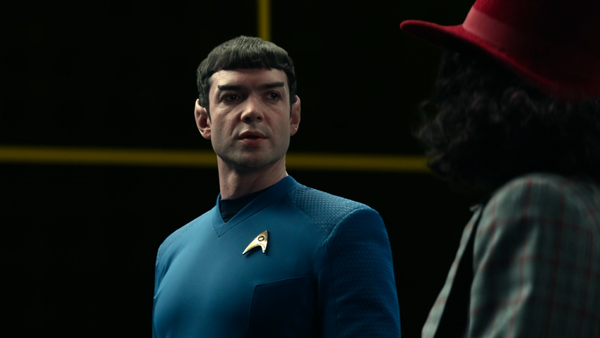
Too much of a good thing is never positive, as La'An Noonien-Singh discovered in A Space Adventure Hour. The Recreation Room, or Holodeck (more on this in a moment), was proposed by Starfleet as a solution to the rigours of long-term space travel. The best laid plans...
This third-season episode of Strange New Worlds is set in 2261, several years before The Practical Joker, the episode that first introduced audiences to the Rec Room. While crafting the story, particular care had to be paid to this bit of wibbly wobbly time travel. How to invent the light bulb before electricity had found its way on board?
The answer was simple: invent it, then break it. That method had worked for holographic communication technology in Such Sweet Sorrow, so why not for holographic entertainment here? Amelia Moon could have been the last hard-boiled detective to walk those yellow and black tiles, save for a last-minute brainstorm from Montgomery Scott. To prevent the holodeck from draining power and resources from every other system, give it plenty of both, purely dedicated to its needs.
In truth, A Space Adventure Hour walks the fine line of being a prequel, but wanting to play with the sequel's toys. It largely succeeds, retroactively using the writers' ideas from Voyager's Parallax, by suggesting it has its own reactors, to ensure that the next test would be more successful. The episode also cements one piece of holodeck lore, right from the very beginning: those safety protocols have never bloody worked!