Star Trek: Deep Space Nine - 10 Best Episodes

Entertainment Weekly has called DS9 "the Trek franchise's most compelling series." Here's 10 episodes that prove it.
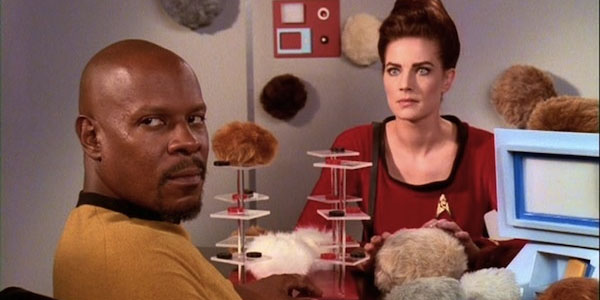
Star Trek: Deep Space Nine was never as highly-rated as its predecessor, Star Trek: The Next Generation, or as much a part of the public consciousness as the original series. Moreover, unlike every other Star Trek television series, Deep Space Nine was set aboard a space station, which had some fans wonder what the word "Trek" was doing in the title. That unchanging location, however, only proved to be an asset to the program, which unlike its predecessors, had no choice but to live with the consequences of each episode, because there wasn't another planet to zip off to the following week. In recent years the series has been the subject of a critical reappraisal, in large part because a number of writers from the program went on to write and produce for the highly-acclaimed remake of Battlestar Galactica. Viewers looking for another Battlestar Galactica will be disappointed, but those willing to accept Star Trek: Deep Space Nine on its own terms will find what Entertainment Weekly has called "the Trek franchise's most compelling series." In this list, I will go through what I view as the ten best episodes of Star Trek: Deep Space Nine and discuss what made them €“ and the series €“ so great.

10. "The Siege of AR-558" (Season 7)

Summary: On a routine supply run to AR-558, the Defiant discovers the Starfleet garrison there has been decimated by endless Jem'Hadar attack, with less than a third of their original number still alive, and morale low. AR-558 is important because a Dominion communications array has been discovered there. If Starfleet engineers can figure out how it works, it means they'll be able to tap into the enemy's entire communications system. When the Defiant is forced to leave, Sisko and a few others elect to stay. A massive Jem'Hadar attack is coming, and they're going to help hold the position until Starfleet can send reinforcements. Why It's Great: The argument made by this episode is a familiar one, but after more than a year of open warfare between most of the Alpha Quadrant powers and the Dominion, it's an argument that needed to be made: war is hell. Up until this episode, the war had been dramatized mostly in terms of ship battles, which never shied away from showing massive casualties. Those casualties, however, were often abstract and impersonal, by virtue of the Defiant being full of characters with their names in the main titles. But the war isn't abstract or impersonal on AR-558. The men and women stationed there have been holding the lifeless rock for months without reinforcements when Sisko and company show up. For them, war is a nasty, dirty business that wears you down, day after day, with no end in sight, and if you let the misery get to you, even if only for a second, you will end up dead €“ but, if you don't, there's no guarantee that you'll live to see tomorrow. The episode ends with Sisko reading the weekly casualty report. He reminds himself that it's not just a list of names €“ every one of them was a person, and it's important to remember that.

9. "The Visitor" (Season 4)

Summary: A freak accident appears to take Captain Benjamin Sisko's life in the Defiant's engine room, right in front of his son, Jake. Later, it becomes clear that Sisko wasn't killed at all, but has become unstuck in time. Every few weeks, months, or years (the interval increases each time) the Captain re-appears for a few moments in his son's life, before vanishing again without a trace. For the Captain, the accident just happened; for Jake, an entire lifetime eventually passes by. At first, Jake tries to lead a normal life, marrying and achieving his dream of becoming a writer. Before long, however, he becomes consumed by his obsession to save his father, which he'll make any sacrifice to accomplish. Why It's Great: 'The Visitor' is a great episode not because of the complicated, sci-fi plot, but because of the relationship between Benjamin Sisko and his son, Jake. Their bond is, in many ways, at the core of the series, and it is never better explored than in this episode. In lesser hands this premise could become sentimental or manipulative, but as written by Michael Taylor, directed by David Livingston, and acted by Tony Todd, Cirroc Lofton, and Tony Todd, the episode just works on every level. The ending, in which an aged Jake decides to sacrifice his own life to give his father a chance to avoid the entire accident in the first place, marks a poignant and tragic end to an hour that is routinely cited as one of the best of the series.

8. "Homefront/Paradise Lost" (Season 4)
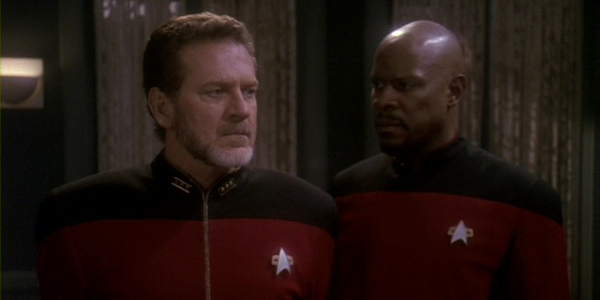
Summary: Sisko is recalled to Earth after a terrorist bombing reveals that the Changelings have reached Earth. Odo accompanies him to help Starfleet security beef up their anti-Changeling security measures. When the global power grid goes down, all evidence points to Changeling sabotage, and the Federation Presidents declares a state of emergency. Fearing an all-out Dominion assault, Sisko recommends that the President tighten security measures. The President does, and Starfleet troops are deployed across the planet. However, Sisko begins to suspect that the power outage wasn't Changeling sabotage at all, but the work of a militant faction of Starfleet that wants to overthrow the civilian government and install a military dictatorship. Why It's Great: The threat of Changeling infiltration is a storyline that continues to resonate, perhaps even more relevant today than when Deep Space Nine first aired. What's great about these two episodes, however, is not that it dramatizes the threat of an enemy that could blend in to any environment in an instant, but that it identifies our fear of that threat as an even greater enemy. As a Changeling posing as O'Brien tells Captain Sisko on Earth, "In the end, it's your fear that will destroy you." In the end, Sisko talks the conspirators down and proves the Changeling wrong, but the fact that what the Changeling predicted came so close to happening is as frightening as the threat of the Dominion itself.

7. "The Way Of The Warrior" (Season 4)
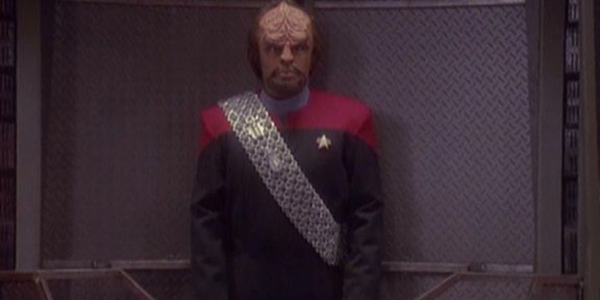
Summary: The station is swarming with Klingons who have arrived to help Starfleet fight the Dominion, but they have been causing trouble, searching ships without warrants and roughing up the station's Cardassian tailor, Garak. Sisko calls in the one Starfleet officer with the most experience dealing with the Klingons €“ Star Trek: The Next Generation's Worf. Worf learns that the Klingon fleet is about to attack Cardassia, having been convinced that the Cardassian government has been taken over by Changelings, despite their being no evidence. The Defiant manages to sneak into Cardassian space and beam aboard the civilian government before the Klingon fleet can get to them. They return to Deep Space Nine and are soon followed by the Klingon Fleet. When Sisko refuses to give up the Cardassians, the Klingons open fire on the station. After a battle with heavy losses on both sides, Starfleet reinforcements arrive and the Klingons retreat. They will not, however, retreat from Cardassian space, and they have pulled out of the Khitomer Accords, their long-standing peace agreement with the Federation. Worf agrees to stay on Deep Space Nine to help deal with the new Klingon threat in the sector. Why It's Great: "The Way of the Warrior" features the biggest action set pieces ever to be depicted on Deep Space Nine up to that point, but even these scenes were removed, it would be notable for one thing: bringing Worf into the fold. As the gruff Klingon Security Chief Worf, Michael Dorn was a strong member of the ensemble on Star Trek: The Next Generation, but on Star Trek: Deep Space Nine, his character really came into his own. It's evident from their very first scenes together that Dorn had strong chemistry with Terry Farrell, which the writers did not anticipate, but would use to their full advantage as the series progressed.

6. "Rocks And Shoals" (Season 6)

Summary: Sisko and his crew crash land their stolen Jem'Hadar ship on an alien planet, and soon discover that a group of Jem'Hadar has also crash landed there and only have one vial of ketracel-white (a narcotic that turns them into fiercely loyal warriors, but will put them in rage-inducing withdrawals if they don't get their daily dose). At the same time as this conflict is unfolding, Kira works side-by-side with the Dominion on the station, and finds she can no longer lead her life as a collaborator. Why It's Great: The first six episodes of the sixth season of Deep Space Nine told a tightly serialized arc, which was a narrative experiment for the Star Trek franchise, but one that would pay off in dividends. By my estimation, at least four of these episodes are among the best the series ever made, but the best of the bunch is "Rocks and Shoals." Phillip Morris may be best known for his work as Jackie Chiles on Seinfeld, but in his role as the Jem'Hadar leader, Remata'Klan, he shows that his dramatic chops are just as excellent. His performance, along with the stark cinematography of the bleak rock quarry location, make the Jem'Hadar's final suicide attack one of the most memorable €“ and tragic €“ sequences in the series. The most powerful moment in the episode, however, comes from Kira's storyline aboard the station, when her complacency is interrupted by the public suicide of a Bajoran Vedek, who hangs herself in front of Kira and dozens of others on the Promenade. It remains a truly shocking moment.

5. "Call To Arms" (Season 5)

Summary: The episode opens with the revelation that the Romulans have signed a non-aggression pact with the Dominion, which leads Starfleet to order Sisko to stop further Dominion reinforcements from reaching Cardassia by blocking the entrance to the wormhole with a minefield. To keep Bajor from being ravaged by another war, Sisko endorses a non-aggression pact offered to the Bajor by the Dominion. As the Dominion fleet approaches, Sisko orders an emergency evacuation of the station. Klingon forces remain to defend the position until the Defiant can finish laying the minefield. When it is finally completed, Sisko and the Klingons flee, and Kira welcomes the Dominion and Cardassians aboard Deep Space Nine. Shortly thereafter, Sisko learns that his son Jake has elected to stay aboard the station and cover the war for the Federation news service. He's enraged, but he can't go back for one man, even if he is his son. Having reclaimed his old office, Gul Dukat notices that Sisko left his baseball behind €“ a promise that he will return. As the episode ends, the Defiant joins a massive force of Starfleet vessels. The Dominion War has begun. Why It's Great: The Dominion threat had been brewing since the end of the second season, and "A Call To Arms" finally makes good on that promise, beginning the series' strongest arc, which would be carried through to the series finale. Any number of moments in the episode €“ Sisko leaving his baseball, Kira insincere welcome to the Dominion forces aboard the station, the image of the Defiant joining a larger force of Starfleet vessels than we had ever seen, the revelation that the Romulans have opted out of the brewing conflict €“ would make it a memorable installment. Combined, they make it one of the best of the series. The cliffhanger, which involves Captain Sisko losing Deep Space Nine, the show's namesake, is the best dramatic hook the show ever offered (and that's saying something).

4. "Trials and Tribble-ations" (Season 5)

Summary: On board the station, Captain Sisko is being questioned by two agents from the Department of Temporal Investigations. The Defiant was recently sent back in time by a Klingon posing as a human merchant, who sent the vessel back to Deep Space Station K-7 to relive the events of the original series episode, "The Trouble with Tribbles." There's only one minor variation €“ Darvin intends to assassinate Captain James T. Kirk €“ and the crew of the Defiant goes undercover about the station (and the Enterprise) to stop him. Why It's Great: The most expensive episode of the entire fifth season is also a loving tribute to the original series, all the way down to the blinking lights on the Enterprise bridge (which were meticulously studied frame by frame to get them exact). For the thirtieth anniversary of the premiere of Star Trek on NBC (September 8, 1966) the producers of Star Trek: Deep Space Nine came up with an ingenious way to honor the long history of the franchise. Why not use new digital technology €“ recently demonstrated by the movie Forrest Gump (1994) €“ to insert Sisko and company into an episode of the original series? When it came down to picking the episode that would be seen by the Deep Space Nine crew, there was really only one candidate €“ "The Trouble with Tribbles," a fan favorite, which also had the lighter tone appropriate for the occasion. It would be impossible for fans of the original series not to smile as O'Brien and Bashir stand in the line-up in front of Kirk after the bar fight, or as Sisko and Dax pelt tribbles onto Kirk from the storage unit above, but perhaps the most amusing moment comes when an embarrassed Worf confesses about the Klingons different appearance in the mid-23rd century, "It is a long story. We do not discuss it with outsiders."

3. "Duet" (Season 1)

Summary: When a Cardassian man arrives on Deep Space Nine suffering from an illness he could have only contracted at a Bajoran labor camp during the Occupation, Major Kira Nerys spearheads an investigation to determine if he is a notorious war criminal responsible for the deaths of countless Bajorans. Why It's Great: It's a testament to the quality of the writing, acting, and directing on Star Trek: Deep Space Nine that an episode like "Duet" works at all. After all, the production didn't set out to make one of the best episodes of the series or to provide Nana Visitor with an episode that defined an already well-written character €“ they set out to balance the season's bloated production budget. Because episodes like "Emissary" and "The Storyteller" had cost more than planned, the series needed an episode that could be shot on standing sets with a minimum of guest stars and as few visual effects as possible. The result was "Duet," an episode which takes place almost exclusively in one room, has only two major characters, and contains almost no action. And yet, "Duet" is easily the most compelling episode of the show's entire first season. Most of the episode is spent between Kira and the Cardassian, in a holding cell, as the two play a game of verbal cat and mouse trying to determine the Cardassian's identity, which, in the end, transforms Kira's viewpoint of Cardassians and forces her to confront her own prejudices. It's not just a great episode of Star Trek: Deep Space Nine €“ it's a great episode of Star Trek, period.

2. "Far Beyond The Stars" (Season 6)

Summary: In a decidedly off-format episode, Sisko experiences a vision from the prophets, which recasts him as Benny Russell, a science fiction writer in the 1950s, who struggles with civil rights and inequality as he writes the story of Captain Benjamin Sisko, a black commander of a futuristic space station known as Deep Space Nine. Why It's Great: Star Trek: Deep Space Nine is still the only Star Trek television series with a non-white lead. In the 1990s, it was one of only a few shows on television starring a black man. For the most part, this was unremarked upon, a silent but important truth, and one that Avery Brooks has said convinced him to stick with the series early on, when the writers were still trying to figure out the character of Sisko. "Far Beyond the Stars," however, deals with race head on by recasting Brooks as Benny Russell, a science fiction writer living New York in 1953. In various roles, and out of make-up, the rest of the cast appears as different characters as well, many of them Russell's co-workers at a science fiction pulp magazine. When the magazine does their annual staff photograph, Russell (as well as Kay Eaton, who writes under the gender-neutral pseudonym "K.C. Hunter") are gently reminded to sleep in that day. You see, the readers don't know that the magazine has black and women writers, and the editor would like to keep it that way. In lesser hands, this episode could become a polemic, or a two-dimensional melodrama, but in the hands of writers Ira Steven Behr, Hans Beimler, and Marc Scott Zicree, not to mention Avery Brooks, who directed, it avoids those pitfalls and becomes something greater. The episode's final shot, in which Sisko sees Benny Russell as his reflection, marks the perfect ending to a terrific hour.

1. "In The Pale Moonlight" (Season 6)

Summary: Sisko is at his wit's end over the losses the Federation is taking to the Dominion. If something doesn't change soon, it's possible they could lose the war. When Betazed is invaded, Sisko decides that it's up to him to bring about that change himself, and he enlists Garak to help persuade the Romulans to abandon their non-aggression pact with the Dominion and join the war on the Federation's side. He soon learns, however, that to accomplish his goal he'll have to abandon his Federation principals. Why It's Great: "In The Pale Moonlight" has been called the darkest episode of Star Trek ever produced. Maybe that's true, I don't really know. What I do know is that from top to bottom, it's a great episode of television. It's an essential part of the ongoing arc of the Dominion War. It allows Sisko to wrangle with a fantastic ethical dilemma (Is he willing to commit unjust actions to achieve his goal of bringing the Romulans into the war, which he views as both just and necessary?). And it's an actor's showcase for both Avery Brooks (as Sisko) and Andrew Robinson (as Garak), who have nothing but magnificent scenes together. From beginning to end it commands the audience's attention, and for my money, it's the best episode of Star Trek: Deep Space Nine. Were there great episodes of Star Trek: Deep Space Nine that we should have included on this list? Let us know what your favorite episodes of the series are in the comments section below.

Watch Next


Contributor
Contributor

Michael is one of the founders of FACT TREK (www.facttrek.com), a project dedicated to untangling 50+ years of mythology about the original Star Trek and its place in TV history. He currently is the Director of Sales and Digital Commerce at Shout! Factory, where he has worked since 2014. From 2013-2018, he ran the popular Star Trek Fact Check blog (www.startrekfactcheck.blogspot.com).