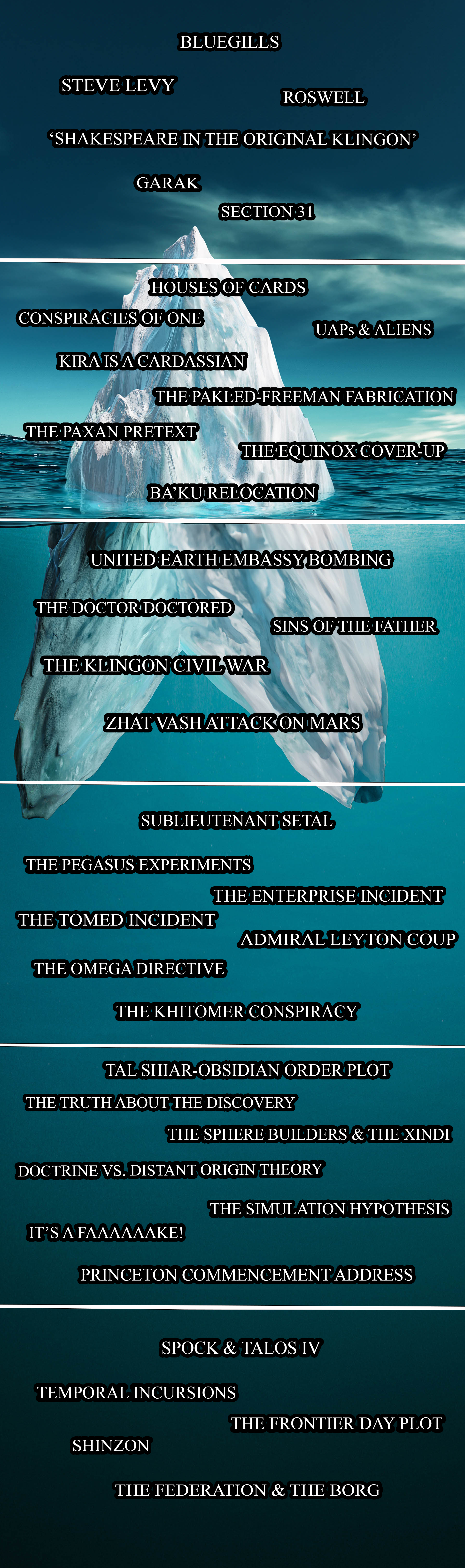
The Star Trek Conspiracy Iceberg Explained
1. TIER SIX
Spock & Talos IV
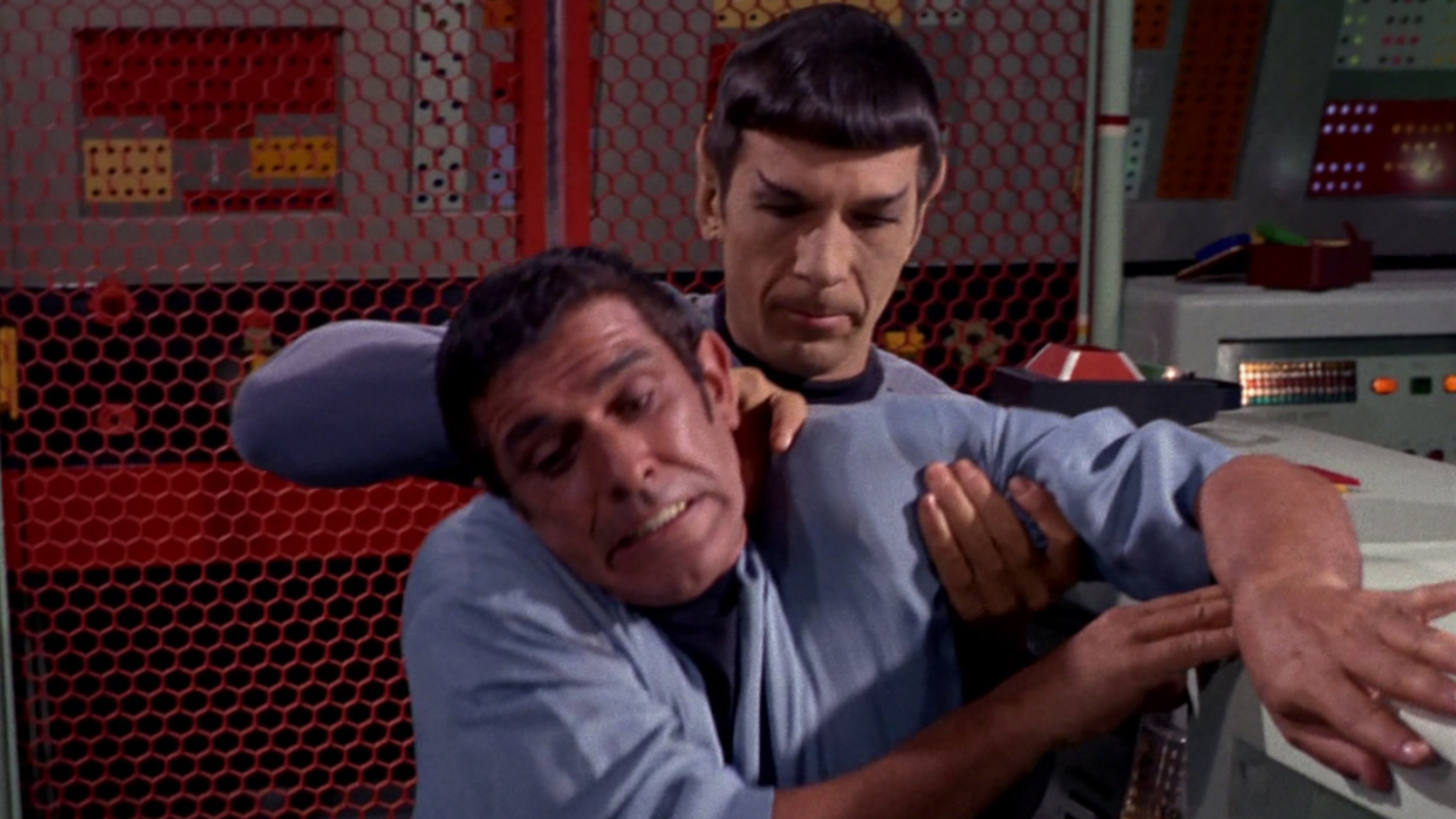
"No vessel under any condition, emergency or otherwise, is to visit Talos IV," stated Starfleet's General Order 7 in no uncertain terms. The (maximum) penalty for violating it, at least in the 2260s, was death. When Spock sought to return to the forbidden planet, you could add conspiracy to mutiny, and indeed mutiny, kidnapping, and theft of a starship, to the list of offences.
Before we judge the accused too harshly, a little historical context is required. Talos IV was so off-limits because of the extraordinary power of illusion of its inhabitants — too much of a temptation for ordinary humans. The Enterprise, under the command of Captain Pike, had found that out after being lured to Talos IV in 2254 in response to a faked distress call from the SS Columbia.
By 2266, that same power of illusion had become a measure of salvation for Captain Pike, brutally maimed by delta radiation whilst rescuing a group of cadets. For Pike, a return to Talos would at least mean the rest of a life lived as the mirage of his former self. Spock knew this. By then, he had served with Pike for eleven years, four months, and five days. Contacted by the Talosians, he didn't hesitate to put a plan in place.
In 2267, Spock fabricated a message to redirect the Enterprise to Pike's hospital facility at Starbase 11. From there, he plotted to commandeer the Enterprise, get Pike on board, and lock the ship's course onto Talos IV. Spock's 'trial' in the interim was all part of the ploy — a Talosian illusion (including the Commodore) — designed to buy time.
Temporal Incursions

Any act of time travel changes the timeline. The only question is to what degree, or to what 'incursion factor,' as measured by the sensors of the USS Relativity in the 29th century. Not all temporal incursions are conspiracies. Some are just ping-pong matches on the way to Captain Braxton. Others are simply historians, observing the past using the "proper procedures" laid out by the Temporal Accord(s).
During the Temporal Cold War, multiple factions plotted to violate those agreements, and to subvert the temporal agents whose job it was to uphold them. We've already mentioned the Sphere Builders further up the iceberg, but there were plenty more antagonists who sought to weaponise time.
"From day one," the Suliban cabal's mysterious benefactor from the 28th century — also known as the 'Humanoid Figure' or 'Future Guy' — had interfered with Captain Archer's mission. He attempted to incite civil war in the Klingon Empire, framed Enterprise for the Paraagan II disaster, and sent Silik to interfere and steal on his behalf. There is a theory that the 'humanoid figure' might have been a future version of Archer himself, using temporal incursions to try to correct history.
The most dangerous faction of the Temporal Cold War was the Na'kuhl, led by radical Vosk, violently opposed to the Temporal Accords. In the 29th century, Vosk and the Na'kuhl developed a form of stealth time travel, escaping the vigilance of the temporal agents to arrive on an alternate Earth of the 1940s. What was a cold war had become an all-out conflict, with multiple temporal incursions across the timeline. The death of Vosk and the destruction of his temporal conduit marked the end of the war. The timeline was reset.
Most recently, we found out that the Romulans had carried out temporal incursions to Earth's past in an attempt to delay human progress. In 2022, their agents notably destroyed Lake Ontario Bridge in Toronto with the use of photonic bombs. That was only the beginning. The primary target for Romulan agent Sera (an alias) was Khan Noonien Singh.
In the future, the Romulans had calculated that the Eugenics Wars were necessary for the Federation's existence (go figure!). Multiple temporal incursions — "whole Temporal Wars," in fact — had already been centred on Khan. As a result, the Eugenics Wars were delayed from their original start in 1992. Khan was still a child in 2022, held at Toronto's Noonien-Singh Institute for Cultural Advancement.
Sera was sent to kill the young Khan, at first by blowing up the nuclear fusion reactor in the same building. La'an Noonien-Singh, Khan's descendent, and an alternate James T. Kirk were sent back (somewhat haphazardly) by the Department of Temporal Investigations to stop her. They succeeded, at a cost.
In the 24th and 25th centuries, the Vau N'Akat used time travel as part of their plot to destroy Starfleet and the Federation. Also in the Delta Quadrant, Annorax of the Krenim built a gigantic weapon ship based on temporal science, using it to inflict temporal incursion after temporal incursion until Captain Janeway called time on his plans.
After the Temporal Wars, time travel was banned completely, as was inter-dimensional displacement. In the 32nd century, temporal devices such as the Krenim chronophage were still available illegally on the black market. Agent Daniels, or Doctor Kovich if you prefer, got a desk job. At least, so it would seem. Red is the new Omega Directive.
The Frontier Day Plot
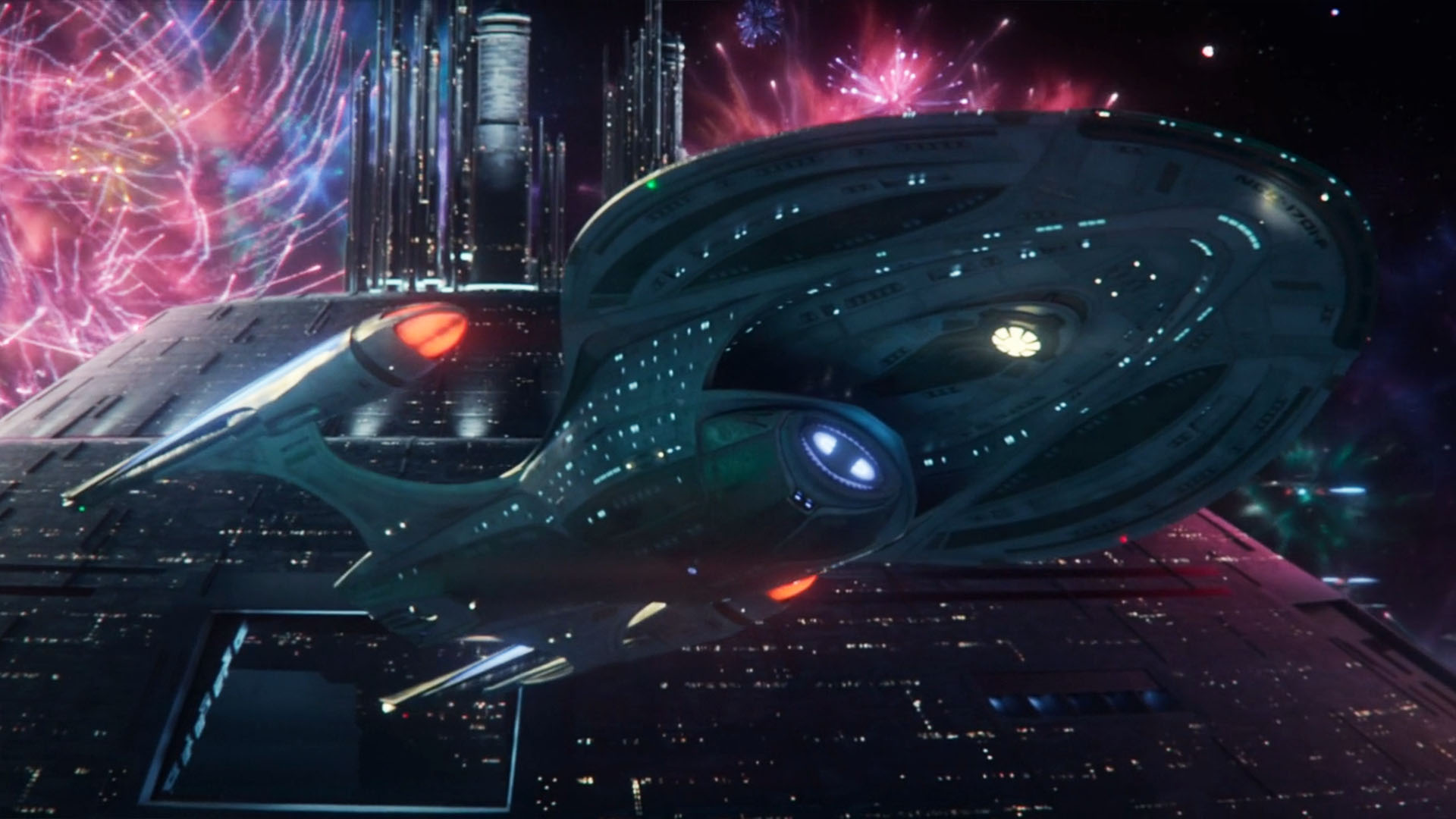
The dawn of the 25th century marked 250 years since the Enterprise NX-01 set out on its maiden voyage. Celebrations for 'Frontier Day' in April 2401 were planned to be big. Amidst the fireworks, Starfleet and the Federation faced one of the most elaborate, most destructive plots in its history. Were it not for the more "analogue," re-built Enterprise-D, the rest of that history would have been Borg!
The Federation was taken off-guard by the 'Frontier Day Plot'. But then few, if any, could have predicted a collaboration between a group of rogue changelings and the remnants of the Borg Collective. Both groups were out for vengeance, and not entirely without reason.
In 2378, the Collective had been decimated by the alternate Admiral Janeway's neurolytic pathogen — the rest left "to die by starvation and age". The changeling splinter faction was led by Vadic. She had been a subject of 'Project Proteus' — a series of brutal experiments carried out by Section 31 during the Dominion War. That's not to forget that Section 31 had conspired to commit genocide against the Founders.
By the time the changeling-Borg plans were uncovered, the mass infiltration of Starfleet had already happened. Vadic's faction had placed itself just about everywhere, modifying transporter systems across the fleet to insert Borg DNA into everyone who stepped through. That DNA — a remnant of Locutus — was taken from the former body of Jean-Luc-Picard, stored at Daystrom Station.
All that remained was to let Vox, formerly Jack Crusher, speak — to send out a signal to activate the newest, youngest members of the Borg Collective. The D flew in to the Borg Queen's cube at Jupiter and saved the (Frontier) day.
Shinzon
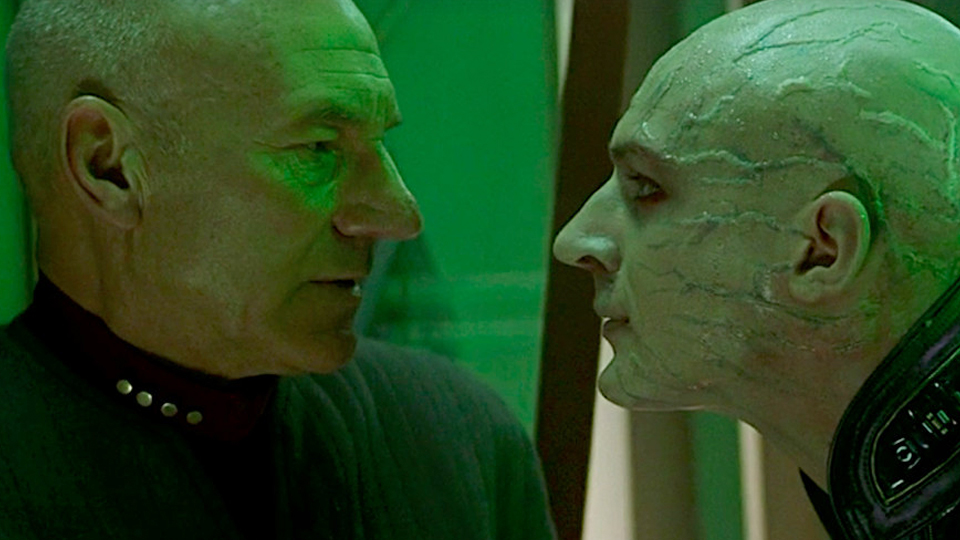
As the 2370s came to a close, there was a brutal change in power on Romulus. Shinzon of Remus had conspired with elements of the Romulan military, and at least one Romulan senator, to overthrow the Romulan government. His coup d'état by thalaron radiation succeeded. He then set a trap for the Enterprise, for his genetic double Jean-Luc Picard, 'inviting' ship and crew to Romulus. Shinzon's ultimate plan was galactic domination, including the genocide of Earth's population along the way.
Why clone Picard, specifically Picard, in the first place, you might ask? By all estimations and calculations, Shinzon must have been 'made' at some point in the 2350s, most likely either in or around 2354. (You can check out the maths in TrekCulture's previous video on this theory.) The dates do fit with a change in government mentioned by Admiral Jarok, already featured above.
By 2354, Picard was in command of the Stargazer, and had been for quite some time. He was clearly a brilliant officer, but the Stargazer was hardly the flagship of the fleet. In Picard's own words, it was an "overworked, underpowered vessel, always on the verge of flying apart at the seams".
It seems more than odd, therefore, that the Romulans would have chosen this particular captain for their infiltration by replacement plot. That is unless you factor in knowledge of Picard's future importance — knowledge the Romulans could have obtained from the alternate Natasha Yar, taken prisoner at the battle of Narendra III.
And so we reach our final entry in the iceberg's dark abyss…
The Federation & The Borg
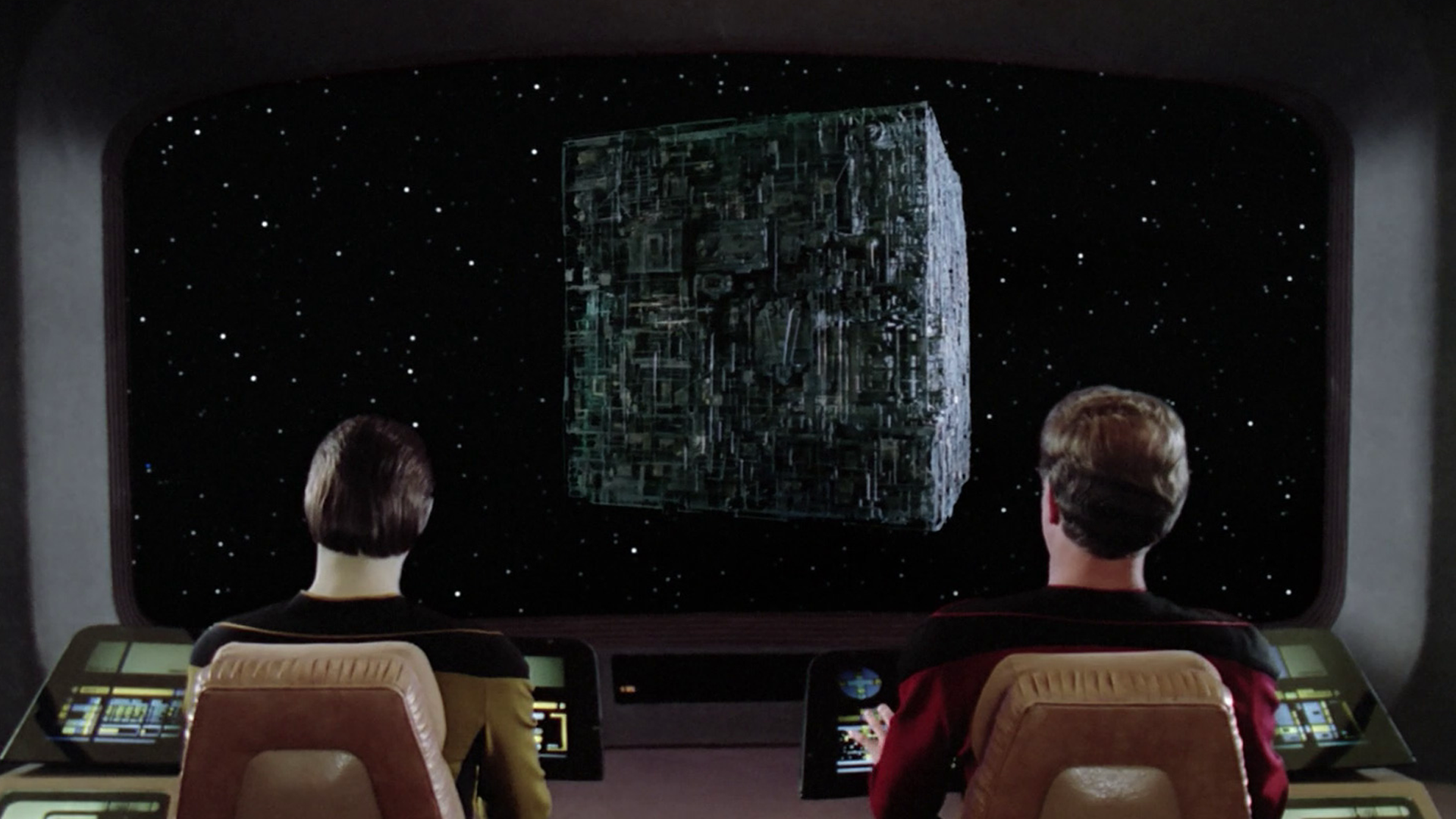
"They're called the Borg," said Guinan to Captain Picard in 2365. Q had flung the Enterprise into the path of a cube some seven thousand light years away. Ship and crew (save for the El-Aurian) were completely ignorant of this new species. And yet, Starfleet were evidently already well aware of the Borg.
In 2347, Magnus and Erin Hansen had set out on a research mission to study the Borg (by name) — a mission at first supported by the Federation Council on Exobiology. Though the Hansens were acting on relatively sparse information, they clearly knew what they were looking for. All the way back in 2293, the Enterprise-B had rescued a group of El-Aurian survivors (including Guinan) of the Borg attack on their homeworld.
That is, of course, not to forget the NX-01 encounter in 2153. Neither Captain Archer nor crew nor anyone in the Arctic ever got a name for the cybernetic lifeforms. They did get a very close look at several drones, the assimilation process, and debris of a Borg sphere. Did all the detailed scans just disappear along with knowledge of the message to the Delta Quadrant? Zefram Cochrane did try to warn everyone!
Even excluding events of the 22nd century, it seems practically impossible, therefore, that, by 2365, Picard had never heard of the Borg. That is unless all knowledge was deliberately hidden from him. Therein lies a conspiracy theory of our very own. "In a way, the Federation owes its existence to the Borg," as Lieutenant Ducane of the USS Relativity put it. Allow us to explain…
The birth of the Federation actually relies on a Pogo Paradox — "a causality loop in which interference to prevent an event actually triggers the same event," to quote Seven of Nine aboard the Relativity. The Borg once travelled back in time to prevent Cochrane's first warp flight. However, that led the Enterprise-E to travel back in time to stop the Borg. The crew of the Enterprise then actively aided Cochrane in breaking the warp barrier, achieving the very thing the Borg had tried to stop. "Causal loop complete."
There is a startling extension to Ducane and Seven's logic, however. Though initially kept away, it was Picard's personal knowledge of the Collective that allowed the destruction of the Borg Cube at the Battle of Sector 001 in 2373. That in turn led directly to the release of the Borg sphere, to time travel, to Cochrane. In other words, Picard also had to become Locutus for the Federation to exist.
So, if Picard and crew weren't aware of the Borg in 2365, it was quite simply because they weren't aware of them in the first place. That is the paradox, the loop of events, which had to be preserved at all costs, even at the cost of lives, at the cost of lies. History — at least galactic history that involved Starfleet and the Federation — would come unravelled without it. Let's not forget that the end of the Borg Collective was equally tied to Locutus', to Picard's, altered DNA. Ducane can't have been the only one to connect the dots. Other temporal agents and agencies must have been watching, maintaining.
Like any conspiracy, it's a house of cards. But then, like any Star Trek, it's also all made up.