The Walking Dead: 7 Scenes That Were Too Extreme For TV

The Walking Dead is a painfully disgusting show. Each episode is packed with enough to shotgun-wielding, sword-swinging, zombie-smashing violence to make even John Rambo blush. The AMC horror drama has most certainly secured its place in history, featuring what has to be the most disembowelments and amputations in television history. Rick Grimes and co. have drawn the ire of undead hoards, the psychopathic Governor, and perhaps their most fearsome foe of all the Parents Television Council!
Basically, its awesome.
For all of the anti-gore criticism the show has faced, which is A LOT, the scripts are tame compared to Robert Kirkmans comic book narratives-turned-nightmares. Today, well take a look at seven of the most extreme scenes in Walking Dead history all of which were scrapped before TV scripting.
For the sake of keeping with television continuity, weve only included comic moments up through about where season 3 ends; or, till around the fall of Woodbury.
WARNING: Some of the things in this article are gross. Also, though these moments havent happened on the show, that doesnt mean they wont happen at some point. No complaining about spoilers. Read at your own risk.
7. Chris & Julies Botched Suicide Pact (Vol. #3: Safety Behind Bars)
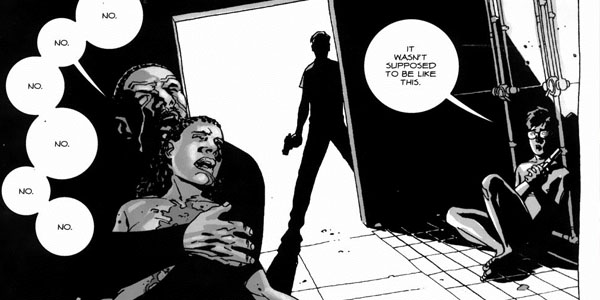
BLAM!
The residents of West Georgia Correctional Facility (or, The Prison) woke with a start. In the world of the Walking Dead, a single shot is more ominous than a multitude.
Officer Rick Grimes, our hero, rushed to the sound of the gunshot. Hed already been beat to the scene by Tyreese, father of the now deceased Julie, who was victim of a badly botched suicide pact with her teenage boyfriend, Chris. This pair of star-crossed lovers had been plotting to take their own lives around the start of their introduction in Miles Behind Us, the second story arc in the series. Unfortunately for Tyreese and the survivors, they hid their plan well enough to execute it almost.
In a fit of rage, Tyreese consummated Chris and Julies original plan, strangling a despondent Chris under heavy sighs of together forever.
For those unfamiliar with the books, this scenes brutality is underscored by a significant revelation: the dead return to life even if zombies havent bitten them. As Tyreese cradles his daughter, pleading for her to return to him, she becomes a Walker. Careful what you wish for.
Regrettably, this scene is also the first in a series of adolescent deaths representing the loss of innocence and romanticism in post-apocalyptic Georgia.
6. The Beheading of Tyreese (Vol. #8: Made to Suffer)

Robert Kirkman really piled it on poor Tyreese, didnt he?
Woodburys first assault on West Georgia Correctional Facility proved amateurish, foolhardy, and fatal. Though they were unable to penetrate the prisons fences, the Governors men managed to injure Rick Grimes, but at a significant loss of manpower.
While both groups looked to retreat and regroup, sword-wielding Michonne managed to convince her then-boyfriend Tyreese to accompany her on a stealth mission behind enemy lines. Her message was simple: hit Woodbury forces while theyre on the run, hit em hard, and dont look back.
At the last minute, Tyreese confessed his doubt about the soundness of the mission. Michonne, doing her best Lady Macbeth, challenged Tyreese to be bloody, bold, and resolute, If we only kill two of them this was worth it. Reluctantly, Tyreese agreed.
Michonnes words proved prophetic. The two of them managed to kill exactly two of the Governors men before Tyreese was captured and Michonne forced to flee without her trademark blade.
Seizing what seemed like a golden opportunity, the Governor and his force returned to the prison intending to use Tyreese as a bargaining chip against Rick and the remaining survivors. The negotiation period was curt, and, unfortunately for Tyreese, he was on the losing end of a utilitarian experiment; the greatest good came from protecting the prison, regardless of the consequences.
In one of the most graphic comic displays since Alan Moores From Hell, the Governor incrementally separates Tyreese from himself while the survivors watch in horror.
5. Carol Commits Suicide By Zombie (Vol. #7: The Calm Before)
I really hope you like me.
The transition from comic book to television show isnt always easy; in fact, its historically been pretty awful outside of animated programming. Anyone remember the Flash television series that ran one season from 1990-1991? Didnt think so. One of the ways the Walking Dead has managed to succeed where others have failed is by tweaking characters to maximize their on-camera potential (e.g., the expansion of Shane).
Carol Peletier is not one of those characters.
The mercurial Carol we met in issue #3 is far-removed from the sterile, at times catatonic Carol of the hit television show. Of course, Comic Book Carol (CBC) also didnt watch her husband and daughter both die, and she certainly never developed into the physical force capable of protecting the camp, which did happened in this past season.
From her introduction in Days Gone By until her passing in The Calm Before, CBC was vocal about her fear of being alone. Her relationship with Tyreese quelled that fear briefly, but the honeymoon period didnt last much further than their groups arrival at The Prison.
CBC was an emotional wreck after the split, resorting to self-harm before seeking confidence in Lori Grimes while their children, Sophia and Carl, played around various parts of The Prison. As her fears of fatalistic solitude increased, so did her emotional reliance on Lori and her husband.
Tensions built around the group. The new world theyd inherited had brought new problems, but few solutions. As the group deliberated about adjusting laws to reflect their present situation, CBC made an ill-timed proposition: polygamous relationships should be socially acceptable, starting with her inclusion in Rick and Loris marriage. Lori rejected her declaration harshly, spiraling CBC into her greatest depression yet.
After making her piece with Lori, and having one last fling with a willing teenage boy, CBC made her way down to the prisons main courtyard. The survivors had kept a zombie restrained there for a few days, hoping to study it for scientific purposes, though not without much internal debate. Even Ricks calculated caution hadnt planned for a potential suicide by zombie.
CBC rambled desperately during her approach. Tired of judgmental eyes, tired of whispers about her self-inflicted cuts and unconventional intimate fantasies, just plain tired; CBC viewed the zombies cold gaze as a reprieve from judgment, from bias, declaring, I hope you like me, before allowing the creature to feast on her.
The group arrived quickly, though they were too late to save her. Theyd always been too late.
4. Andrea & Dale Hook Up (Vol. #2: Miles Behind Us)

Okay, I think we need a bit of a reprieve from the macabre, dont you?
One of the funniest, most compelling pairings in the hook-up filled landscape of the Walking Dead was the relationship between Andrea and Dale. Despite an overwhelming age gap, somewhere in the neighborhood of forty years, the two remained intensely loyal in the face of their volatile cohort.
Members of the group speculated about the relationship as early as the first arc, though it wasnt confirmed until the second arc, Miles Behind Us, when Donna accidentally walked in on them mid-act.
Conflicting reports from the writers room down to the set have presented themselves about the use (or misuse) of Dale's character. Whether planned or forced by unknown circumstances, the show built something of an antagonistic relationship around Andrea and Dale, with Dale taking the role of a cautioning father figure to Andreas rebellious, independent daughter.
For me, this take was especially confusing because: A) Dale already played that role for Glenn, Rick, and several other characters, and B) the age difference between Andrea and Dale had been cut in half for the television series. Wouldn't it have made more sense to play that pseudo-paternalistic tension with the greater age difference?
I imagine it would have been quite a bit more difficult to pull off the depiction of an intimate relationship between a sixty-something-year-old man and a twenty-something-year-old woman without appearing creepy and somewhat exploitative, particularly when you cast age appropriate actors to actualize the script. While it would be less of a concern in the comic world, the potential alienation of viewership with Dale, the heart and soul of the series early run, could have been disastrous.
3. Thomas Richards Rampage (Vol. #3: Safety Behind Bars)

Ready to return to the world of all things awful?
In Safety Behind Bars, the inaccurately titled third story arc, the reader is introduced to West Georgia Correctional Facilitys last four remaining residents: Dexter, Andrew, Axel, and Thomas Richards.
Rick and his merry band of post-apocalyptic survivors approach the four former inmates with increasing suspicion, though both groups reach an agreement to split the prison and its supplies.
Of the four inmates, Thomas Richards is the only person who had been imprisoned for non-violent crimes, or so it was believed. His calm, passive demeanor allowed him to stalk the prison relatively unnoticed. With a few kind words, Thomas ingratiated himself with the survivors and separated himself from the other inmates very quickly.
Thomas was so good at playing the role of a meek white-collar criminal that he was able to effortlessly abduct and murder the Greene twins. His bloodlust continued with an attempt on Andrea's life, though she was able to get away with superficial wounds to the cheek and ear.
Thomas spree ended when Rick Grimes caught him in mid-pursuit of Andrea. Rick bloodied and battered Thomas, severely breaking his right hand in the process. The other survivors marveled at this showing of unrestrained brutality by one of their own, the first real incident of its kind.
Though Thomas was only around for about seven issues, the ramifications of his rampage were felt far into the eighth story arc, Made to Suffer. When it was time to decide what should be done with Thomas, the group split on the issue of punishment. Ultimately, it was Rick that declared the prison a dictatorship with only one rule: you kill, you die.
The survivors had seen their fair share of violence and horror before, but theyd never been hit in a safe place like that, and theyd never experienced the kind of evil that only a human can inflict. Thomas rampage portended the future of the franchise; the real horror isnt zombies, its other people.
2. The Death of Baby Judith (Vol. #8: Made to Suffer)

Shes lucky. Shes going to think everything is normal. She wont know that everything is messed upor how things used to be.
Judith Grimes was the only person in the Walking Dead that was born after the apocalypse in both the comics and in the television series. As the title might imply, thats about all the two mediums have in common when concerning Judith.
There had been many deaths in the Walking Dead. Of them all, Judith was the youngest, the most surprising, and perhaps the most senseless. She was killed by accident, her mother hit by a shell that pierced through both of them while fleeing.
The shooter, a soldier in Woodburys army named Lilly Caul, had been mislead about the details of the mission to West Georgia Correctional Facility. When the gunfire broke out, she returned fire on anyone who wasnt from Woodbury, though she had no intention of killing Judith, and perhaps none of killing Lori, either.
The consequential nature of Judiths death is one of the most gut-punching, devastatingly realistic moments in the entire series. There was no intent, no reason. It was just another thing that happened. The grand horror of life is that, sometimes, things just happen and we are made to live with that reality, utterly powerless.
1. The Torture of Michonne (Vol. #5: The Best Defense)/The Governor Gets Mutilated (Vol. #6: This Sorrowful Life)

The top spot goes to two moments split in time, but intrinsically bound to one another by depravity, vengeance, and a makeshift torture chamber.
Woodbury soldiers captured a small group of The Prisons occupants as they attempted to investigate the crashing of a helicopter in the woods nearby. The soldiers brought Rick, Glenn, and Michonne back to Woodbury to be sacrificed to a horde of zombies in the name of sport and spectacle. It appeared the citizens of the city had developed a very warped sense of entertainment following the collapse of society.
The leader of Woodbury, known only as the Governor, believed that the survivors had a camp nearby, as theyd been captured while walking and were without many supplies. Determined to procure any possible resources, the Governor began an interrogation that quickly escalated to the severing of Ricks right hand. Glenn shrank into the corner while Michonne mounted a retaliatory act, biting off the Governors left ear.
What happens next is perhaps the single most grotesque act Ive ever seen in comic book history. The Governor has Michonne bound in what appears to be an abandoned garage. He proceeds to torture her in ways that, frankly, I feel wholly uncomfortable writing about.
Periods of torture are bookended by medical aid from a third party. The Governor reveals that he has no intentions of killing Michonne. His hope is that shell figure out a way to kill herself between one of his little sessions. A concession.
Eventually, Rick and Glenn are broken out of their separate confinement by a Woodbury defector named Martinez. They free Michonne, though she refuses to make an escape with the group, Ill catch up with you or I wont. I just cant leave without doing this.
There is a brief struggle in the Governors apartment. He wakes up a little bit later, bound and gagged at the scene of his most unspeakable crimes. Michonne narrates what the next few minutes will be like for him. A pair of pliers. A hammer. An acetylene torch. A spoon. A power drill. A sword. All of them will be used. There will be no concession.
The Walking Dead has been the subject of much criticism. Some viewers write off the boundless violence depicted on the show, as the most common recipient of it is a brainless monster, groaning and stumbling around some dark pit. Indeed, the furies that befall zombies are constant and grotesque, but the worst of all fates are reserved for and committed by human beings.
As the body count rises, as the actions intensify, we, the audience, continuously savor moments thick with retribution. We crave the flesh and blood that we are born of, just like those we hope to separate ourselves from most, of those we fear.
Dont you get it?
We are the walking dead.