Why Cobra Kai Is The TV Show You Need In Your Life Right Now
The Best Around.

This article contains spoilers for Cobra Kai season one.
The Karate Kid is a slice of Americana.
It captures the story of a down on his luck kid fulfilling the American dream for both himself and his expatriated karate sensei. It is corny, but then, so is the tapestry into which it is woven. A quintessentially 1980s film, all dates, babes, synths and fighting, there's a tremendous warmth, tragedy and pathos to it that elevates it into a timeless realm. It's also incredibly inspiring - so much so that even William Zabka, who played antagonist Johnny Lawrence, took up the martial art after filming.
The very last line is jarring and quite amusing. It's not entirely incongruous - Zabka registers his fright wonderfully, when Martin Kove's John Kreese instructs him to break Daniel LaRusso's leg in the final fight - but it is sudden. Lawrence grabs the trophy, hands it to the victor, and says "You're all right, LaRusso!"
This, after beating the sh*t out of the guy for about an hour and a half and trying to steal his girl. Credits roll. The awesomely histrionic fist-pump of "You're The Best" plays over them. It doesn't undercut the heft of the film, but it does bring into focus what outrageous wish fulfilment it is. The guy gets the girl, wins the fight, and you can rest assured, is never bullied again! It's the ultimate happy ending, and to underscore the genuine magic of the film, it is totally earned. Everybody watching, and those watches are probably in the double digits by now, wants to travel back to this more innocent time.
CONT'D...(1 of 6)
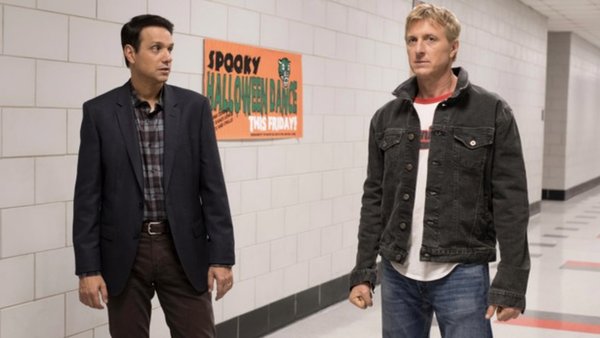
The Cobra Kai reboot recognises the ending and uses it to inform a show that has no goddamn right to be as fantastic as it is. The magic of the show means you can go back. Those times don't seem so unrecoverable in the hellscape viewed from every window on what has become of this planet.
And it has no right. Everything about the show feels so cynical. An upstart streaming service designed to extract yet more money where there was already so much seemed to wrap a blindfold around itself, turn around in circles, and point at whichever 1980s property hadn't yet been cannibalised before settling on the Karate Kid franchise. "Karate Kid?" as Monkey Tennis for lazy execs, basically. It felt, as these things so often do, like grim desperation: the death of originality slain by cynicism.
The plot is simple: Lawrence, drawn to LaRusso's fancy car dealership in his later years, is driven by his failures to reboot the Cobra Kai dojo in a bid to turn his life around. How that plot mutates into such layered and sophisticated drama is something else.
The Karate Kid isn't a particularly funny film, beyond Mr. Miyagi's delight at his own mischievous riddles. Its eternal magic lies in how earnest it is. Cobra Kai in contrast is genuinely hilarious. Johnny Lawrence, now a dual protagonist, is an almost unconscionably cruel sensei. He berates his students for their physical appearance and their pathetic mentality. A lot of kids get punched in the face and more get verbally incinerated. Undercutting the cheese the show otherwise embraces, the black comedy element provided by the revelation that is Zabka is sublime.
CONT'D...(2 of 6)

The nostalgia element is there, but it's not suffocating, nor does the show rely entirely on it. Crucially, it's unashamed. Lawrence, when an echo of the past is just about to reveal itself, wears a beaming smile before the cut. There's a meta quality to these transitions - he knows that we want to see his students decked out in the black and yellow - that also positions him as an audience surrogate, thus further connecting the character to them.
Cobra Kai balances comedy and drama, and nostalgia and depth perfectly, but it also achieves a far trickier feat - quite appropriately, thinking back on Miyagi's teachings.
The entire show is themed on balance, in what is its true thematic masterstroke. Cobra Kai takes the most obvious first pitch - Johnny and Daniel train young students to continue their rivalry into adulthood! - and subverts it magnificently. It's really about the balance in the lives of the characters.
Johnny Lawrence was a school bully who surveys his life, drinking from the bottle, in a state of remorse. The empathy that flickered in the closing shot of the Karate Kid is switched on fully when he sees the plight of bullied Miguel Diaz. They become better together - Johnny pities the bullied child, the bullied child learns not to take sh*t from people he shouldn't - but also worse. Miguel can't achieve the balance in his life because the teachings of Cobra Kai are outdated. Diaz and fellow student Hawk become too overpowered by their newfound strength and confidence in the end. History is cyclical in a devastating late-season blow the wry nods to the past foreshadowed so effectively.
This strive for balance is further thrown askew by the skilful plotting, all of which is driven organically by the motivations of characters with far greater depth than the archetypes of 1984.
CONT'D...(3 of 6)
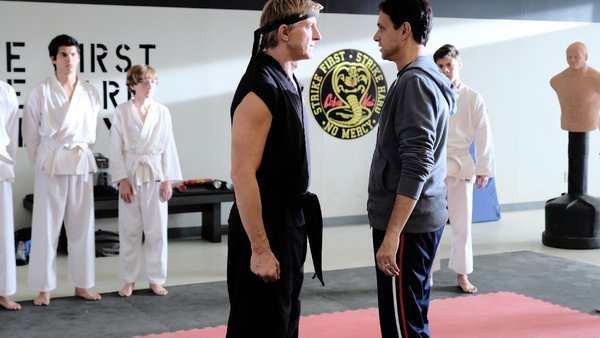
Johnny wants to be a better person, but he was once something worse than the rich kid who beat up the poor kid because he thought that's how it had to go in his formative years. He was a deadbeat dad. Everything you come to admire about his redemption story is brutally undermined by the spectre of his real son. You come to resent the good emerging from him because it is at the expense of Robby Keene.
In a magnificent twist that tears Johnny and Daniel apart - or delays their extended buddy movie - Keene comes to study under LaRusso to torment his father, or earn his approval. It's all out of order - Diaz is a LaRusso, Keene literally a Lawrence - but various dramatic permutations keep the characters from recognising this.
It bears a powerful anti-wealth message. There is balance between wealth and achievement. Deepening the heft of the characters, LaRusso at times walks beyond it. He is, fundamentally, a good man. He loves and wants to connect with his children. He is as warm and avuncular as his own surrogate father.
But the wealth he has created for himself comes with an attendant snobbery and spite.
CONT'D...(4 of 6)

He serves the most expensive fish even though he knows his daughter's teen boyfriend is hardly going to like it. He ruins the lives of business owners just to repay a petty old debt. But he is no villain just as Johnny is no villain.
And, just when the lesson is finally set to be learned, it isn't. Diaz only feels remorse after he injures Robby and after Sam has left the climactic tournament; Johnny and Daniel's past always comes back to inform their present; and, in the shocking twist that brings season one to a close, Johnny has just realised that the Cobra Kai philosophy needs to be updated for the present day when Kreese returns from his past.
You desperately want these good, flawed characters to connect. This is what will allow them to achieve that balance. This desperation you feel manifests as binge-worthy episodic TV that effortlessly strides between the feel-good and the dramatic.
As American TV shows go, Cobra Kai is in perfect balance itself.
CONT'D...(5 of 6)
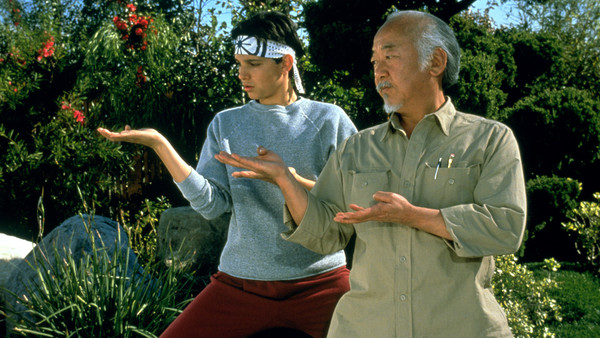
This is going to read as corny, but what better subject matter to warrant it: whether these connections are realised, in crisis, or elusive, they all form beautiful symbiotic relationships from which we can all learn something. When Johnny and Daniel quietly and tentatively rock out to REO Speedwagon, a sense of joy, even hope, radiates from the screen.
Even if it's just Hollywood bullsh*t, it's effective Hollywood bullsh*t. Cobra Kai isn't going to change a thing. It seems like nothing will. But, amid wave upon wave of trauma, little else is engineered so perfectly to enhance one's mood. In a world from which there is no escape, Cobra Kai allows it in 30 minute bursts of glow.
The Karate Kid felt even more corny, as the years wore on, because its unabashed hope receded further and further into view. It was almost an artefact.
Cobra Kai somehow contrives to restore it.