10 Crazy Things You’ll Find On WWE Network (If You Search Deep Enough)
The Bad, the Bad and the Ugly.

The Network is an odd and wonderful aberration in this era of WWE, which until very recently was unilaterally dictated by the whims of one spent force.
Unlike the television storylines, pushed projects, and excessive, draining PPV run-times of the mid-to-late 2010s, the Network stands alone as the one thing that benefits the fan more so than the company. As yet, not that it matters much in this age of exorbitant rights fees, WWE hasn't recouped the (not at all inconsiderable) revenue stream lost by dropping the traditional pay-per-view model. The Network has under-performed against initial projections, and WWE have reached a point at which they no longer report the subscriber count to investors in quarterly financial reports. This isn't a good omen.
WWE likely aren't thrilled, but the fans are: the Network is exceptional value for money, insofar as the relative cost of monthly pay-per-views, but its brilliance is genuinely profound. Its existence allowed hardcore fans to at last watch the Bret Hart Vs. Tom Magee Holy Grail, something, in another time, we'd have been lucky to wait 18 months to see on a three-disc DVD set or other. We can relive the glorious territory years through their own filter, and not merely a two-hour retrospective doc. We can also...
...see lots of deeply weird and ill-advised sh*t.
10. WWE Being Lazy, Hilarious

At Uncensored 1996, WCW gifted us the greatest best-worst professional wrestling match of all times, in which Hulk Hogan and Randy Savage took on eight (8) heels, all at once, a monstrosity of two factions incorporating Ric Flair and a jobbing actor named after the Nazi plan to exterminate the worldwide Jewish population.
In three cages.
With frying pans ultimately proving the most effective weapon.
It's the most harebrained piece of sh*t ever curled off by any wrestling booker ever. It's The Room of professional wrestling, and Lex Luger literally couldn't even get the "I did not him. I did naht," part right because he mistimes an accidental glove shot so awfully in Flair's direction that he actually appears to hit him on purpose. Even Hogan, who received a preposterous ego rub, was fed up with this world, and turned heel months later.
On the Network, in what might actually be a farcical meta joke in tribute, the thumb features said jobbing actor (later renamed the Ultimate Solution) in his guise as Bane from 1997's Batman and Robin, and if it's not in fact a joke, some staffer has flirted with a copyright strike because they couldn't bring themselves to watch the sh*tshow long enough to take a screen grab.
9. WWE Being Arrogant, Hilarious

Zack Sabre, Jr. participated in the (superb) Cruiserweight Classic of 2016, which apparently compelled WWE to throw his name all over the 2017 Royal Rumble promotional material...despite him having not signed for the company.
Sabre, Jr. elected not to sign with WWE full-time, and offered this explanation to the official New Japan Pro Wrestling website:
"It would be like asking a musician, 'Why didn’t you sign with the biggest record label?' I’m just concerned with being the best professional wrestler I can be. It was really just a personal choice. This is my path."
There's no way of determining quite how this (very minor) botch, seen on the TakeOver: San Antonio pre-show occurred, but it would be very WWE of WWE to simply assume they'd bagged their man by virtue of being WWE. At the time, it compelled some into believing that they'd ruined a surprise, but in reality, Sabre, Jr. elected to progress his career in east.
The staunchly liberal performer with a distinctive style probably didn't fancy being told how to work by Michael Hayes.
8. Something EVEN WORSE Than WCW In 2000

This one will take a concerted, term-specific search, because following last year's Network host provider switch, the glorious Hidden Gems section has been cruelly thrust deep into the unsearchable bowels of the system. It's still there, but for some unfathomable reason they want you to really look out for it.
"This" belongs in the bowels, at least, because it is unadulterated sh*t. Gloriously sh*t. "This" is the 1989 pilot for the AWA Team Challenge Series, launched just before the zombie promotion finally shuffled into oblivion. A desperate attempt to appeal to a WWF-adjacent audience, in a depressing subversion - the WWF years earlier was astute enough to recruit the AWA's key personnel to launch its expansion - the show was, mercifully, so legendarily sh*tty that you can't help but laugh at it.
Ageing promoter Verne Gagne introduces us to this hip new blend of rock, chicks, and wrestling by sitting in a park, with a dog on his lap, wearing a sweater and khakis. A guy who makes Todd Pettengill look like Atsushi Onita talks us through the upcoming events from a control centre before our first in-ring contest, to which Tommy Jammer enters flanked by green-screened fans. The match happens, it isn't much of anything, and the crowd thunderously responds to it nonetheless because their reactions are incongruously spliced in.
The Destruction Crew (Beverly Brothers) cut a promo in front of a green screen, before which they "attack" it with sledgehammers, as if they have in fact demolished the building that is so clearly an image. And then, because the principles that held up the old AWA are so boring and passé, and wrestling as people knew it is dead, some girls engage in boxing wearing lingerie.
Verne Gagne introduced this wearing a pair of khakis.
Magnificent.
7. The Work Of A Convicted Sexual Felon

"We must scrub every mention of Chris Benoit's name in every data field. He isn't to be timestamped in any way, shape or form. It goes without saying that users cannot search for his work."
"Completely understandable. What about incestuous paedophile Buck Zumhofe?"
"Well, he didn't garner us any negative mainstream attention."
That, quite obviously, is a joke, but it's stunning to discover that one can simply up and search Zumhofe's name and watch much of his body of work, as if he was only a territorial journeyman, and not a veritable monster. The ethics of a complete whitewash are debatable - then again, it's not as if the innocent parties would miss out on the royalties they don't receive for working Zumhofe on streamed transmissions - but the fact that his name can be searched, whereas Benoit's cannot, feels at least like a lazy omission/careless double standard.
Zumhofe is a convicted sexual felon. This isn't court-of-public-opinion cry-arsing. On a logistical basis, scrubbing his work from the Network would likely prove an expensive headache, but maybe...don't let people...actively appreciate the work of a genuinely evil man.
The Top Of The Pops reruns don't feature Jimmy Saville nor Gary Glitter because the life of a man who ruined others is not to be endorsed.
6. WWF Over The Edge 1999

This is beyond strange.
The abridged Over The Edge 1999, one would hope, is not streamable for the purpose of adding precious minutes to the time-watched metric touted to investors - but that does beg the question. For what purpose is the show streamable?
It is the show on which Owen Hart's tragic, preventable death occurred. It is the the show most if not all believe should have been cut short. It is the show that, watched at the time, became a grotesque and harrowing experience as we awaited an update on the situation. How could anybody possibly be entertained at a time like that? How could the crowd be sent home "happy"? Who wants to watch it now?
There is no value in even capturing the gravity of the tragedy for research purposes; every single passing and express mention of the Owen's death is edited out. With the exception of a memorial dedication graphic, the show is transmitted, as if it didn't even occur, "solely intended for the viewing pleasure" of either the sociopathic or morbidly curious.
It is an unfathomable, indefensible decision.
5. Crass Exploitation Of WWE Legends

'Legends House' was an optimistic pitch, in that it assembled various older WWE alumni in a Big Brother-type deal under the hope that the combative, charismatic personalities would converge to create some wholesome enough drama.
The reality was exponentially sadder, as became apparent in the first episode.
The producers engineered a bonding scenario, as these faux-reality types tend to do, by plying the stars with alcohol. This is timestamped on the Network as 'The Legends relax with some drinks'. Piper isn't among them. He had quit drinking and abusing substances in 2009, and, unable to cope with the temptation - "it clicks you back in" - leaves the house to wander the streets, and somewhat distressingly, howl at the moon. Worse, ominous synths and orchestral strings are played over the scene in post-production, to further engineer a narrative of his real distress. The show on which some whacky scenarios were to play out, perhaps an unscripted promo on a golf cart or two, soon degenerates into grim, sh*thouse theatre. Piper later told Sam Roberts at the premiere that he hated his experience. "I'm not sure I like myself," he says. Jesus Christ.
Piper wasn't a man without flaw, which we'll get to, but this was deeply exploitative.
4. Weird TNA Elements
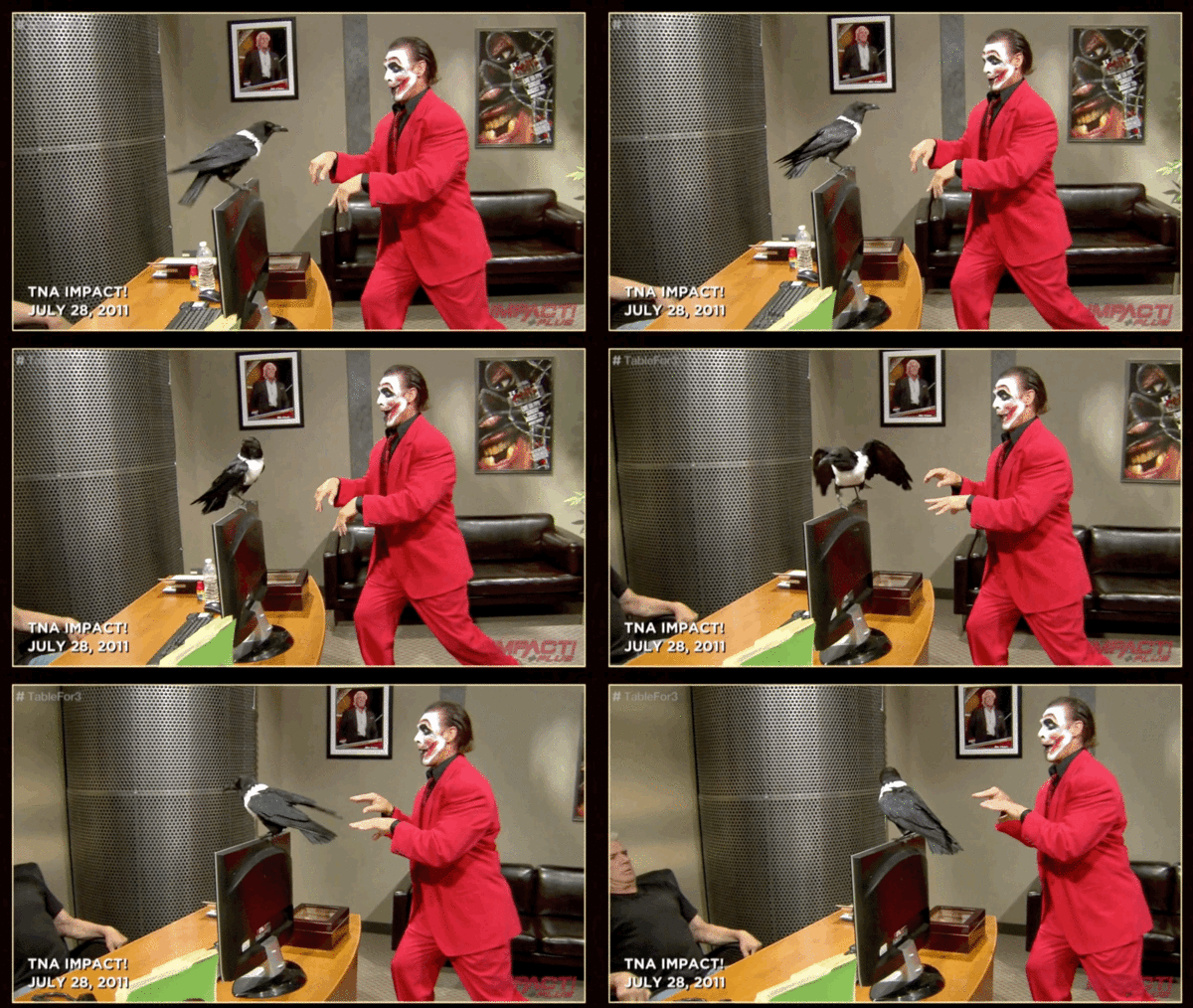
WWE and IMPACT! Wrestling do not share a working relationship, but for a presumed sweetener of a fee, the former TNA has allowed WWE use of its footage to flesh out the history of its old talent on Network specials.
On the recent Table For 3 featuring Sting, AJ Styles, and Jeff Jarrett, various footage is shown to complement stories that are told orally, and of course, while there are customary glimpses of the X Division's awesomeness, the Stinger is seen hamming it up as the Joker. He speaks very fondly of his time in the role, but it doesn't do much to present TNA, or Impact, as this great producer of future talent.
Moreover, searching for 'TNA' also reminds one of a bizarre, very minor period in WWE's history, in which, in an early harbinger of the company's later attempts to dominate all wrestling platforms, the dot com page for a brief time covered events outside of WWE in a weird bid to subsume online wrestling journalism. They don't want Dave Meltzer getting over, much less 70% of the talent warehoused in the Performance Center. Regrettably, there is no snarky editorialising, which may prove amusing. The information is disseminated succinctly, and pointlessly. If anything, mightn't this have alerted fans to the existence of new competition?
Actually, it is amusing that WWE was once more threatened by the existence of prowrestling.net than a corporation-backed promotion with household name talent.
3. Vince McMahon Casually Drops The N Bomb
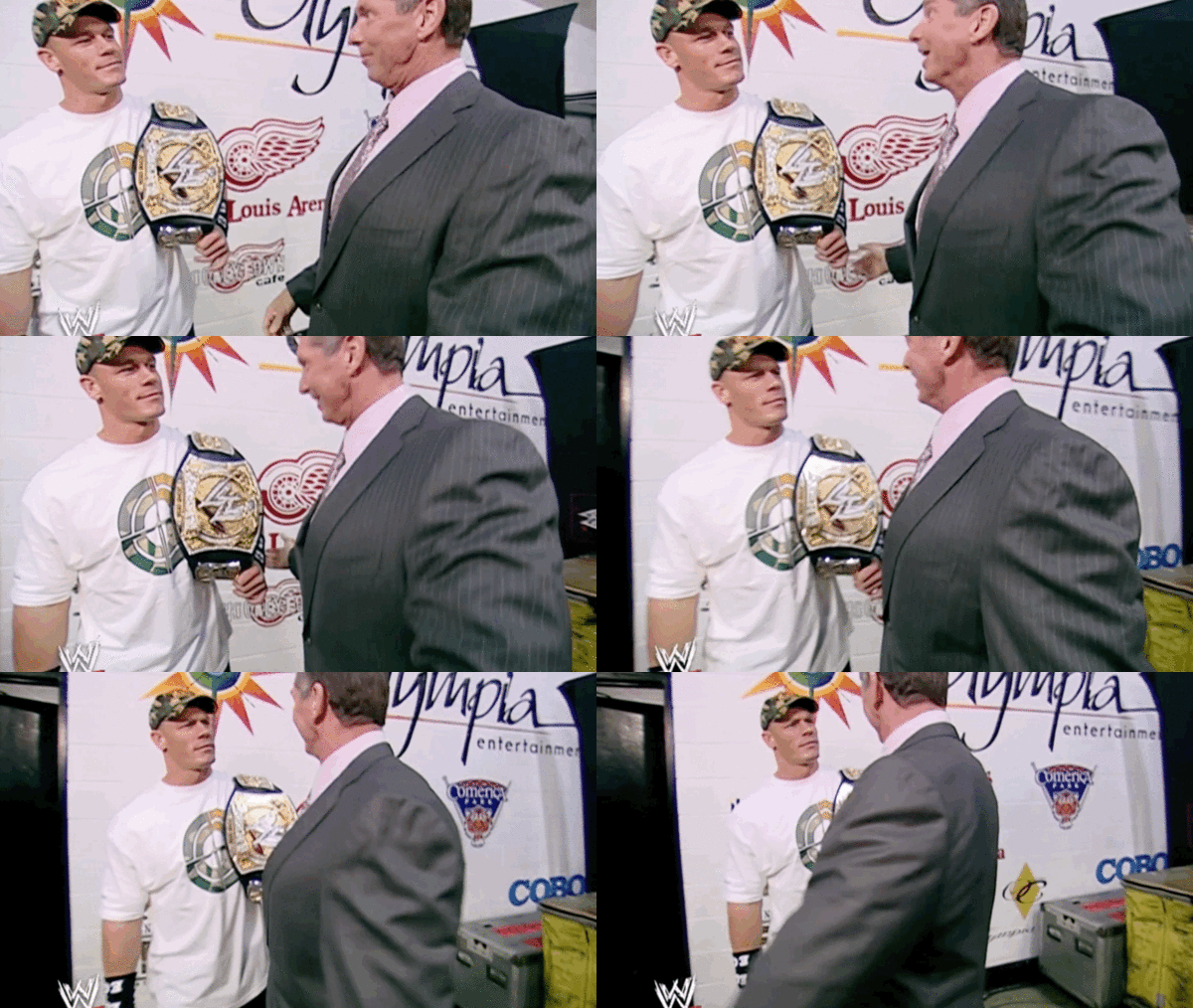
Though it wasn't much reflected in TV ratings and pay-per-view buys on a significant level, anecdotally, you may read that several fans point towards CM Punk's Pipebomb promo as their re-entry point into the world of pro wrestling.
They will have missed Vince McMahon casually dropping the 'N' bomb on pay-per-view.
He is such a strange paradox of a man. His admiration of Martin Luther King Jr. seems earnest enough - praising a recognised hero figure some 50+ years after his death is hardly an effective, cynical PR exercise, but then, he also dropped an 'N' bomb in front of Booker T as a joke. This is the same Booker T who had endured very real racism as part of an infamous 2003 storyline that both evidenced - and inexplicably reinforced - the company's institutional culture.
At Survivor Series 2005, McMahon caught up with John Cena backstage who had, it should be pointed out, more or less dropped the rapping elements of his promo style, and asked him "what's good in the hood". "Keep it up, ma *****," he says, which is revealed to be a joke when the camera pans to an annoyed, mystified Booker. The audio feed does not capture any laughter from the live crowd. This obviously isn't timestamped 'Vince McMahon calls John Cena the 'N' word. You'll find it under the chapter 'Mr. McMahon wishes Eric Bischoff good luck'. WWE responded years later to the furore to TMZ in its customarily quite funny way:
"[This was] an outlandish and satirical skit involving fictional characters, similar to that of many scripted television shows and movies."
Translated: Oh for f*ck's sake, everybody else does it!
2. Roddy Piper Cutting An Ill-Advised Promo
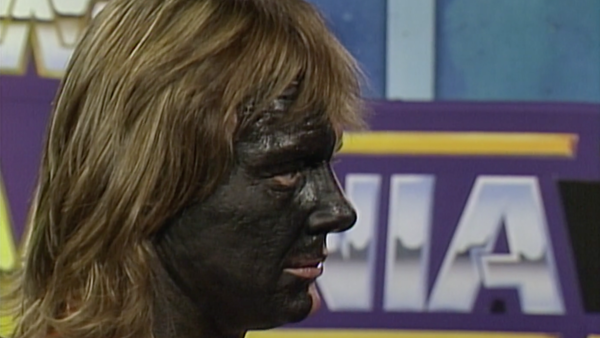
It's more crazy that whatever this was hasn't been scrubbed. It's crazy that Roddy Piper didn't scrub the grease paint before cutting this promo. Racism was a, sigh, tried-and-tested heel tactic in that era. Piper was the babyface.
Music rights?
Scrub, pal.
Purposeless racism?
Who cares, pal, it was the '80s!
You don't even have to search hard enough. In just a few clicks, at WrestleMania VI, you can see Roddy Piper standing sideways, so that he can reveal his f*cking blackface as a bit.
To wit:
Set-up: you can't see his face.
Punchline: he's black!
He proceeds to cut a promo at the expense of opponent Bad News Brown, a ring name he took rather too literally, and a close examination of the verbiage yields a troubling conclusion. Piper describes Brown's face, and the description is remarkably similar to a t-shirt that WWE somehow produced in 2019. Piper talks of Brown's "big bug eyes" and "schnozzola" with "dilating nostrils". He does well to call him "Son," and not "Boy," mind. Calm down, SJW police, it wasn't that bad!
If this is bad, but inconclusive, just wait until they upload Prime Time Wrestling from 1990. On the March 24, 1990 episode, Piper is worse; he mimics a stereotypical black voice and claims to be fighting on behalf of the black power movement.
1. That Which Is WCW Thunder In The Year 2000
That entry, on the AWA Team Challenge Series being even worse than WCW in 2000?
That is accurate, as it pertains to Nitro. WCW Thunder was the worst, most incomprehensible, most outrageously lazy milk-job of a rights fee any promotion ever had the gumption to produce. It is horrendously, hysterically bad. Deep into the year 2000, WCW, to which Thunder began as an inconvenience, dropped the pretence of creating a good TV show entirely.
Look at the state of some of the cards bearing the name. Shane Douglas headlined well past his prime. Scott Steiner battled three cruiserweights at once, just because. Gene Okerlund wrestled. Handicap tag matches were as prevalent as straight singles. Straight singles matches were the exception, and not the standard, under Vince Russo's "bro-bro-wrestling-is-boring-bro" mentality. It's a wonder the guy never popped a "sis," just for the swerve.
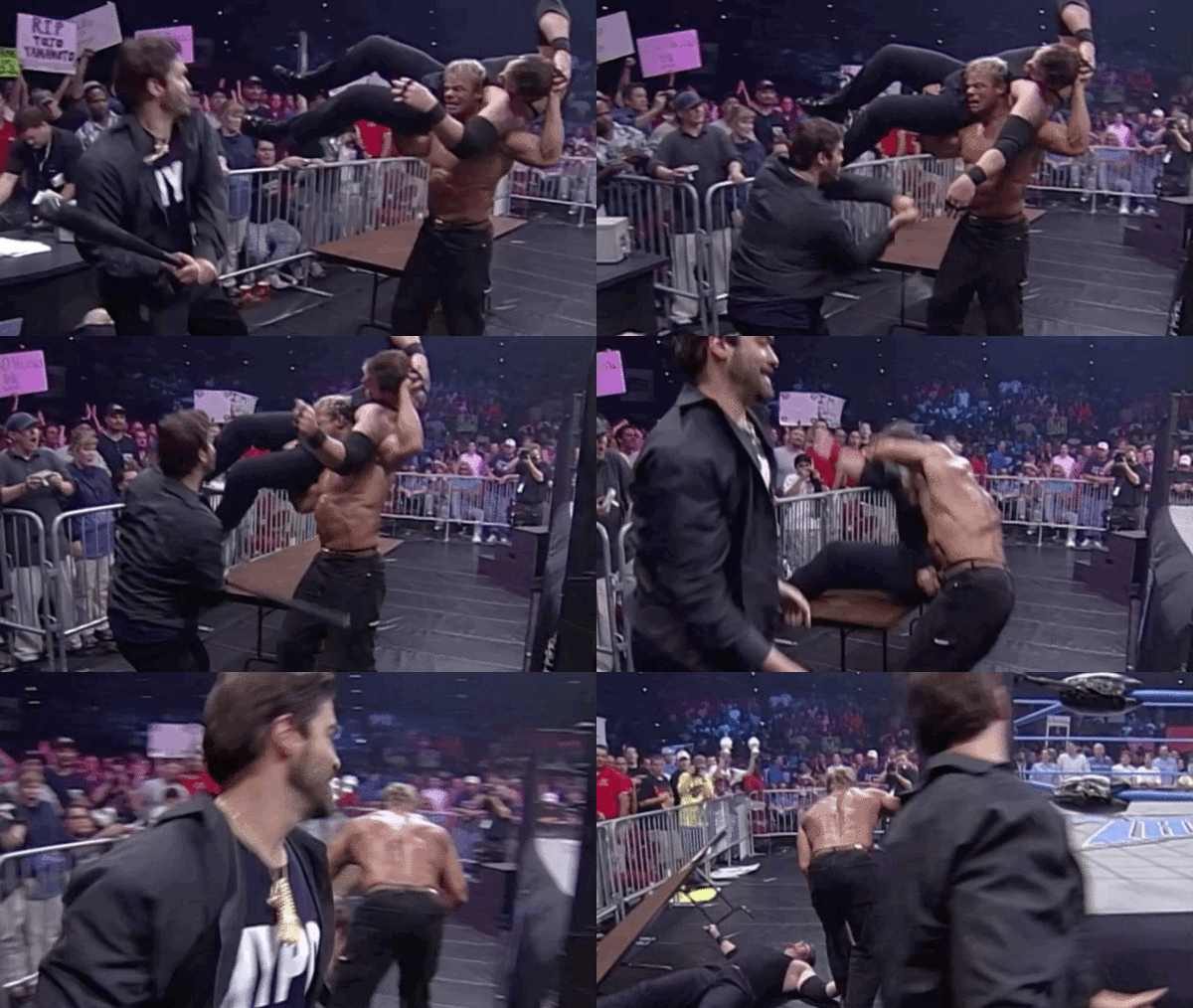
On the subject of Russo, on May 3, 2000, he presented arguably his greatest desecration of wrestling on one of its most hallowed grounds: the Mid-South Coliseum in Memphis Tennessee. Every match was fought under 'New York Rules', which, until they forgot what the stip was halfway through the show, saw matches held under no rules with no referees. The idea, perhaps, was to promote a series of contests so violent that they would endanger the officials. The Wall helpfully put this brutal premise over by gently landing leg-first through a table, thus securing Lex Luger the win, in a Tables match, on a show on which every match was to be a New York Rules match.
In another match - this is real - Kevin Nash declared Mike Awesome the winner of Ric Flair Vs. Billy Kidman via disqualification in a match with no rules.