10 Important Steps In The Undertaker's WWE Evolution

How the Deadman became The Phenom.

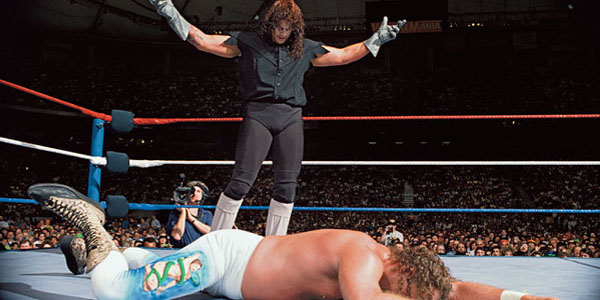
The Undertaker is the single greatest gimmick of all time, arguably the greatest Superstar of all time, and the most respected WWE Superstar of all time. Over the course of twenty four years, he has demonstrated unwavering loyalty to Vince McMahon and the WWE Universe, and has been more or less a main-event level Superstar since his debut. Few Superstars can really say that they have such magnitude for such a long time. So what is the Undertaker€™s secret? Simple: he evolved over time. It is said that the key to success in professional wrestling is to adapt to the ever-changing landscape that you find yourself in. This can often be very difficult, as the WWE has a very clear pecking order, and deeply-ingrained structures on what happens within the company and in the ring. And bad things happen to those who disturb that order. However, the Undertaker has managed to evolve significantly over the course of his career. Some of these changes were small, from a slight change in attire, to a considerable change in the quality of his matches. This article will look at ten significant steps that led to the evolution of the Undertaker. These steps will not necessarily be in chronological order, but instead will be ranked based on how significant they were in relation to the Undertaker€™s transformation over the years. So without further ado, let€™s begin.

10. Switching Managers From Brother Love To Paul Bearer
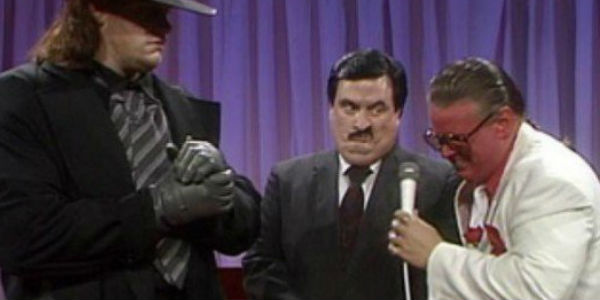
On November 22nd, 1990, the mysterious fourth man for Ted DiBiase€™s Million Dollar Team was revealed to be the Undertaker. He appeared as a tall, ominous-looking figure in grey and black clothes, dressed as a mortician. His face was pale and zombie-like to a degree€and he was led to the ring by his manager, the loud, red-faced preacher Brother Love. Despite being a heel manager (back when managers were actually important), Brother Love€™s character simply didn€™t mesh well with the Undertaker; he stood out so much that they might as well have been an apple and an orange. As a result, the first major change in the Undertaker€™s career was his change in managers, from Brother Love to Paul Bearer. It doesn€™t take a genius to see that the two of them meshed perfectly, with Bearer€™s ghoulish appearance and over-the-top voice and mannerisms complimenting the Undertaker€™s silence and mesmerizing gaze. It also helped that William Moody was a real life mortician, which went better with the Undertaker than a red-faced preacher spreading €œthe word of love€. https://www.youtube.com/watch?v=3g5jysAqYAs The combination of Paul Bearer and the Undertaker was absolutely perfect. Together they ran roughshod over the WWE, with the Undertaker destroying his opponents in the ring, while Bearer intimidated them from outside the ring. And of course, this led to the idea of the Undertaker€™s sacred urn. Bearer carried the golden urn, which was said to be the source of the Undertaker€™s powers. This became a story itself, as many of the Undertaker€™s opponents, from Kama Mustafa to the Dudley Boys, stole his urn. This latter feud even led to the Undertaker €˜killing€™ Paul Bearer by €˜burying him in cement€™. It is a shame we will never hear Paul Bearer€™s iconic €˜Oooohhh yeeeeeeeesss€™ ever again. Rest in Peace, William Moody.

9. Going Bald

For most of his career, the Undertaker could be distinguished by two physical features: his wrestling attire, which usually covered most of his body except his head, neck and arms; and his hair, which was anywhere from somewhat short (as the American Badass), to so long that it went down to his shoulders and covered his face. So when images of the Undertaker surfaced in late 2010 showing the Phenom sporting no hair on his head, it got people talking. In that leaked image, the Undertaker looks, well, old. He looks much older than he did when in the ring. The change looked so dramatic that some people even believed that he had cancer in late 2010 which, thankfully, proved to be nothing more than a rumor. But this new image of the Undertaker, with less hair on his head than when he debuted, was the new look that the Undertaker would sport going forward. This was a sign to Undertaker fans everywhere that the Deadman was going through yet another change, and that it was time for him to lose his signature long hair, much like Triple H and Edge did as well. During the lead-up to WrestleMania 28, it was rumored that he was even wearing a wig during his promos. When he took off his hood during his entrance for WrestleMania 28, he had a thin Mohawk, a far cry from what he used to have. It was the first moment that marked the end of an era.

8. His Face Turn In 1992

During his first year in the WWF, the Undertaker was a monster heel that demolished everyone, including Hulk Hogan in a World Title match at the 1991 Survivor Series. But as Undertaker himself alluded to in his documentary, €˜This Is My Yard€™, by the time he entered the ring for that match, the fans were roughly 60-40 in his favor. So the WWE figureheads capitalized on this by turning him face in early 1992. After being aligned with Jake €˜the Snake€™ Roberts since SummerSlam 1991, the Undertaker turned against his former ally, and defeated him at WrestleMania VIII. Going forward, the Undertaker became a massive fan favorite. Fans were no longer truly €˜afraid€™ of the Undertaker, but more fascinated by him. His character was becoming popular all over the world, and, as Bret Hart mentioned in his book €˜Hitman: My Real Life in the Cartoon World of Wrestling€™: €œhe was getting a huge response everywhere, being greeted by hundreds of kids dressed in black with rings under their eyes.€ This marked a key point in the Undertaker€™s career, as he would remain a face for the majority of his career. Though he would turn heel again in 1998-1999 for the Ministry of Darkness, in 2001-2002 as €˜Big Evil€™, and one more time in 2004 during his feud with Paul Heyman (who had stolen the urn), even during those periods it was somewhat difficult to really boo the Undertaker. But none of this would€™ve happened if the Undertaker did not turn face in 1992. Imagine if the Undertaker had been a monster heel for many years, rejecting the cheers he received from the fans in the same way Stone Cold Steve Austin did prior to his face turn. Though Undertaker€™s face turn seemed inevitable, the turn in 1992 helped transform his career, and made him one of the most popular and celebrated WWE Superstars of all time.

7. From Mortician To Dead Man

Despite the Undertaker€™s now-legendary status, it didn€™t start off that way. When he debuted, Undertaker was one of the many €œeveryday professions as wrestlers€ characters that came to the squared circle during the first half of the 1990s. At the time, he was, after all, a Western mortician; his ring name was his literal job title. It wasn€™t until roughly 1994 that the Deadman truly came to being. He began using the color purple for his gloves and boot spats, and he began looking less like a mortician and more like something supernatural. It was also during this period that one of the Undertaker€™s biggest mind games took place: when he lost to Yokozuna in a Casket Match at the 1994 Royal Rumble, he €˜ascended to the heavens€™ while vowing to €˜never rest in peace€™. It should also be noted that this version of the Undertaker looked different from the Western mortician not just in terms of attire, but also in terms of his facial appearance. This stems from the injury he sustained at the hands of Mabel, who broke his orbital bone. Taker was out of action for a while, and briefly wore a Phantom of the Opera-like mask. Once the mask was removed, and the Undertaker resumed wrestling without it, one could notice that his face literally looked different from before. This is because his orbital bone and cheek bones had to be surgically reconstructed. Though it seems in the grand scheme of things, this marked another evolution in the Undertaker: this €˜new€™ face would be the one that fans would most likely remember when thinking of the Undertaker.

6. Lord Of Darkness And Supernatural Powers

Between 1996 and 1998, the Undertaker evolved yet again. He would come to the ring with his hair wet and combed back, instead of the shaggy look he had beforehand, and he began using his supernatural powers, both of which would become signature aspects of the Undertaker for years to come. From shooting fireballs from his hands and commanding lightning to appearing seemingly out of nowhere and torturing his opponents with his mastery of mind games, the Undertaker€™s truly supernatural side took off during this era. This period also marked his involvement with two match types that would help cement his legendary career forever: Hell in a Cell and the Inferno match. Though his €˜mind games€™ would seem rather outdated in today€™s WWE, at the time, his alleged supernatural powers really helped him stand out (as if he really needed trouble doing that). Some of his more famous acts of supernatural power include: burning Paul Bearer€™s face, using lightning to make the ring collapse at the 2006 Royal Rumble, and returning from the dead so many times, including this one instance: https://www.youtube.com/watch?v=gvPpXVXiek8 Though he would continue to use these supernatural powers during his more recent feuds with Kane, Randy Orton, Mr. Kennedy, and Edge, they first made famous during his Lord of Darkness period. Without this evolution in the Undertaker€™s character, fans would€™ve missed out on some of the most famous moments in the Undertaker€™s career that didn€™t even involve him actually wrestling.

5. His Feuds With Kane And Mankind

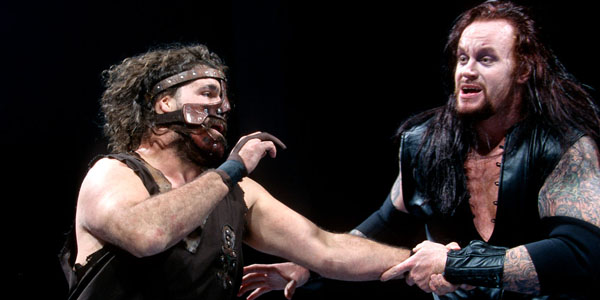
When people ask which of the Undertaker€™s feuds was the most significant, there are two that are often fighting for that top spot: either his classic feud with Mankind, or his incredibly lengthy feud with Kane. Both of these feuds helped bring about change in the Undertaker. Mankind was a kind of opponent that the Undertaker had never really faced before: one that truly enjoyed pain. This feud would last throughout 1996 and 1997, during which Mankind would cost the Undertaker numerous wins and titles. The animosity between them reached new heights as Paul Bearer turned on him just as he was about to win a Boiler Room Brawl against Mankind. This particular feud would reach its zenith at the 1998 King of the Ring, in the now famous Hell in a Cell match between the two. After throwing Mankind off of the cell, and then Chokeslamming him through the cell, and then Chokeslamming him onto a bed of thumbtacks, the Undertaker solidified himself as a legendary performer, even after believing that the call through the cell had killed Mick Foley. Undertaker€™s feud with Mick Foley really marked another turning point in the Undertaker€™s career: by this point, he was becoming a legend. It also helped that he wrestled in the Cell match against Mankind with a broken foot.
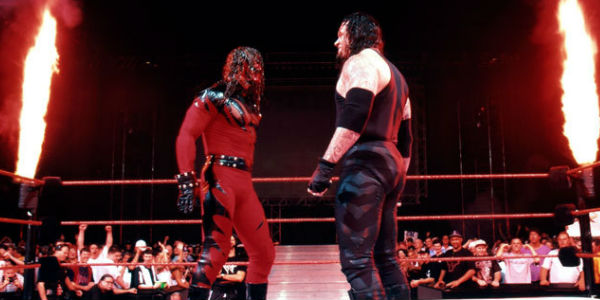
Kane, on the other hand, brought about an entirely new dimension to the Undertaker character. Prior to Kane€™s introduction, many of Taker€™s feuds were recycled, with one Superstar, or a group of Superstars, trying to take the Undertaker out, usually gaining the advantage through dirty tactics. Only in the end, the Undertaker would overcome them all, often through €˜the power of the urn€™. The complex story that is the Undertaker-Kane storyline dropped that process on its head. Paul Bearer cryptically referenced Kane as Undertaker€™s younger brother, and created an entire backstory on the Undertaker that showed him as something he had before been presented as: a normal human being with a family that he cared about. This feud also brought us some memorable moments in Taker€™s career, including this fantastic performance: http://www.youtube.com/watch?v=dKJfiYXen5I The Undertaker and Kane would feud on again and off again for years to come. They would be bitter enemies, allies, Tag Team champions, fight each other for the WWF Championship, be allies in the Invasion storyline, try and bury each other alive, among other things. All in all, Taker€™s feud with Kane brought about a long-complex storyline that created some sense of humanity and compassion in the Undertaker, which allowed the gimmick to be taken to new heights.

4. Changing His Move-Set

During a triple threat match between the Big Show, Brock Lesnar and the Undertaker, Kurt Angle, who was at ringside doing commentary said €œThe Undertaker€™s dangerous with submissions€. In another match, the Undertaker performed a small package roll-up, which is a move normally with cruiserweights. Furthermore, The Undertaker€™s signature WrestleMania maneuver is his no-hands over-the-top-rope running suicide dive, which is remarkable given the fact that he€™s 6€™10 and around 300lbs. The point here is that the Undertaker has constantly changed his move-set over his twenty-four year career in the WWE. The only moves that have been real constants were the Tombstone Piledriver, and his €˜Old School€™ ropewalk chop. Other than that, virtually everything has changed over time. He even added his Last Ride Powerbomb to his arsenal to freshen things up. This is a key feature that has made the Undertaker not only stand the test of time, but has made him keep wrestling without getting stale. Even the smallest of changes help make him a bit different. From 2005-2008 or so, his signature €˜superstar comeback€™ would be as follows: multiple clotheslines to a cornered opponent, followed by snake eyes, then a big boot to the face, ended with a pin. From 2009 onwards, he added a leg drop to make things different. This might seem small in the grand scheme of things, but small changes add up over time, especially for the Undertaker. How many near-7-foot tall wrestlers frequently dabble in submission holds like the triangle choke or the gogoplata? And how many heavyweight wrestlers have the balance to perform a ropewalk chop or a flying clothesline? And most importantly, how many big men in WWE history are so agile that they can perform suicide dives like the Undertaker? There is only one: Undertaker. https://www.youtube.com/watch?v=5chOuc-UPSU These are the things that make the Undertaker unique and change over time: he started off as a stiff, slow-moving zombie of a wrestler with power moves, and evolved to a striker with submission moves. The Undertaker knew how to adapt constantly throughout his career, which is why he is so revered.

3. Switching To Smaller Opponents

For the majority of his career, the Undertaker was often called a giant-slayer, despite himself being a big man. He was put in feuds against bigger men than him, as a means of making the already massive Undertaker seem threatened. There was one problem with this theory, however: most of those bigger men were terrible wrestlers. It has often been said that out of all the wrestlers in the WWE, no Superstar has improved in terms of match quality more than the Undertaker. His earlier matches were slow and often boring. Because he was staying to his gimmick as much as possible, he no-sold much of his opponent€™s offense, making it very hard to really create any drama in his matches. Just look at the opponents he€™s had to deal with in the past: Giant Gonzalez, King Kong Bundy, the fake Undertaker, Mabel, Diesel, Sycho Sid, KroniK, Heidenreich, The Great Khali, the list goes on. The point here is that when the Undertaker fought against superstars that were either his size or bigger, those matches were generally poor (with some exceptions). However, when you look at his matches with smaller opponents, those matches are by comparison much better. His WrestleMania matches against Randy Orton, Edge, CM Punk, and of course Shawn Michaels were fantastic. His matches against Kurt Angle at No Way Out 2006, against Bret Hart at One Night Only in 1997, and against Shawn Michaels in the first Hell in a Cell at Badd Blood 1997 were among the best non-WrestleMania matches of his career. What did these matches all have in common? The Undertaker€™s opponents were all smaller than him. They weighed at the most 240lbs, and they were technicians who could carry themselves in a match. This marks a major point in his evolution: people realized that the big-man could have the best matches on the card, despite his size. By making this change, the Undertaker would go from having some of the most disappointing WrestleMania matches to stealing the show in the latter end of his career. So much so that his WrestleMania matches with Shawn Michaels were arguably the best of his career, and their first encounter at WrestleMania 25 continues to be praised as one of, if not the greatest matches in WrestleMania history. https://www.youtube.com/watch?v=i4HrTYf41jY Quite a transformation for a man who once barely moved at all in the ring.

2. Becoming The American Badass

Judgment Day 2000 was a historic Pay-Per-View event because it marked the return of the Undertaker€sort of. The Lord of Darkness did not walk down the aisle; a tall man sporting a long coat wearing sunglasses and riding a motorcycle came down and attacked D-Generation X and Vince McMahon. The man we saw standing before us was the Undertaker in name, but the supernatural character he was not. He was the American Badass, and this was the closest thing to the real-life personality of the man behind the gimmick, Mark Calaway. His entrance theme no longer featured smoke, dark lighting or ominous funeral music; instead there was rock music. The tone in his voice changed from a dark, eerie figure to that of an ordinary person. He even began bringing his now ex-wife Sara to the ring with him, to reflect a more human aspect of himself. He even phased out his Tombstone finisher in place of his new Last Ride finisher, to complement his biker persona. The American Badass persona of the Undertaker marked, up to that point, the most dramatic transformation in the Undertaker€™s career. For a decade he was known for his gimmick and for the mystery that surrounded him, so for many fans, the sudden change in character was very surprising. https://www.youtube.com/watch?v=OzCSQR4C-qc Despite the change in character, Undertaker was still able to give fans some memorable moments during this period. He turned on JR, forcing him to kiss Vince McMahon€™s ass on RAW; he dragged Hulk Hogan around the arena while riding his motorcycle; he made Tommy Dreamer drink his tobacco juice, and he nearly ran over Vince with his motorcycle. These are only a handful of the moments brought to us by the American Badass. The Undertaker managed to demonstrate to everyone just how versatile he could be. He managed to switch from one of the most unrealistic yet successful gimmicks to a more normal and human character without losing his top spot in the WWE.

1. The Streak

For years, the Undertaker€™s name has been associated with his revered WrestleMania undefeated streak. Up until WrestleMania XXX earlier this year, the Undertaker had appeared at 21 of these annual events and had won them all. Ever since WrestleMania 20 or 21, this Streak has been the central focus of his appearance at the greatest of WWE€™s annual events. It had evolved over time, taking on a life of its own, increasing in significance with each passing year. The legendary Streak was so impressive that many people within the WWE considered breaking the Streak to be either greater than or equal to winning a World Championship. It gave WrestleMania another unique hook: fans tuned in to the event to see if the Undertaker would win despite getting older, his injuries getting worse, and his opponents possibly becoming more likely to break his coveted Streak. It was even said that whosoever ends the Streak would be guaranteed a spot in the WWE Hall of Fame. But things didn€™t start out that way. Long before the Streak was ever a thing, the Undertaker had WrestleMania opponents like anyone else, and there were some points where it was rumored that he was scheduled to lose. Chief among these is that he was supposed to lose to Diesel at WrestleMania 12, but Diesel€™s plans to go to WCW changed that. But in those early years, there was no Streak. Vince McMahon simply wanted the Undertaker to win in his feuds, which usually culminated at WrestleMania anyway. In those days, it was simply smart booking to have the Undertaker win. In more recent WrestleManias, the Undertaker€™s match would be one of, if not the main event, unless he was also challenging for a title. He has also in more recent years not been seen at any point during the year (with a few exceptions) except during the lead-up to WrestleMania itself. For him, the Streak would come to truly define the legend of the Undertaker. While his career has many highlights, and he is a very accomplished wrestler, it is his Streak that has become that which people remember most about him. Ultimately, the Streak was ended at the hands of Brock Lesnar at WrestleMania XXX, and fans have not seen or heard from the Undertaker since. Perhaps this is a sign that the Undertaker is evolving yet again; or rather, that the WWE is adapting to becoming an entity without the Undertaker. Regardless, the Undertaker has managed to evolve a lot over his quarter-decade long WWE career, and has given fans countless memories. And for that, Undertaker, we thank you. Thanks for reading. Be sure to let me know what you thought in the comments section, and be sure to check out WhatCulture€™s other articles.

Contributor

Alexander Podgorski is a writer for WhatCulture that has been a fan of professional wrestling since he was 8 years old. He loves all kinds of wrestling, from WWE and sports entertainment, to puroresu in Japan. He holds a Bachelor of Arts degree from Queen's University in Political Studies and French, and a Master's Degree in Public Administration. He speaks English, French, Polish, a bit of German, and knows some odd words and phrases in half a dozen other languages.