10 Things AEW MUST Achieve Over The Next Five Years
How AEW Dynamite can score higher ratings - Kenny Omega, new gimmick matches, NJPW partnership!

All Elite Wrestling has roared into life as legitimate, demo-chasing, head-turning competition.
It is the epicentre of professional wrestling conversation, whether that manifests as euphoric praise or, in the absence of WWE inspiring any new debates worthy of everybody's time, pedantic flash-take criticisms. It's where the buzz is, ultimately, and AEW has a real knack of generating it most weeks.
Kenny Omega, as it turns out, dressed like a scrub on purpose to resonate more like a star when he made the decision to turn stardom on like it was a faucet. This long, long-term vision and sheer audacity best exemplifies AEW's ability to reward its fanbase and get the pro wrestling world talking. That Kenny Omega wore a barely suppressed smirk in the face of criticism, and answered it with the sudden impact of his own V-Trigger, builds yet more trust in a process that simply can't be doubted headed into 2021. This is a company that rehabbed the ailing Miro and Matt Hardy in the same match at Winter Is Coming.
AEW has accomplished much already. The O.G. Elite are all gilded stars after many dummies were spat at their presentation early on. The TV ratings and PPV buys remain very impressive, as fans evidently are drawn to rising, needle-moving stars like Darby Allin, MJF and Dr. Britt Baker. The immaculate presentation of the Jon Moxley character in itself acts as evidence that AEW is a legit alternative.
But there's more to be done...
10. A Strong Women's Division

The AEW Women's division is not good enough.
AEW has something of an excuse. The promotion can only recruit from an existing pool of talent, and the market leader of North American pro wrestling only upgraded the classification of women from "things" in 2015. The independent scene is of course desolate in 2021, and, pre-pandemic, was more oriented towards pushing elite-tier men in the last phase of a Super-Indie era WWE quashed with its greedy, desperate recruitment strategy.
But there are signs, too, that AEW is all too happy to hide behind all that.
The usual one weekly segment has long developed a "token" quality. Whispers of a turnaround linger in the air, but have done for too long now to take seriously. And if there's a thoughtlessness and not malice to the presentation of the women - Hikaru Shida stood front row where Jon Moxley would never stand, Jim Ross expressing shock when calling the work of a more seasoned talent - that's not great, either.
The booking feels obligatory and is badly lacking in the detail that proves so immersive in, for example, Hangman Page's arc. That AEW used this attentive quality to put a cross-promotion over more than the talent - Abadon dragging Hikaru Shida under the Go Big Show ring apron was more of a commercial than a jump scare - is really an indictment. Proof that much of this is won't, not can't.
It's not just unfair and apathetic: if you look at which two WWE performers put on the highest-rated TV match of 2020, it's really quite daft.
9. An Aggressive Move Across The Pond

The United Kingdom is there for the taking.
WWE has endured the same fate on each side of the pond: a decline in popularity illustrated by plummeting TV ratings and, pre-pandemic, live gates. WWE's position in the UK should prove particularly anxious for shareholders. House shows should in theory be more of a novelty, since the promotion tours Britain so infrequently, and yet it isn't enough. WWE's relationship with Sky Sports collapsed in recent years, and is now broadcast to fewer homes by BT Sport. Ratings are dire. WWE finds itself in the low end of five figures in recent times.
"BritWres," meanwhile, is dead. The boom is over. No shows are running. WWE drained its talent pool. Those who were willing to support what had became a cause, and not something especially fun nor vital to do, have lost the desire to do so for self-evident reasons.
Britain hasn't been this apathetic about pro wrestling in forever; it was, after all, WWE's home-away-from-home in a decade, the 1990s, defined by poor domestic performance for much of it.
The TV deal needs revising - the delayed Friday 11PM slot isn't good enough - and AEW might force a rethink by landing in the UK if and when we settle into a new normal. AEW is still performing well in spite of it, and if the success of those first live shows is replicated here - huge interest, near-instant sell-outs - there's more than mere expansion to consider.
Launched perfectly in the live arena, AEW could dominate the UK as the #1 promotion.
8. A Talent Developmental System

AEW is not ideally positioned to develop talent in-house, which puts over the evolution of Dr. Britt Baker, Wardlow and Powerhouse Hobbs all the more.
AEW's recruitment method clashed with the planned schedule well before the pandemic changed everything. And now that AEW has ramped up its recruitment ahead of a planned third hour of TV, the problem has been exacerbated. Sonny Kiss showed much promise in 2020, by revealing a new sense of aggression and improving his body language to match specific story beats - he looked distraught and embarrassed after that Kenny Omega squash - but can't further grow as a performer without the platform. Private Party have stagnated after a head-turning 2019. There are several green Dark Order recruits in need of reps. The Women's division is in stasis, as mentioned.
AEW mustn't follow WWE's Performance Center model - theirs is an homogenised and oppressive approach to training that hasn't produced a great crop of talent - and signs are that they won't. The EVPs all developed beyond one system, one way of doing things. Kenny Omega had the foresight to become a great by leaving Deep South Wrestling; Cody's wanderlust and sense of defiance informed his own evolution from also-ran to top star after his exit from WWE in 2016.
The Nightmare Factory is entry-level. The graduates and the latter-generation post-boom indie guys must, upon a return to a new normal, go out on the same excursions with which the New Japan Young Lions become big show-ready.
All in service of...
7. Phasing Out The Elite

It's not a particularly nice thought.
Kenny Omega is the best wrestler on the planet, for your writer's money. No one performer best fuses the exhilarating thrills of the modern hybrid style with such attentive narrative depth. And it's no wonder he and the Young Bucks were drawn together; Matt and Nick Jackson best apply this dual philosophy to a tag team scene they have spent several years preserving and, arguably, perfecting.
But it's a necessary one.
Every pro wrestler thinks they'll be the one to get out before time humiliates them. Really, only CM Punk got out in time to retain his iconoclastic aura.
Hangman Page and Nick Jackson are 29 and 31, respectively. The final chapters of the Elite saga should be penned to elevate them as the key singles players of the promotion in the years to come. Omega should settle into a role not unlike that played by Hiroshi Tanahashi in NJPW presently: the undying Ace legend against whom a big win will always matter, regardless of when he last held the IWGP Title.
It's a pick 'em, who the Elite ultimately decide to put all the way over: MJF, Jungle Boy, Wardlow. AEW has only existed for two years, and they boast several talents who have proved themselves capable of being handed that ball.
But it's crucial that they do; AEW, to preserve its future and break the trend of wrestling ageing out of itself, must have its EVPs set a new standard for a veteran's twilight years.
6. A Drawing Gimmick Match Of Its Own Creation
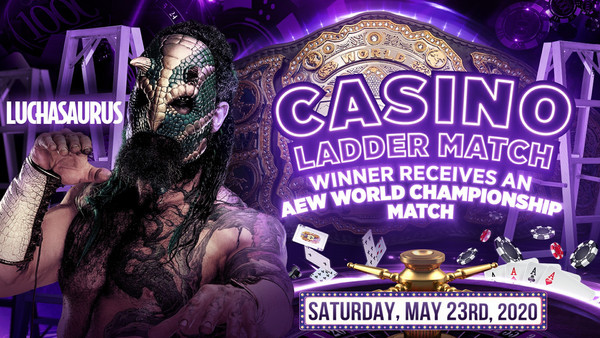
Stadium Stampede was a one-off: a seminal mood-dependent affair that diffused a mood nobody would ever want to languish in again.
The Casino-prefixed stuff meanwhile isn't working, cute though the marketing is.
The Casino Ladder match was a strange attempt to fold in the countdown drama of WWE's eternal Royal Rumble stip. The drama it attempted to tack on was at once barely there and unfair. The last entrant held no advantage - in theory, were it "real," somebody else might have won before they made their way to the ring - rendering the whole thing illogical and pointlessly drawn-out.
The Casino Battle Royal attempted to tweak the countdown drama by placing various entrants into groups of four, but only succeeded in creating the sup-optimal, perplexing visual of a group of opponents sharing the same spotlight. Convoluted and gimmicky, these stips are more TNA than Elite and should be abandoned immediately.
What's strange about AEW's poor form in creating in-house gimmick attractions is that the promotion excels at the old standards: the glorious modernisation of the Steel Cage no escape/no surrender psychology; the delirious fun of the Bunkhouse Brawl; the totally committed insanity of Lights Out. A great gimmick match is a drawing card unto itself, and establishes an identity around a promotion.
AEW have much to gain from nailing this, not least of which roaring back at the critics for a rare, good-faith burial.
5. Establish Mainstream Recognition

The entertainment marketplace is oversaturated.
WWE management tends to gussy up its failures to shareholders - they have the deepest talent roster ever amassed, but alas, a handful of 'em got injured last quarter! - but Triple H wasn't joking when he said in 2019 that WWE competes with sleep and everything else. The days of the cultural powerhouse are dead. Everything is atomised. Even the Star Wars franchise pushed too hard; the mainline series and the countless offshoots have confronted the limit in recent years.
AEW is going to struggle to draw lapsed fans because pro wrestling has a unique way of fatiguing its audience - "going dark" isn't something that happens with other realms of entertainment - and WWE over the last decade has killed the perception of the industry. This is before one considers what AEW is up against in the streaming age, or that WWE has forced the league to compete with a similar product domestically.
The doomscroll age is upon us all too. Cable news, the one show nobody wants to become a hit, is dominating that ShowBuzz Daily top 50.
AEW has made various moves to make the news and go viral - Shaq, Snoop Dogg and Sting have all made appearances on Dynamite, and Jon Moxley Vs. Kenny Omega aired on free TV - to not inconsiderable effect. The week after Winter Is Coming scored that unprecedented win.
The aim now is balance - to draw the casuals with big stars and fix them in place with the top-to-bottom quality of Dynamite.
4. Maintaining The Integrity Of The Ranking System
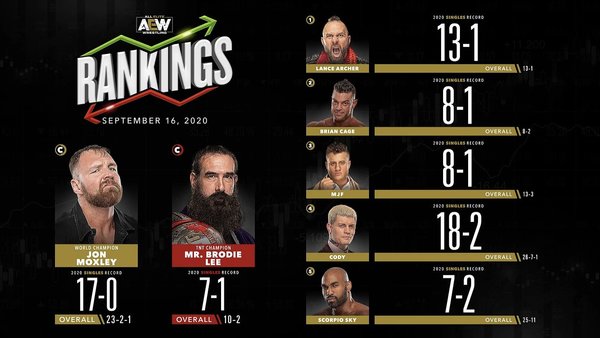
Now that 2020 has ended - not that there's any appreciable difference, it's all still a living hell - AEW's ranking system can be assessed.
The verdict is mostly very good, and if it's mixed, it should be. Emotion drives the narrative of pro wrestling as much as accomplishment. AEW must balance that which draws viewers with the framework that makes everything coherent and tethered to viable competition.
The rankings system did so much to inform the heft of AEW's tremendous Tag Team division. FTR got over as the Ace figures over the summer months, whereas the Young Bucks were visibly positioned throughout 2020 in accordance with their arc as top stars who, until they won the big one, were unable to realise their glittering reputation in the mainstream sphere.
In the singles Men's division, MJF's impressive streak informed his successful main event push. Brian Cage's ranking meanwhile informed the gripes of Team Taz - Darby Allin was selected as Cody's Full Gear opponent ahead of AEW's preeminent body guy - and recent events have synergised the rankings system with grudge-based storytelling to distil its potential as a narrative driver.
But there's a dissonance with Shawn Spears. He had a great year under the confines of the system, but was last seen raging against his IRL good-hand stigma. This was a clash between kayfabe and reality that ripped open a plot hole.
AEW arrived at a backwards Women's Title match at Full Gear through apathy. We'd already seen a better, stipped-up match between Hikaru Shida and Nyla Rose. The ranking system in this scenario proved an uninspiring imposition.
Yet omens remain strong for the years ahead; this is a strong innovation AEW must uphold to make it all matter. There's nothing more deadening than meaninglessness.
Just look at WWE.
3. A Better Domestic TV Deal
AEW's deal with TNT is worth $174 million guaranteed by a rights fee paid through 2023.
At the time - January 2020 - this was considered (and remains) a major accomplishment, given how pro wrestling was once viewed by the TV industry and the extent to which WWE had monopolised it. The deal ensured that, barring any drastic financial mismanagement, the promotion would turn a profit well before that was expected. It was the goal: professional wrestling at this level is driven by the TV revenue stream, and AEW's early over-delivery of success was rewarded with medium-term security.
Even before WWE moved NXT to USA as an anti-AEW defence shield, the rights fee for which is shrouded in mystery, the company was set to rake in $435 million from the TV deals struck with USA and FOX effective October 1, 2019 - in 2020 alone.
This was all commensurate with the respective status of each promotion. WWE's popularity is in decline but remains a proven leader on cable, whereas AEW is still an upstart irrespective of how many tests it has passed, the pandemic representing a major one.
But it doesn't feel like that one year later.
AEW has massacred NXT in the so-called Wednesday Night War, and by December 2020 had scored an unprecedented 3-0 18-49 demo victory over the pro wrestling flagship.
Should this trend continue over the next several years - and really, it can't not, since Vince McMahon has proven himself incapable of change to an extent that is almost objective - AEW must leverage its improvement into securing the big, big money. The CM Punk money. The Brock Lesnar money.
The money that will break what remains of the monopoly.
2. Grooming The Next Creative Minds

Professional wrestling is cyclical in a way that even its greatest creative minds fail to consider.
This is obvious throughout history, so much so that it barely qualifies as an insight. Most every wrestling fan is aware of how rapidly the pioneering Bill Watts declined in the early 1990s. He exemplifies the trend. Vince Russo's mega-successful formula aged horrendously in about three years, and he refused to abandon it - or was incapable of abandoning it - to the defining detriment of TNA/Impact Wrestling. Paul Heyman leaned on garbage wrestling despite it being subsumed by WWE and WCW by 1998/9. Even NJPW's Gedo, who enjoyed a longer peak than most, is cracking.
And now Triple H is confronted by merciless time: his NXT, with its emphasis on heavy workrate matches with soulless, polished build, is no longer the "future" of pro wrestling. When was the last time anybody cared about a great video package, at which NXT still excels?
The live fire of the unscripted promo best sells the wrestling match in 2021. WWE is lagging behind badly insofar as the hype, buzz and conversation goes.
AEW cannot repeat Vince McMahon's greatest mistake - he's still in charge despite being woefully unqualified, and here's the refrain again, despite how good he once was. By 2026, AEW's new and exhumed ideas alike will have developed the odd callous. Vice President Chris Harrington will know the pattern better than anybody. He is a knowledgeable wizard of the numbers game.
Your writer reckons that Santana has the booking gene, but it's on AEW to determine that - and, crucially, have the lack of ego to recognise it.
1. The One Big HOOK WWE Doesn't Have

At this point, it's difficult to determine what else AEW needs to do to grow past that elusive million mark and, more importantly, perform as consistently on Wednesdays as WWE does on Mondays and Fridays to emerge as viable competition in the same way WCW did in 1996 and 1997.
The product is excellent. Those who like it love it; AEW has established a fervent base in thrall to the long-term storytelling, decisive match results, unregulated match quality and the soul that manifests across Tony Schiavone's enthusiasm, Jon Moxley's authenticity and Orange Cassidy's very presence.
AEW has over-performed by business metrics, drawn consistent, near-stratospheric acclaim, and has built an audience of incredibly dedicated diehards. They've attracted a young audience. They've drawn lapsed fans. They have even, gauging by those viewers per home numbers, bonded people together by the experience of taking Dynamite in.
Is it a format thing? Is wrestling stigmatised as culturally irrelevant? Is it too match-heavy? Is AEW fated to just pull in the people it does?
If it can grow, AEW perhaps needs that one big narrative flashpoint to double as a marketing strategy. Wrestling is rarely bigger than when it collides with itself. The NJPW/UWF-i series was one of the biggest money angles ever, and it shaped the future of the western product forever.
And that big moment, the one thing AEW must do that WWE won't, to realise the final stage of its alternative strategy, is to open the Forbidden Door. The mere hint of an NJPW show featuring the Elite sold out Madison Square Garden.
The potential for a crossover is vast.