10 Things Wrestling Needs To Ban RIGHT NOW
Wrestlers sometimes need to be saved from themselves...

It seems counterintuitive to ban most anything in pro wrestling.
Before AEW was created, when the WWE monopoly was at its most antagonistic, samey and clichéd, how many times did you complain that expression was the one thing that wrestling was missing on the big stage?
AEW was formed in no small part because Vince McMahon actively discouraged it. One of the most famous wrestling podcasts ever, the Emancipation of Jon Moxley on Talk Is Jericho, was a compelling must-listen rant on that exact subject. Mox used those frustrations and newfound creative freedom to, in AEW, become the best version of himself - and, one could argue, an all-time great.
It feels now that wrestling has reached the opposite end of that extreme, having succumbed to a lot in the way of excess. The grim byproduct of creative expression is that every cool thing feels like it's been done twice over, and the unscripted promo can sometimes feel like very personal venting as opposed to a wrestler using their own voice to advance a story.
Does wrestling in 2024 actually need some restrictions?!
A mix of the important stuff and the trivial bugbears follows...
10. Lack Of Transparency Surrounding Injuries

Using footbal as an example, injuries are disclosed to the media. More often than not, the exact nature and severity of the injury and the expected recovery time is stated.
A manager will at times play a shadowy game. A player might miraculously recover more quickly than anticipated; the idea is to lull the opposition coach into tactical errors by not building a strategy around a key player who, unbeknownst to them, is actually available to start. As a rule, however, even if the piss gets taken a bit, every injury is disclosed. 99.9% of the time, if a player is not available, you know exactly why that is.
Why can't wrestling do this?
Half the time, you might not know that a wrestler is injured at all. Neither AEW nor WWE publicise an injured list; this information is mostly, eventually, sounded out by reporters. The other half of the time, the details of the injury are kept secret. Are the two majors afraid that this indicts them and their safety record?
What's the deal?
This lack of transparency, which has no actual benefit, just fuels the rumour mill. If a wrestler is out, and you've no idea why, it is very easy to conclude that something is amiss. Conclusions are jumped towards. Are they unhappy? In the doghouse?
And if that isn't fair, if a wrestler is out of sight, even if no unseemly rumours arise, at a minimum, you are left to think that the promoter has lost interest - which in turn lowers your investment in the character.
Just make this information public.
9. Multiple Chop Battles Per Show

What does the pro wrestling producer do, exactly?
Because what they should be doing isn't really getting done. A pair of skilled and experienced pro wrestlers should be able to put a match together beforehand. A pair of skilled and experienced pro wrestlers should be able to go out there and call it without a former midcard act telling them what to do.
The average wrestler will however step on the dick of their peers by trying to get their sh*t in. It is incumbent on the producer to ensure that they don't all do the same sh*t - at least that's what Tyson Kidd told Chris Van Vliet.
So why, then, on AEW television in particular, do at least three of the usual six matches feature a chop battle?
Wrestling is homogenised to a drab extent in 2024, a stylistic blur, and the machismo chop battle is a not inconsiderable part of the problem. No move should be banned outright and forever in the creative freedom promotion, but to make a broader point, the wrestlers and agents should liaise with one another, determine who's doing what, and work out who's best at it (Rush and Eddie Kingston, to use the chop example).
Then, they should task themselves with doing something different. If they're good enough under that pressure, they will improve through self-discipline.
No AEW fan wants a version of the factory settings WWE TV match, but a balance should be struck.
8. Stomach Stuff

Dave Meltzer recently indulged himself in a rant about this exact thing, which will be expanded upon here.
Adam Copeland last week accused Daniel Garcia of "trying to take food off his table". This is one of those "everybody says it, nobody has stopped to ponder how little sense it makes" deals. Copeland is a very wealthy man. Now, while Dave does have a tendency to take things literally when he shouldn't, this phrase should be banned. Garcia isn't reaching out for Copeland's food - which is grits, probably - but rather trying to grab a payday at his expense.
Seth Rollins in his annus horribilis of 2019 said something similar about Jon Moxley, who by joining AEW had apparently tried to eat into his business.
What?
If anything, the existence of AEW actually improved the business of Colby Lopez: independent contractor. Even if he never fancied making the jump, he could feign interest to get more money out of WWE.
Rollins moved to clarify on Twitter that "It's an expression about [AEW] coming for [WWE's] business", but that's still dumb. WWE is not entitled to a monopoly on pro wrestling.
Even away from the semantics of it all, the figure of speech is a rampant cliché and pro wrestling is homogenised enough.
7. MORE Stomach Stuff

Wrestlers are absolutely fascinated with eating, aren't they?
Many former WWE wrestlers had no choice; a few short years ago, since there was nothing else to do beyond mill around catering, it's no surprise that this fascination has developed. You'd hope AEW puts on a decent spread, too, since that promotion has utterly broken its own talent:TV time ratio. Happily, the food in catering is most likely "great", since according to Tony Khan, virtually everything else is.
In addition to becoming furious at the mere prospect of somebody stealing food from their table, a lot of wrestlers these days are always "hungry".
This is obviously a synonym for "motivated", and while using the word "hungry" is halfway effective in casting the wrestler as somebody who'd happily devour flesh to get the job done, it's very over-used in 2024. They're all "hungry". Some of them are more hungry than ever before. Some of them need to scoff something, and pronto, because this word is becoming supremely irritating.
More irritating, in fact, than when a toddler who refuses to eat something suddenly turns into Adam Copeland two minutes before beddy-byes.
6. Certain Gimmick Matches (Temporarily)

This is never going to happen, and if that needs any further explanation, on the February 14 Dynamite, Tony Khan booked a Texas Death between Orange Cassidy and Matt Taven.
The match was actually a blast, and felt as hysterically violent as it should have, but much more of that excess, and Texas Death - among the last of the truly great, scary stipulations - will lose its mystique.
The artistic story of professional wrestling is too vast and intricate to be summed up in a single sentence, but if that were true, the sentence would read as follows:
The professional wrestling promoter simply cannot help themselves.
They'll indulge their own whims, they'll repeat their own and in many cases everybody else's mistakes. Between Gedo doing mandatory 30+ minute main events, Vince Russo swerving all over the shop, and every booker ever promoting too many gimmick matches, not a one of them operates on the basis of less-is-more - and this fatal attitude is all the worse when combined with wrestling's never-ending schedule.
They should all learn the lesson of the antibiotic: even the most effective things wane if overused.
A self-imposed and temporary restriction on each gimmick match - doing a ladder match once per year but never on a fixed date, for example - would preserve their aura and test the true creativity of the storyteller.
5. The Creation Of More Titles

Not a single new title needs to be created across WWE, All Elite Wrestling, and New Japan Pro Wrestling.
A wrestling title is meant to feel elusive, as if capturing it will take nothing less than a career-best performance from the challenger. In Triple H's defence, his slow and uneventful approach to television exists for this very purpose: it will feel enormous when GUNTHER and Roman Reigns are eventually dethroned. That still doesn't excuse the dumb and oxymoronic concept of secondary Word titles, which exist across the men's and women's divisions. The belt Seth Rollins wears has been treated with utter disdain directly by Roman Reigns and indirectly by Cody Rhodes as a consolation prize, and that, canonically and literally, is why it exists in the first place.
AEW's title picture is out of control even if you don't factor ROH into the equation.
The TNT title used to actually reward those worthy of it - Darby Allin and Miro - and now, after it became a belt-makes-the-man rehab project for the likes of Wardlow, it is tacked onto a grudge programme, in Christian Cage Vs. Adam Copeland, that doesn't need it. That might be because it is unnecessary in and of itself in the wake of the International and Triple Crown titles, which are either synonyms of World title or were used by another promotion as the de facto World title.
It's all a bit diluted and meaningless, and NJPW - in parallel with its wider decline - promotes so many titles that lapsed fans can't keep up with the amount nor the name changes.
4. The Worked Shoot-ADJACENT Promo

Mainstream US wrestling first outed itself as a predetermined sham in storyline back in the '90s through the lines-blurring of Brian Pillman.
Now, much of today's generation don't know any different.
The worked shoot is, as the oxymoron suggests, a flawed concept. It is difficult to believe that two talents truly despise one another when they have amicably agreed to fold their tension into a storyline (during which they will protect one another from real harm in the ring). Done well, the knowledge of real animosity can enhance a match - but not everything is CM Punk Vs. Eddie Kingston at AEW Full Gear '21.
You can see why a wrestler would draw on something real to taunt or challenge their rival. This is meant to deepen the realism of it and in turn fan investment. The problem is that talking about the "real" conflict or conduct is now such an unconscious act, like breathing, that wrestlers will use it when it doesn't make much sense.
Darby Allin, who has otherwise improved considerably as a promo, recently accused Ricky Starks of making excuses for not making it as a top star - except, as the champion of the tag division at the time, he in fact had made it in the fictional universe of All Elite Wrestling.
More generally, wrestlers constantly make references to "politicking" - Seth Rollins drew on that to build his new programme with Roman Reigns - and what sense does that make?
Is wrestling fake or not?
3. Deliberate Attempts To Draw Blood The Hard Way
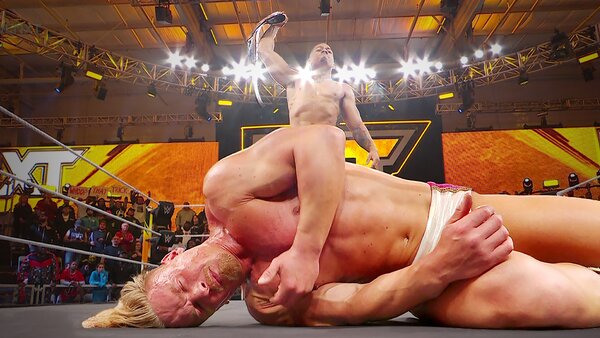
Blood enhances the drama of a professional wrestling match. Blood sells tickets for wrestling matches.
Blood - subjectively - rules.
If a wrestler is intent on drawing blood, there is one objectively good way to facilitate it: with the use of a blade.
It is not a failsafe device. There are risks; a wrestler can cut too deep and strike an artery, or, if they rely up on it too heavily, they can permanently scar themselves. Using the two preeminent blading enthusiasts of the day, however - Jon Moxley and Bryan Danielson - they haven't disfigured their foreheads, and in the case of the latter, he is 100% more likely to injure himself by bumping rather than blading.
In wrestling, and this is wild, the illusion of violence is often far more effective than real violence.
Brock Lesnar busted his face open at Backlash last year with no repercussions, since he's Brock Lesnar. He also (under instruction) laid elbows into Randy Orton at SummerSlam 2016. Despite Orton suffering a concussion in that bizarre scene, Roman Reigns was carved open at WrestleMania 34.
While it's very unlikely that you'll see Lesnar again, at least for years and years, WWE still allows versions of this on its programming. Ilja Dragunov is asking for trouble with what seem like obvious attempts to get around the ban on blading.
Head injuries are much too serious to piss about with the "optics" of being wrasslin'.
2. Excessive Match Lengths (For A Cynical Goal)
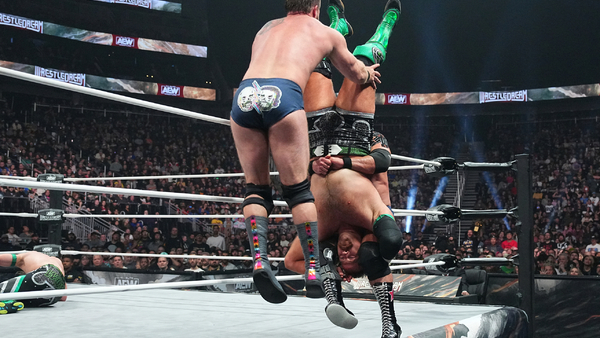
For the longest time, match length has been conflated with match quality.
There's apparently no such thing as a classic short match, even if KENTA Vs. Ricky Marvin is more electrifying than literally thousands of lengthier matches worked in the "hybrid" vein. That famous sprint, from October 15, 2009, lasted just 01:59. Great short matches are possible.
What's ironic about wrestlers is that, while many of them bemoan Dave Meltzer, just as many wrestlers work matches within the parameters of what he has historically considered a "classic". They know that the currency of wrestling is in acclaim and "bangers" - a take, given the contrasting fortunes of LA Knight and Ricochet, that is out of date - and so they wrestle long back-and-forth matches in the pursuit of it.
Is this all not getting a bit...repetitive? Meaningless? Tedious?
It's backwards - similar, in a way, to when WWE would book events on a calendar-first basis. The length of the match feels like it comes first at the expense of the story. The idea that a great match is long and a long match is great is like gum on a pavement.
"Ban long matches" is silly, obviously, but a booker/agent should truly ask themselves if the match needs that many minutes - minutes that could be spent on promos or video packages or anything else that makes you want to watch more wrestling.
WarGames is a criminal offence in particular. It's so weird. Not a single match held since the 2017 reboot has troubled MOTY lists. If the first was some awesome, seminal deal, yes, chase that dragon. But nobody believes they're all-time great attractions. Blood & Guts performs very well in the ratings, but would anybody care if it was 10 minutes shorter?
Isn't that in fact what everybody would prefer?
Another question:
You know what absolutely f*cking ruled, and should have imparted a lesson (but sadly didn't)?
Yes, the answer once more is Eddie Kingston Vs. CM Punk at AEW Full Gear 2021. They needed just 11 minutes to unleash a funny and brutal torrent of pure hatred.
It would just be neat, years after the great match has been normalised, if wrestlers could begin to test themselves with sprints or shorter, leaner matches. It would be nice to get away from that feeling of wrestlers just doing moves to one another.
After all, you don't like star ratings, right?
1. Non-Consensual Kissing Spots
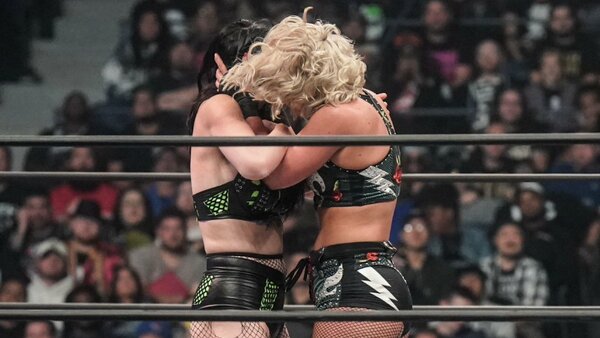
Now obviously, there is no such thing in the predetermined, fictional context of pro wrestling. Talents who agree to be kissed in a worked non-consensual kissing spot have by definition consented to it as part of the performance.
They are acting. They are acting on a scripted entertainment show. They often act alongside close friends.
Professional wrestling is not real.
Still, professional wrestling is meant to function as a silly escape from the horrors of the real world. Sexual misconduct, sadly, is rife; if you yourself are lucky enough not to have your own story, it is statistically inevitable that you know somebody who does. This spot - which Jon Moxley and Toni Storm have performed in recent weeks and years - is a needlessly triggering act that does nothing to enhance the drama or entertainment value of a match.
Other than titillating some unpleasant people who, terrifyingly, are unaware of the difference, it is valueless. The spot risks upsetting people who have been placed in similar situations.
Dustin Rhodes did it to Jake Hager's wife at AEW Revolution 2020 years after Ric Flair was excoriated for doing it to Becky Lynch.
It's revolting, and while it shouldn't take something like the Vince McMahon scandal to put it in the bin, there is no better time to think about the effects.