10 WCW Stars From The 2000s You Totally Don't Remember
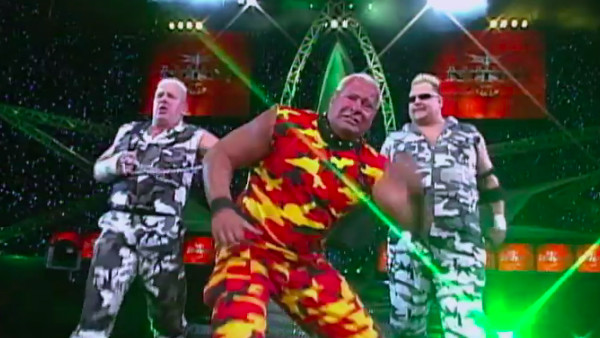
Behold the majesty of The Stro..

The once-proud WCW, a promotion which offered a genuine alternative to the WWF throughout the 1990s, was an ailing giant by the turn of the millennium. Gone was the sparkle that had helped WCW become the wrestling market's top dog from late-1996 until late-1998, and posted missing was the ingenuity involved in ideas like the original nWo.
This is true when analysing WCW's roster from January 2000 until March 2001. There were so many performers who didn't get over, mired on the undercard with others also struggling for house room in the jumbled mess that was Nitro and Thunder.
As such, many men and women were quickly lost in the endless shuffle. WCW was hanging on for dear life as a viable product and management were throwing anything at the wall to see what might stick, so it makes sense that many roster members were fleeting
Here are 10 obscure WCW performers and characters from the promotion's final year that you may not even remember at all...
10. 'The Artist Formerly Known As' Prince Iaukea

Prince Iaukea was a young wrestler who burst onto the WCW scene in 1996 and was handed the Iaukea surname as a tribute to the legendary 'King' Curtis Iaukea; then-creative team member Kevin Sullivan was impressed by the youngster, and felt that giving Prince the Samoan gimmick and Iaukea surname would help establish him.
By the time the year 2000 rolled around though, Iaukea had moved on to other things and dispensed with the previously upbeat islander gimmick. The change may have started in late-1999, but it was in 2000 that a switch to 'The Artist Formerly Known As' Prince Iaukea was truly cemented.
An obvious nod to the pop star Prince, this persona led to WCW Cruiserweight Title success for Iaukea before he was awkwardly released from his contract in the summer.
This is likely why many won't remember the 'Artist' gimmick; Iaukea was stripped of the Cruiserweight Title when WCW pushed the reset button that spring, and was rarely back on WCW television before being released.
9. Buzzkill

Being reduced to a bargain-bin version of his brother's more successful Road Dogg gimmick was not a fine use of Brad Armstrong's talents, but that's exactly what Vince Russo had in mind for the man towards the end of 1999.
Heading into the year 2000, Brad was transformed into 'Buzzkill', and instantly came across as a one-man cheap imitation of The New Age Outlaws. Played to the ring by eerily-familiar entrance music and declaring himself the 'B.U Double Z', Buzzkill never had a hope in hell of getting over.
This was the kind of thing you'd expect to see on a WWE tribute show, not on WCW television.
Unfortunately, Brad would go down with an injury in March 2000, meaning he was almost immediately forgotten and would only be remembered by those looking to castigate Russo's time at the helm in WCW; parody or not, rehashing his old ideas from the WWF was never going to work well, so lord knows what Russo was trying to accomplish with Buzzkill.
This utter nonsense was only marginally better than 'Arachnaman', the Spider-Man rip off gimmick Armstrong had previously used in 1991.
8. Reno

Fans who did stay loyal to WCW throughout a topsy-turvy 2000 will recall the hype that surrounded a group of young wrestlers called The Natural Born Thrillers. The likes of Mike Sanders, Chuck Palumbo, Sean O'Haire, and Mark Jindrak were all products of the WCW Power Plant training facility, and they were largely considered to be the promotion's future.
Other members included Johnny The Bull, Shawn Stasiak, and Reno, the latter of whom is the focus here. Reno possessed a definite upside, but he would never really make a splash outside of WCW after the promotion crumbled in 2001 - although the WWF did sign Reno to a developmental contract, he was released quickly in December of that year.
Fans didn't get a chance to learn whether or not Reno could cut a decent promo, because the man barely talked during his appearances on WCW TV. He did become WCW Hardcore Champion in October 2000, but that would be it in terms of notable success.
For a guy who was supposed to be part of WCW's future, the creative team sure didn't give Reno a lot to work with.
7. Kid Romeo

Kid Romeo would have the distinction of wrestling the second last match in WCW history on the final edition of Monday Nitro. Teaming with Elix Skipper, the former male stripper lost the WCW Cruiserweight Tag-Team Titles to Rey Mysterio and Billy Kidman during the match, and that would be it for Romeo's career at a top level.
Another product of the WCW Power Plant, the flashy heel actually made his debut in early-2000 before then working in Japan and for the WWF as an enhancement talent. He'd return to WCW the following year as Skipper's hand-picked tag partner, and the duo would become the first Cruiserweight Tag Champs at Greed.
That's about it for a career recap, as Romeo didn't do anything else of any note during his stint in WCW, although he did make a handful of appearances during TNA's early months.
A clear take off of Latin pop stars like Ricky Martin (making that two performers WCW packaged as pop singer tributes on this list), the dancing Romeo also had an air of Disco Inferno about his performances.
6. Jason Jett

Jason Jett was amongst the glut of young talents WCW injected into their product right before the end, and he's definitely a prime example of a wrestler that should have gone on to bigger things after the promotion closed down.
Capable of flying around the ring and defying his muscular physique, the man had also worked in ECW as 'EZ Money' for a spell. Under Paul Heyman's guidance, he memorably produced a stunner alongside Kid Kash at the Anarchy Rulz 2000 pay-per-view, but he was never given a prolonged chance to truly show what he could do on the WCW stage.
Jett went on a mini winning streak that included victories over Alex Wright, Kwee-Wee, Disco Inferno, and Kid Kash during the latter's own WCW debut. Had WCW lasted longer, there's a great case to be made that Jett would have become a fixture of the Cruiserweight division.
As it turned out, the timing was off for Jett in WCW; the promotion closed down less than a month after he joined, and - making matters worse - Jett was later released from a developmental deal with the WWF.
5. Asya

Leave it to WCW's brain trust to try and ape the success of Chyna over the WWF with their own female bodybuilder character. In 1999, Christi Wolf was repackaged as Asya, and the reasons for that were simple: Asia (as a whole) is bigger than China, which is precisely why Wolf was given this silly moniker.
Heading into the year 2000, Asya was part of The Revolution stable alongside Shane Douglas, Chris Benoit, Dean Malenko, and Perry Saturn. Later, the bodybuilder would become involved in the awful Oklahoma debacle and then be aligned with The Demon in another awkward alliance.
Wolf may have been impressive to look at physically, but pro wrestling wasn't something she took to with any aplomb; during every match Asya had on television, it was clear she didn't have the slightest clue about ring positioning or how to carry herself inside the squared circle.
Released in August 2000 to little fanfare, the Asya character is likely forgotten by most due to how pointless it was in the first place. Chyna was a star who connected with the WWF's audience, but Asya offered little to WCW's own fan base by comparison.
4. The Maestro

One of the most ludicrous ideas in WCW history happened at SuperBrawl 2000, and the angle also involved one of the most ridiculous characters the promotion ever used, as Ernest 'The Cat' Miller and The Maestro were engaged in a musical feud, leading to the WCW debut of James Brown.
That's right, the James Brown, only one of the world's most recognisable soul artists. WCW neglected to properly promote Brown, a fact which means they gleaned ultimately nothing from his pay-per-view appearance.
Still, at least The Maestro got to cut a hokey promo aimed at Miller and eat up valuable minutes on a show people were paying to see.
Returning to WCW (having previously worked as a jobber in the early-90s) in 1999, The Maestro was supposed to be a modern day version of 'Gorgeous' George Wagner; incredibly, The 'Stro was actually the great nephew of Wagner in real life, which is why he used the gimmick.
Maestro wouldn't see out the year 2000: he was released before calendars turned to 2001 and hasn't wrestled above an independent level since.
3. Air Paris

Long before AJ Styles was bringing the best out in John Cena, Roman Reigns, and virtually everybody he works with in WWE, and even before he was a TNA stalwart, the future WWE Champion was a fresh-faced rookie looking to make a name for himself in WCW.
Drafted in as part of the promotion's new Cruiserweight Tag-Team Title idea, the young AJ formed a short-lived unit with a man who wouldn't go on to share the same level of success as Styles. That guy was Air Paris, a wrestler Styles had worked with numerous times on NWA Wildside cards in the late-90s.
Barely looking old enough to be inside the ring, Paris was nonetheless an exciting and dynamic high-flyer; together, he and Styles were collectively known as 'Air Raid', wrestling several times on shows like Nitro and Thunder.
The tag-team wouldn't make it to pay-per-view before WCW went out of business, and neither AJ or Paris would have their contracts picked up by the WWF. This means that Air Paris only had a few months in the WCW spotlight before disappearing into relative obscurity.
2. The Dog
The late, great George 'The Animal' Steele successfully acted like a beast rather than a functioning human being for years. Perhaps that's the kind of aura WCW were trying to create for Al Green when they repackaged him as 'The Dog' in 2000, but the gimmick didn't quite match Steele's level of success.
Introduced by Fit Finlay and Brian Knobbs, the new canine character was led to the ring on a leash and generally tried to act like a ferocious mutt who was out of control; at one point, Dog could even be seen drinking from toilet bowls, which shows the dedication of Green to the character if nothing else.
Green's last guise in WCW was less-than-memorable, and it marked a tremendous come down from his previous role as part of The Master Blasters tag-team with Kevin Nash during the early-90s.
Although he played the character as best he could, there was no way pretending to be a dog was going to have much longevity for Green; quietly phased out by the time WCW bit the dust, The Dog remains a curiously forgotten part of WCW's history.
1. The Machine

The gigantic Emory Hale only wrestled one match under the guise of 'The Machine' in WCW. A massive man, the heavily-muscled frame of Hale meant he was a perfect pet project for the company; Hale was even managed by 'The Mouth Of The South' Jimmy Hart at one point, although he'd never quite cut it for any serious length of time.
On the 2 February 2000 edition of WCW Thunder, Hale went under a mask as the mysterious Machine to face Diamond Dallas Page. The match has become infamous to those who closely followed WCW, largely because Hale comedically jumped from the top turnbuckle onto the ropes for no apparent reason.
DDP had smashed into the ropes directly opposite The Machine, apparently causing the big man to lose his footing and dramatically leap from safety onto the top strand. Even Page couldn't stop himself from smiling; the spot looked woeful and would come to define Hale's time playing the character.
Post-loss, The Machine was never seen again in WCW, making the entire exercise a pointless one.
-
What other obscure WCW stars from the 2000s do you remember? Let us know down in the comments section below!