10 WCW Stars You Totally Forgot Existed

From Misfits in Action to Missing in Action.

One of the biggest problems with the WWE's almost absolute TV monopoly is overexposure. It's only a matter of time before we grow totally bored of seeing the same guys, week in, week out. In an era with only one product on TV, how can we ever have the chance to forget about any of them? Before Vince McMahon gained complete control of the wrestling industry in 2001, the business was awash with talent showcased in three major national promotions. Trading blows with one another for the best part of a decade, there was a constant influx of new grapplers in the WWF and WCW as each company looked to gain an advantage. It was an exciting, unpredictable time to be a wrestling fan. Yet when WWF bought out WCW, many of the Atlanta promotion's roster just...disappeared. One company simply was not big enough for two locker-rooms. With no-where else to go, several relative rookies who had just started to make a name for themselves were left to scrap in the indies, whilst a number of more established stars decided it was time to call it quits. Likewise, with the victorious WWF eager to promote their own legacy ahead of their failed rivals, several names from the vanquished promotion's past slipped into obscurity. Here are ten ex-WCW stars lost in the mists of time.

10. The Master

Between 1995 and 1997, for better or worse, the Dungeon of Doom were the primary heel faction in WCW. Despite Eric Bischoff's intention to make Nitro the antithesis of Raw - a cool, hip, 'anything goes' show devoid of the hokey cartoon characters of the WWF - the reality was somewhat different. Uncomfortable in his new, wrestling-oriented environment, Hulk Hogan needed something to make him feel at home. The answer was the Dungeon of Doom, a collection of traditional villains led by Kevin Sullivan, all waiting in line to be on the receiving end of The Hulkster's legdrop of doom. There was Ugandan giant Kamala. There was John 'Earthquake' Tenta biting people as 'The Shark'. There was Zodiac - yes or no? There was a seven foot giant, imaginatively called The Giant - latterly the Big Show. But looming behind them all, most curiously, was the terrible, pallid face of The Master. The character was lifted straight out of Apocalypse Now: a huge, crazed cult-leader reminiscent of Marlon Brando's Colonel Kurtz. In reality, it was portrayed by veteran wrestler of over thirty years and Kevin Sullivan's close friend, King Curtis Iaukea. The Master's only role was to declare Sullivan the Dungeon's 'Taskmaster', and instruct him to rid WCW of 'Hulkamania'. No prizes for guessing how that worked out for them.

9. Charlie Norris

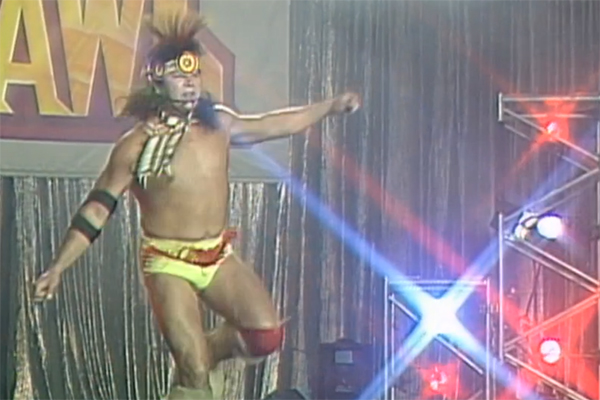
In the early '90s, Chris Chavis achieved a modicum of success in the WWF with his Native American 'Tatanka' gimmick, being pushed as a top babyface and given an unbeaten run stretching between 1992 and 1993. WCW, looking on with envious eyes, decided to try a similar gimmick of their own. It didn't quite work out. Their solution was Charlie Norris. Billed from the Chippewa Reservation, Norris would skip to the ring bedecked in a feathered headdress, finishing off his foes with a strangely familiar tomahawk chop. Unusually for professionally wrestling, it wasn't just a gimmick; like Chavis, Norris was a legitimate Native American, hailing from Red Lake, Minnesota. Unlike Chavis, he wasn't a success. Though he had a small mid-card push culminating with a TV title match against Steven Regal, Norris was gone from the company within five months. He later claimed he was the victim of racial discrimination in the company by being forced into playing a 'degrading' Native American gimmick, ultimately rendering his position untenable. He sued the company for $50,000 in damages. Coincidentally, Norris had already spent every last penny he'd earned in the industry.

8. Lodi

Whilst the nWo dominated Nitro's airwaves during WCW's run at the top, they weren't the only renegade faction in town. Arguably, they weren't even the best. Making ripples in the undercard were Raven's Flock, a motley crew of misfits and outcasts led by the eponymous Raven. The stable - a continuation of a similar outfit from ECW - made minor stars of a number of wrestlers who would have otherwise been lost in WCW's massive roster. The likes of Kidman, Perry Saturn, and Kanyon all established their names when part of the group, eventually going on to have relatively successful singles careers after the Flock disbanded. One of the most entertaining of the assemblage was Lodi, who entered the Flock as a replacement for the injured Stevie Richards. Lodi soon became known as the 'sign guy' due to his habit of carrying an assortment of amusing placards to ringside, often making inside jokes at the expense of other workers. When Raven's coterie were 'freed', Lodi began teaming with ex-jobber Lenny Lane in another politically incorrect WCW gimmick - a gay tag-team whom the fans were supposed to jeer for their homosexuality. Reaction from LGBT groups was rightly disparaging. After being pilloried for essentially endorsing violence towards gay people, WCW eventually pulled the gimmick, and the incident ultimately led to liberal owner Ted Turner firing Eric Bischoff. Lodi meanwhile, took a six-month sabbatical before returning with his name reversed as the raver Idol. He was finally released in 2000 due to the dreaded 'personal demons'.

7. Chase Tatum

After beginning a career as a personal trainer, Chase Tatum came into contact with a client from WCW who suggested he go for a tryout with the company. As a teenage bodybuilding prodigy and a former Mr. Georgia, Tatum was ripe for pro-wrestling. Yet his stay in the industry was brief. Upon completing his training at the Power Plant, Tatum began to appear on WCW TV in 1999, serving as enhancement talent whilst adapting to the new profession. Soon after, he was drafted into Master P's massively unpopular No Limit Soldiers faction. Tatum enjoyed a brief singles run, but within two years of making his debut, chronic back pain started to affect the former bodybuilder, and in 2000 he bowed out of the industry. The move wasn't a disaster for Tatum; his connections with Master P allowed him to serve as the rapper's PA and road manager for his group Outkast. He even found a role in the movie Who's Your Caddy? with the band's Big Boi. Yet his brief stint in the ring took its toll. Despite spending only two years between the ropes, Tatum became dependent on painkillers to alleviate the issues caused by his troubled spine. The end of the story is depressingly familiar; in 2008, Tatum was found dead in his home following an apparent overdose.

6. Blitzkrieg

Just four years after making his debut for Ronald Alexander's APW, Californian Jay Ross signed the first big money contract of his career with WCW. With a style encompassing lightning fast aerial bombardment, Ross had the most apt of ring-names: Blitzkrieg. Blitzkrieg fit like a glove in WCW's exciting mid-nineties cruiserweight division, competing alongside the likes of Juventud Guererra, Dean Malenko, and Psicosis. Among such names, the eye-catching speedball impressed to the extent that he claimed the Wrestling Observer's Rookie of the Year award, putting himself in the same light as previous winners Steve Austin, Barry Windham, and the Road Warriors. Then - appropriately enough - Blitzkrieg was gone, quick as a flash. By October of 1999, Ross had left the ring for a considerably slower-paced career behind a desk as a computer technician. But who can blame him; Ross earned more working 9-5 than he ever did for 'ATM Eric'. Any hopes of a comeback were dashed when Ross bequeathed the gimmick to indie star Jack Evans, himself inspired to become a wrestler by Blitzkrieg's phenomenal contest with Juventus Guererra at Spring Stampede '99. An honoured Evans started to use the Blitzkrieg II name, though a botched 630 splash made him think twice about competing under the hood. The mask has only returned occasionally since.

5. Lash LeRoux

The only entry requirements for WCW's Power Plant wrestling academy (aside from a hefty $3000 fee) were that applicants be at least five foot nine and weigh over 180 pounds. As such, it attracted a number of would-be grapplers from a surprisingly diverse array of backgrounds. Naturally, there were the usual muscle bound tough guys - the likes of Goldberg, Sean O'Haire, and Johnny The Bull. But the loose criteria meant the door was also open to Jacksonville State University pre-med undergraduate, Jonathan LeRoux. Despite having no athletic background, LeRoux suitably impressed at the wrestling school and was promoted to Nitro in a year. LeRoux adopted the name 'Lash' LeRoux - a take on Western star Lash LaRue, the man who had taught Harrison Ford how to wield a bullwhip. Other than his moniker, LeRoux shared nothing else with his namesake. He bounced around the cruiserweight division, most notably feuding with Disco Inferno, until he was fired on-screen and returned as part of the Misfits In Action stable, repackaged as Corporal Cajun - another subtle nod to Louisianan LaRue. When WCW was absorbed by WWF, LeRoux was signed to three-year developmental contract, but grew tired of auditioning for Vince in the Ohio indies, eventually negotiating his release in order to join the newly founded TNA. LeRoux, though a fan growing up, only entered wrestling because a golden opportunity presented itself. His true passion was as a cartoonist, and after retiring from the ring, the 'Ragin' Cajun' committed himself to sketching full-time.

4. Big Sky

The list of esteemed alumni trained by the legendary Stu Hart rolls off the tongue. Dynamite Kid. Chris Benoit. Brian Pillman. Lance Storm. And...Big Sky? True enough, Saskatoon native Daryl Karolat did indeed train in the Dungeon, albeit briefly, before making sporadic appearances in WCW as the bodyguard of Doom in the late '80s. After touring Japan and Mexico with AJPW and CMLL respectively, Karolat found his way back to Georgia in 1993 where he began to team with Vinnie Vegas (Kevin Nash) under the name 'Big Sky'. It was a short-lived arrangement; Nash left for WWF in the same year, and Big Sky was left hanging in the air. WCW were typically unsure of what to do with Sky, and by the end of the annum he left for UWF. When founder Herb Abram's suddenly passed away in sordid circumstances, the company dissolved and Karolat decided to call quits on the wrestling game. Sky - who preferred to go by the name Tyler Mane - had a contingency. His impressive six foot eight frame had earned him various small television roles, and in 2000 he got his big break as Sabretooth in X-Men. Ironically, the role had originally been intended for former partner Nash, but Big Sexy's conflicted schedule saw the part go to Mane. How many other Dungeon graduates can claim a Hollywood career?

3. Crowbar

Christopher Ford has regularly referred to himself as 'the World's biggest Star Wars fan', and appropriately enough, in WCW he was named after an item most effective when using force: Crowbar. Ford had forged a successful partnership with Ace Darling on the indie circuit, and the two had a very short sojourn in WWF before the pair turned up in Atlanta. The team - known as The Extreme - struggled just as they had for Vince, and Ford later returned under the name of Crowbar, aligning with the similarly 'insane' David Flair and Daffney. After holding the tag straps with Flair, Crowbar also lifted the Cruisweight Championship until suffering the ignominy of being pinned by Daffney, as WCW in their infinite wisdom put a 130lb girl over a 230lb brute of a man. Crowbar nevertheless rebounded, and had the honour of trading blows with hardcore legend Terry Funk in WCW's tepid extreme division. Ford was released from his contract just months before WWF's buyout of the company, and promptly returned to the indies. In the mid-2000s, the former Crowbar - a trained physiotherapist - began working in the field of rehabilitation, all the while wrestling independently. By night he would beat people up, and the next day help them recover. Though his stint in the big time was relatively short, Ford can count himself as part of a very elite club; he is one of only five wrestlers to compete in WWE, WCW, ECW, TNA, and ROH.

2. Mike Sanders

Mike Sanders was one of the huge influx of successful Power Plant graduates who began to populate Nitro in 1998, following the training school's open invitation period. Sanders - who was born on the day of the moon landing and was named for all three of Apollo 11's astronauts - had a more traditional path to the ring: soldier to bouncer to wrestler. A possible rib on Mike Awesome (whose family ties with Hulk Hogan resulted in a spiteful Vince Russo burying the former ECW champion after the Bash at the Beach debacle), Sanders - a close friend of Russo's - was formally introduced to WCW audiences in the summer of 2000 as 'Above Average' Mike Sanders. As seemed customary for freshly graduated Power Plant students, Sanders immediately began to associate himself with perennial mid-carder Disco Inferno. Using a finisher known as the 3.0 - so called for being an above average GPA - Sanders' entertaining mic skills made him a popular figure in the ailing company. Indeed, such was Sander's ability to work a crowd that when he retired in 2005, he swapped the ring for the stage, embarking on a relatively successful stand-up career. Perhaps in a few years time we'll see a dream comedy double act of Mike Sanders-Dolph Ziggler?

1. Prince Iaukea

Though his name made him sound like the heir to a flat-pack furnished empire, Prince Iaukea was a solid worker and a mainstay of the WCW landscape for over half a decade. Iaukea - born Mike Hayner - made his first appearance for WCW as a cadet delivering a missive to Cobra on behalf of Sergeant Craig Pittman. Booker Kevin Sullivan was impressed with the rookie's attitude towards the business, and quickly drafted him into the company, naming him after his close friend King Curtis Iaukea - otherwise known as The Master. A black belt in judo, WCW were clearly keen to capitalise on Iaukea's tough guy image by remolding him into a modern Haku (meanwhile, Haku had been donning business suits as Colonel Robert Parker's bodyguard, Meng). Dressed nearly identically to the Tongan hardman, Iaukea embraced a typical Samoan gimmick - despite being Hawaiian. Yet the gimmick got over nevertheless. Iaukea also began to get over behind the scenes - specifically, with the wife of one of WCW's top brass. Though he denied the rumours, Iaukea just happened to soon be lumbered with an appalling - though guiltily amusing - new gimmick: The Artist Formerly Known as Prince Iaukea. An obvious satire of popstar Prince, Iaukea was clad in a purple velvet suit and hat, and despite the best efforts of Hayner, the character was more miss than 'Kiss'. Another of Vince Russo's 'Let's Go Crazy' moments.

In this post: 
WCW WWE Lodi
 
Posted On: 
Editorial Team
Editorial Team

Benjamin was born in 1987, and is still not dead. He variously enjoys classical music, old-school adventure games (they're not dead), and walks on the beach (albeit short - asthma, you know). He's currently trying to compile a comprehensive history of video game music, yet denies accusations that he purposefully targets niche audiences. He's often wrong about these things.