10 WWE Gimmicks Stolen From WCW

McMahon owes Bischoff more than WWE's version of history lets on.

WWE get to write the history books, and if you believe their Monday Night War propaganda, it was Vince McMahon who innovated much of what became successful in the pro wrestling industry. However, the truth is that WCW's Eric Bischoff, and even some of his predecessors, were the real pioneers of what came to work massively in the WWE. Vince would end up killing off WCW, by using WCW concepts. Even in the years after the war, he would continue to rip off WCW concepts and gimmicks. Which brings us up to the present day, with Ryback going all in as the new Bill Goldberg. After years of comparisons, he's fully embraced the Goldberg gimmick. The spray painted singlet is gone, and he's now coming to the ring in black. He's the spitting image of the WCW Icon. Whether he can replicate Goldberg's success is another matter, but look does matter a lot in this business. He definitely looks meaner. What WWE need to do is support the image change with a stylistic change, book Ryback to go out there and just destroy people in a matter of minutes. You never know, he may just end up getting over. And as the Goldberg comparisons flood in, it also boosts the money for a potential Ryback versus Goldberg match in the future. Here's a range of other WCW gimmicks WWE ripped off, not just in terms of wrestlers, but also looking at concepts and formats.

10. Nitro Inspired Raw

Even though Raw debuted two years before Nitro, it was WCW's Monday night flagship which really innovated the stature of episodic professional wrestling. Firstly, it was Nitro that ran with the two hour format from May 1996. Raw then copied that move in February 1997, after a cataclysmic 2.2 rating the night after the 97 Royal Rumble. Vince got the message loud and clear with that one, Nitro's unopposed hour was winning the war. Something else Raw eventually copied was Nitro's live format. Bischoff was finding tremendous success with WCW being live opposed to WWE's taped format. There was more of a feeling that "anything can happen" on Nitro, so more people tuned in. It took a while for Vince to wake up to that, and it was 1999 before Raw went fully live. Furthermore, Nitro led the way in a three hour format, which Raw would eventually copy a decade after WCW went out of business.

9. Mr McMahon Is Ripped Off From Eric Bischoff

The Mr McMahon gimmick is one of the greatest of all time, it was the heel act that made Stone Cold Steve Austin the biggest star in history. Such was its greatness, that many have decided Vince came up with that character. In truth, it was just a rip off of the 'Eric Bischoff' character played by Eric Bischoff in WCW. As WCW President, he had been opposing the nefarious NWO, only to then join the group in late 1996. His act then became an egomaniac, with WCW eventually "suspending" him due to abuse of power. He did of course return, wreaking havoc, and even wrestling Larry Zbyszko at Starrcade 97. The reality is he was doing the heel GM act a good year before McMahon copied the character, and the WWE has been ripping it off with other heel power characters ever since.

8. DX Is Ripped Off From The NWO

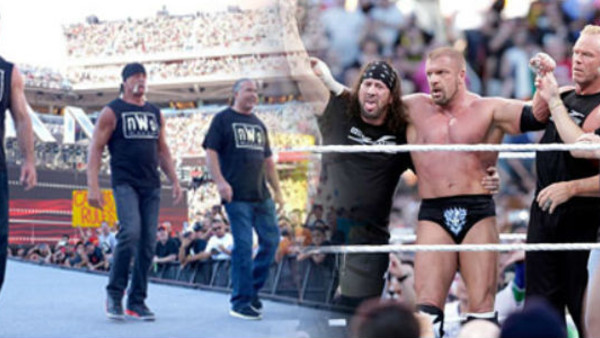
The NWO invented the cool heel faction, which D Generation X later copied and used to great effect. The history books now portray DX as the great innovators, with NWO's legacy being focused upon for its later failures. In truth, NWO actually borrowed the concept from New Japan, with Eric Bischoff picking up on the revolutionary NJPW versus UWF storyline. The WCW chief reinterpreted it in a North American context, with Scott Hall and Kevin Nash coming in as outsiders in spring 1996. They then formed the NWO with Hulk Hogan, the story being that they didn't operate under the jurisdiction of WCW. They were there to take over. When D Generation X arrived on the scene in the summer of 1997, the NWO had already been in action for a year, and they had set the tone for what a rebellious group should be. Even the DX merchandise was black like the NWO gear. Vince and WWE had borrowed massively from the WCW faction.

7. War Games Inspired The Elimination Chamber

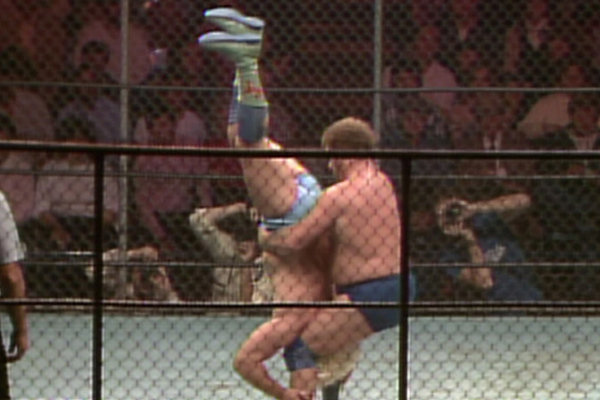
The War Games match was originally created by Dusty Rhodes in the late eighties, and it quickly became a success story at the NWA's Great American Bash. WCW then absorbed the match as part of their expansion, featuring it heavily in the early nineties as one of their key selling points. Right away, it became a success story, with the War Games match at WrestleWar 1992 earning a five star rating in Dave Meltzer's Wrestling Observer Newsletter. WCW's version of War Games went on to become one of the most celebrated gimmick matches in the industry. Triple H was always a fan of the gimmick, and got in Vince's ear about it in the early 2000's. The result was that WWE ripped it off, reinterpreting it as the Elimination Chamber. There's been several good matches since, although nothing has been quite as good as those early WCW War Games bouts.

6. Starrcade Inspired WrestleMania

WWE history tells the story of how WrestleMania revolutionised the industry in 1985, when in fact, NWA Jim Crockett Promotions (what would become WCW) hosted the first Starrcade special in 1983. This was the first North American supercard, not the WWF's WrestleMania. Furthermore, Crockett was broadcasting the event on closed circuit television, which was what Vince McMahon did with the first WrestleMania two years later. Off the back of that first Mania, McMahon told the story that he'd invented the concept of pay per view mega cards, but really he was just going off what Starrcade had set out to do in early eighties. Indeed, Starrcade remained the crown jewel of WCW's pay per view productions, and was more over than WrestleMania in the mid nineties.

5. The Cruiserweight Division

Something Eric Bischoff gets way too little credit for is his implementation of the cruiserweight division in WCW. It was Bischoff who brought high work rate guys like Eddie Guerrero and Rey Mysterio to the mainstream. The quality was phenomenal and provided WCW with some of its very best matches. McMahon tried to rip the gimmick off with his own "light heavyweight" division in 1997, for which he brought in several Japanese and Mexican wrestlers to support the endeavour. However, it never really caught fire, and it wasn't until the 2000's that WWE really found success with high work rate smaller wrestlers. To achieve that success, Vince outright stole the gimmicks that got WCW's cruiserweights over. Rey Mysterio came in with his mask, and instantly became a huge star. However, even with all of WCW's great workers, the WWE Cruiserweight Division still ended up extinct in 2007, although the style and worker quality ended up transitioned throughout the card. The fact is, if Bischoff hadn't proved there was a place for smaller workers, you may never have saw the likes of Eddie Guerrero becoming WWE Champion. WCW proved that a work rate gimmick could go a long way.

4. Sting Inspired The Ultimate Warrior

As the 1980's came to a close, Sting had established himself as the next big thing in professional wrestling. With his face paint and colourful gear, he was so much more vibrant and fresh than the ageing Hulk Hogan. Slowly and surely, he was putting WCW on the map as a force in professional wrestling. Vince McMahon took note of this, and decided to push his own face painted wrestler to the top in 1990. The WWF version of Sting was The Ultimate Warrior, complete with his own bright colours and distinctive face paint designs. However, what he didn't have, was Sting's wrestling ability. While Sting shot to even greater heights in 1990 as the World Champion, Warrior floundered as the WWF Champion.

3. The Higher Power And The Black Scorpion

Speaking of Sting and his 1990 championship run, he was haunted throughout the year by The Black Scorpion. This mystery figure was huge in the storylines, with the character played up in vignettes as Sting's biggest threat. It played out over months and months, until Sting finally wrestled The Black Scorpion in the main event of Starrcade 1990. Upon defeating him, he unmasked the heel and found out it was Ric Flair. After months of speculation and wild theories, it turned out to be just the same guy Sting had always been feuding with. Even though the gimmick was ultimately considered a disappointment, the WWF ripped it off with 1999's Higher Power storyline. Running for months on end, fans wondered who The Higher Power could be. It had been built around The Undertaker having a Higher Power and feuding with babyface Mr McMahon, so imagine the disappointment and confusion when The Higher Power appeared and removed his hood to reveal... Mr McMahon. Like the Flair reveal, fans felt let down. The gimmick of a mystery heel is fun, but when it just turns out to be the same old wrestler, it is inevitably disappointing.

2. Thunder And Smackdown

The WWE often hype up how they were so popular that they launched a second weekly broadcast, Smackdown, in 1999. However, the gimmick of a more wrestling focused show later in the week, was actually a WCW innovation. They launched Thunder on thursday nights from January 1998 onwards. It preceded Smackdown by over a year. When WWE came along with their own thursday night product, it even had Thunder's same blue branding. Unfortunately, Smackdown also ended up mirroring Thunder's negative points. At this point, the WWE show is just as irrelevant as the WCW show was. In the same way that Thunder became an after thought to Nitro, Smackdown is now just Raw's side show. The copying of the show's gimmick has literally been for better and for worse.

1. Ric Flair And The World Title

One of the most literal examples of WWE stealing a WCW gimmick, was when Vince McMahon brought Ric Flair in during the tail end of 1991. They even brought over the WCW World Title, literally presenting WCW's main franchise on WWF television. The embodiment of the southern company was now 'wooooing' WWF audiences. Such was the level of copying, that WCW legal moves followed, and the World Title ended up being removed from storylines. A decade and a bit after that, Vince once again brought the World Championship into WWE. Even though a new lineage started, it was marketed off the back of WCW's prestige and rich history of champions. Triple H even took it upon himself to become the new Ric Flair. However, the gimmick of the second championship never quite gained the reverence of the WWE Title, and Vince McMahon eventually dropped the second belt completely at the end of 2013. WCW's greatest gimmick prop had died a quiet death, with WWE unable to sustain two equal world championships.

WWE Writer

Grahame Herbert hasn't written a bio just yet, but if they had... it would appear here.