10 WWE Stars You Never Knew Were Announcers
A mix of big stars and oddities who had forgotten runs as WWE announcers.
Not as much lately, but for years, WWE would go through announcers like a hot knife through butter. With how much they value a "TV look," they've tried out a lot of announcers that, for whatever reason, didn't work out in the long term. A number of low-level announcers came and went, lasting anywhere from a few weeks to several months. One example I didn't include in this list, since he made it on to a pay-per-view event (SummerSlam '93), was prolific infomercial host Joe Fowler.
Maybe it was longer, but it felt like he was gone within weeks, back to selling me wonderful doodads I can't get in stores. They also experimented with a number of existing wrestlers and managers as color commentators, interviewers, hosts of the "Event Center" segments, and so on. Just think of some of the higher profile experiments over the years: Shane McMahon as the original co-host of Sunday Night Heat, the Honky Tonk Man on Superstars of Wrestling, Lita on Sunday Night Heat, older wrestlers like Tony Garea and Angelo Mosca early in the expansion era, Tammy "Sunny" Sytch as Tamara Murphy in the Event Center, and so on. You get the idea: There used to be tons of turnover.
Let's look at some of the most obscure of WWE's announcer runs.
10. Ian Mooney On Wrestling Spotlight
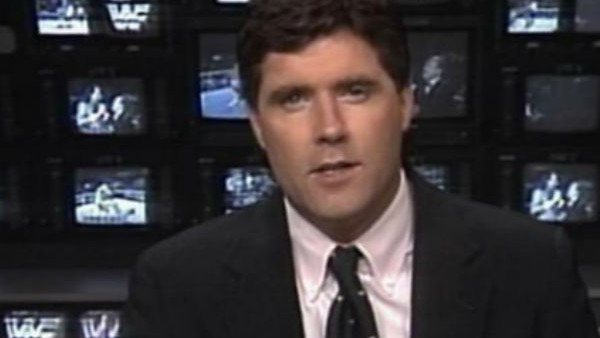
If you watched WWF shows in the late '80s and early '90s, you remember Sean Mooney, who hosted the Event Center segments and was the C-team level announcer for Coliseum Video and recap show exclusive matches, usually with Lord Alfred Hayes. He replaced Craig DeGeorge, who was the first in the line of the company hiring "non-wrestling" announcers for that role.
He wasn't an all-time great announcer, but he was fine in the role and had a good knack for the goofball WWF comedy he had to do. He didn't host Wrestling Spotlight. Instead, his identical twin brother Ian hosted the show. Well, not exactly. There was no Ian Mooney.
Ian was Sean playing his own twin brother. Why? I'm not sure anybody knows. It's not like it was ever played up for comedy. He was just Ian Mooney, being a regular announcer doing regular announcer things with his co-host...
9. Sensational/Queen Sherri On Wrestling Spotlight

Yes, WWE once had a show hosted by the combination of Sean Mooney's Fake Twin and Sensational Sherri. I've only seen a few clips of this in the past, and never online, but it looked like it was sheer madness. For whatever reason, Spotlight became the place to experiment with announcers in terribly weird ways. I wish this was online because it was pretty awesome from what I've seen.
Ian Mooney didn't contribute much, but Sherri, well...what do you expect? Her promos could be absolutely insane back then, so you can get an idea of what it looked like when she was in control of an entire television program.
8. Miss Elizabeth On Wrestling Spotlight
As you may or may not remember, once Miss Elizabeth and Randy Savage were completely split on-screen in 1989, she appeared very sporadically at WWF events in the next two years. She managed Hulk Hogan for some WrestleMania V rematches and appeared at WrestleMania VI to accompany Dusty Rhodes and Sapphire, but that was about it until she made her big return at WrestleMania VII.
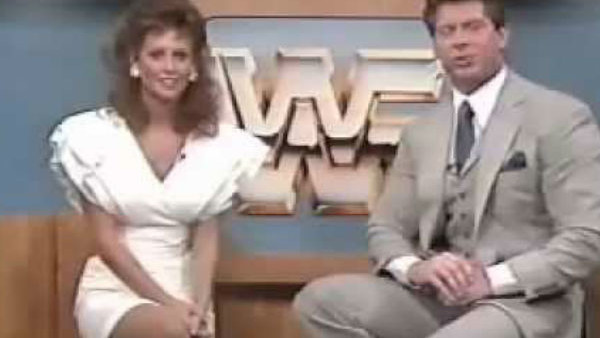
Well, sort of. For a while in 1989, she was also Vince McMahon's co-host on Wrestling Spotlight, the syndicated C-show consisting of recaps and obscure exclusives. She was an odd choice, to say the least, given how little she spoke during her career, though she did do wraparounds hosting the TV show of the Poffo family's ICW promotion several years earlier. Those were a lot more generic than her role here, but she actually did pretty well in the give and take with Vince, with a solid delivery.
So few people actually got Spotlight (or got it in an inconsistent time slot, like in New York) that it's hard to find footage of the show or even someone who remembers it well get an idea of how long anyone hosted it. I have no idea what led to the end of Elizabeth on the show and I'm not sure anyone else does, either.
7. Bruce Prichard On A Lot Of Shows In A Lot Of Characters That Weren't Brother Love
When he joined the WWF in 1987, Houston Wrestling announcer Bruce Prichard continued to call the Sam Houston Coliseum matches which were aired locally on KHTV and now nationally on various WWF shows. Joined by ring announcer Mike McGuirk and long-time job guy Pete Doherty, they were among the worst broadcasting teams in wrestling history, though it wasn't all Prichard's fault. Soon enough, Prichard became an on-screen character as Brother Love, hosting his own interview segment and occasionally calling matches. After several years, he was written off TV and eventually fired.
He returned in 1993, first as an unseen character named The Wizard, which was basically him using his regular voice. He was relegated to the lowest-profile English language WWF shows, like the Canadian-exclusive C-level recap show "Super Card."
Later in the year, when Jerry Lawler left to deal with legal issues, he was promoted to Vince McMahon's co-host on Superstars and repackaged as Reo Rogers. Reo Rogers was essentially Prichard doing a Dusty Rhodes impression while wearing a cowboy outfit with a ridiculous fake mustache. It didn't last long.
However, he did have one memorable segment: During the build-up to Survivor Series '93 (where Shawn Michaels replaced Lawler in a match against the Hart brothers), he hosted "Reo's Roundup" at what they claimed was Hart House. They visited "Stu and Helen Hart" (two people in "old man/woman" masks) and it was notable for having a ton of foreshadowing to Owen Hart's heel turn.
Prichard would return as Brother Love from time to time and even do some C-show work as himself again, but he was sort of replaced in that role by...
6. Dr. Tom Prichard On Metal
Bruce's wrestling brother was primarily a trainer when he started doing commentary on Metal, the "daytime"/more family friendly version of the WWF's syndicated B-show that replaced Shotgun Challenge. He was paired with Kevin Kelly, who was generally used as a backstage interviewer who The Rock would call a hermaphrodite (that sure wouldn't fly today) on the main shows at the time.
Prichard was actually very good, which wasn't surprising since he had experience as an announcer in various territories he worked in earlier in his career. It was different from his past work in that he wasn't doing a Roddy Piper impression the whole time, though. He just flew way under the radar, to the point that if you didn't watch Metal, you probably had no idea he was still part of the company.
After going to rehab in 2001, he never appeared on WWE programming again, though he had several more stints as a trainer in various developmental territories.
5. Vince Russo On WWF New York
Yes, he did appear on TV regularly in the WWF. When the WWF decided to start running a new original weekly syndicated show in January 1997, they started by launching Shotgun Saturday Night as a live (or almost live in some markets) late night show from night clubs with "edgy" content. That fizzled within weeks, and it just became a regular B-show taped before Raw.
Still, the name and format depended on the time slot, the market, and the preferences of the local TV station: Shotgun Saturday Night aired in the aforementioned late night slot, Shotgun and Shotgun Challenge were more family friendly shows that could be aired in any slot, and in international markets, including Canada, it was called Superstars.
In late 1997, one more version was added: WWF New York, which featured commentary customized for the New York market. Initially, they wanted Paul Heyman, but he wouldn't do it. After going on for a while without any real New York flavor on commentary, Vince Russo got the nod, teaming with Jim Cornette.
Really. Honestly, he wasn't that bad. He was no great shakes, but he was fine for the role he was playing. There's probably a good reason he didn't do any other shows, though.
4. Frenchy Martin On The French And Spanish Language Shows
Best known as a manager and sometimes wrestler, Frenchy Martin was actually an important part of the WWF broadcasting team for several years. Fluent in English, French, and Spanish, he would do color commentary in addition to serving as a featured interviewer with his own talk show segment, Le Studio. He'd also serve as Bobby Heenan's "assistant manager" to help translate his charge's promos.
In the spots where segments like Piper's Pit, The Body Shop, The Flower Shop, The Snake Pit, and later The Brother Love Show aired on English-language WWF programming, Le Studio replaced it for French and Spanish speaking audiences.
Unfortunately, unlike all of the above segments, Le Studio and its predecessors, such as Le Brunch de Pat Patterson, were taped in the TV studio at WWF headquarters without any kind of audience. Even though Martin was really good in his role, it loses a little something in that it comes off so canned.
3. Blackjack Mulligan On Superstars Of Wrestling
When the WWF started its national expansion in 1984, it had three syndicated shows: Championship Wrestling (A-show that became Superstars of Wrestling in Fall 1986), All-Star Wrestling (the other A-show turned B-show that became Wrestling Challenge), and Superstars of Wrestling (C-show with recaps that became Wrestling Spotlight). Most markets didn't carry Superstars of Wrestling, and it was repackaged a number of times during its early days.
Later in the year, it became a show where the newly hired Rodger Kent (having just left the AWA, he'd leave quickly but return in 1988) and Blackjack Mulligan hosted in a studio and threw to matches from Toronto's Maple Leaf Gardens, which they also voiced over. Kent was never good, so it looked like a move to hurt the AWA, while Mulligan was a great talker as a wrestler.
However, as we've learned over the years, interview/promo ability doesn't always translate to putting others over, and Mulligan wasn't very good. Nobody seems to know how long this format lasted, but it couldn't have been more than a few months.
2. Brad Armstrong On ECW On Syfy
When WWE started the new ECW, it was designed to be the bridge from developmental to the main roster. To assist in the process, they hired a number of veteran wrestlers who only worked on house shows to help teach the younger talent. The idea didn't last long, but they hired Mark "Henry Godwin" Canterbury (never worked a show), 2 Cold Scorpio/Flash Funk (worked on four shows), Rodney Mack, and Brad Armstrong. It wasn't long before ECW-specific house shows were dropped, with the top stars on the brand being added to the SmackDown house show tour.
Everyone was quickly let go, except for Armstrong. He had a reputation as an absolutely hilarious guy backstage, but he never got to show that side of his personality since he was, with a few brief exceptions, a career white meat babyface. WWE brass felt they could try to take advantage of his untapped potential and make him a color commentator.
He was introduced as a new analyst during the Matt Striker vs. Balls Mahoney match on the December 19, 2006 edition of ECW. I have no idea how much practice he had, but it may not have mattered as Tazz, ECW's usual color commentator, seemingly worried about his spot, sandbagged him verbally. He wouldn't give Armstrong any room to breathe, and that was the end of Brad in WWE.
1. Mark Jennings In The Event Center
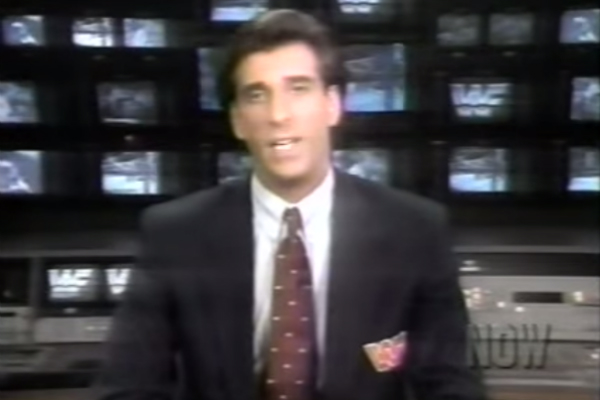
Where do you even start with this guy? In 1991, the WWF held a nationwide talent search for a new announcer. They picked a radio announcer of some sort (it's impossible to find biographical information about him, so who knows if he was a disc jockey or a newscaster or something else) named Murray Hodgson. After about two weeks of Event Center segments where he used the name Mark Jennings, he was fired.
He only made it to TV in a small handful of markets. The WWF said it was because he was absolutely terrible. Hodgson disagreed, and filed a lawsuit alleging sexual harassment and wrongful termination, since he said he was immediately fired when he refused an unwanted advance. His claim was that at July 29, 1991 TV taping in Worcester, Massachusetts, Pat Patterson made a pass at him that led to his downfall when he refused.
He recounted the conversation going like this: Patterson: "So you're the new guy. What do you taste like?" Hodgson: "You've got the wrong guy." Patterson: "Not if you want to keep your job, you don't."
When Hodgson debated Vince McMahon on "Donahue," he got the better of the exchange, which convinced a lot of people that he was telling the truth. Well, he wasn't. When it turned out he filed a near-identical claim against a previous employer, his lawyer quit the case and apologized profusely to the WWF.