15 Things We Learned From Scott Hall On Steve Austin Show Part 2

The second half of Hall's awesome interview with Stone Cold.
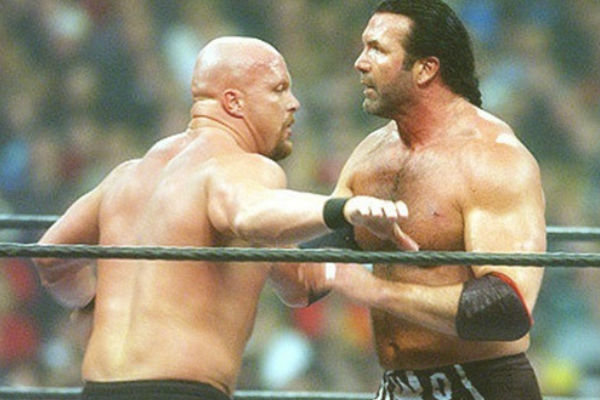
To borrow a phrase that our host and subject are quite familiar with, Stone Cold and Scott Hall are back for another one on this week€™s Unleashed version of The Steve Austin Show. The first installment produced some interesting talk between the two veterans with Hall giving us a glimpse into the early days of his career. The two men discussed how the €œThe Bad Guy€ broke into the business through Barry Windham in Florida as well as how much of his success he owes to the breaks he received from Diamond Dallas Page. We also got some great insight into Curt Henning who, despite being one of the industry€™s most legendary practical jokers was beloved by nearly everyone he came in contact with. Part two promises more of the same, with the two icons delving into the now years, such as what led to Hall making the jump from WWE to WCW, the story behind Sting€™s crow gimmick and learning to play politics with Hulk Hogan. It€™s another awesome installment from one of the greatest minds in the business. After hearing how knowledgeable - and perhaps more importantly €“ lucid Hall is after these two appearances it would be a real shame if he doesn€™t land a gig contributing to the business in some significant manner, provided that€™s something he€™s looking for. Read on to find out what we learned from Scott Hall in part 2 of his interview on The Steve Austin Show.

15. WWE Tryout

We pick up where he left off with Hall telling the story of how he first got into the WWE, after being told by Pat Patterson a year prior that WWE would being him in once his WCW contract was up and then...nothing. At this stage of his career, Curt Hennig was serving as somewhat of a liason between the talent and the office, €a step above the talent but not quite management€ as Hall puts it, so he had Vince€™s ear. Hall called him and asked if he could get him a tryout. He says that whenever a guy was brought in for a tryout, if he had a little name value to him they would throw him in with a nobody and job him out as a way of checking his attitude. He had been smartened up by Curt Hennig and expected that to happen but instead they had Hall go over.

14. Becoming Razor Ramon

After the match he was taken backstage to talk with Vince, with the added comfort factor of having his good buddy Curt sitting in on the meeting. This was during a time when the gimmicks were all based on reality and professions. Vince told Scott that he€™d heard his father was in the military and Hall stopped him and said €œVince, if you want me to be GJ Joe I€™ll be the best damn GI Joe I can, but have you ever seen Scarface?€ The WWE boss is notoriously behind the times when it comes to pop culture and this instance was no different as he had never seen the iconic movie about the drug kingpin. The head honcho was sold on the gimmick and told Hall he needed a name. One of the first suggestions was Shrug Shadow, but that didn't click for obvious reasons. Road Warrior Hawk also offered up the bane Deadbolt, which Hall liked but didn't feel fit the character. Razor was a name that he liked but Vince was initially reluctant, telling Scott there's already a boxer named Razor Ruddock. Hall replied in character "I'll kick his f*cking ass" and McMahon laughed and decided to go with it. But the last name was still missing, and it was Tito Santana who suggested the name Ramon while both men were using the urinals at the arena.

13. What He Learned In Puerto Rico

Hall credits his early success in WWE with some of the knowledge he gained while working in Puerto Rico, which for a while had one of the healthiest territories in the business running large baseball stadiums. He said that he would study tapes of Carlos Colon and his matches with Bruiser Brody and Stan Hansen, not for the moves but the psychology of working an angle. He talks about what a violent society Puerto Rico is and that to get over there you had to be a bad*ss. Scott remembers how thought out his push was in Puerto Rico, with him going over every babyface in the region on his way to working with Colon himself.
"The first time I put him over was in a bullrope match. He touched the four corners, he never pinned me and he never bumped me. I started thinking 'I get it. I'm going to kill everybody until I get to you, then I'm going to kill you in an angle. And then you've got to buy the job back. You've got to buy the bumps."
He said the formula worked because Carlos was happy and the arenas were full.

12. Working With Sean Waltman

Austin asks how fun it was getting to work with his good buddy Sean Waltman - at the time known as the 1-2-3 Kid - and Hall replies that he had never met him at the time they had their famous match. He says that the angle was laid out for him six months in advance, with Vince saying that the fans were turning him babyface so they had to go with it. He didn't want to turn him in the traditional way by having him run in and save another good guy, so he thought up the entire angle with Waltman. The two talked backstage and Hall told him he had one spot to get in and asked what he wanted to do and Sean told him "moonsault". Scott jokes that Papa Shango - AKA The Godfather - came up to him after the match and asked if he failed a drug test, and Rey Mysterio told him they thought he was legitimately injured and had to go to an impromptu finish.

11. The Ladder Match

Steve talks about ladder matches and how they changed the business for the better and worse, and asks Hall his opinion on the infamous bout between Razor Ramon and Shawn Michaels, calling it awesome and groundbreaking. Scott says he was comfortable with the angle because it was never based around hatred but rather sheer competitive desire. You had two guys who wanted to prove they were better than the other and they had matches to decide the answer. Scott comments that the Intercontinental title headlined the B-town shows, which was a good spot, and the two of them walked in one night and the program called for a ladder match. He says they probably had 50 more than just the one they're most known for, and even one where the ceiling in the arena was so low that he could have hit his head.
"I actually think we had some better matches that weren't televised. Sometimes the ladder just works with you and falls a certain way. Once you learn how to work with a gimmick then the gimmick does all the work."

10. The Curtain Call

Next we dive into the infamous Madison Square Garden curtain call when the departing Scott Hall and Kevin Nash were joined in the ring by Shawn Michaels and Sean Waltman to break kayfabe and say goodbye to the fans and each other. Austin asks about that moment, confused thinking that Hall cut a promo on Vince. Scott replies that he didn't actually get on the mic, but when the fans began chanting "You sold out! You sold out!" he pointed at Vince and said "You tell him to pay me and I'll stay right here." Steve asks what the feeling was like when they went backstage and he said that Vince wanted to talk to him. He had gone off on his boss six months prior and asked what areas of his work he needed to improve so he could make more money and Vince told him he was happy with the job he was doing. That night at the garden McMahon asked him how much WCW offered him, and he said they were past that point because he was leaving to go work for WCW the next day. When Hall told him what he'd be making Vince was impressed, saying that was good money was business is good but that at the time both companies were struggling. Hall said he remembers driving away that night apprehensively thinking "What have I done?"

9. The First Nitro Appearance

Scott remarks that the first Nitro he appeared on was in Macon, GA - an event at which this author was in attendance - and mentions that heat had already preceded him before he arrived. He recalls The Nasty Boys complaining that they'd have to start working house shows now that he and Nash had arrived and were making all that money. Credit goes to Larry Zbysko for the layout of that first appearance. Initially Bischoff was going to have him come from the walkway with entrance music and everything just like any other wrestler, but Larry talked him out of it, saying it needed to look like a shoot. Having him interrupt the match while the wrestlers just stopped fighting and exited the ring amidst the confusion was another nice touch that added to the realism and gave off that "this isn't supposed to be happening" vibe.

8. Giving Sting The Crow Gimmick

Hall says it was at that first Nitro that he gave Sting the gimmick that would not only revitalize his career but make him the hottest wrestler in the business for about 18 months. The man who was considered WCW's franchise had been growing out his hair and letting it revert to his natural darker color because dying it blonde had been taking a toll on it. Hall asked if he was growing his hair out, and when he told him he was he asked "Are you still going to wear the happy guy tights?" and he responded that he was. Scott asked Sting if he'd ever seen The Crow, and when he said he hadn't he began to explain the character to him, adding "I'm not telling you to rip off Undertaker, but rip off Undertaker." Sting went and researched the character, pitched it to Eric Bischoff and they ran with it to amazing results.

7. Kevin Nash Making The Jump

Stone Cold probes about Kevin Nash joining Hall in WCW and how that all came about. Nash's contract was up about ten days after Hall's, but originally he had planned to remain in WWE. Hall told him if he changed his mind, try to sign for more than he did because his favored nations clause would give him a raise to match Kevin's salary. The incident that changed Nash's mind was a cage match where he was working against Bret Hart. Diesel would hit Hart with the jacknife and go for the pin but the match would be interrupted by The Undertaker pulling Nash down through the ring. When it came to do the match Bret refused to take Nash's finisher because he didn't want to look weak, and Nash was p*ssed. Furious at the fact that plans for him could be changed because Bret "made a boo-boo face", he decided to bail and join his best friend in WCW.

6. The Birth Of The nWo

Austin asks how the nWo was born, and Hall responds that a lot of was freestyling, He credits Gene Okerlund with giving them the name The Outsiders and adds that the only reason any of it ever worked was because he and Nash were coming off "that hot New York TV." For his first appearance, they had it written down for him to say "You know who I am, but you don't know why I'm here." He says that's one of the things that got the lawyers involved, but he was contractually protected against any legal action. Eric Bischoff is the man who came up with the name "New World Order" and he says it's evident because Hulk Hogan alternated between calling it "Order" and Organization" in the famous promo the night he turned heel and joined the group.

5. Life After WCW

In regards to the end of his run in WCW, Hall said he had gone through a brutal divorce and his wife had gone to the lawyer's office and said that she would be dropping his kids off in his driveway later that day, surrendering custody. He called the office to explain the situation and told them he was quitting, calling that time some of the happiest days of his life. "Just sitting at home doing the dad thing. And I really, really liked it. It was during this time that he was at home and the phone rang, he looked over at the caller ID and saw the call was from Stamford, Connecticut...

4. Returning To WWE

He answered the call and it was his former boss Vince McMahon, although like just about every wrestler ever who gets a call from Vince he thought it was someone doing an impression to rib him. McMahon told him that he'd been talking to Hulk Hogan and Kevin Nash about coming back to WWE. Hall said he told Vince that it would be a good move because those two were proven stars, milking it because he wanted to hear Vince say it. The WWE boss said "We can't do with without The Bad Guy. Do you think we can work something out?" Hall said they could if they both wanted to and Vince told him he'd had Jim Ross call him later that week. Before they made their official return the Hall, Nash and Hogan were sitting around having a few cocktails and wondering if Vince would really push the nWo since it wasn't one of his creations.

3. Getting Clean And Sober

Truly inspirational and work that needs to continue. Austin asks what it was like getting inducted into the Hall of Fame, and comments on how different Scott looked since the last time he'd seen him. Hall says his life had changed so dramatically in that time that a year prior to that he arrived in Atlanta in a wheelchair. Austin agrees, adding that he "looked like sh*t" and he couldn't believe it was the same person. Scott says he was in a very dark place at the time, and while he never considered taking his own life he didn't care if he died because he'd completely given up all hope. DDP reached out to him - a guy who Scott says has always been a close friend to him - and brought him to his home in Atlanta. He's been back to his previous home in Florida to visit, but he was hanging out with the wrong people and didn't want to get back into that. Hunter contacted him and told him he'd wanted to reach out for a long time but the WWE's on-staff experts were saying that Hall needed to be completely away from wrestling in order to get clean. WWE had sent him to several traditional rehabs, none of which were working and they finally decided to take a different approach. They sent him to a facility in Texas where they gave him some in-depth psych counseling and began treating the root of the problem rather than symptoms.

2.The Most Important Thing He's Learned About Himself

Stone Cold asks Hall what the most important thing he learned about himself throughout all his years and the business was. He replies that he's never been one to take himself too seriously, so that's something that helped him. He also welcomed the make-believe part of wrestling and getting to be a character, noting that he never had any real success or got over when he was Scott Hall - the original, AWA version - because he was the same guy in the ring that he was in the grocery store and never knew how to flip the switch. It wasn't until DDP created a new look and character for him that he felt the freedom to let loose and come out of shell that he'd never felt before. "Everything's over the top anyway. Outlandish behavior and flashy clothes was all new to me."

1. Favorite Memory From The Business

When Austin inquires what his favorite road story or memory from his career is, he names a bittersweet moment when he and his friends were leaving Madison Square Garden after the curtain call. He talks about how they'd had a successful sold-out show, no one was injured and the curtain call itself had gotten over huge, and now he was gone. Shawn was the new champion and the man in WWE and he was happy, teasing that Hall better not try and come back in a month when they were beating WCW in the ratings, and he said he just felt lost. Scott says he knew he was about to get paid something serious and was content with that, but as far as everything else he had no idea what was waiting for him and in the long run it didn't turn out to be that good of a situation for him. He doesn't think he would have struggled and made as many bad decisions as he did had he been under Vince's watch. We end with Steve congratulating Scott on his recovery, complimenting him on the improvements in his health and appearance and Hall talking about his appearance in The Resurrection Of Jake The Snake and how hard that was for him, saying he's still taking it one day at a time. Another awesome installment from Scott Hall, and along with the aforementioned Jake Roberts, he's a guy who I could listen to talk about wrestling for hours on end. Stone Cold's been on a string of great podcasts lately with the last few guest so hopefully he keeps it up.

Contributor
Contributor

Brad Hamilton is a writer, musician and marketer/social media manager from Atlanta, Georgia. He's an undefeated freestyle rap battle champion, spends too little time being productive and defines himself as the literary version of Brock Lesnar.