It's Official: A New Era Has Begun In NXT
Finding faces in a Universe full of heels.

On a recent edition of NXT, The Undisputed Era's Kyle O'Reilly defeated Timothy Thatcher, Cameron Grimes, Bronson Reed and Kushida in a slightly convoluted gauntlet match to earn a shot at Finn Bálor's NXT Championship at TakeOver: 31.
There is something magnificently unspectacular about all of that.
Judging by online response - and where else is there to judge? - this was a popular decision. As was re-strapping the Champion that oversaw the original elevation of the brand from unknown quantity to barely-hidden gem half a decade ago.
Bálor/O'Reilly is as good as brand spanking new, reflects significant change at the top of the card, and interestingly looks set to main event a card free from the bells and whistles often deemed necessary to try and sell these supershows in the current era.
June's In Your House was a humongous hit with those that appreciated the nostalgia, whilst the thirtieth edition of the show in August added the faintest air of gravitas along with three giant X's to the barren set. Both were vastly improved from the catastrophic rearranged Tampa card, and all the actual TakeOvers feel worthier than the Great American Bash-esque television specials.
If all of that reads as a slightly complicated set of qualifiers about why this particular event kicks off a bold new journey for NXT, blame those in charge. "WE ARE NXT" might remain the calling card of the still-converted, but never has that felt quite as patently false. NXT categorically isn't NXT anymore, or if it is, it's time to reclassify what those letters now represent.
But a new era cannot be forged without understanding how the old one crumbled. And the events of just 12 months prior feel so long ago that they already appear in the mind's eye through a sepia Instagram filter.
CONT'D...

On 18 September 2019, NXT made the enormous leap between two very different Networks, moving from its safe haven on WWE's streaming service to the cut-and-thrust world of actual television with USA.
Both sides were theoretically playing things quite safe, even if their goals were a little different. Building off a relationship with Vince McMahon spanning decades, USA had a relatively good idea of what they were getting in the black-and-gold brand. Numbers weren't always revealed from how the show did for WWE (though weekly Top 10s sometimes listed 'Table For 3' et al outperforming it), but TakeOvers sold out buildings comparable to Monday Night Raw and the network's soon-to-be former property SmackDown Live. This was another wrinkle in the arrangement between WWE and USA - the blue brand was about to shift to Fox on Fridays. A week bookended by McMahon programming was about to be halved, until NXT slotted quite nicely into the schedule on Wednesdays - the night it would always air on the WWE Network.
But that's not why it aired on Wednesdays. Nor why it was moved at all.
AEW Dynamite was set to premiere on 2 October on TNT. That NXT got a two-week head start (that was patchy at best - the company had to split the shows between USA and their own Network due to the rush release) speaks to how desperate WWE to marginalise the success of their new opposition before they were even acknowledged as such.
A year later, and that audience-splitting marginalisation is just about the only thing left about the once-beloved three letters that seems to function precisely as intended.
CONT'D...
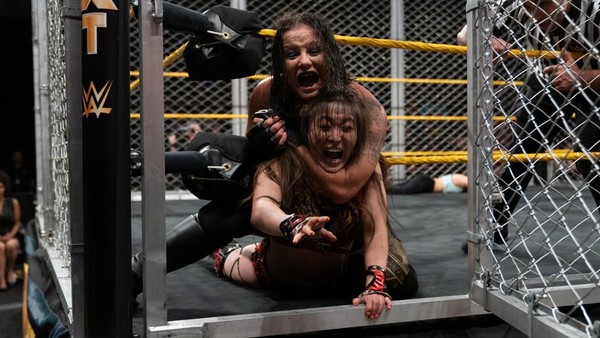
NXT had already advanced beyond what it once might have been (developmental/hideaway brand first, touring arena show second), but it had comfortably achieved that by 2017 at the latest. The ethos of the show had switched a little since then, but the TakeOver specials sold out just the same.
A golden era for babyfaces and breakout stars between 2014 and 2016, the show gradually morphed into a WWE-polished super-indie, with wrestlers and matches that had already defined the genre for PWG and similar organisations. At TakeOvers and occasionally on the Network show, NXT was matching or bettering contests taking place anywhere in the world. New Japan was in a period of unparalleled critical and commercial acclaim, but the black-and-gold brand routinely argued the toss for match-of-the-year candidates thanks to many of the cult favourites and internet darlings that were getting mainstream exposure for the very first time.
Perhaps most important of all was the perception battle NXT had won during its own formative years. Longstanding WWE fans had gravitated towards the show because it looked and felt more like the one they'd first fallen in love with, compared to the messy modern day "main roster". That very title was an important division, until the Wednesday Night War took its first casualty.
CONT'D...

In broad terms, the biggest fear most NXT hardcores had about the move was that Vince McMahon would pollute the with the same foibles that had made elements of Raw and SmackDown borderline unwatchable for the last 20 years.
What materialised was slightly more complex, but no less of a problem.
Losing weekly viewership battles to Dynamite triggered levels of panic booking hitherto unseen on the black-and-gold brand. In the old days, the formulas and patterns on the show were occasionally used as a stick to beat it with, but yet another incredible TakeOver typically justified the rigid process. Problem was, it was easy to see when it was no longer being followed.
Capitalising on a Survivor Series "won" by NXT, the show earned strong viewership victories with what proved to be the last of their major longterm payoffs. Rhea Ripley's NXT Women's Championship triumph over Shayna Baszler was carefully crafted over the summer, while Keith Lee's star shone so brightly after pouncing Adam Cole into space that it seemed like a Royal Rumble win (or at very least, elimination of Brock Lesnar) was in the offing. Rule-proving exceptions poked through elsewhere, but the frantic new pace and extra hour had exhausted resources, ideas and the once-sacred tenet of stability.
All of it was the beginning of the end, and it has taken nearly ten months for the show to catch up with the rest of the broken world and establish a new normal.
CONT'D...
Empty Full Sail is a challenge to promote a heated two hour wrestling show in, but WWE are the market leaders of a market that has (for better and worse) found ways to adapt, so that excuse only stretches so far. March saw the world sent inside, but NXT's weekly show had been on a significant decline from December's peak before then.
TakeOver: 31 - from its branding through to the eclectic but excellent choice of main event - feels like a conscious effort from Triple H to reclaim a bit of control from the two-pronged pressures brought forth by Network television and his dotty old in-law.
That number, 31, is nothing and yet absolutely everything. It doesn't announce itself as an obvious theme, like a thirtieth anniversary or a mid-'90s Floridian house. It doesn't try to make good on bad times, be they in or out of the company's control. It does, however, continue a tradition the Chairman himself insisted get the axe on the main roster right around the time the golden era of NXT shone brightest.
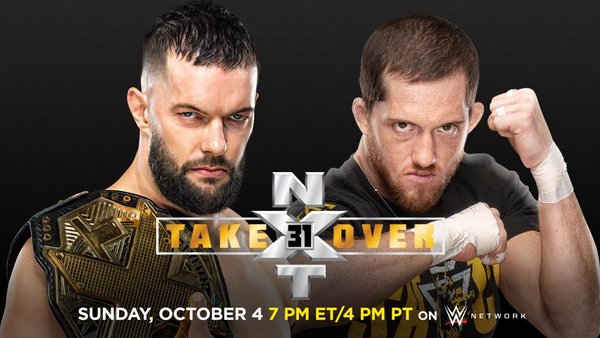
"31" was the number 2015's WrestleMania wasn't permitted to boast about. McMahon deemed it too old-sounding, prestige be damned. Having lost credibility, the babyface veneer and a substantial amount of respect, Triple H needs prestige more than just about anything else right now. He needs fans to trust the workers and the process, just like they used to before his baby became fodder in a quest to maintain a monopoly.
Finn Bálor vs. Kyle O'Reilly is more than just two very un-WWE guys likely to have a very un-WWE match on a show that will aim to be the most un-WWE of NXT's year. It's an outstretched hand to those that have lost their love for the brand, and the cutest act of defiance Hunter could realistically get away with.
Bálor hadn't yet won his first NXT Championship when the aforementioned 'Show Of Shows' featured more Triple H-per-minute than any other wrestler on the card. Back then, 'The Game' (who wrestled Sting, had a years-long entrance for that match and returned later for a segment featuring Ronda Rousey and The Rock) still wasn't convinced there were many better than himself for that stage. Five years on and he's come to understand how few have managed to reach that level with his help.
If this conscious attempt at a new era fails, only Vince McMahon's incandescent rage will be as loud as the audience's calls to abandon the existing model of NXT for good.
Watch Next
Can You Handle The BIGGEST Finn Balor Quiz!
