The Disturbing Truth Behind New Japan Pro Wrestling
Pro wrestling is a work.
New Japan Pro Wrestling is an absolutely awesome pro wrestling promotion.
It is unremittingly awesome, in fact. In 2019, IWGP Junior Heavyweight Champion Will Ospreay has graduated to become the best wrestler on the planet in critical circles. A phenomenal athlete who hasn’t so much perfected the aerial genre but transcended it, his rate of improvement is astonishing. Just last year, in a bid to refine his all-round game, Ospreay took to emitting howls of agony each time his battered neck struck the canvas. This overwrought selling almost amused some, and so Ospreay abandoned the approach. In 2019, he lands on his feet, somehow, having avoided a multi-rotation bump from his opponents’ most formidable weapon. That opponent, in turn, sells Ospreay’s impossible athleticism in awe.
Ospreay, in his execution and the psychological registering of it, has sold the last of the naysayers on his genius. He has replaced Kenny Omega as NJPW’s Best Bout Machine. The company continues to surpass itself. Its quality is guaranteed. Inevitable. That word develops a chilling connotation.
Will Ospreay stole the show at Dominion recently—but not the headlines.
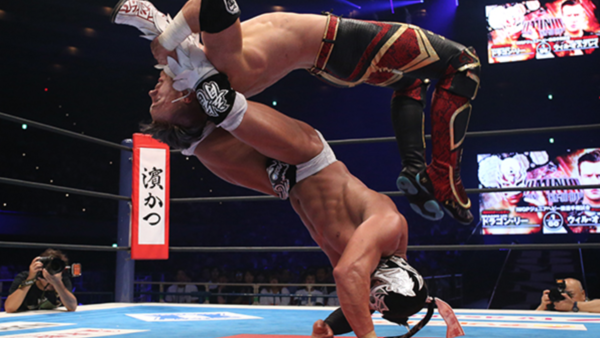
Kota Ibushi and Tetsuya Naito inspired a fierce debate across the wrestling Internet following the third entry of what most hope is a mere trilogy of disturbing, neck-driven violence. In the turning point of the match, both men hovered on the ring apron. Naito rained down forearms on Ibushi’s back. Ibushi, prone, relinquished his grip on the ropes. Naito wrapped his arms around Ibushi, hoisted him in position, and drove his head onto the fringe of the ring apron with a German suplex. Ibushi’s neck only clipped it. The rest of his body twisted, disgustingly, in the opposite direction. For a harrowing split-second, he resembled the hanged victim of capital punishment—only, nobody could see the rope.
Not least of which Ibushi.
CONT'D...(1 of 5)
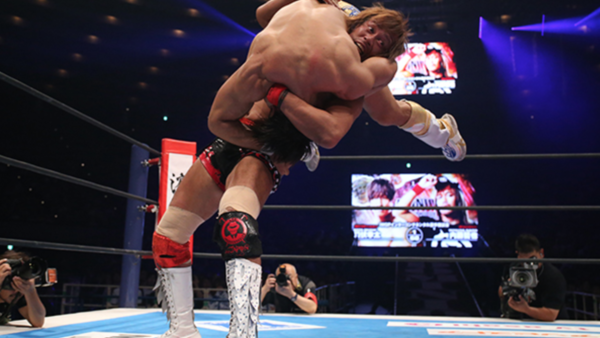
Ibushi continued the match with no intervention. His subsequent performance almost rendered this not a botch, but an artistic choice. He sold the impact as if catatonic, but timed every bump and comeback with a disturbing, graduating perfection. This wasn’t an instinctive performance reliant on muscle memory. He seemed to know what he was doing under the worked veil of semi-consciousness, informing an agonising but undeniable strain of none-too-real drama.
It was an incredibly dramatic spectacle. It was also a complete betrayal of the art form.
The match was less dangerous—just—than it first appeared in the disturbing throes of drama.
The Young Lions of NJPW and the informal disciples of Strong Style alike strengthen their neck muscles, in strenuous exercises, designed explicitly to mitigate the damage incurred from this sort of high-angle impact. These men are masters of the craft. Often, what appears reckless is executed safely. Pro wrestling commentators will tell you, in soundbite shorthand, that a ring general knows every square inch of the squared circle. These guys know to which millimetre a neck bump must be taken. That margin, however, is too fine for even the most masterful to judge. And, in the case of Ibushi and Naito, the kink for danger compels them to overstep it.
These neck bumps are taken under the fighting spirit philosophy. A Japanese talent gets over if they show enough of it; Tokyo’s Korakuen Hall crowd, in particular, rewards this endeavour. The molten, oscillating reactions of a loud Japanese crowd are not rooted in contrarianism, but rather a conflict. To earn the love of the crowd, a pro wrestler must fight when there is little fight left in them. The duelling support of the crowd acts as ammunition in the fast draw. It also doubles as an elixir under wrestling’s strange and fatalistic conflation of the work and the shoot.
It is so potent that it holds the power to obscure from the talent how little fight is actually left.
CONT'D...(2 of 5)

On June 13, 2009, All Japan Pro Wrestling and Pro Wrestling NOAH Ace Mitsuharu Misawa died in the ring as a result of what was, effectively, an internal decapitation.
The decades spent wrestling on the King’s Road, the most punishing wrestling style ever—in the ultra-demanding main event picture—eroded Misawa’s spinal cord to dust. He passed away after taking a back suplex. Dangerous in premise but flawless in execution, this was no freak accident; his bump clock simply struck midnight. Misawa’s in-ring death was as inevitable as the setting of the sun.
Misawa’s death did change things. For a time.
Decorated NJPW star Hiroshi Hase’s committee of education and science encouraged representatives of each major puro league to both implement formal safeguards and discuss a shift in the dangerous in-ring philosophy. Referees were made to apply for an official license for which they had to qualify; doctors were dispatched to ringside as a preventative measure; unprotected weapon shots to the head were effectively banned.
None of this was mandated by the Japanese government, and as such, it was only incumbent on the talent and the promoter to enforce the measures. Less than a decade later, this philosophy has crept, insidiously, back into the mainstream.
Kota Ibushi deifies Hiroshi Tanahashi. It’s ironic: the New Japan Ace flourished within this tentative new dawn of the early 2010s. Tanahashi perfected the space between moves as his stock elevated in parallel with that of the company he starred in. Tanahashi extracted drama not from gruesome impact but the evasion of it. The twisting, defensive, reversal-driven finishing sequence he trademarked subverted, ingeniously, puro’s modern theme of anxiety. Curiously, Ibushi did not learn that lesson from his teacher.
Sadly, the teacher himself appears to have forgotten it.
CONT'D...(3 of 5)

Tanahashi is thrashed.
In another ironic twist, the Ace this year captured the IWGP Heavyweight Title from Kenny Omega in a classic Tokyo Dome match promoted as a battle of philosophy. Tanahashi deemed Omega’s overtly dangerous style an inelegant, foolish bastardisation of the worked art. In the parameters of the storyline, Omega dismissed Tanahashi as an old man out of time.
But, to tell this story effectively, Tanahashi had to level up to Omega’s new-school risk having absorbed the ghastly brunt of it. He returned fire with a poisoned ‘rana ahead of the exhilarating finish, the dramatic effect of which was incredible because it was so atypical of the Ace. He had to lose something of himself to win—a strategy that informed the awesome drama and put Omega over as a proper Champion—but in winning, he didn’t reclaim the soul of New Japan. The danger has only accelerated in the months since.
Ibushi, Naito, Tanahashi: none of these men would do this, if it weren’t over. But what’s almost infuriating is that Naito was more popular before he indulged his lunatic tendencies to an extent that he is now defined by them.
The 2016 vintage of Naito was the coolest pro wrestler on the planet. His aloof flexing was far more effective than his recent, stupidly dangerous approach. It’s weirdly unimaginative for a performer of his creativity. It’s as if Naito actively enjoys endangering himself, because he is demonstrably talented enough to judge when exactly to inject danger in his most high-profile matches. Is this an adrenaline junkie thing, or are Naito et al. high on the critical acclaim?
CONT'D...(4 of 5)

You might be part of the FDM crowd.
Without opening up an entirely separate debate, Dave Meltzer commands respect from all arms of the industry. Both Will Ospreay and Dustin Rhodes, as different as two wrestlers can get, both rexpressed appreciation on Twitter to Dave after he awarded them with ***** match ratings. He is a respected man of influence, and although danger is the one, dubious constant in his highest-rated matches, it is not his responsibility to curb this death march. He is complicit—as are the fans—but he’s not guilty. It is the responsibility of New Japan management. They hold the authority, and they should know better. They are aware of the grimmest lesson in puroresu history, and New Japan is more stylistically diverse than All Japan ever was. This is all so unnecessary.
That Ibushi suffered this bump so close to the 20th anniversary of Misawa’s death felt like the interference of benevolent fate. And yet, Ibushi won’t listen. He won’t listen, even though the retired Katsuyori Shibata returned to the company in a non-wrestling capacity on the same show. Hiromu Takahashi has recovered from a broken neck, and is set to return to the ring imminently, tempting the risk/reward balance once more. These men have the devil in them. It is long past time the company acted as the angel on their shoulders.
The Disturbing Truth behind New Japan Pro Wrestling is that somebody is going to die in that ring.