The Best Ever Batman Comic Is One You've Never Heard Of
A look back at the genius of Darwyn Cooke's Batman: Ego.

As far as legends of the medium go, they don't get much greater than Darwyn Cooke. A legendary artist and writer who primarily contributed to DC during his career, Cooke was renowned for his cartoony-style and historical comprehension, with most of his stories directly weaving the past into their wider narrative.
His magnum opus, The New Frontier, is widely considered to be one of the finest stories in DC's library, with Cooke having used the story to analyse the medium - DC's character's specifically - through the lens of JFK's eponymous 1960 speech. His understanding of history was unrivalled in the medium, and while Cooke is no longer with us, having tragically passed in 2016, he crafted a legacy on and off the page that'll be remembered for decades to come. He was one of the true visionaries of the industry during the modern age of comics, and so it should come as no surprise, then, that his love-letter to Batman, a story called Ego, is really something special.
Except, for the most part, Ego has largely been squared away in discussions relating to the Caped Crusader's finest comics. The works of Frank Miller, Jeph Loeb and Dennis O'Neil are frequently optioned as the definitive Bat-comic (as they should be), but Cooke's work continues to elude the spotlight. Why this is the case, exactly, is still unclear. But what is clear is that the comic is in urgent need of reappraisal, certainly in regards to its critique of Batman's psychology, which Cooke marshals effortlessly throughout the comic's thirty-or-so pages.
Irrespective of the book's age, or its perceived popularity (or lack thereof), the genius of Ego's story lies directly in academic reflections of the Dark Knight, and in wider discourse surrounding the character himself. It's a true dissection of the character, but the conclusion that will no doubt resonate the most with Bat-fans relates directly to what people consider to be the character's real mask: Bruce Wayne, or Batman.
Cooke's reply to this debate is as surprising as it is authoritative, but - irrespective of that - it's plain for all to see that it's a seminal comic book text, and perhaps even the Caped Crusader's best...
3. A Hero On The Edge
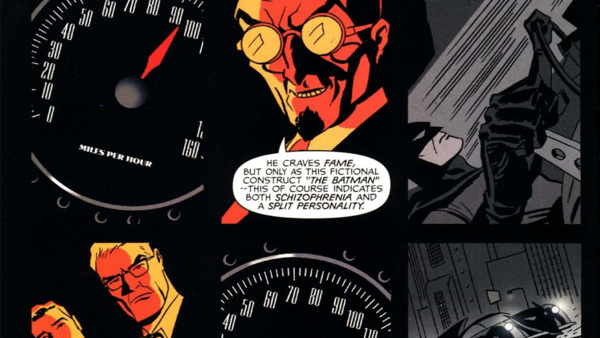
Adopting a BTAS-style aesthetic, which lends Ego an imperceptible kind of timelessness to it, Cooke brings the reader to a Batman at the pinnacle of his career. He's weary, but determined, and has just experienced yet another chastening encounter with the Joker. Having used an informant to find his way to the Clown Prince, the Dark Knight rushes to apprehend him before he skips town, perching atop Gotham's main bridge in an effort to do so.
Unfortunately for Bats, he fails to account for his own actions. The thug in question has actually gone to the bridge to kill himself, petrified at the inevitable prospect of the Joker breaking out of Arkham and murdering him and his family for turning him over to Batman. In his attempts to save him, Bruce also discovers that the man has killed his wife and children, so potent is the Joker's reputation for extreme violence, before he commits suicide with a self-inflicted bullet wound to the head.
In the proceeding panels, Cooke illustrates that the Dark Knight is about to experience the night of his life. This was a death that laid bare the impact Batman, and the villains his presence undoubtedly invites, has on Gotham's citizens. Racing to the Batcave in an earlier Batmobile, Bruce is taunted by the ghosts of his past, with Hugo Strange foreshadowing the themes of the story with a passing comment on Wayne's ostensible "split personality". There's a real sense of speed - and urgency - in the sequence, with Cooke also taking the opportunity to illustrate how close to the edge the character is, by having the Batmobile stop just short of plummeting into the depths beneath Wayne Manor.
The book's prologue is powerful for a whole host of reasons, but one thing that definitely stands out is Cooke's eye for Gotham as a character in and of itself. Taking inspiration from Fleischer Studio's Superman shorts and, by extension, Batman: The Animated Series as well, Cooke's Gotham is a veritable metropolis, one that oozes atmosphere right off the page. It plays directly into his classic aesthetic, and for fans of New Frontier in particular, it's a delight to see him working in that period yet again.
2. What Lies Beneath The Mask

After returning to the Cave, Bruce finds himself questioning his role as the Dark Knight. As Batman, he was meant to protect, but his presence only gave way to a more extreme kind of crime and, whether directly or not, his arrogance (or ego), just cost the lives of an entire family. In a moment of desperation, Wayne dares to dream of a life after Batman: "I can't do it. Not anymore."
And then, quite literally, the spirit of Batman comes to life. Manifesting on the Bat-Computer, the ghostly figure of the Dark Knight berates Wayne for losing his will to avenge, with Cooke taking the opportunity to visually illustrate the duality of the character and, more importantly, how both are integral to his success. It shows Bruce at his most vulnerable (an important aspect, in light of the character's reticent nature both on and off the page), with Cooke's navigation of Bruce's formative years - as in, the ones immediately preceding and succeeding the death of his parents - a key highlight of the story.
It carries real emotional weight, and while there've been plenty of Batman origin stories over the years, none are as thorough in their analysis as Cooke's. It chronicles the psychological genesis of Batman as an entity, and while it's a moment steeped in tragedy, there's something almost triumphant in the way Bruce comes to terms with his role as Gotham's Dark Knight.
It doesn't lend itself to clichés that have stipulated that Bruce, not Batman, is the real mask, and proclaims with real confidence that you cannot remove the Bat from the Man - the two must cohabit to be who they are.
1. The Essence Of The Dark Knight
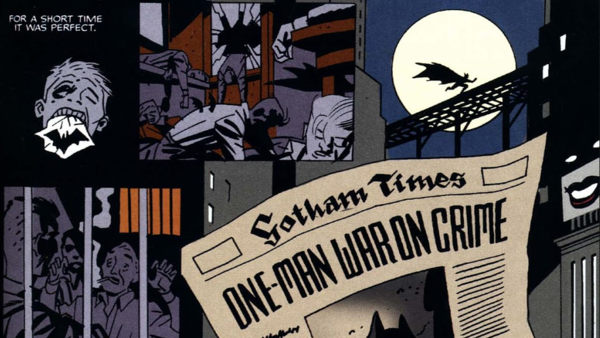
At its core, Batman: Ego is as much a celebration of the Bob Kane, Bill Finger creation as it is an analysis of his evolution over the years. Atmosphere drips from every panel, and in addressing one of the most contentious aspects of the character, the book's importance is impossible to overstate.
What Cooke's story also does, however, is encapsulate pretty much everything there is to love about the character in a tremendously short space of time. It's Batman as he's meant to be; emotive, determined, but also uniquely human. In a world crammed with Kryptonian aliens, magic users, and intergalactic policeman, that element - more than any other - is of key importance.
And yet, whether it be because of its length, or its age, Ego struggles to find the fame other Bat-books have for so many years. It might not have redefined the genre in the same way like a Dark Knight Returns or a Year One could, but it's no less salient. Those comics wrote the book on modern Batman, but Darwyn Cooke understood what those stories didn't. The Dark Knight might be a force of nature, but he is, at his core, still Bruce Wayne.
You can't take away one, without losing the other.
For more Bat-tastic retrospectives, be sure to head on over to WhatCulture Comics on YouTube!