10 Beloved Movie Heroes Who Are Actually Trash
The greatest trick the Devil ever pulled...
What does (almost) every movie need? A hero, of course, and on the shoulders of a charming, courageous or badass protagonist are so many unforgettable movies made.
But the sheer number of garbage heroes throughout cinema is proof perfect of just how tough it is to create one that's likeable, relatable and ultimately iconic.
Just look at Anakin Skywalker (Hayden Christensen) from the Star Wars prequels or the DCEU's gloomy sad-sack interpretation of Superman (sorry, Henry Cavill).
Sometimes, however, a filmmaker will succeed in giving audiences a hero they can truly root for and revere, but a closer inspection will reveal that, in fact, they're actually trash stacked six feet high and sculpted into human form.
This obviously excludes heroes well aware of their own douchebaggery - Deadpool (Ryan Reynolds), for instance - but instead much-loved cinematic heroes whose valorous and noble acts are coloured by questionable acts that the films themselves don't care to address.
People are complex creatures after all, and just because you save the world from annihilation, it doesn't mean you're inherently a beacon for all that's good in the world...
10. Batman - The Dark Knight Trilogy
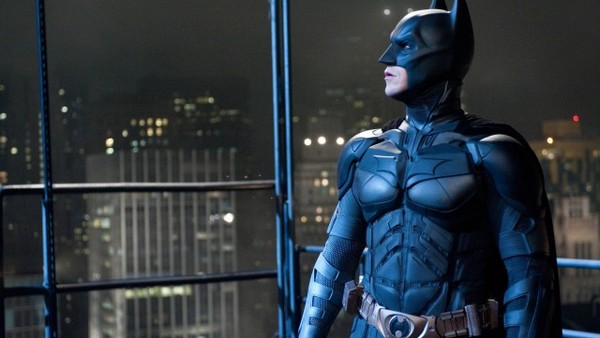
Batman is without question one of the most iconic superheroes in all of pop-culture, and he was lent an especially evocative treatment as played by Christian Bale in Christopher Nolan's Dark Knight saga.
A cornerstone of Batman's mission statement in ridding Gotham of tyranny is his no-kill rule, yet it's one which the Caped Crusader rather recklessly violated in each of the three movies.
Batman Begins saw Bruce Wayne burn down the League of Shadows' temple and quite clearly kill at least a few men in the process, and he "didn't save" Ra's al Ghul (Liam Neeson) after setting in motion the events of his demise.
Meanwhile in The Dark Knight he killed Harvey Dent (Aaron Eckhart), and in The Dark Knight Rises, he killed Talia al Ghul (Marion Cotillard) in the climactic car chase.
Now, nobody's doubting the moral quandary Batman faced in most of these scenarios - especially killing Two-Face to save Jim Gordon's (Gary Oldman) son - but it's the unbearable, unspoken self-righteousness with which Nolan depicts the character, as though these kills "don't really count."
If anything it just underlines how difficult it would be for a superhero to conduct their business without the occasional act of murder, but given that The Dark Knight in particular highlights Bats' steadfast refusal to take lives, the frequency with which he does it just makes him seem like a massive, sanctimonious hypocrite.
Granted, Nolan's depiction of the Bruce/Batman dichotomy has always been a bit morally frayed, but there's a clear cognitive dissonance between the sweeping portrayal of heroism we're supposed to be seeing and the more challenging, ambiguous one we actually get.
Just accept it, Batman - you're a stone cold killer when the time calls for it. But not as murderous as Batfleck, at least.
9. Rick Deckard - Blade Runner

There's perhaps no movie genre more ripe for moral uncertainty than film noir, so it's not terribly surprising that Blade Runner's protagonist Rick Deckard (Harrison Ford) isn't the most virtue-filled of movie heroes.
His entire charge, of hunting down rogue replicants, is itself rife with questions about the moral righteousness of killing entities which may or may not be "alive."
But ultimately Deckard is the audience's hero to root for, and let's face it, it's nigh-on impossible not to gun for Harrison Ford even at his most surly.
Yet as with Nolan's Batman films, the difficulty is in the chasm between how the movie wants audiences to view Deckard and the actual reality.
Yes, Deckard is a gritty, hard-nosed detective, but he's also dangerously close to being labelled a rapist, as evidenced by his forceful attitude towards replicant Rachael (Sean Young) during their first "love" scene.
It's certainly possible that the point of the scene is to highlight Deckard's de-humanised view of replicants, consent and all, but it's such a cringe-inducing part of the movie that Denis Villeneuve's sequel effectively had to (quite successfully) re-write the nature of their relationship to make it seem more loving.
Deckard is frequently held up as one of the all-time best-loved movie heroes, but really, he's quite the a**hole.
8. Star-Lord - Avengers: Infinity War

Star-Lord (Chris Pratt) is easily one of the most likeable superheroes in the MCU, largely thanks to the character's goofball persona and Pratt's effortlessly charismatic performance.
But even if you accept Peter Quill's status as The Avengers' resident man-child, he has one undeniable black mark against his name: he basically let the Snap happen.
After all, it's Quill's impulsive, emotional reaction to learning Gamora's (Zoe Saldana) fate which allowed Thanos (Josh Brolin) to keep hold of the Infinity Gauntlet and ultimately decimate half the known universe.
You can argue that it simply "wasn't meant to be" as presumably ordained by Doctor Strange's (Benedict Cumberbatch) delve into the future, but even so, weren't we all left groaning in exasperation last year as Star-Lord lost his rag with Thanos?
It may have been an action consistent with Quill's established character, but that didn't make it any less difficult to loathe him as a result.
7. Paul Kersey - Death Wish

Paul Kersey (Charles Bronson) is the undeniable figure-head of the revenge movie, having starred in five Death Wish films over the course of 20 years, with each new movie taking an increasingly absurd and less moralistic approach to notions of violence and vengeance.
Though the first Death Wish was a more pared-down movie about a man avenging his slain wife and raped daughter, the sequels increasingly saw Kersey basically begging urban "undesirables" to antagonise him so he could gun them down in hilariously brutal fashion.
There's inherent sympathy for Kersey in the original film, but with each passing sequel the motivating death/rape/whatever becomes less a vehicle to examine the effect violence has on a man and more an excuse for him to slaughter dozens of (often non-white) criminals.
It's all right-wing bait, of course, and to that demographic Kersey is an undeniable paragon for gun rights and the notion that "the only solution to a bad guy with a gun is a good guy with a gun."
The clear relish Kersey takes at unleashing vigilante justice makes him rather tough to sympathise with, especially in a time where gun control is a more contentious political issue than ever.
6. James Bond

It's not exactly a secret that James Bond is a serial misogynist, but he is certainly one of the more "problematic" movie protagonists who, despite his misgivings as written, continues to endure as one of cinema's all-time most beloved heroes.
Revisiting some of 007's earlier outings proves especially alarming: Sean Connery's Bond dismissively asks a black sidekick to fetch his shoes in Dr. No, and didn't have many qualms at all about back-handing a "disobedient" woman or two.
It's not just a case of Bond being a product of his time, though - a time where racism and sexism weren't bad? - because 2012's Skyfall was rightly skewered for having Bond (Daniel Craig) creepy sneak into a shower to have his way with Severine (Bernice Marlohe), a victim of sex trafficking. Nice.
007 has always been a tough, ambiguous character and the more recent instalments have further highlighted his closed-off, dubious sense of humanity, but given how millions of fans still hold Bond up as a quintessential "man's man" and an ideal of masculinity, it's pretty troubling that he's such a shameless trash-pile.
5. Daniel Hillard - Mrs. Doubtfire

If you grew up in the 1990s, there's a solid chance you're a huge fan of Mrs. Doubtfire, the delightful family comedy where an unreliable father, Daniel Hillard (Robin Williams), dons complex prosthetics to pose as an old housekeeper and get unrestricted contact with his blissfully unaware children.
At the time of the film's release, Mrs. Doubtfire was embraced as a harmless, effortlessly charming depiction of dedicated fatherhood, with Daniel's estranged wife Miranda (Sally Field) basically accepted to be a stone-hearted bitch who wouldn't give Daniel the time of day.
But there's no reality where Daniel's elaborate ploy isn't insanely creepy, and if gaining unapproved access to his kids by posing as somebody else isn't off-putting enough, he almost kills Miranda's suave new partner (Pierce Brosnan) by poisoning his dinner with pepper, to which he's deathly allergic.
Williams' charm in the role is strong enough that younger audiences in particular can probably still have fun with it, but viewed as an open-eyed adult, it's easy to see why Daniel's visitation with his kids was so aggressively restricted.
4. Tom Hansen - (500) Days Of Summer

(500) Days of Summer was an instant critical and commercial hit on release, winning much praise for its "authentic" and unexpectedly complex depiction of human relationships.
Our hero is Tom Hansen (Joseph Gordon-Levitt), a hopeless romantic who quickly finds himself infatuated with Summer (Zooey Deschanel). But their "happily ever after" wasn't meant to be, and after warning Tom that she wasn't after anything serious, she eventually dumps him.
The movie unfolds from Tom's perspective, and for many audiences - especially young men - it appears to depict Summer as cold-hearted and difficult, breaking poor Tom's heart and positioning him as an easy-to-root-for romantic hero.
Except, that's not what (500) Days of Summer is really about.
Tom may be an initially charming chap thanks to Joseph Gordon-Levitt's inherent likeability, but he's also a textbook example of a "nice guy" - placing Summer on a pedestal, refusing to accept her on her own terms, not listening to her clear terms for the relationship and entering a self-imposed depression when his unrealistic expectations aren't met.
Gordon-Levitt himself said as much in a tweet last year, and though this reading was clearly intentional on the part of writer-director Marc Webb, it's an aspect of the movie that flies over the heads of so many viewers.
And considering how many fellow "nice guys" may watch the movie and use Tom's plight to fuel their own demented underdog narrative, it's arguably a little bit dangerous, too.
3. Holly Golightly - Breakfast At Tiffany's
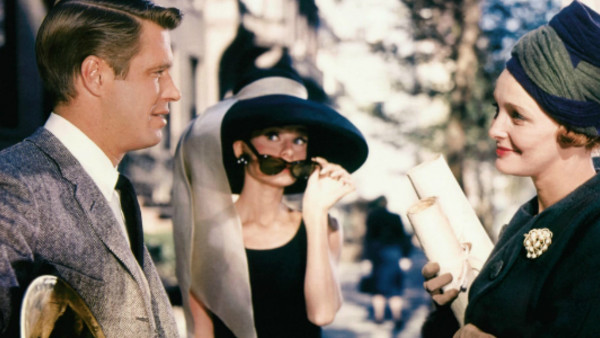
Breakfast at Tiffany's is an undeniably classic rom-com, albeit one which hasn't aged all that well in a number of key areas.
Outside of Mickey Rooney's embarrassingly racist portrayal of an Asian man, we have protagonist Holly Golightly, the signature role of Audrey Hepburn's career and one which has remained unshakably iconic for almost 60 years since.
But take away Holly's undeniably alluring style and you have a "hero" who isn't much heroic at all.
Holly is a country bumpkin-turned-socialite whose falseness drips from her every pore, yet her striking looks allow her to part men with their money for use in the "powder room", while the particulars of her interactions with these men are left somewhat ambiguous.
You can certainly argue that Holly is simply gaming the system and using her natural sex appeal to upend a patriarchal system, but for generations of young women to view her as a feminist icon is a bit iffy.
Feminism is, at its core, about the equality of the sexes: not using men and viewing most of your interpersonal relationships with them as transactions to "redress the balance."
As lovely as Hepburn is in the role, when you take away the chic black dress, Holly's a skittish character not worthy of trust or admiration.
2. P.T. Barnum - The Greatest Showman

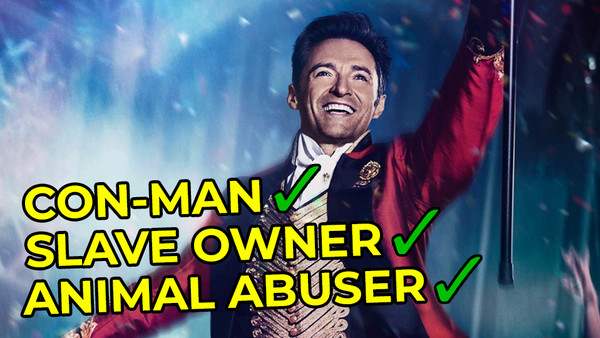
If you took 2017's hit musical The Greatest Showman at face value, legendary showman and entrepreneur P. T. Barnum (Hugh Jackman) was not only a great businessman but also a pretty swell guy, too.
Building a circus empire out of nothing and giving his performers a grand stage on which to showcase their abilities, the film holds Barnum up as a champion for those with unconventional talents, while depicting precious little of his darker side.
Yes, there are hints of a possible affair with striking Swedish singer Jenny Lind (Rebecca Ferguson), but overall the movie presents a cleaned-up depiction of Barnum's rise to fame.
In reality, Barnum's most egregious infractions include buying an elderly, blind and near-paralysed black woman named Joice Heth, who he toured around the U.S. as a 161-year-old woman, and upon her death even charged admission for her public autopsy. Nice.
Elsewhere many of his early attractions relied on exploiting racial stereotypes - and indeed, racism itself - such as billing a black man as "half-man, half-monkey".
That's to say nothing of the flagrant, well-documented abuse of animals under his possession, especially elephants. Animals were frequently kept in cramped and inhumane conditions which often led to their deaths.
Though Barnum did become a politician later in life and ultimately rallied against slavery, his early successes are forever tarnished by his unscrupulous methods, which the film itself unsurprisingly decided to completely ignore.
It's almost as if a figure of Barnum's ruthlessness needed a more grounded, gritty biopic rather than a doting, glossy musical...
1. Rocky Balboa - Rocky

There aren't many movie heroes more beloved than Rocky Balboa (Sylvester Stallone), the prototypical cinematic underdog who came from nothing and got to prove himself against the top dog.
But the first Rocky has also been taken to task in more recent years for its depiction of Rocky's icky courtship with Adrian (Talia Shire).
Rocky's designs on Adrian ultimately come across as eyebrow-raisingly aggressive, especially during the infamous scene where they first share a kiss, with Rock blocking the doorway as she attempts to leave.
Some have argued that this is merely Rocky's awkward, dopey attempt to combat Adrian's clear shyness, but it also accentuates an already noted power differential between the two, with Adrian likely feeling pressured to "give in" and smooch Rocky.
This isn't to say that the entirety of Rocky and Adrian's relationship is a lie because of how it started, but his behaviour here definitely runs counter to his heroic status, and especially in the era of #MeToo, his conduct sticks out like a sore thumb compared to the rest of the film.
What's your assessment of these movie "heroes"? Cancelled or not? Shout it out in the comments!