10 Glaring Plot Holes You Didn't Realise The Movie Actually Solved
It's not a plot hole if the movie explains it.
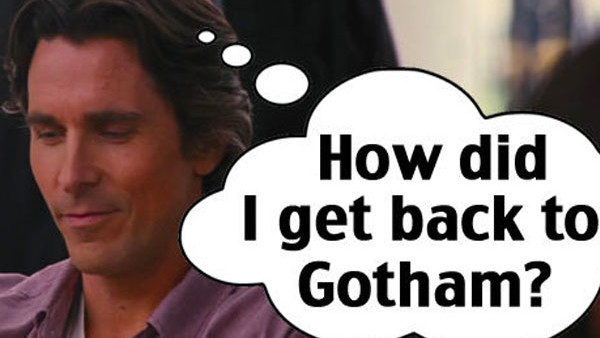
If there's one thing people love to do more than enjoying movies it's tearing them to shreds. And nothing is more destructive than pointing out a massive plot hole.
There are some pretty big ones out there. How did Cypher manage to go into the Matrix to visit Agent Smith without a techie in the real world? Why does Buzz Lightyear stay still when Andy's around if he doesn't think he's a toy? What time zone do Gremlins measure midnight in (and when does it stop being "after")? Why does monkey Tim Roth take over Earth at the end of Tim Burton's The Planet Of The Apes? OK, so that last one isn't technically a plot hole, but it's still really annoying.
The thing is, there's plenty of plot holes out there with shockingly simple solutions. Far from ruining their movies, they're really just a sign of people missing what's right in front of them.
And they're not just solved by fan theories either. Whether people have missed the obvious solution, or the director's put just enough in to make it feasibly solvable, many of cinema's biggest "mistakes" are explained in their own movies.
So come along and see which of the biggest movie plot holes are anything but.
10. How Did The T-Rex Get Into The Welcome Centre? - Jurassic Park

The Plot Hole: Not content with stealing three scenes in Steven Spielberg's phenomenal dino-romp, the T-Rex shows up one final time at the end of Jurassic Park to save our heroes. Sneaking into the Welcome Centre, she (they're all female, remember) gobbles up the velociraptors that were going to treat the park's early guests like melting ice cream.
But wait a second - fossil records reveal the T-Rex normally stood at six metres tall (its body sat horizontally). How did it manage to get into a building designed for creatures a third of its size?
The Solution The Movie Gave Us: The whole deus t-rex machina ending wasn't included in the film until late in the day, but that doesn't mean there wasn't time for Spielberg to provide a get-out for this particular plot hole. In the first full shot of the saviour beast, a wide open hole in the wall can be clearly seen - the building is, after all, still under construction.
If you want a genuine Jurassic Park plot hole where spatial awareness goes out a giant-sized window, check out the first tyrannosaur scene where the T-Rex paddock goes from being on a level with the track to having a massive drop in minutes.
9. Loki Gets Captured Just To Bring Together Those Who Can Stop Him - The Avengers

The Plot Hole: In a series notorious for pretty bland villains, Loki is a highlight of the Marvel Cinematic Universe - most people are excited for Thor: Ragnarok simply because it marks a return of Tom Hiddleston's God of Mischief. He improves every film he's been in, even the already incredible The Avengers.
The film's second act sees Loki captured in what is revealed to be a complex plot to drive the titular heroes apart. Which is the stupidest plan ever - not only does it rely on, but it actually creates, the very thing that stops him. Dumb as well as puny.
The Solution The Movie Gave Us: This is a fair enough criticism of Silva in Skyfall or the Joker in The Dark Knight, where a similar trick is played, but there the meticulously plotted schemes lie heavily on coincidence. Not only does Loki's plan allow more for unpredictable events, it's also got a genuine purpose - he appears to be doing pre-emptive damage control.
Bear in mind that he's not the mastermind of the Chitauri invasion and this all seems pretty sensible. The mid-credits sting, revealing that the whole thing was all part of some grander plan of Thanos (he does, in the comics at least, literally want to "court death"), suggesting the Titan seems to want the team together.
8. Who Heard Kane's Last Words If He Died Alone? - Citizen Kane

The Plot Hole: What is Rosebud? The entire plot of Citizen Kane is driven by the meaning behind the newspaper tycoon's final words. And, after two boobless hours, it's revealed it's his sled from when he was a boy. Aw, so the monster is just like us.
It's a great narrative technique, a curious reporter's investigation allowing for a ground-breaking non-chronological story. So it's pretty movie ruining when you realise that no one was there to hear him actually say the words - his nurse comes into the room only after he's died.
The Solution The Movie Gave Us: It's possible those final gasps somehow echoed through Xanadu, but there's a much simpler explanation that the film itself puts forward.
When the reporter interviews Kane's butler, he reveals he was in the room with him when he died - we just didn't see it in the meticulously edited opening. Although that poses another question - why did he just stand in the shadows when his master died?
7. How Did Bruce Wayne Get Back Into Gotham? - The Dark Knight Rises
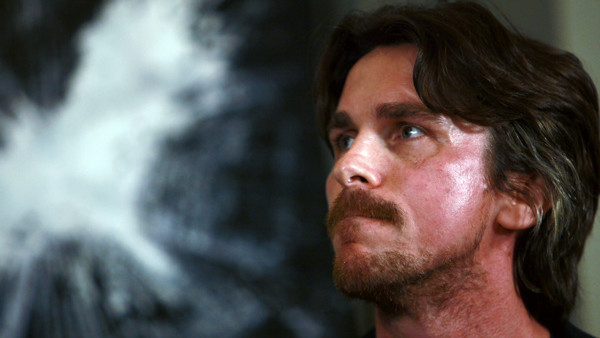
The Plot Hole: The Dark Knight Rises is full of alleged plot holes that aren't as movie destroying as its detractors would have you believe. That doesn't mean there aren't some dumb ones.
There's clearly an editing snafu in the location of Miranda Tate in the lead up to the final battle (Batman asks Gordon where she is, despite having just been with her), but the biggie is how Bruce Wayne got back into a sieged Gotham without the use of any of his Bat-tech.
The Solution The Movie Gave Us: There's lots of crazy theories as to who Bruce got back, ranging from the kinda logical (he used the Bat on auto-pilot) to the kinda totally not (Superman flew him across). But using everything we know about Gotham from across The Dark Knight Trilogy it's easy to construct an in-world solution.
In Batman Begins we learn two important things about the Wayne Mansion - it's not actually in Gotham (confirmed in The Dark Knight) and it has a bunch of old tunnels that connect it to the city. And that's really all you need to explain it. As for getting back into the US from the Pit, we saw in Begins that Bruce has experience as a criminal - this isn't the first time he's smuggled himself over borders.
6. How Did Andy Reattach The Poster? - The Shawshank Redemption

The Plot Hole: In a surprise twist ending, it's revealed that a movie that has Redemption in the title is going to have a happy ending. Shocker. Turns out that Andy Dufresne, wrongly convicted of a double murder, has been slowly tunnelling his way out of Shawshank Prison for a hammer-blunting twenty years.
Using a poster of Raquel Welch to cover his escape, one night he crawls to freedom. Good thing his cell was on the end. The problem here is that it'd be nigh on impossible to put the poster back up - it's not a position people normally find themselves in. So how did Andy manage to reattach the poster at all four corners?
The Solution The Movie Gave Us: Short answer, he didn't. The framing of the reveal scene is incredibly interesting in that the poster isn't seen until the Warden throws the chess piece through it. This obviously stops the audience from preemptively thinking it's important, but has the added benefit of making it impossible to tell how exactly it's hung up - it's conceivable Andy just stuck it to the wall above the hole and let it drape naturally.
Remember that Andy didn't need his escape to go unnoticed forever - it'd inevitably be discovered soon after morning inspection. He just needed time to get round the banks and reveal the warden's corruption before the search properly got under way.
5. Why Does Obi-Wan Lie? - Star Wars

The Plot Hole: Star Wars is the typical fantasy story, just transplanted into space; there's a wizard, an evil castle and camp sidekick. Heck, the hero is even an orphan. Not just any orphan either - his father was killed by the big bad guy.
But then in The Empire Strikes Back it's revealed that the big bad is his father. Cue worldwide playground debates and a subsequent marring of Obi-Wan Kenobi's lines in A New Hope - now Alec Guinness' Jedi looks like a senile fool.
The Solution The Movie Gave Us: The solution the series gives is pretty explicit, it's just pretty hard to swallow, particularly in light of the prequels. In Return Of The Jedi Obi-Wan calms a naturally perturbed Luke by saying his previous statements were true "from a certain point of view". In the same way Jar Jar's funny from a certain point of view.
It's not much of an explanation, although it still is one. Lucas didn't want Obi-Wan to be an all-out liar, so tempered it by striking a middle ground. The ret-con does prompt some more questions - why did Obi-Wan link Vader to Anakin at all - but it doesn't mean this is the plot hole it's so often stated to be.
4. Why Not Just Use The Eagles? - The Lord Of The Rings
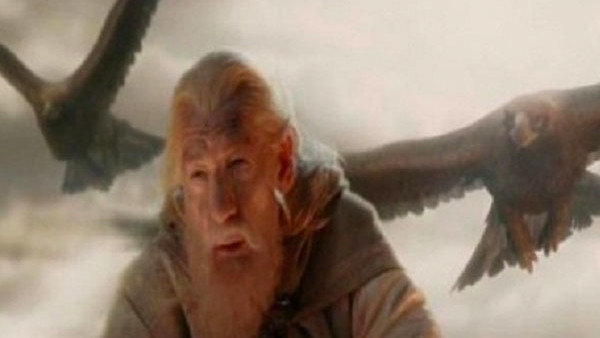
The Plot Hole: The eagles are the Tolkien equivalent of a bus - when they run properly they're great, but you can hardly rely on them.
They save Gandalf from Isengard and help in the Battle of the Black Gate, but for some reason no one thinks they could be used to fly the One Ring to Mordor, saving countless lives and two movies' run time in the process. It's only made worse in The Hobbit, where the eagles seem to be on Gandalf's speed-dial.
The Solution The Movie Gave Us:A recent fan theory has suggested this was Gandalf's original plan (that's really what he meant by "fly you fools"), but there's enough in the movies to suggest a more logical explanation.
One does not simply fly into Mordor. It may be easier than walking, but it's still fraught with danger. There's plenty of air-based threats and the risk is just too great; if something goes wrong here, the Ring is essentially back in Sauron's control. The final shot in The Two Towers hammers this home, showing the landscape of Mordor with fell beasts clearly patrolling the skies.
Although it's easy to dismiss this as flippant straw-grabbing, it's clearly the intended reading - in the director's commentary producer Philippa Boyens insists the Nazgûl are the obvious detterant after Jackson and Fran Walsh jokingly brought up the fan issue.
3. Why Is Brand Still Young At The End? - Interstellar

The Plot Hole: Christopher Nolan has a love of the varying passage of time. After the time-dilated dream levels of Inception, he brought it to the waking world with Interstellar. Based on the theory of relatively, the device is treated rather logically, with things slowing down only under extreme gravity.
There is one minor caveat. The ending of the film sees Matthew McConaughey's Cooper jump fifty or so years into the future, where he swiftly sets out to try and reunite with Anne Hathaway's Dr. Brand who, despite not being thrown through a black hole, has miraculously aged as little as him in the intervening years.
The Solution The Movie Gave Us: This could be chalked up to deceptive editing (see The Dark Knight Rises, where Batman is seen in the Bat when the bomb is five seconds away from detonation), but there is an in-movie solution.
This is only a plot hole if you take Cooper's actions in the never-ending hall of bookcases as being inside the black hole (and thus he's under the effects of its gravity). As he himself states, it's most likely some time-meddling on the part of the future humans, meaning the time dilation came from his approach to the black hole instead, something Dr. Brand will also have experienced as she was slingshotting herself around it - surely in going so close the effect of its strong gravity would have slowed down her clock as well.
2. How Did Things Work The First Time Around? - The Terminator

The Plot Hole: The Terminator has such a tight ending that it's unbelievable over thirty years after release Hollywood is still looking for ways to stretch out the story. But that closed-book nature doesn't stop people asking movie-breaking questions.
Who was John Connor's father the first time around, before Kyle Reese was sent back? And how did Joh neven become a revolutionary leader without his mother going through all this? Isn't time travel difficult to follow?
The Solution The Movie Gave Us: General audiences seem to have a massive misunderstanding of the mechanics of time travel. Blame Back To The Future - its vague rules (which are habitually broken) present a warped version of the Butterfly Effect, where meddling in the past can change the present.
And while that's the case in many movies, it isn't in The Terminator. Here it's a very simple time loop - Skynet send a machine back to kill Sarah, in reaction humans send back Reese, who destroys the machine and fathers John Connor, who in turn motivates Skynet to send the machine and so on. So the machines are inadvertently creating the cause of their defeat.
The main reason for the confusion is the film's sequel, Terminator 2: Judgement Day, which presented a more malleable form of time travel - the future can be changed. But that doesn't stop the original being a time-loop.
1. Why Didn't They Both Go On That Door? - Titanic

The Plot Hole: James Cameron's $200 million excuse to go diving to his favourite shipwreck contains one of most universally mocked plot holes in movie history; there was easily room on the door-thing Rose uses to keep herself out of the water after the Titanic sinks for Jack as well, making his sacrifice meaningless.
The Solution The Movie Gave Us: Jack and Rose sharing the piece of driftwood is such an obvious idea that it's literally the first thing the pair think to do. And you know what? It doesn't work. There may be enough physical space for the pair to fit, but doing so destroys the wreckage's buoyancy. The film explicitly disproves it.
Sure, they could have taken turns, but given that Rose was near death by the time a rescue boat finally came by, odds are neither of them would have survived.
Yes, Mythbusters did an episode that proved it was indeed possible, but that required a knowledge of engineering and a level head, something neither character would have had in the circumstances.
What other plot holes have painfully obvious solutions? Share your examples in the comments below.