10 Worst Examples Of Hollywood Whitewashing
Matt Damon's not the only white saviour to cinematically trample across other cultures...

Matt Damon is neither the hero China needs, nor the one it deserves, if you go in for the latest controversy from the world of cinema. His lead role in The Great Wall, the newly released fantasy epic about the construction of the Great Wall of China, has not gone down well – after all, why should a movie about an important piece of Chinese history be led by a white actor?
This is an issue that has plagued Hollywood embarrassingly often over recent years. Just last year, one of the most anticipated comic book movies, in Doctor Strange was criticised for rebranding a major character as white, and that wasn’t even the only whitewashing controversy of 2016.
Racially questionable casting is a long-standing cinematic tradition, though. Some earlier cases – and the make-up techniques used – would really not be acceptable today, so it’s reassuring to know that some progress has been made.
Still, it's a storied and unfortunate history...
10. Benedict Cumberbatch As Khan (Star Trek Into Darkness, 2013)

The second film in the Star Trek reboot series may have moved farther away from anything resembling Star Trek and closer to all-out visual effects headache, but critics and audiences alike were impressed by the performance of Benedict Cumberbatch as legendary Trek villain John Harrison.
No, wait, that’s not his name, is it? It's Khan - or to give him his full name, Khan Noonien Singh – who, in the original Star Trek canon, was an Indian Sikh. So, with all due respect to Cumberbatch’s talents, it doesn’t seem right that he be played by an actor whose very name has become an oft-parodied shorthand for Britain’s current school of white, upper-class actors.
Then again, Khan was played in the original Star Trek series by Ricardo Montalban, who was Mexican and who actually portrayed the character as Indian, whereas at least the Cumberbatch character was just a white guy with an inexplicably Indian name.
Then again, Montalban was cast in the ‘60s, when it seemed that any foreigner would do, and we should really be expecting better diversity from today’s Hollywood.
9. Natalie Wood As Maria (West Side Story, 1961)

A contemporary update on Romeo and Juliet, West Side Story focuses on a New York gang war between the Jets – who are white American – and the Sharks – who are Puerto Rican. It’s a very clever use of the classic text, maintaining Shakespeare’s powerful romantic drama while having something to say about troubled race relations in America, which is thematically front and centre throughout.
And yet, the Juliet figure is played by a white woman, Natalie Wood. Though the Rebel Without A Cause star no doubt brought in audiences, and her spray tan and accent aren't as painfully over the top as they could be, it is a shame that this was seen as more important than staying true to the racially charged story.
Oh yeah, and the leader of the Sharks, Bernardo, is played by Greek-American George Chakiris. But these were the sixties, and this would never happen today, would it...?
Well, maybe not as explicitly.
8. Ben Affleck As Tony Mendez (Argo, 2012)

Ben Affleck’s thriller about the Iranian hostage crisis won big at the Oscars, and you might remember the public controversy about the portrayal of the Iranians, most of whom were in reality in favour of freeing the hostages, and the Canadian intelligence, who played a bigger role in the mission than was portrayed.
But there's also a problem with whitewashing, even though it's less noticeable than in other films on this list, when considering two of the major characters. The character Affleck played, CIA specialist Tony Mendez, is Mexican-American in real life. Similarly, Clea DuVall’s character, captive diplomat Cora Lijek, is in reality Japanese-American.
This is a different type of whitewashing – it’s not as outrageously offensive as a white actor pretending to be a different race, but the changing of a real-life person’s race so viewers might not even realise the person has ever been anything other than white.
While it may be more difficult to spot, it’s arguably just as bad, as the role of ethnic minority heroes in a real life crisis has been subtly erased.
7. Johnny Depp As Tonto (The Lone Ranger, 2013)
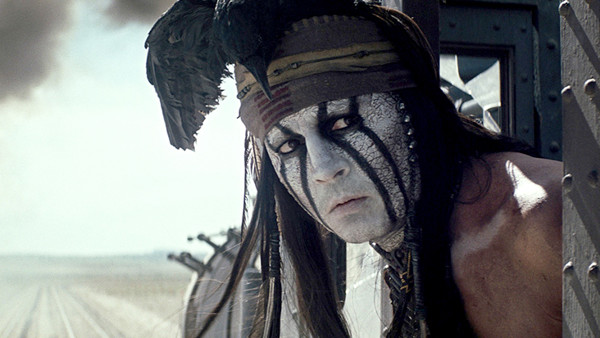
The TV series of The Lone Ranger last aired way back in the 1950s, and was an odd choice for director Gore Verbinski to turn into a modern blockbuster. But this was the guy who’d turned a modest theme park ride into a massively successful franchise, so why shouldn’t this one work?
Well, the main reason was the Ranger’s sidekick Tonto, who was one hell of a Native American stereotype back in the day, an issue which was the first thing brought to mind when most people thought of the franchise.
Would Verbinski thoughtfully address the issue and portray the Comanche fairly? No, he hired Johnny Depp, who brought his usual subtlety to the role: decked out in white face paint and with a bird as a hat, Depp pranced around in an annoying variant of his Captain Jack Sparrow shenanigans (and indeed, those of most other characters he’s played).
Confronted with questions about the race issue (mostly along the lines of “what the hell were you thinking?”), Depp decided to argue that he had Native American ancestry, a fact which he couldn’t prove, and that he wanted to “right the wrongs of the past”. Well, Johnny, maybe you weren’t the best person to do that.
6. Mickey Rooney As Mr Yunioshi (Breakfast At Tiffany’s, 1961)

Breakfast At Tiffany’s is such a legendary movie that anyone seeing it for the first time today will no doubt be delighted by the very funny screenplay and charmed by the very charming Audrey Hepburn, but also surprised by just how unforgivably racist the character of Mr Yunioshi is.
Yunioshi is Holly Golightly’s upstairs neighbour, and becomes highly exasperated by Golightly’s behaviour at various points in the film – because apparently being exasperated at young people is what all old Japanese men are like. As Yunioshi, Mickey Rooney bumbles around in the most painfully exaggerated make-up you’ll ever see, and with an accent that’s even worse.
Most people involved in the film didn’t take too long to express their regrets, with director Blake Edwards wishing he’d never cast Rooney, and producer Richard Shepherd even claiming to have been against it at the time. Rooney, however, never seemed to understand what had been done wrong. Different times, eh?
5. Emma Stone As Allison Ng (Aloha, 2015)

Oh, Cameron Crowe, what happened to you? The director, once beloved for the likes of Fast Times at Ridgemont High, Jerry Maguire, and Almost Famous, made a return to filmmaking in 2015 with Aloha, a rom-com set around Hawaii.
Filling this with non-Hawaiian main characters would be one thing, but Crowe went one step further into controversial territory by casting Emma Stone as Captain Allison Ng, a character who was apparently quarter-Chinese and quarter-Hawaiian. We say apparently, because she’s clearly quarter-white and three-quarters-also-white. But hey, at least they didn’t try to paint her yellow.
When the controversy about Stone’s casting started to dominate the film’s publicity, Stone acknowledged that whitewashing was an issue and that she regretted taking the role, while Crowe offered what he described as a “heartfelt apology” for her ill-advised casting, trying very hard not to say “I’m sorry, but please will you go see my film now”.
Possibly for the best, people didn’t.
4. Joseph Wiseman As Dr. No (Doctor No, 1962)

The James Bond series may not be renowned for being the best when it comes to racial politics (remember that time Sean Connery’s Bond disguised himself as a Japanese man by using a fake tan and squinting?), but it started out with one of its more regrettable offences.
Doctor Julius No, the eponymous villain of the first Bond film, is meant to be a half-Chinese half-German mad scientist. Now, that’s drawing on a lot of stereotypes already before we’ve even started to think about casting, so they must have had to be careful.
Of course not – they cast Joseph Wiseman, a Canadian Jew, and applied a bit of yellow make-up to make him look the part. All the racial politics going on here are a lot to think about, and we haven’t even mentioned that he was meant to have no hands.
It was the biggest job of Wiseman’s career, but he later admitted that he looked back on the role with great disdain – and who can really blame him?
3. Various White Guys As The Entire Egyptian Pantheon (Gods Of Egypt, 2016)

Egyptian mythology is fascinating and complex, with a broad range of gods and situations to draw upon, so Alex Proyas had a potentially great concept on his hands with Gods of Egypt. Too bad he fluffed it in almost every respect. Not only did the film go beyond so-bad-its-good into so-bad-its-unrelentingly-dull, but it trainwrecked its own marketing campaign with its controversial casting.
Who should play Set, the Egyptian God of Darkness? An Egyptian actor? No, Gerard Butler, of course, is perfect to shout his way through this nonsense! Other gods were played by Nicolas Coster-Waldau, Geoffrey Rush, and Rufus Sewell, who could all do much better, and who, in case you haven’t noticed, are all white. Even the main human character, Bek, was played by white guy Brenton Thwaites, while the one black actor, Chadwick Boseman, felt awkwardly token.
When other high-budget films have made similar casting misjudgments, their creators have sometimes claimed they needed big name stars to draw in the viewers, such as when Ridley Scott cast Christian Bale as Moses in Exodus: Gods and Kings. But Gerard Butler? Really?
2. Laurence Olivier As Othello (1965)

One of cinema history’s more cringeworthy moments. We can’t fault Laurence Olivier’s love of Shakespeare, but while his Hamlet and Richard III may go down as classics, everyone involved probably regretted this one a few years down the line.
The reason for that, unfortunately, is that Olivier decides to play the Moor of Venice in blackface. That’s full-on minstrel black, not just a lick of brown. He completes the effect with some bright red around the insides of his lips, a curly black wig, and by mangling Shakespeare’s dialogue in a vaguely foreign accent.
And this is for a story about the racism faced by the central character – though you’ll hardly pick up any of the plot if you watch it today, for you’ll be covering your eyes and ears as much as possible.
Olivier may not have been the first actor to black up to play Othello, but this release came out at the height of the Civil Rights movement, and shortly after Sidney Poitier had become the first black man to win a Best Actor Oscar, meaning he was, thankfully, one of the last.
1. Tilda Swinton As The Ancient One (Doctor Strange, 2016)

Doctor Strange is a film about a white guy travelling to Nepal to have a go at the ways of the East, and learning them weirdly quickly, so it’s already a bit skirting a fine line regarding its racial politics before we even get into the controversial casting of Tilda Swinton as the character who trains Strange.
Then again, the film’s creators were at least aware of the problem; the awkward situation with the Ancient One’s casting was compared by co-writer C. Robert Cargill to Star Trek’s Kobayashi Maru – an unwinnable situation. The character in the comics, which originate in the less PC 1960s, was an old Asian man, and the filmmakers feared that casting as such would be invoking the outdated Fu Manchu stereotype.
They also thought about how casting an Asian woman would be invoking the Dragon Lady stereotype, and a younger Asian woman could be accused of exploiting fanboy fetishes. And so they ended up switching both the character’s gender and race. Try and imagine the charts drawn up by the casting team while working that one out... It doesn't bear thinking about.