20 Sci-Fi Movies You Must See Before You Die

11. The Terminator (1984)

The legacy attached to the Terminator franchise is perhaps incalculable; as a series, the very fabric of James Cameron's sci-fi classic - and its sequels - are ingrained into society. The very sight of Arnold Schwarzenegger, after all, is enough to provoke reactions of "It's the Terminator!" all these years later ("I'll be back" has also been said so many times that we don't want to hear it anymore). So this was the movie that started it all, written and directed by James Cameron, and featuring Michael Biehn and Linda Hamilton as Kyle Reece and Sarah Connor respectively. Tight, thrilling, and loaded with ground-breaking special effects, The Terminator is a triumph. And despite its pretensions as an action movie, the plot is excellent: tasked with protecting the leader of a future resistance before he's even born, soldier Kyle Reece travels from an apocalyptic future to the 1980s and must ensure that said leader's mother - Sarah Connor - isn't murdered by the Terminator, a robot that has been dispatched by sentient machines to kill her. The pace of the story is near-on flawless, Arnie is surprisingly excellent in a role that could have been embarrassing, and the rich mythology (which would be expanded in the sequels) proves to be endlessly intriguing; who imagined that Cameron could top himself with the follow-up?

10. Aliens (1986)

For the follow-up to Ridley Scott's immensely successful and incredibly terrifying sci-fi masterpiece, Alien, director James Cameron decided that it probably wasn't a good idea to make another movie in exactly the same vein; instead, he opted to do things differently, taking the ideas and concepts that made Alien so appealing (and did we mention terrifying?) and moving them all into the realms of a totally different genre. Which is to say, whereas Alien is a horror movie with sci-fi aesethics, Aliens is a balls to the wall blockbuster. And man does it kick ass! Aliens picks up where the last movie left off, with our hero Ellen Ripley (Sigourney Weaver) awaking from cryosleep to find that the remnants of her old life have long drifted away into the vacuums of time. She's soon manipulated into escorting a group of Marines to an abandoned base on a lowly planet, and before long is facing off against not one, but dozens of Xenomorphs. The attention to detail apparent here is astounding, the cast are brilliant and memorable, the movie dark, funny and terrifying; you could not have asked for a better sequel.

9. Metropolis (1927)

It's strange - and somewhat unbelievable - to think that Metropolis was made all the way back in 1927. Especially since there was a noticeable lack of worthwhile science-fiction movies in the wake of its release until decades and decades later. It's well known that director Fritz Lang went about assembling his vision for Metropolis with all the subtlety of a bull in a china shop - the production process was notoriously nightmarish. People were injured. Sets were burned to the ground. And yet the final film is a dizzying, technical accomplishment - a sci-fi classic. Lang achieved his dreams of conjuring Metropolis' detailed, dystopian city using clever camera tracks and by way of constructing some of the most ambitious sets ever built at the time. And it's all up there, in all its glory, to behold: indeed, not a single shot in Metropolis disappoints. The movie is genuinely mesmerising on a purely aesethic level, but it being a movie in the sci-fi canon, it probes far deeper into the nature of humanity and its relationship with technology, but also deals with the class system and how it affects us all. A silent masterpiece.

8. Close Encounters Of The Third Kind (1977)

The most remarkable thing about Close Encounters of the Third Kind, perhaps, is the way in which it gave back credibility to a sub-genre that was thought to be done for; after aliens and extra terrestrials had been reduced to something of a joke throughout the '50s, (all bad costumes and silly voices), the world's most famous filmmaker set out to craft a motion picture that took intergalactic lifeforms seriously. The results were mesmerising, of course; to this day, Close Encounters still feels important in the way it chooses to deal with man/alien relations. Which is to say, Spielberg's insistence on building a movie around the mystery of a UFO sighting, only to reveal in the final moments that the aliens aren't here to harm, but to study and interact with us, gives the movie an everlasting appeal. As Roy Neary, Richard Dreyfuss gives one of his best performances as a man who literally becomes obsessed with his own close encounter after he's almost abducted. At the time of its release, Close Encounters was praised for its amazing special effects; today, it's still hard not to feel blown away by the thing.

7. Jurassic Park (1992)

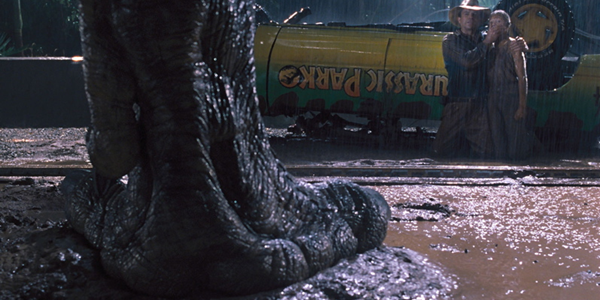
For kids who grew up in the 90's, Jurassic Park hovers in a state of perpetual flawlessness; for those youngsters who spend the Sundays of their youth immersed in Steven Spielberg's bold and visionary dinosaur adventure, it's impossible for them to see Jurassic Park as anything other than perfect. Truth is, whilst Jurassic Park is without a doubt an essential blockbuster, it's also a fairly flawed one - at least, when approached as a Spielberg movie, anyway. The plot occasionally feels heavy-handed, the structure of the movie is questionable, and most of the characters - saved for Jeff Goldbum's Ian Malcolm - are a little bland. And yet... its power cannot be silenced. Excuse us, then, for detailing what's wrong with Jurassic Park before detailing what's so right about it. But that's kind of the point - none of it matters because Spielberg's movie is so entertaining, so innovative, and so remarkable in other ways that the downsides are completely overshadowed by the relentless thrill-ride that follows. Essentially a theme park ride masquerading as a movie, Jurassic Park explores what happens when human beings mess with nature, rendering the consequences with special effects that still impress today. For Spielberg the technician, this is arguably his masterpiece. Is anybody bored of Jurassic Park yet? Thought not.

6. The Thing (1982)

How is it that a relatively low-key movie set in Alaska featuring a shapeshifting alien with the ability to masquerade in any form also happens to be one of the greatest science-fiction movies of all-time? It's all in the reflexes. So John Carpenter remade '50s B-movie The Thing From Another World in 1983 and in doing so crafted a movie superior to that of the original; tense, paranoid, tight, and endlessly entertaining, the mastery at which The Thing plays out is apparent from the very first scene, which sees a lone mutt bounding across the snowy white desert whilst a Norwegian scientist attempts to shoot him from a pursuing helicopter. This dog is "the thing" of the movie's title, of course: an alien creature gifted with the ability to absorb and transform into anything it comes into contact with. With tension deriving from Ennio Morricone's stripped back electronic score, and led by Kurt Russell's likeable and rugged hero, J.R. MacReady, The Thing remains gripping from the moment it begins to the moment the credits start rolling because Carpenter keeps us guessing. The creature could be anyone, after all. The desolate setting and wonderful cast of characters confirms this as a classic, and it also features one of the best ever ending scenes: "Why don't we wait a while? See what happens."

5. Alien (1979)

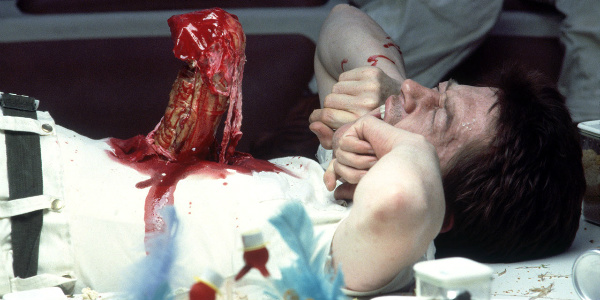
Like so many of the movies on this list, Alien is a picture in which absolutely every aspect of production is firing on all cylinders - unlike some, however, it moves at such a calm, deliberate pace, that nothing ever comes across as being too "showy." Which is to say, Ridley Scott's horror/sci-fi hybrid - which acts somewhat like a slasher movie in space with a terrifying alien creature picking off crew members on a space vessel one by one - seems to linger in a sort of void, inching ever close to the next terrible incident, but never overstating or overplaying it. The confidence at which Scott renders his movie is astounding, but credit where credit is due; the production design elements are astounding - space isn't clean and shiny like you'd expect hundreds of years in the future, but dark, grimy, and super depressing. The crew of the Nostromo come as the results of brilliant, careful casting; John Hurt and Yaphet Kotto, among others, make their characters feel well-rounded, even though we don't learn that much about them. And at the centre of it all, Sigourney Weaver, who has never been better (or more iconic).

4. The Matrix (1999)

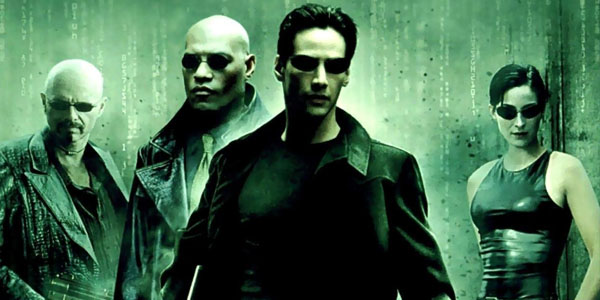
Vice recently ran an article about The Matrix that called it "dated and embarrassing." Though a number of points mentioned in the piece have some validity, for the most part the author seems to miss the point of what makes the Wachowskis' movie so great - pure and simple, The Matrix is a hell of a lot of fun. Sure, some of the technological aspects don't ring anywhere near as true as they did back in 1999 when we were all still using dial-up and wearing leather trenchcoats was deemed to be genuinely cool (though to be fair, we're not even sure that was cool back then). As a slice of unadulterated, sci-fi entertainment, it has few peers. If the plot feels a little bombastic in retrospect (what with its "chosen one" mythology), does it really matter much? In a time where Inception is constantly branded as "intelligent sci-fi," The Matrix looks positively genius. Because whereas Inception doesn't make use of its complicated narrative structure to say pretty much anything except "isn't this neat and clever?", The Matrix combines action and spectacle whilst posing questions about the nature of reality, perceptive and the advancement of technology. And taken as a blockbuster movie, it delivers in droves: the kung fu fight scenes are practically cheer-inducing. Dated? Embarrassing? Nowhere near!

3. Terminator 2: Judgment Day (1991)

Aliens confirmed that James Cameron could make the hell out of a sequel, but it was Terminator 2: Judgment Day - the follow-up to 1984's The Terminator - that near on confirmed him as the sequel master. What could have felt like a pointless return to the world of The Terminator, then, emerges as quite the opposite; in fact, Terminator 2 is so good in absolutely every way - the script, the action, the special effects, the acting - that it pretty much eclipses the first movie as something of a test run. Without a doubt, it's Cameron's masterpiece. The stroke of genius that made this movie so downright brilliant, though? Role reversal. This time Arnie's T-8000 plays the good guy, and its in his relationship with young John Connor (an annoying but appropriate Edward Furlong) that cements the movie as a classic. Most will remember Judgment Day for the groundbreaking SFX that allowed its terrifying antagonist, the T-1000, to change shape at will, but praise also needs to be handed to Linda Hamilton, who effortlessly transforms her once lowly Sarah Connor into one of cinema's biggest badasses.

2. 2001: A Space Odyssey (1967)

Often considered to be the definitive science-fiction masterpiece to end all science-fiction masterpieces, Stanley Kubrick's mesmerising, transcendent 2001: A Space Odyssey is arguably the most enigmatic and technically impressive motion picture to have ever existed. As an exercise in visuals alone, there are few that are comparable. Almost five decades after its release, the story of an astronaut's battle with a chillingly antagonistic A.I. program named "Hal 9000" still has people riveted to their seats - surprising, given that during its initial release, 2001 received countless walkouts (Rock Hudson famously asked: "Will someone tell me what the hell this is about?") 2001: A Space Odyssey is about more than just a man's fight with a moody computer, however; based on a script he worked on with legendary sci-fi author Arthur C. Clarke, Kubrick manages to unload a narrative that encompasses the span of the entire universe; the film's most famous scene, in fact, is probably the one at the beginning which shows how our primate ancestors first adapted to tools. This is followed by the most famous cutaway of all-time, of course, as a bone soars into the air and becomes a spacecraft, bridging the gap between thousands of years of evolution. Ambitious like no other move ever made, this hallucinatory intergalactic trip deserves to be remembered until the very end of a time as a sci-fi masterpiece - and it probably will be.

Contributor

Sam Hill is an ardent cinephile and has been writing about film professionally since 2008. He harbours a particular fondness for western and sci-fi movies.