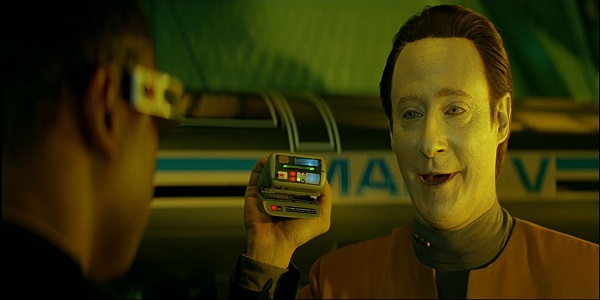
Star Trek Generations was arguably the most hated and polarizing Trek film before the more recent entry, Star Trek Into Darkness. Well, I'm here to tell you we need to start taking it easy on Star Trek Generations because upon further review, it's an extremely fun, very "Trek" themed entry into the franchise. There was simply too much focus on this film when it was released concerning how Kirk's death was handled, along with many questioning what the Nexus ribbon's true meaning was. From the layers associated with explorers finding a new life inside the Nexus, to the different themes of friendship, and death, this film was very true to the vision Gene Roddenberry had established almost 50 years ago. Bottom line, strap yourselves in for 5 reasons Star Trek Generations is an excellent Star Trek film...
5. Kirk Did Die Heroically!
So you're thinking Kirk didn't die a graceful death in Star Trek Generations, well you're wrong. The opening of the film allows Kirk to go out in a blaze of glory, saving the Enterprise, her crew, and the El-Aurian survivors. Regardless of what happened at the end of the movie, where Kirk sacrifices himself once more to save others, he did get a fitting demise right out of the gates. Fans tend to focus solely on how a bridge fell on top of him on Veridian III, and write it off as that's the only death sequence he had. But he got two, and the first was as epic as you're going to get in scope and scale. So the next time you throw in Generations, see how you feel about the film if you focus more on the end of James T. Kirk in the first act, then the final one. It may soften the blow of arguably the films biggest sticking point with critics and fans alike...
4. John Alonzo's Cinematography
Whether you enjoy this film or not, it's not up for debate that John Alonzo's work on this film with the cinematography is bar none some of the best Star Trek films have ever had. More specifically the way he handled lighting the interior sets of the Amargosa observatory, the Enterprise bridge, Ten Forward, and Picard's quarters was absolutely gorgeous. Additionally, the fact these were many of the same sets from the TV show, that due to his lighting techniques did not look too basic for the silver screen, was a feat within itself. Next time you watch this film try to pay attention to how well it's shot. It may end up being one reason of many that you grow fonder memories of Star Trek Generations than you once had...
3. A Bad-Ass Villain
Dr. Soran, played to perfection by Malcolm McDowell was another major bright spot for this movie, and a villain with a motive to say goodbye to his reality after the carnage the Borg did to his world. Maybe this is taking it too far but he's the kind of villain we can relate to, to a point, where we see the cards he's been dealt, attempting to get to his end goal, the Nexus ribbon, and then getting ripped away in the final seconds. That would probably piss a lot of us off as well, eh? If nothing else he had the full capability of badassery to walk right up to a Klingon commander and knock them down on their bridge. That should never be forgotten among the more famous villains in Trek's history. And make no mistake about it, some of the lines he had will never be forgotten in Trek lore like "Time is the fire in which we burn", or as he's reminding Picard that time will eventually hunt you down, and make the kill. All classic one liners and brought to life so well by McDowell here. The only real shame is he never got to return to Trek as Soran, it would have been interesting to see where they could have taken his character in the long-term. Nonetheless, his character was largely overshadowed by the film's harshest critics and in turn deserves some revisiting...
2. Dennis McCarthy's Soundtrack
Over the years I never realized just how fitting and effective Dennis McCarthy's score was for this film: it had frenetically paced moments, and more touching moments to balance out a soundtrack that fit this film like a glove. One particular cue that more than likely hits a nerve is while Picard is with this family in the Nexus ribbon, at Christmas time. This is arguably the best part of the entire score and brought a uniqueness to Star Trek music the feature films didn't have up until this point. Another great cue was with Kirk riding his horse, in Iowa, as it meshed with the scenery and Kirk's reinvigorated mind seamlessly. I mean hell, it made me want to go jump on a horse and ride off into the sunset as well, so that my friends is the mark of excellent music to fit what's on screen. So hopefully the next time you revisit Star Trek Generations you'll be able to embrace the soundtrack a little more, it's a gem...
1. Pacing And Fun Factor
The biggest takeaway one should get from re-watching this movie is the rock solid pacing, and direction involved. It rarely lets up from beginning to end, and allows a certain "fun" factor that wasn't present in the later Next Generation films. Case and point, it's not too dark or serious, and even when you run into some extra dialogue heavy scenes, many of the lines are punchy enough to keep you engaged. Needless to say a shout out should be given to director David Carson for ensuring the film never really let up, except for maybe to have Picard and Kirk cook breakfast together, ha! In the end, there's a lot to love in this film, from seeing Data let loose for once, Kirk save the day not once but twice, superbly staged action scenes set in space, and on the ground, and lastly Picard's emotional turmoil from beginning to end, losing his only family and then being confronted with Soran destroying millions of people. You really got to see a side of Picard who rarely showed off his emotions during the TV series 7 season run. Some argue that too much was jam packed into one film, but the end result is clearly more good than bad. I'll be interested in hearing your comments below on your views for Star Trek Generations, good, bad, ugly, and if your views have changed over the years on this film like my own have. Please feel free to sound off in the comments.