Alien: Covenant - Possible Answers To Its 10 Biggest Questions
In space, no one can hear you scream for answers.

Alien: Covenant is like that annoying friend who insists on answering a question with another question.
Ridley Scott’s 2012 Alien prequel Prometheus left its follow-up with roughly 2,352 unresolved queries to address, and while loose ends were tied up, fans left theatres scratching their heads even harder than before.
Apparently we need at least three films to explain how and why a ‘Space Jockey’ on a ship full of Ovomorphs sent that warning signal the Nostromo detected, but the gap-bridging process has felt like one wild Xenomorph chase after another.
Almost everything in Prometheus that wasn’t a plot hole is an unresolved issue that Covenant left dangling, though the latest sequel did pose bigger questions, like why would you put Danny McBride and James Franco in charge of a colonisation mission?
But at least we know where the Xenomorphs came from now… or do we? No doubt Scott has few more surprises up his sleeve before the two timelines collide.
In the absence of full enlightenment, we can only speculate vociferously and cry out in frustration at being kept in the dark - it’s a pity no one can hear you scream in space.
10. Why Did The Engineers Want To Destroy Mankind?

If there was one question on everyone’s lips at the end of Prometheus… it’s why in god’s name did Millburn think petting that nightmarish cobra alien was a good idea?
But if there were two, the second no doubt concerns the Engineers’ motives for attempting to wipe out their own creation, humanity.
Possible Answers: There are many schools of thought on this but most tend to agree that either mankind failed to live up to its creators’ lofty expectations, or were viewed as enough of a threat to deserve a generous helping of DNA-altering pathogen.
Considering the inventions humanity has dreamed up in the Alien universe, from weapons of mass destruction to robots with Frankenstein complexes, wouldn’t the Engineers have good reason to view us with a sense of foreboding?
And given their fate at the hands of David in Covenant, our creators had good reason to perceive humanity’s pursuit of technological advancement as a threat, but there are other possible explanations for their actions.
The scene in which a dying Peter Weyland attempts to request more life from the surviving Engineer may be telling, particularly the god-like being’s reaction to David. He looks outraged by what he sees before him.
Could the Engineers have a parasitic wasp in their bonnet over mankind’s attempts to play god by creating synthetics? Or had they pre-empted how dangerous David and his mechanical cohorts really are and formulated a plan to take them out, along with their creators, before they lay waste to the entire universe?
These are but a few of many theories surrounding the Engineers’ reasons for attempting to end human life, and we haven’t even got to the idea that Christ was an Engineer who failed to steer mankind onto a righteous path.
9. Okay, So Why Did They Leave A Map To LV-223?

Given the Engineers’ ultimate plight in Covenant, one could argue they had good reason to turn on humanity, but why lure the would-be victims of your dastardly plot to the very place you’re hatching it?
Prometheus begins when Elizabeth Shaw and Charlie Holloway discover a star map in Scotland, which they interpret as an invitation to meet their creators, though it is in fact directions to the universe’s deadliest pathogenic warfare base.
From the distant moon of LV-223, the Engineers are formulating a plot to throw a spanner in humanity’s works which involves tonnes of DNA-altering goo.
Wouldn’t it have been better to strike unannounced, rather than send out open invitations for a tour of the war room?
Possible Answer: One possibility is that the star map is some kind of test. Once mankind’s tech was advanced enough to reach LV-223 they were deemed enough of a threat to neutralise.
8. Why Did David Kill The Engineers?

David rains death from above on an Engineer city in Covenant, yet the movie never reveals his motives… beyond making it clear that he does this kind of thing for kicks.
The synthetic has a distaste for humans, viewing them as unimpressive creators and this likely extends to the Engineers; but is that the only reason for the aerial bombardment?
Possible Answers: It’s clear that David, in his own twisted, inhuman way, loved Elizabeth. Was his attack on the galactic giants a pre-emptive strike to protect her, or perhaps himself?
It is also feasible that he’s after some raw materials for the generic experiments he carries out on the ground, which were in essence an attempt to replace a species he deems unworthy of existence with a superior one.
7. What’s Left Of The Engineer Race?

After the devastating attack on their homeworld, it’s natural to jump to the conclusion that the Engineer race is as good as wiped out.
But this is almost certainly not the case, for more than one reason... so what's left of our apparent creators after David's gooey assault?
Possible Answers: Firstly, there’s the Space Jockey of Alien fame who clearly survives beyond Covenant’s timeframe - did he flee the planet when David launched his attack? Unlikely given that his ship was full of Facehugger eggs, which appear to have been created by the synthetic afterwards.
And let’s not forget the Engineers have the means to traverse the universe. The chances of them colonising a habitable planet other than their own are pretty high.
One thing's for certain, we haven't seen the last of the Engineers.
6. What Happened To The Xenomorphs Spawned In The Attack?

In the wake of David’s assault, the Engineers' home planet should have been swarming with Xenomorphs; the ones which burst from their hides in classic Alien fashion.
Yet when the Covenant crew arrive on the world, it’s the extra-terrestrial equivalent of London in 28 Days Later. What gives?
Now, we know David carries out generic experiments in his chilling makeshift lab afterwards, but enough to account for thousands of missing aliens? Unlikely.
Possible Answers: Either the Xenomorphs turned on each other, or this is a plot hole the size of a small planetoid.
5. What Went Wrong Between David And Elizabeth?
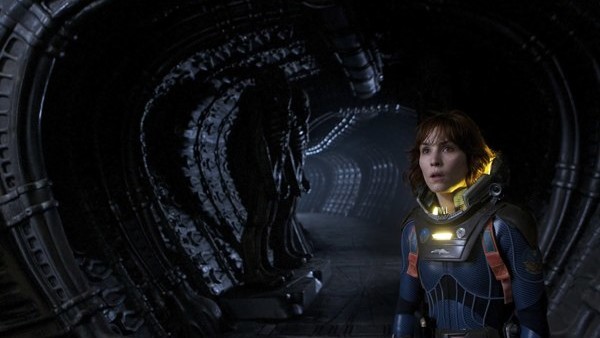
For a sociopathic mechanical monster, David appears to have genuine affection for Elizabeth, so why subject her to every human guinea pig’s worst nightmare?
The entirety of their interaction in Covenant plays out off-screen (excluding the prologue that was released online) and thus we can only speculate about the inter-character dynamics between the pair when they were confined together on the Engineers’ planet.
Possible Answers: Likely we were spared an awkward human-robot love story in which David’s synthetic affections are rebuffed, for obvious reasons. Did he subject Elizabeth to an organ-harvesting fate in retaliation?
Perhaps his intentions were never so malicious, and in his twisted, artificial mind he actually thought he was committing an act of kindness by enabling Elizabeth to create life, something Prometheus establishes as impossible when it reveals her infertility.
More likely, David’s research took precedence and he deemed Elizabeth as a necessary sacrifice.
4. Did David Actually Create The Xenomorphs?
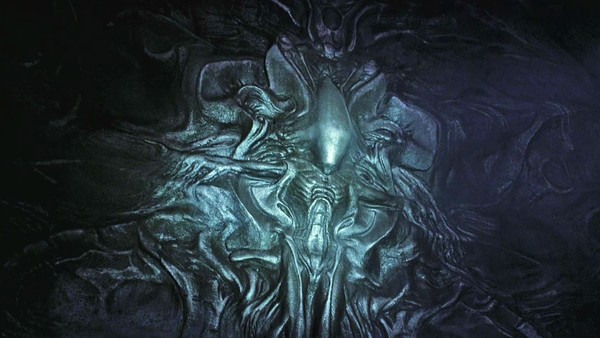
This is what Covenant leads us to believe.
After David transforms the Engineers’ stronghold into his own personal lab of horrors, his experiments - with the help of Captain Oram’s exploding chest - eventually result in the creation of what he deems the perfect organism.
This strongly suggests David is the father of the eponymous beasts in the Alien franchise, but the ends don’t quite tie up as neatly as it would appear at first glance... is the unwholesome synthetic REALLY the architect of one of cinema's scariest entities?
Possible Answer: Perhaps it isn't as cut and dry as this.
Eagle-eyed Prometheus fans may have noticed what appears to be a Xenomorph-like figured depicted in a bas-relief inside the giant head chamber at the end of the movie.
Assuming this is indeed a Xenomorph sculpture, somebody may have created the deadly space beasts prior to David’s genetic meddling and the synthetic merely perfected, or reproduced, the design.
3. Who Created The Engineers?
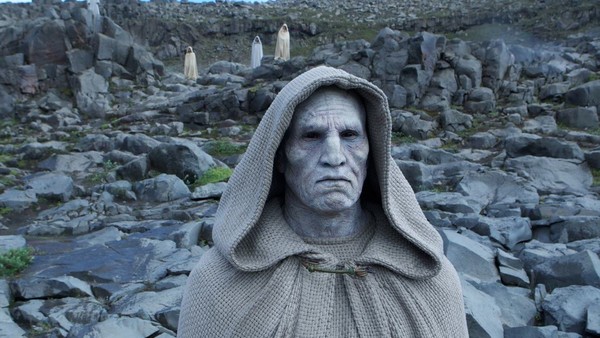
This is a relevant question, right?
The Engineers supposedly created us, we created synthetics and a seriously faulty one of them created the Xenomorphs.
So the only mystery that remains in this scenario is who created our creators?
Possible Answer: This is an interesting debate and one that is touched on in Prometheus. The film examines the relationship between science and religion and asks whether the two can coexist - could technological advancement could one day prove the existence of a higher power, one which created the universe itself?
Elizabeth, a Catholic, represents faith in the movie and you can read what you will into the fact that she's its sole human survivor, only to suffer a grizzly fate in Covenant.
This could well be one of those questions that is never answered, but can be speculated about until long after the pubs close.
2. What’s With That Blue Mist In The Original Alien?
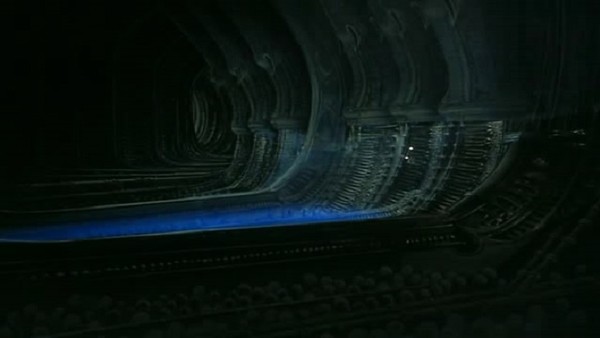
This is a question dating back to 1979 that’s worth revisiting now we’ve learned more about the Xenomorphs, the Engineers and the Alien universe in general.
When the Nostromo crew first encounter the Facehugger-housing eggs in the original Alien, they’re surrounded by a mysterious blue mist that appears to react to proximity. What exactly is that stuff?
Possible Answers: No doubt this is some kind of security mechanism, but the true nature of it remains unaddressed after three sequels and two prequels.
Maybe the eggs themselves emitted the mist as a means of detecting impending danger - although there's nothing in any of the subsequent films to support this theory.
Perhaps the Space Jockey applied it as a method of preservation?
And while we’re on the subject, why did the Space Jockey have a ship full of Facehugger eggs anyway? Don’t be surprised if he crosses paths with David in a future sequel.
1. Does David Incorporate Himself Into The Xenomorph?

Take a close look at the Xenomorph design in Covenant and compare it to its counterparts in the Alien movies.
There are subtle differences, notably the absence of biomechanical elements in the latest prequel.
Covenant’s version of the acid-blooded monstrosity is an all-organic offering; so why the discrepancy?
Possible Answer: The folks over at IGN speculate that David’s work perfecting his creation is far from over, and somewhere between Covenant and Alien he manages to incorporate synthetic elements into his diabolical life’s labours.
We can still only guess at what David’s ultimate fate will be, but it seems in keeping with the character to sacrifice himself to achieve his ultimate goal and a form of immortality in the process.