David Cronenberg: All 21 Films Ranked From Worst To Best

11. The Dead Zone

Every film from here on in is classic Cronenberg. The order basically just boils down to personal preference, really. The first is The Dead Zone, the Christopher Walken-starring adaptation of Stephen King's classic novel. It's basically a study of psychic potential, with Walken's character capable of seeing the future, and an exploration of the impact that would have on someone's life. It's not Cronenberg's greatest adaptation (Naked Lunch, Spider and Crash are superior), but it's a pretty good take on King's novel. Walken is exceptional at its core, both literally and symbolically straddling two worlds (the real and the "dead zone"). This is one of the most complex explorations on internal struggles that Cronenberg has ever presented, which is testament to both the source material and his own ability to wield it. It suffers slightly from, again, not being as "shocking" as some of Cronenberg's absolute greatest works. It hasn't aged brilliantly, with many films taking similar themes and running with them. But it's still a great watch, and was pretty innovative on its release. Fun fact: lead character Johnny Smith was originally meant to be played by Bill Murray (King's choice for the role), not Walken.

10. Eastern Promises

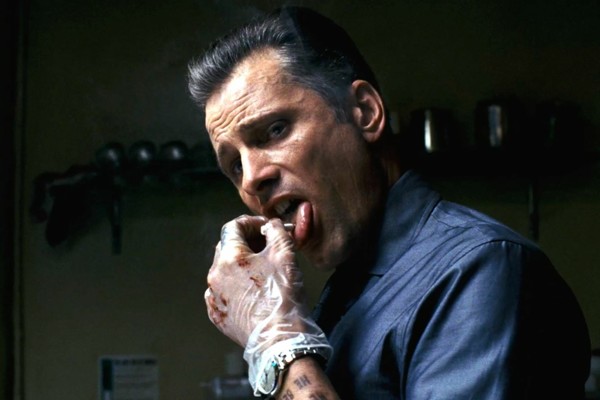
Eastern Promises is quite difficult to place in this list, because on paper it may actually be a slightly better film than A History Of Violence, its predecessor and the one with which it is so frequently compared. However, AHOV finishes the higher of the two masterpieces because, on its arrival, it was just more stunningly shocking to see Cronenberg doing crime drama. Eastern Promises lacked that shock of the new. It's great on repeat viewings, though. Viggo Mortensen is amazing in this film. He is undoubtedly one of the best character actors in the business, and Cronenberg has trusted him with some of his most complex characters. He embodies Nikolai Luzhin perfectly, to the extent that it doesn't take long to absolutely believe that he is a Russian. This is a heavily-layered film, with espionage, double-crossing, romance and hyper-violence all appearing throughout, and Mortensen manages to pull all of these loose threads into one carefully layered character. It is difficult to fully decide what Mortensen's motivations are, and whether the audience is supposed to be rooting for or disturbed by him. In other words, he is just about the perfect anti-hero. That is testament to both Cronenberg's exceptional writing, and Mortensen's nuanced performance. The film is also helped by its completely unforgettable shower scene too, of course.

9. eXistenZ

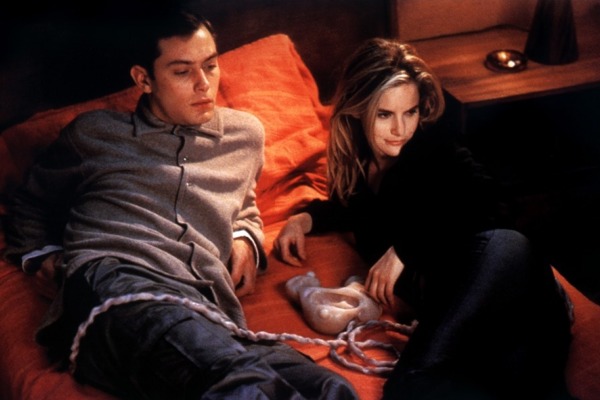
While eXistenZ is not Cronenberg's strongest film, and occasionally feels a bit like Videodrome-lite, its cyberpunk themes and glossy aesthetics make it a worthwhile and - particularly for its time - brave entry into the director's canon. It's basically a film about virtual reality, video games and the separation between the real world and the digital world. There's no doubt that you'll have seen this done a million times before, from Tron to Lawnmower Man to Futurama. eXistenZ works, though, because it employs Cronenberg's trademark visceral, bodily aesthetics. The technology seems alive, organic almost. This isn't some tacky amusement park ride visit to video game land. Once you enter eXistenZ's world, you become one with the machine. As indicated, these are issues that were worked to a far, FAR more successful end in Videodrome. But that doesn't mean that eXistenZ should be discounted entirely. Some of its virtual reality sequences are great fun, and it maintains several interesting issues that could certainly be applied to today's culture of smartphones and social networking.

8. Spider

David Cronenberg's foray into minimal drama with Spider, a film that centres wholly on a single nigh-unintelligble mumbling character, is masterful. Undoubtedly one of the Canadian's most under-appreciated films, it deserves its place among his more revered works. It is basically the story of a mentally ill individual whose life has completely broken down. Told through a series of unclear, fragmented flashbacks, the narrative is compellingly difficult to follow, perfectly balancing mystery with confusion in a way that impressionistically reflects the psyche of its protagonist. Of course, a film so dependent on the emotions and experiences of one figure requires a strong lead actor, and the selection of Ralph Fiennes was a stroke of absolute genius by the director. As Dennis Cleg, he gives one of the most hauntedly understated performances in cinema. Fiennes makes Cleg probably the most impressive and unforgettable character in Cronenberg's canon, succeeding in holding a dank and dark film together even as his character's mental state disintegrates. Throw in the fact that the film had practically no funding, and that those involved in its creation received no salaries, and Spider seems like even more of a minor miracle.

7. Naked Lunch

Naked Lunch, William S. Burroughs' stunningly abstract, confrontational and downright disturbing novel, was one of many to have been granted the description of "unfilmable". A series of unconnected vignettes (dis)ordered in a non-linear fashion, the novel graphically covers dark themes such as paedophila, excessive drug use, fellatio, necrophilia and inter-special sexual relations without flinching. As Cronenberg himself noted, a straight adaptation would "cost 100 million dollars and be banned in every country in the world". When he was offered the chance to create a cinematic version Naked Lunch, the director decided to take a different approach. Selecting the largely underrated actor Peter Weller to play Burroughs' alter-ego Bill Lee, Cronenberg elected to make a heavily fictionalised "biopic" of the author peppered with sequences, ad verbatim passages and images from the novel. What he created may not be a real "adaptation", but it's as close as the world is ever likely to get. It's also brilliant. Set in Burroughs' mythical city Interzone (based on Tangiers, where he spent much of his life), it follows his life after the accidental shooting of his wife and involves uncovering various dark plots involving parasitic insects, living typewriters and the farming of "milk" (read: semen) from the hideous mugwumps that litter the film. It is fairly tricky to follow for anyone unfamiliar with Burroughs' life story or the original source material, but for fans of the author it is beautiful. Oh, and Howard Shore's jazzy soundtrack is just outstanding. Burroughs seemed to be a big fan, too. Naked Lunch is a great piece of film-making, and it shows Cronenberg at his twisted best.

6. A History Of Violence

A History Of Violence is one of Cronenberg's most celebrated films, with its complex and mysterious structure, excellent lead performances and deeply graphic depictions of gangster film violence standing out a mile when compared with the work that had gone before. Although Eastern Promises would arguably build on many of the themes established in AHOV, this is where Cronenberg's "later" era began... And it began with a bang. It's telling that this is the first Cronenberg film to feature Viggo Mortensen, the man that would front three of the most important films of Cronenberg's later career (AHOV, Eastern Promises and A Dangerous Method). As with the other films mentioned, Mortensen is just exceptional. He understands Cronenberg like few actors before or since, and his characters balance the inbetweenness (good and evil, beautiful and ugly, human and parasite, infection and improvement) that the director so loves perfectly. AHOV is the story of a family man looking to leave what, the audience is led to believe, is a life of crime behind. The title could, effectively, be extended to be (This Man Has) A History Of Violence - the plot is about his past catching up with him. As is so often the case with this sort of narrative, he is incapable of escaping the past. What is brilliant here, however, is the way in which Cronenberg balances familial drama with hyper-violent imagery (wounds that BREATHE) without compromising on either. It is breathtaking stuff. The film would be amazing anyway, were it not for William Hurt's cameo. The Academy Award-nominated performance is one of the most incredible in cinematic history, and lifts the film to new heights.

5. The Fly

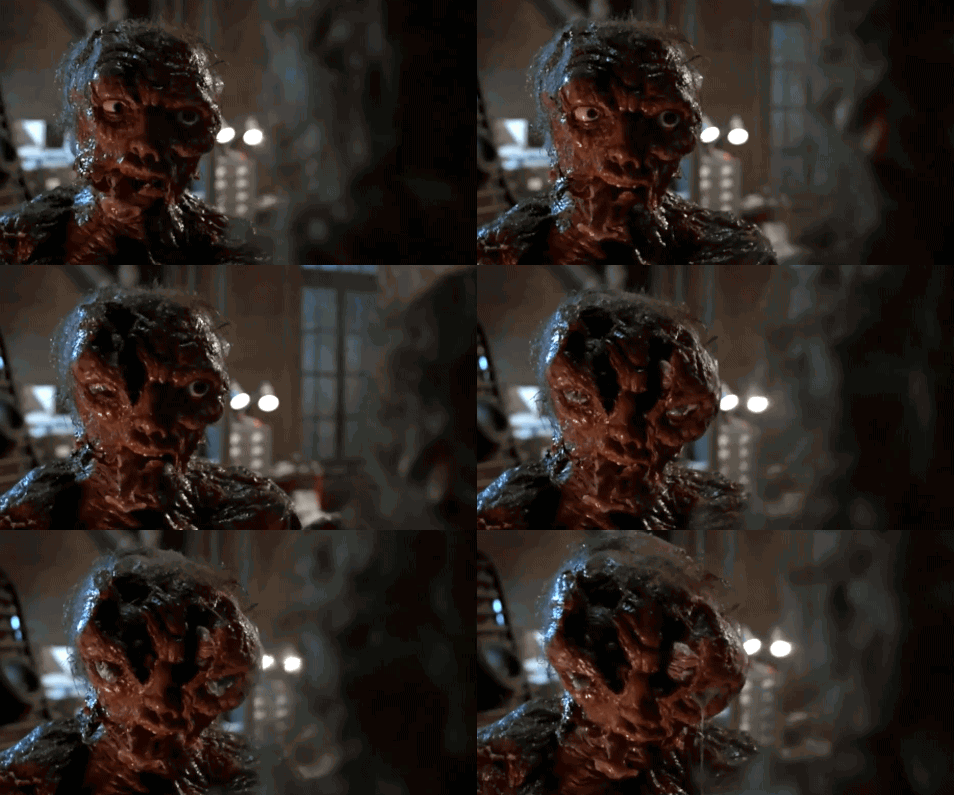
Cronenberg's biggest success. The Fly is the nearest that cinema has ever managed to get to balancing a truly dramatic love story and a deeply psychological body horror aesthetic. Its brilliance is down to three key elements: the most incredible makeup in any of Cronenberg's films, a script that is so perfectly weighted that it must have taken years to get right, and a lead performance from Jeff Goldblum that manages to be repulsive, heartbreaking and terrifying at the same time. A remake of sorts, based on the schlocky 1950s short story and film of the same name, Cronenberg takes a fairly silly B-movie narrative (man creates teleportation device, man inadvertently gets genetically fused with fly, man becomes monster) and makes it something utterly devastatingly human. Yes, Cronenberg uses a lot of the creepy bodily mutations and dissolutions that mark his other films (teeth falling out, heads contorting, fingernails being torn off), but the sign of a standalone film-maker is one that manages to provide a deep and meaningful story beneath the visuals. As Goldblum's character turns into the horrifying Brundlefly, becoming increasingly violent towards his beloved Veronica (Geena Davis, whose character falls pregnant and has disturbing visions of giving birth to a giant larvae), the audience sees his humanity drift away slowly and painfully. As the character states, in probably Cronenberg's most expertly crafted line ever, "I'm an insect who dreamt he was a man and loved it. But now the dream is over... and the insect is awake." The final scene, in which Brundle goes completely insane and accidentally becomes hybridised with the machinery of the telepod, is one of the most powerful in all of cinema. Gorgeous film-making.

4. Dead Ringers

He may have struggled in M. Butterfly's self-indulgent narrative, but Jeremy Irons had no such difficulties in Cronenberg's eerie Dead Ringers. Irons plays twin gynaecologists with unique personalities, one of whom is reserved and quiet where the other is a confident womaniser. The two brothers con women, as the braver of the two sleeps with them, gets bored, and passes them onto his brother. The film basically covers many familiar themes of sexuality from Cronenberg's other works, including mutilated genitalia, parasitic sexual sicknesses and almost symbiotic human relationships. The twins, despite their frequent fall-outs during the film, are connected in ways both psychic and organic, while the quieter brother's eventual adoration for a woman passed down to him provides the basis for a further exploration of these themes. Dead Ringers manages to be truly creepy without resorting to the same horrifying body horror of other Cronenberg films, and it is perhaps its slow subtlety that sets it apart. It's definitely one of his harder sells (the narrative is deeply symbolic, there's no schlock, and the premise is fairly bizarre), but it is also one of his most consistently fulfilling and thematically complex creations. Throw in the fact that Irons is magnificent throughout, and that the story of the brothers' demise is remarkably resonant, and you have a must-watch film that has gone down as one of the direct's best ever.

3. Crash

JG Ballard's Crash was one of the most controversial novels of all time on its release (noticing a trend here?), so it wasn't particularly surprising when Cronenberg elected to adapt it for the big screen. The novel covers all of the "big" themes that clearly excite the director, from sexuality to posthuman organic/mechanical cyborgism, and so it was only a matter of time before he elected to make this film. It doesn't disappoint. Even forgetting the amazingly angular soundtrack from Howard Shore or the brilliant lead performances from James Spader and Deborah Kara Unger, the film is a masterpiece. As Mark Kermode puts it, "it's pretty much perfect" in its summation of everything that Cronenberg's cinema is all about. It's his masterpiece. It is basically the story of people who have become so desensitised that they only medium through which they can achieve sexual satisfaction is through intensive car crashes. They get off to videos of car crashes, have sex in cars, touch wounds and scars with deep sensuality and actively look to come as close to death as possible to achieve the ultimate thrills. There are clear links to both a sexual admiration for robots AND an obsession with sado-masochistic fetish cultures, and it is all presented in that typically Cronenbergian way in which the flesh and the machines breathe like human beings. Perfect, yes. But not Cronenberg's absolute best. It is, by its very nature, so disturbingly sterile and mechanical that it is hard to adore. The fleshy weirdness of the two films that place above it in this list make them somewhat more enjoyable, even if technically/thematically they are weaker than Crash. Crash is his finest accomplishment, but it is not his greatest film.

2. The Brood

The Brood is the culmination of Cronenberg's early cinema, perfectly encapsulating all of the themes and imagery employed in Stereo, COTF, Shivers and Rabid (and, indeed, its follow-up, Scanners) into one depraved and consistently shocking study of family life, parasitic sexuality and body horror. 36 years after its release it still has the capacity to disturb even the most desensitised fan of horror cinema. At the film's core is the brilliant Oliver Reed, a doctor that performs "psychoplasmics". It's basically a psychological form of plastic surgery, in which characters that are struggling with their emotions undergo bodily transformations in order to become mentally stable. Nola Carveth, his patient, is so disturbed that - after undergoing the procedure - she finds herself capable of creating a "brood" of monstrous asexual, colour blind, toothless and navel-less children willing to do her bidding. Given that this is a horror film, it's not really a shock to learn that her bidding basically involves killing anyone that annoys her. It certainly all feels slightly far-fetched, when the narrative is laid out like that. But the way that Cronenberg teases out mysteries, the often astonishing imagery, the excellent acting and the ease with which the director melds themes of family, fear of childbirth and the increasing popularity of posthuman plastic surgery into a complex and simultaneously terrifying narrative is brilliant. There have been suggestions that this is a somewhat autobiographical film, underlining similar fears of fatherhood to those of David Lynch's Eraserhead. Whatever its inspiration, The Brood is one of Cronenberg's most impeccable films, and it continues to freak audiences out even after multiple viewings.

Contributor
Contributor

Articles published under the WhatCulture name denote collective efforts of a number of our writers, both past and present.