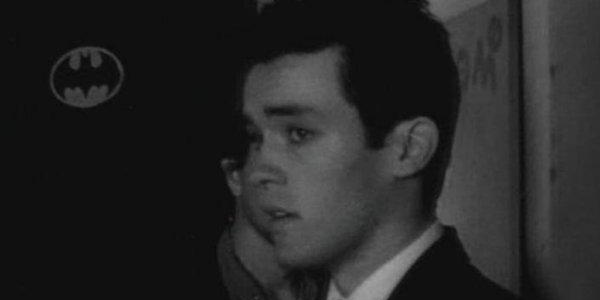
Christopher Nolan Movies: Ranking The Rug-Pull Moments

You know to expect a twist with Nolan.

With a staggering 78% (7 out of 9) of his films in IMDb€™s Top 250, it is hard to dispute that Christopher Nolan is one of the most influential directors of the 21st century. Only Alfred Hitchcock (9 out of 52) and Stanley Kubrick (8 out of 13) have a higher total of entries on the list, but with no sign that Nolan is slowing down his career, he looks set to surpass his fellows and firmly establish himself as one of Hollywood€™s defining auteurs. One of the director€™s key strengths is how he weaves complex narratives with blockbuster set pieces and mainstream Hollywood appeal, marking his work popular with critics and audience alike. Of particular note is his penchant for dramatic twists or €˜rug-pulls€™ in the final act of his films. Whilst some directors can get bogged down in the complexity and pseudo-intelligence of their own story (M. Night Shyamalan being the cliched and yet entirely indisputable example of this), Nolan appears (for the majority) to have confidence in both his story and his audience to deliver a twist only when it can be absolutely justified within the context of the film as a whole. As such, this article will explore each of Nolan€™s films and their respective rug-pulls, how they effect the tone of the movie and whether or not they have a justifiable place to be there. It should be noted that the ranking is not based on the film as a whole but on the effectiveness of these plot twists. Naturally, this article will contain detailed recounts of all of Nolan's twists (including recent release Interstellar), however spoilers will not be made in the individual headings of each page, giving you the opportunity to skip over any films you haven't seen without fear of reading something you might not want to.

9. Robin Williams (Insomnia)

One of Nolan's most endearing traits is his absolute conviction in telling the story that he wants to tell. His 2002, Nordic-esque thriller Insomnia substantiates this when considering that the director went uncredited for his final rewrite of the script - a move that somewhat elevated him away from the 'studio mercenary' earmark that many were keen to associate to any up-and-coming directors at the time. However, what Insomnia boasts in solid direction, it somewhat lacks in plot twist or rug-pulls when compared to the director's other work. It represents the point in Nolan's career where he had to prove he was studio-friendly, after the casual post-release (yet financially tepid) success of Memento. As such, arguably the biggest moment of surprise comes when Robin Williams, an actor known for his catalogue of amicable protagonists, is revealed to be the killer in the case spear-headed by Al Pacino's insomniac cop. It is a bold move from Nolan that reflects his penchant for nonconformity without alienating mainstream audiences from what is essentially, a straightforward thriller. This is not to take away from what Insomnia does achieve. When compared to Memento, their objectives are starkly contrasting; Memento looks back on itself, searching for reason where Insomnia looks forward, following a protagonist forced to deal with the consequences of his actions. To this end Insomnia is a success, however in a list based on the merits of a scintillating twist, it unfortunately fails to deliver.

8. The Cafe Scene (The Dark Knight Rises)

Moving on from his first low-budget neo-noir thrillers (Following, Memento and Insomnia), Nolan moved into a more mainstream, franchise-influenced project with the Dark Knight Trilogy. The director oversaw the transformation of the superhero genre from the camp, Lycra-clad outings of West and co., to the gritty, unremitting realism of superhero films flooding the modern cinema market. This tonal change had always been credited to Nolan's sombre but well received style of filmmaking and fans thrived on this case-hardened storytelling. So when the closing scenes of The Dark Knight Rises went against the perceived (and often misconstrued) idea that everything in Nolan's worlds must die, there were general murmurs of discontent amongst fans. Whilst Batman surviving is no bad thing, his appearance in the cafe seemed somewhat contrived; an afterthought thrown in to put to bed any doubt that Bruce Wayne got blown up along with Bane's atom bomb. Blunt has never been a word to represent Nolan but it is a word befitting the scene. It has subsequently prompted the taboo question; could the mighty auteur have finally been subjected to an executive decision that might have influenced the ending of the film? This was the valediction to his trilogy and rather than sign out with a bang, fans were given a neat little package, complete with bow ribbon and 'thank you for watching' card - ultimately it fell well flat of that which came before. Surely leaving it with scenes of Alfred weeping at the grave cut together with Fox's technicians revealing the news about the Batpod, would have delivered a greater emotional impact?

7. The Wobbly Spinning Top (Inception)

Inception is the most original concept of Nolan's résumé, stemming from an idea conceived ten years prior to its release. Somewhere between finishing Insomnia and landing the Batman gig, Nolan wrote an 80-page treatment about a group of characters that specialized in infiltrating dreams. That germ of an idea stayed largely the same through the production process but, in an interview with The Telegraph, Nolan admitted that the scale of his story grew:
"It€™s intimate and emotional, but I realised I had this concept that lent itself to an epic-scale movie. I€™m really happy that it worked that way because, having been involved in the Batman films and The Prestige, which had a fair amount of cinematic sleights of hand, and with all the experience we€™d gained, we were ready to make it.€
That, alongside the growing cast of film stars, marked Inception as Nolan's first - and riskiest - original blockbuster. In an attempt to make a film both populist and composite, Nolan's efforts at a climactic rug-pull - the ambiguous wobble of the spinning top - was lost in a cacophony of internet speculation and demands for Inception 2 that detracted from the rest of the film. The scene works as a brilliant talking point for post-cinema discussion, but ultimately divides audience in way that is not conducive to the film. If one perceives the final shot of the spinning top as proof that Cobb is still dreaming, then Nolan has committed the cardinal '...but it was all a dream' sin. Taking the wobble as proof he's awake and the twist becomes redundant, garnering for a cheap last-minute shock that devalues the journey of the protagonist and the emotional conclusion the audiences reaches when he is reunited with his children. It is a rug-pull that works effectively on a first viewing but only serves to frustrate and sow needless doubt on a subsequent re-watch.

6. Who Is Henri Ducard? (Batman Begins)
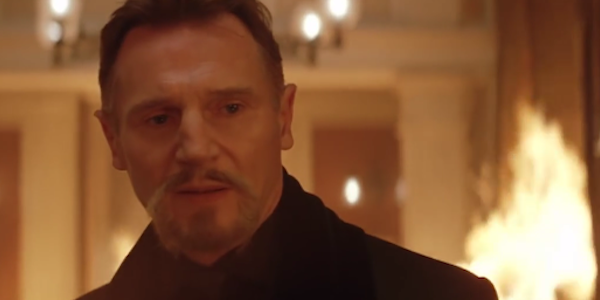
Batman Begins signified Nolan's first foray into franchise films and with it, he took a large gamble in dedicating almost an hour of screen time to Batman's origin story. Unlike The Dark Knight and The Dark Knight Rises, Begins gallantly attempts to focus on Bruce Wayne rather than his mask, playing on the insecurities of being an orphan, playboy and superhero-vigilante. Starting with the genuinely brutal death of his parents as a child, Nolan and script-writer David S. Goyer delved deep into understanding the psychological dynamics that would shape their hero. For Nolan, the role of secondary characters in influencing Batman's ethos was as important to the story as Bruce Wayne's own arc, and the director spent a great deal of time in getting to know the authoritarian figures that populated his protagonist's world. Henri Ducard is one of Wayne's early mentors, helping him physically and technically to achieve the basic elements of, in his words, "being more than just a vigilante - a legend". Philosophical whimsicality aside, Ducard had a significant role in shaping Batman's ethics so when he is later revealed to be Ra's al Ghul, nefarious leader of the League of Shadows, the emotional effect it has on Bruce Wayne is telling. It is a pivotal moment in his character arc and marks the point at which he fully embraces his role as Gotham's defender. However, for anyone half clued up on Batman lore, the reveal of Ducard as the villain was no surprise, leaving it as one of Nolan's weakest shock factors. As with Insomnia, it is not to detract from what Batman Begins achieves - successfully teeing up a hugely profitable franchise, as well as reinventing the iconic superhero for a modern audience. The film was never really about the twist, but about de-constructing the legend.

5. Behind The Bookshelf (Interstellar)

Nolan's most recent picture has managed to radically split opinion, with some citing it as his worst film to date. What Interstellar is, more than any of Nolan's other work, is an homage to the director's own cinematic influences and this may have hampered the director's uniquely meticulous and original visions people have come to expect of him. However, the true measure of Interstellar's success is in its ability to fuse emotional family drama with sprawling sci-fi epic, offering an emotional core often missing in his previous work. Whilst Matthew McConaughey characterizes this genre-blend in his affecting representation of Cooper, a father travelling across the universe to save his children, the film's final act also serves to bring together these threads in a characteristic, Nolan-esque manner. Interstellar opens with Cooper's daughter quizzing her father about the ghost in her bedroom. It later becomes apparent that the ghost is in fact Cooper, trapped inside a five-dimensional 'tesseract', designed by utopian humans that have mastered the ability to manipulate time and space. Its chicken or egg foundation has been a stalwart of discussion in time travelling circles for as long as the concept has existed, but Nolan does not try to justify his logic with puffy exposition. He uses the power of Cooper's determination to get back to his kids as the cornerstone on which to build his twist. It is a rug-pull that some will argue they saw coming but its message is unshakable, clichéd but ultimately endearing. Matt Damon's Dr. Mann talked about basic survival instinct being the unremitting drive to continue existing, but Nolan takes a step into the profound to suggest that a parent's love for their children is the most powerful force in the universe. Sweet and sufficient, but by no means his best.

4. The Warehouse (The Dark Knight)

Often is the case that when a franchise recasts a role, the change feels clunky and undermines the consequent role of the character. However, the characteristic growth of Rachel Dawes between Batman Begins and The Dark Knight - from tepid, one-dimensional love interest to gutsier, more well-rounded individual - was given a physical representation by swapping in Maggie Gyllenhaal for Katie Holmes. In The Dark Knight, Gyllenhaal lent maturity and resoluteness to a character demanding far more from an actress than was required in the first film, and whilst there is no knowing whether Nolan had his hand forced into the recast or whether it was an informed and agreed-upon decision, it appears to have worked out well for the trilogy's legacy. So, blowing her up halfway through the mid-instalment of his trilogy was a bold move from Nolan, especially as she was the only female character given even a slither of screen-time between both films. It was unquestionably the most shocking moment in a film that, whilst tense, played out without much of a twist in the foreseeable plot. If one were to consider Rachel's death within the context of The Dark Knight as a single film, the shock factor works extremely well. However, weighing up the arcs of the characters across the trilogy, it can't be helped feeling that a character finally given the chance to develop into a rounded, intriguing personality, was whimsically killed off as a mere plot convenience.

3. Cobb's Motive (Following)

Following is Christopher Nolan's directorial debut and can be seen as an influence in several of his subsequent projects. Leonardo DiCaprio's protagonist in Inception does not only share a name with Following's mysterious thief, Cobb, but also his profession (albeit in a somewhat different manner) and most notably, his influential and manipulative role on other characters. It also shares The Prestige's capricious editing, layering the story to become a multi-faceted narrative. Like Memento it shows repercussions without offering reasons why, leaves the audience as clueless as its protagonist and exploits black and white cinematography to create a visceral step-by-step unfolding of a story. It is also Nolan's most Hitchcockian film and, for a then-first time director, he delivers his rug-pull with a conviction and judgement the 'master of suspense' could be proud of. The twist comes as a deadly second blow, at a point where the audience is still catching their breath from the first. The protagonist (known only as the Young Man) is double crossed by his lover in a robbery orchestrated by the sycophantic Cobb. Whilst the Young Man protests his innocence to the police, Cobb then goes on to betray and murder the lover, to further incriminate the Young Man and silence the one witness to the murder committed by Cobb's employee. Different points in the film's timeline are interwoven, gently piecing together the puzzle until only the key pieces (from all the different chronological points) are left. Nolan then proceeds to rapidly slot these key pieces into the puzzle one after another, leaving the audience's and the protagonist's realizations to deftly coincide at the same point.

2. John G (Memento)

Daring to be different, Memento's defining feature is its backward narrative, opening with the chronologically final scene and subsequently tracing itself back to establish reasons why events unfold as they do. However the film's mechanics are far more complicated than this when considering the intermittent black and white scenes that progress both on a parallel and at an opposite to the main plot, only to converge further down the line. It is due to the structural intricacy of Memento, and the audience's consequential effort to get their head around it, that Nolan can hide his plot twists in a story that, when played out chronologically, is not nearly as complex as it makes out to be. It transpires that cinematic-level amnesiac Leonard Shelby - a man unable to form memories since an injury sustained in an attack that also left his wife raped and murdered - had already avenged his partner with the killing of several John Gs, only to deliberately leave no trace of the acts and go on to forget they ever occurred. By moving backwards in time, Nolan identifies that the real twist comes from the flawed, yet fundamental motive of Shelby's investigation - that he's in denial and guilty of extreme confirmation bias. Of all Nolan's plot twists, this is unique in the sense that the twist shapes the story rather than finding itself as a plot resolution and this could only have been achieved through the canny utilisation of a backward storytelling. This exemplifies Nolan's justification for using such a technique and proves that it is far more than an art-house gimmick.

1. The Revelation Of The Transported Man (The Prestige)
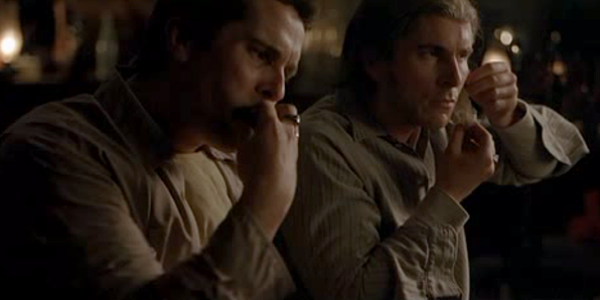
It is easy to believe that The Prestige, based on Christopher Priest's novel of the same name, is Nolan's hidden masterpiece; a secret chef-d'“uvre known only to his die hard fans and reserved exclusively for the true cinematic aficionado. This is simply not the case. Whilst its modest return at the box-office is dwarfed by that of TDKT, Inception and Interstellar, Nolan's Dickensian cat-and-mouse thriller is arguably his most thought-out and personal work to date. The rug-pull comes at a point in the film where Robert Angier is desperate to know the secret to rival magician Alfred Borden's trick, 'The Transported Man'. It is revealed that Borden used his twin as a body-double, a solution offered up by ingénieur John Cutter throughout the film, only to be repeatedly snubbed by Angier for being too simple. It substantiates Nolan's attitude towards magic and showmanship whilst also serving as a meta-reflection of his own experiences as a film-maker. This is what makes The Prestige's rug-pull Nolan's greatest - to quote John Cutter; "Now you're looking for the secret. But you won't find it because of course, you're not really looking. You don't really want to work it out. You want to be fooled". This can be applied as much to the audience watching his movie as the audiences watching the magicians on-screen. Nolan lays bare his twist, daring the audience to find it by his demonstrating his faith in the rule his characters live by; that an audience wants to be fooled. Of all his films, it is in The Prestige's complex, layered representation of its over-arching message that Nolan's conviction in his storytelling is most clear. The foundations of the film are built upon the commitment to the final reveal and it is in the confidence with which it is approached that makes this Nolan's finest rug-pull. How would you rank Nolan's twists? Share your favourite in the comments below.

Contributor
Contributor

Aspiring screenwriter. Avid Gooner. Saving the rest of the self-descriptive stuff for the autobiography.