What Does The Ending Of Memento Really Mean

Remember Sammy Jankis...

Before he resurrected Batman and made us forever uncertain if we were actually dreaming, Christopher Nolan made Memento. A twisting tale of revenge told in reverse, the film was the first suggestion to many that Nolan was something really special (it was only his second feature film). Widely regarded as one of the director's best films (and also of the 21st Century as a whole), Memento has betrayed its indie origins and become a widely regarded masterpiece. It was incredibly strong at box office thanks to glowing word-of-mouth, but it's on DVD where the film really exploded, becoming a must see for a whole generation of movie goers. But what's actually going on? Memento is intricately presented in a manner that require multiple rewatches to just pin down what's going on, while Nolan himself has thrown irritatingly conflicting viewpoints out there that make unravelling the story incredibly tricky. Well today we're going to try and shed some light on that, explaining what exactly happened in Memento. For more Nolan ending exploration, check out our looks at the finales of The Prestige and Inception.

What's Up With The Narrative Structure?

Before we start we really have to ask ourselves what exactly Memento's ending is. Far from employing the conventional narrative, Nolan's film takes advantage of its amnesiac protagonist and presents events in a totally unique way. Most of the film's action is portrayed in reverse, with vignettes each a few minutes long slowly giving us a little more of the story. These are interspersed with black and white scenes that provide narrative exposition and serve as a window into Leonard's psyche. Yeah, you can see why this is a pretty hard film to crack. To this end there's actually two endings to the film; the narrative ending (the actual end of the film - Leonard decides to kill Teddy), and the chronological ending (the opening where Teddy is finally killed). Most of this article is focusing on untangling the reveals present in the former, although we will also theorise the repercussions of the latter. It's worth noting that the Special Edition DVD comes with a hidden easter egg that allows you to watch the film in chronological order. That may seem an easy way to unravel the mysteries, but in actuality it only poses the questions in a different order.

The Story

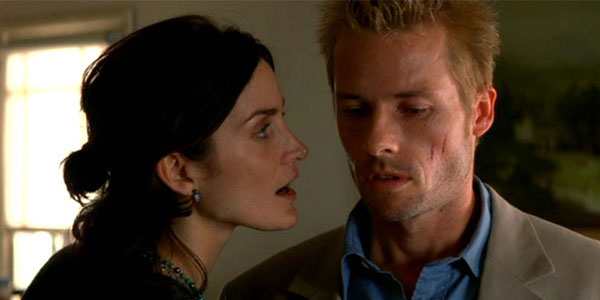
Here's the basic set-up of Memento: Guy Pearce plays Leonard, a man with short-term memory loss who is trying to avenge his wife's death. He believes she was killed in the same attack where he developed his condition. Over time he's developed a way to live and began to solve the mystery of who attacked him, a man named John G. To go deeper into the plot is tricky because of the narrative presentation. We're going to try and cut out the misdirection and run through the story as it happened chronologically. This should make the broad strokes and motivations of certain characters a little clearer. Bear in mind that through all this Leonard has little idea how he got into these situations. Events begin with Leonard in his motel room furthering his investigation for John G. He's figured out that the attacker was a drug dealer and, despite having tattooed a warning to the contrary on his arm, he talks with a cop on the phone. He meets with this cop, Officer Gammell although he's currently going by the name Teddy, who has tracked down a Jimmy Grantz he believes is the real John G. Leonard kills Jimmy and takes his clothes. It's at this point that Teddy explains to Leonard that he already got his man a year ago and that he's been using him to hunt down other nefarious J.G.s ever since. Leonard burns the evidence of having finished his mission and decides to frame Teddy, leaving notes for himself that implicate his friend as the attacker. Teddy implores Leonard to leave town, but instead he follows a note left in Jimmy's jacket to a bar where the deceased's girlfriend Natalie works. Once confirming Leonard does indeed have short-term memory loss, Natalie takes him home and manipulates him into dealing with Dodd, an acquaintance of Jimmy's who is looking for money. In recompense for Dodd Natalie helps Leonard solve the mystery he set himself, implicating Teddy as John G. The story ends/film begins with Leonard killing Teddy.

What Actually Happened To Leonard?

Throughout the movie we, along with Leonard, believe a skewed view of events. In his mind, one night his wife was attacked by two men, one of which he killed, but the other cracked his skull and escaped. His wife died and he developed his memory condition. The police didn't believe his story of a second attacker, leading to him, with the help of a cop, starting to hunt down the mysterious John G. That's not quite the truth. The attack on his wife (suggested to be junkies too high to realise they were breaking into a house with two people) did happen, with the same conjecture over the number of attackers, but the hunt wasn't instantaneous, mainly because his wife didn't die then. She died later on of totally unrelated circumstances (which will be fully expanded on in the next point), meaning the whole mission Leonard's on is motivated by skewed facts. Here's where one of the key themes in the film comes into play; the role of memory. Leonard himself says mid-way through the film that "memories can be distorted. They're just an interpretation," which is evidently happening here; the sight of his wife under the shower curtain has developed so she appears to not be breathing. A couple of times in the film Leonard delivers by rote a statement of "who he is", which is described by Teddy as "who you were". Obviously on a basic level this is commenting on how the hunt for vengeance has changed him, but with what we're seeing "distorted", it's actually looking closer at how much who we are is defined by our experiences; if Leonard's memories are being altered then at what point does he become a different person?

Sammy Jankis

One thing Leonard's always keen to remind himself of is the story of Sammy Jankis. Although it's told as a cautionary tale (don't make unordered notes, have a purpose), it's actually the key to Leonard's past. When he worked for an insurance company before the attack, Leonard dealt with a claim by Sammy and his wife following a car accident which left him with a near-identical condition to the one Leonard would develop. Tasked with figuring out if it was a scam or not, Leonard ultimately concluded, through Sammy's inability to form new habits through conditioning, that the problem is mental, not physical. The story ends with Sammy's wife, unable to cope with the cost and emotional strain, killing herself in the ultimate test; repeatedly asking Sammy to administer an insulin shot. As the final scenes of the film reveal, however, this isn't totally Sammy's story. After the onset of his memory-loss it was Leonard's wife who couldn't cope with the changes in her husband and orchestrated her own death; is was Leonard, not some John G. who killed her. We know Sammy did exist in some form - we're told he didn't have a wife, implying his case (and Leonard's role in an insurance firm) are to some degree real - so this is not a totally fabricated story, rather another distorted memory. Throughout the story Leonard has talked of conditioning, stating how you can teach yourself something through repetition rather than memory, which is exactly what he's doing in repeated the to everyone he meets (Jimmy's last word, "Sammy", is likely an attempt to appeal to Leonard). What's really interesting is that the insulin murder is an example of a new memory, suggesting Leonard's conclusion that physically Sammy should be able to make new memories was right; Leonard remembers killing his wife, but he's managed to condition himself through repetition it was a story he witnessed, rather than was involved in.

Teddy

Much of the 'truth' of Leonard's story at the end comes from Teddy. And here's where so much of the ambiguity about the film as a whole comes from; we don't know whether to believe him. Which is pretty impressive manipulation on the part of Christopher Nolan, because the main reason we distrust Teddy is that throughout the film we have been told to not "believe his lies", something the narrative end shows us is entirely fabricated by Leonard to keep his mission going. Teddy is a cop (he has a badge) and we can chalk up his reluctance to address that directly for most of the film to one of two things; he's undercover as he says to Leonard or he's crooked (given the link to drug dealers and his extreme measure, we're tempted to conclude it's the latter). He is a long-term friend of Lenny's, allegedly the police officer assigned to his case, who in the dearth of police action helped Leonard hunt down the original John G. Subsequently, once it became apparent getting his man had little impact on Leonard's health, he took advantage of him, having him kill various bad people. It's in one of these cases where the black-and-white sequence takes place. Later on, his multiple appearances in the colour segments appear to be with the same goal; ; convince Leonard to leave town lest he becomes recognised as the guy who killed drug dealer Jimmy (as happens with Dodd). That's the most likely version of events. There's a possibility he's the real John G., but that would have to co-exist with him being a cop (there's too much evidence that suggests he was on the force at some point) and requires taking various statements as flat-out lies for the sake of proof. However, the ultimate endorsement that what he's saying is true comes from Leonard himself; at the narrative ending of the film he must believe Teddy's telling the truth as he (once more) adjusts his hunt to target a man he knows isn't his wife's attacker. Deep down he knows it's true.

Natalie

Early on in the film it appears that Natalie is the key to the whole mystery; she's helped Leonard find John G at long last. But as we go further back in time it becomes apparent that things are painfully more morally ambiguous. In terms of the ending Natalie isn't really totally relevant. Instead, she's a sign of how people can easily manipulate Leonard, using his disability to make him do things. Leonard has killed Jimmy, her boyfriend, and is parading around in his car and dressed in his suit. The initial anger dissipates when it's apparent he's no idea what he's done, but when pressure comes from Jimmy's associates she decides to use him. Although this could make her look totally manipulative, her actions near the chronological end (narrative beginning) show a different side to her; once she's learned of Leonard's past and his current mission there's a definite change in character - she's actually nice to him. Interestingly, the chronological end provides some resolution to her character arc. Her main drive seems to be to cleaning up after Jimmy's presumed death; get Teddy for killing him and keep his acquaintances at bay. In helping Leonard in a selfless way by providing him the identity of the new John G., she's actually dealing with one of those issues; she's unknowingly sending him to kill Teddy.

What Happens After The End?

Asking what happens after the end of Memento is as simple a question as anything about this film. There's the two endings to deal with, but you also have a series of conflicting accounts that make wider truths harder to confirm.

The Narrative End

Quite simply after the end of the film all the events we've already seen play out; Leonard meet's Natalie, attacks Dodd, kills Teddy etc. He's purposely decided to forget that he's reached his prize already and continue the journey. The reason for this lies in many of Leonard's quotes from the film. In comparing himself to Sammy he says "I use habit and routine to make my life possible. Sammy had no drive. No reason to make it work." He recognises, if only subconsciously, that without his crusade there's little point to his existence and that he'll revert to the state he was immediately after the death of his wife.

The Chronological End

What happens after the events of the film, which culminate in Leonard killing Teddy, are rarely addressed in discussion of Memento, but it's fascinating to explore. Obviously there's no Teddy to tell Leonard the truth, meaning the only way for him to even suspect he got him man is the photo he takes of Teddy's body (at the very start of the movie). Proof that his quest is over (assuming he writes something incriminating on it), this would remove that purpose in his life and likely send Leonard in a downward spiral, like Sammy in the home. However, as we know from the narrative ending, he's conditioned to constantly be hunting the second attacker, even after they're dead, so there's a distinct possibility he could somehow restart his quest. Quite what would give him the leap to do that (in the narrative end it was being told explicitly he got his man) is unclear, but it would only take one sliver of doubt (he has removed pages from his police file that don't work with his current theory) for Leonard to willingly forget it. In this case he'd find himself in a loop; one of his permanent facts is that Teddy's car belongs to the killer, meaning he'll be forever hunting a dead man. Which, in a way, makes this the happiest ending; Leonard would be involved in a mystery that he literally can never solve. There's also some extraneous elements that are worth addressing. Dodd and the rest of Jimmy's associates are still out there and Leonard is driving around with $200,000 in the trunk of his car. Too little is known about Jimmy's connections to conclude the impact this could have on Leonard. However, with Teddy, the man who in everyone's minds killed Jimmy, now dead there's a chance all the heat will be called off. Now we've explained the ending, we'd like to present one little theory a little off the beaten track that may further explain just what's going on in the film.

Does John G. Even Exist?

One question the film doesn't really explore is that of the second attacker's existence. Everyone, except Leonard, reportedly believed it was a case of a single attacker, but we're led to believe they were all wrong. The thing is, there's very little evidence to back this up (and most of it's highly suspect); there's only Leonard's memory and Teddy's testimony. Leonard's recollection of events has been called into conjecture by all those involved, with the evidence in the bathroom pointing towards a lone attacker. As he can manipulate events in his mind from both before and after the attack (Sammy having a wife and his own having diabetes), there's a big question mark over whether we can believe this. Teddy's account, with him brandishing a polaroid of a victorious Leonard, suggests that in his mind there was an attacker, although this is far from an unbiased account. We know Teddy/Gammel has been using Leonard to bump off various John G's, with the addendum to one of Leonard's facts suggesting he could be called Jimmy likely influenced by Teddy; what if the manipulation reaches further back than Leonard knows. If this is true this pushes the notions of memory and conditioning to even more extreme lengths; Leonard is completely living in a fantasy. Do you have any theories about the end of Memento? Which film would you like us to look at next?

Contributor
Contributor

Film Editor (2014-2016). Loves The Usual Suspects. Hates Transformers 2. Everything else lies somewhere in the middle. Once met the Chuckle Brothers.