Gene Roddenberry's Original Pitch For Star Trek 2 Will Blow Your Mind
Time-travel? JFK? Roddenberry's idea for Star Trek II would have been quite the adventure.
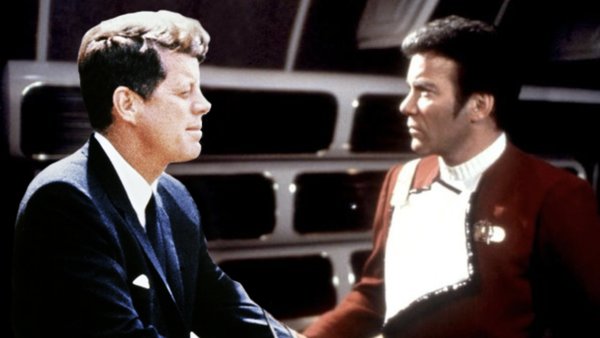
Star Trek II is widely revered as one of the greatest Star Trek stories ever told. However, franchise creator Gene Roddenberry was only the movie’s executive consultant. But what if he wrote the movie instead?
In this edition of Lost Trek, travel back in time to see Roddenberry’s dramatically different take on the classic film, why it was canceled, and what the Trek Universe would look like if it were actually produced.
Let’s travel back to 1980. Star Trek: The Motion Picture was released in theaters last year. With the movie’s modest box office returns and strong fanbase, Roddenberry quickly went to work on the sequel. By May, Roddenberry delivered his 60-page treatment for a sequel.
Whereas “Star Trek: The Motion Picture” aimed for high-concept existential science fiction, Roddenberry’s “Star Trek II” delved into time travel, altering American history, and surviving planetary dystopias. One thing is for sure, no one would nickname this film “the slow-motion picture.”
Roddenberry’s Star Trek II: Kirk Meet JFK

Instead of opening with an explosive no-win scenario with Kirstie Alley at the helm, Roddenberry’s “Star Trek II” opens with the U.S.S. Enterprise arriving at Earth with Spock’s parents Sarek and Amanda Grayson aboard. But something is wrong. Instead of a pristine technocratic utopia, planet Earth is now a desolate wasteland inhabited by savage de-evolved former humans.
The Enterprise crew then discovers that Klingons have used the Guardian of Forever to travel back in time to successfully undermine human history. But before the Enterprise can travel back in time, they are attacked by the dreaded Klingons resulting in the death of Spock’s parents.
Somehow, the Enterprise is able to travel through the Guardian of Forever and crash lands in Canada on November 22, 1963 --the day of the Kennedy assassination. However, instead of participating in the parade that will result in his assassination, Kennedy is quickly diverted to the White House to examine new U-2 spy plane reconnaissance of a UFO ---which is actually the Enterprise. Captain Kirk is whisked to the Oval Office and meets President Kennedy before beaming him up to the bridge of his own ship.
The surviving details of this pitch contradict in how the movie ends. Some accounts claim that Kirk and the Enterprise defeat the Klingons and return to the Twenty-Third Century with a resurrected President Kennedy and a love interest for Dr. McCoy whom he marries after taking her back to the future. What is that Temporal Prime Directive, anyhow?
However, several other accounts of the pitch aggressively claim that Roddenberry’s Star Trek II ending was reminiscent of “The City on the Edge of Forever” in which President Kennedy must die to maintain the integrity of the timeline. Apparently, the unknown shooter on the grassy knoll was an Enterprise crewmember. After Kennedy’s death, the Enterprise defeats the Klingons and returns to the Twenty-Third Century.
With these details in hand, Roddenberry marched into the Paramount executives ready to bring his vision to the silver screen. Except that didn’t happen.
Why Roddenberry’s “Star Trek II” Was Canceled

There are two principal reasons for why Roddenberry’s “Star Trek II” collapsed into its own pocket dimension.
For starters, the Paramount executives found the concept of time traveling to the Kennedy assassination in bad taste. In modern terms, Roddenberry’s Star Trek II would be like a modern time travel movie revolving around the 9/11 terrorist attack. Tinkering with the implications of such an event on the space-time continuum was just too soon.
More importantly, however, Paramount’s rejection of Roddenberry’s pitch dealt with how he handled Star Trek: The Motion Picture. With an initial budget between $8 to $15 million, cost overruns ---partly due to Roddenberry’s leadership--- ballooned Star Trek: The Motion Picture’s price tag to $35 million by the time it landed in movie theatres. Roddenberry’s vision was one of the most expensive films of its time. With big budget films such as Michael Cimino’s 1980 western Heaven’s Gate bankrupting studios like the United Artists, Paramount ordered “full stop” on big-budget projects. Star Trek was at the top of the list.
Instead of continuing with Roddenberry’s big-budget sci-fi spectacles, Paramount gave the command chair of the Star Trek franchise to TV producer Harve Bennett. Bennett’s mission was to make a blockbuster film on a TV production budget and schedule. Roddenberry was sidelined to Executive Consultant status.
Despite his diminished status, Roddenberry continued to insist that his “Kirk Meets JFK” script was the only viable direction for his franchise. From Wrath of Khan to the Voyage Home, Roddenberry repeatedly submitted this treatment as one of his contributions to each production.
Ordinarily, that would be where the story ends, but since this is a Star Trek history article, you are invited to break the bounds of conventional reality and travel…
Across The Multiverse
Let’s create a parallel reality in which this lost film was actually produced to discuss its full creative potential and financial impact on the Star Trek universe.
We begin with the #FinishThePitch challenge. You are invited to finish what Roddenberry started. All story details leading up to this section are historically documented and cannot be changed. However, details can be added to complete the story. Here’s an example of a #FinishThePitch challenge story. The Enterprise visits the dystopian Earth, travels back in time, and is shot down by a Klingon battlecruiser forcing the ship’s crash landing into Canada. As documented in the pitch, Kennedy cancels his visit to Dallas to investigate the crash thus avoiding assassination. A new timeline forms. Kennedy is re-elected but he rapidly loses funding for the space race. In the original timeline, Kennedy’s tragic death galvanized Americans to land on the moon since it was the late president’s challenge. In this new timeline, Americans grow impatient with the space race and decide to drop out.
This change in the timeline allows for the Soviets to land on the Moon, causing a chain reaction that culminates in a nuclear war that devastated humanity resulting in the dystopian wasteland featured at the start of the story.
Using the ending in which Kennedy must die, the Enterprise travels back in time and apprehends the Klingon vessel before it can contaminate the timeline. Kennedy goes to Dallas as planned and is assassinated. The timeline is preserved and Spock is reunited with his resurrected parents in the Twenty-Third Century.
But What If...
Feel free to devise your own completed pitch, but in terms of its financial effect on the Star Trek universe, Roddenberry’s Star Trek II would be a franchise killer.
Compared to Bennett’s significantly cheaper Wrath of Khan, the set-pieces and special effects necessary to bring Roddenberry’s Star Trek II to theaters would be massively expensive. This would cause box office returns to be on par with --or potentially higher than-- the returns of The Motion Picture.
However, due to the creatively dubious decision to feature a relatively recent national tragedy as the story’s central conflict, audiences would most likely be dissatisfied, resulting in a lower box office return than Star Trek: The Motion Picture.
At best the Star Trek franchise would have stopped at Roddenberry’s Star Trek II if it were produced. There would be no financial need for future Star Trek movies or spinoff TV shows. At worst, Roddenberry’s Star Trek II would have bankrupted Paramount Pictures.
But what do you think? One of the greatest details of Star Trek history is that it is open to debate. Write your completed pitches and financial predictions in the comments.