This week US audiences can enjoy Jack Ryan: Shadow Recruit, a reboot of the popular character created by Tom Clancy who hasn't been seen on screen since The Sum of All Fears in 2002. Chris Pine steps into the title role previously played by Alec Baldwin, Harrison Ford and Ben Affleck, and there are strong hopes that this film, under the direction of Kenneth Branagh, will reignite the franchise after Clancy's death last year.
There are a number of reasons to be excited by Jack Ryan, which reaches British audiences in a week's time. Pine has proven himself through Star Trek to be a very capable leading man, and I've already professed my love for Branagh's directorial work in my article on Shakespeare two months ago. But the film is also notable as Keira Knightley's return to the mainstream, after several years of concentrating on theatre and smaller, more independently-spirited films. Knightley has had her fair share of critics over the years, with Mark Kermode labelling her "Ikea Knightley" at the height of her Pirates of the Caribbean days. But like many actors we're covered on this section of the site, she also has her moments when she is paired with a proper director, as her collaborations with Joe Wright testify. So before you go about shadowing her in Jack Ryan, let's take a look back at the highs and lows of Keira's career. Let's kick off (in more ways than one) with a very British offering...
5 Awesome Performances
5. Elizabeth Bennet - Pride & Prejudice (2005)
Nothing quite says period drama like Jane Austen, and none of Austen's works have quite captured the public imagination like Pride & Prejudice. Bringing the book back to the big screen was a risky undertaking; 18 years on, the image of a wet-shirted Colin Firth still looms large in public perceptions of the story. But overall Joe Wright's first collaboration with Knightley is a solid effort, bolstered by her performance as Elizabeth Bennet. In case you need reminding, Pride & Prejudice revolves around Ms. Bennet, the second of five children who live in relative luxury as gentry at the family farm of Longbourn. Since the farm will be inherited by their cousin, Elizabeth's father (Donald Sutherland) is keen to marry off his daughters as soon as possible. The rest of the plot revolves around the various suitors that the daughters encounter, including the wealthy, charismatic Mr. Bingley (Simon Woods) and the now-iconic Mr. Darcy (Matthew Macfadyen). Pride & Prejudice received four Oscar nominations, including a Best Actress nod for Knightley. While Wright's version is generally more melodramatic than the 1995 TV series, Knightley's performance keeps us grounded as an audience. She is particularly adept at conveying her character's alienation from the family, something which Wright sought to explore in a more realistic manner than in the book. It's a very fine performance combining poise and vulnerability, and the perfect place to start our countdown.
4. Sabina Spielrein - A Dangerous Method (2011)
It's often the case that the performances that stick out in an actor's career are those which make the best out of somewhat inferior material. Ricardo Montalbán, best known for his title role in Star Trek II: The Wrath of Khan, claimed to have spent his entire career making slightly sub-par roles more interesting. The same goes for Knightley's performance in A Dangerous Method, in which she is the saving grace in a disappointing affair. A Dangerous Method explores the relationship between famed psychoanalysts Sigmund Freud (Viggo Mortensen) and Carl Jung (Michael Fassbender). Adapted by Christopher Hampton from his own play The Talking Cure, it explores the two men's friendship in relation to Jung's affair with a patient (Knightley). Having named Jung as his heir, Freud begins to bully his protégé, using his relationship with Spielrein against him while Jung takes Sabina under his wing as both a lover and a mentor in her own studies. While most of David Cronenberg's work has a visceral intelligence and kinetic energy about it, A Dangerous Method is surprisingly talky and stagey. But while the male leads struggle to get anything out of the material, Knightley delivers a very convincing portrayal of hysteria and frustrated sexuality. It's a lot busier than any performance we've seen from her before, but she brings the kind of energy and emotional conviction that the rest of the film is crying out for. It's worth checking out just for her performance, and Cronenberg would be wise to work with her again.
3. Cecilia Tallis - Atonement (2007)
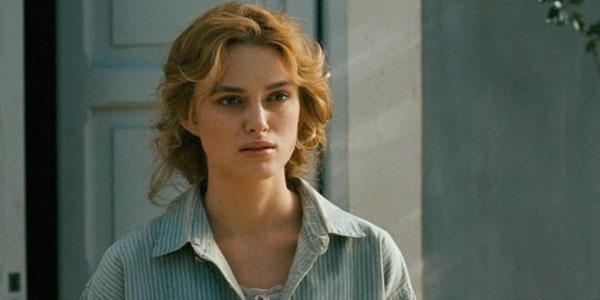
Choosing between Knightley's collaborations with Joe Wright is no easy task: all the films they have made together are good, or at least interesting in some way, and it's clear how much of an artistic affinity they have together. But for all the merits of Pride & Predujice or Anna Karenina, Atonement is the biggest all-round success, both as a piece of film-making and as a showcase for her talents. Based on the celebrated novel by Ian McEwan, Atonement is a story of jealousy, guilt and unrequited love which begins a few years before the onset of World War II. Briony Tallis (Saoirse Ronan) comes across an erotically explicit letter, written to her older sister Cecilia by a servant called Robbie Taylor (James McAvoy). Racked with jealousy, Briony frames Robbie for the rape of her teenage cousin Lola (Juno Temple). Robbie is sent to prison and subsequently joins the army to fight in France. Atonement is a very fine piece of work which does justice to its source material and has a stellar cast; Benedict Cumberbatch got to play Sherlock after impressing Steven Moffat with his performance. But it simply wouldn't work without a believable central romance, and on this level Knightley delivers in spades. Cecilia could be played as an increasingly bitter, mopey child, but she brings an ethereal stillness to the role which lifts even the most incidental sequences. It's an elegant performance which avoids feeling too measured, and the fountain scene is something very special.
2. Ruth C. - Never Let Me Go (2010)
Mark Romanek needs to make more films. One Hour Photo was a compelling, well-made thriller featuring one of Robin Williams' most electifying performances, as a photo technician who obsesses over a family whose films he develops. And then there's his most recent effort, Never Let Me Go, a little-seen British gem which is sure to take its place as one of the most underrated sci-fi films of the last ten years. Never Let Me Go is based on Kazuo Ishiguro's novel of the same name, adapted by Alex Garland (The Beach). It takes place in an alternate reality where medical advances have led to human cloning, with the clones' organs being harvested to prolong the lives of other human beings. The film follows the adult lives of three such clones, played by Knightley, Carey Mulligan and Andrew Garfield, and the love triangle that evolves between them. Never Let Me Go is a very clinical film, drawing equally on dystopian sci-fi and period drama to tell a tragic story about human ethics and the fleeting nature of existence. It's a very moving piece of work, brought to life by the three main performances. Mulligan and Garfield's credentials are widely known from their subsequent work, but Knightley is just as good, capturing a sense of distance from the world while longing for something deeper than her eventual purpose. It's a moving performance in an equally moving film, and both demand much greater attention.
1. Georgiana Cavendish - The Duchess (2008)
Considering Knightley's life-long affinity with period drama, it's no surprise that her best performance would come in this genre. It's easy to dismiss the genre as one obsessed with nothing deeper than pretty dresses and dancing, but The Duchess is a film for confounding those expectations. It's also the film, following on from our introduction, that convinced Mr. Kermode that there was something to Ms. Knightley after all. Lavishly directed by Saul Dibb, The Duchess tells the story of Georgiana Cavendish, Duchess of Devonshire during the late-18th century. Georgiana is a much-loved and highly influential public figure, rubbing shoulders with the most powerful people in British fashion and politics. After her grim husband (Ralph Fiennes) begin an affair, she makes the fateful mistake of responding in kind by courting the future Prime Minister Charles Grey. When The Duchess was released, comparison were drawn between Georgiana's predicament and that of Princess Diana: both were much-loved figures with blue blood who had extramarital affairs. From a purely cinematic point of view, Dibb's film knocks Oliver Hirschbiegel's Diana into a cocked hat, but its success rests just as much on Knightley's performance. Going toe-to-toe with Ralph Fiennes is no easy task, but she manages it with a performance which manages to find light, joy and dignity in her predicament, no matter how awful said predicament becomes. It's a role that she was born to play, and a performance she has yet to better. Having sung Keira's praises, let's now look at 5 performances in which she truly was Ikea...
And 5 That Sucked...
5. Sabé - Star Wars: Episode I - The Phantom Menace (1999)
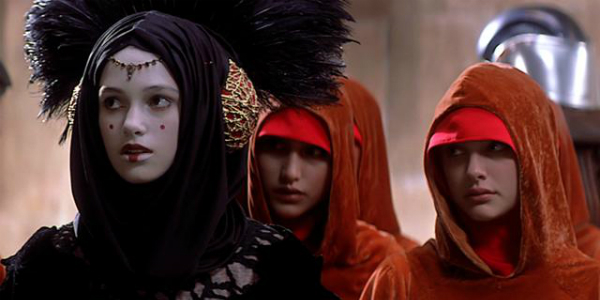
This might seem a trifle unfair or spiteful on my part, considering my past remarks about Star Wars both here and in my reviews on Mumby at the Movies. Knightley doesn't feature in my article on actors who couldn't let Star Wars go, because she quite clearly has gone on to a lot of better things. Being in The Phantom Menace may not be a crime in and of itself, but being bad in a really bad film does deserve to be reprimanded. The plot of The Phantom Menace (what there is of it) has been described, dissected and joked about in such detail that repeating it here seems altogether pointless. Suffice to say, Sabé is one of the handmaidens to Queen Amidala (Natalie Portman), who accompanies her and the Jedi on their journey to Coruscant to address the Trade Federation. It eventually transpires that Sabé has often served as the Queen's body double to protect her; Knightley was cast on the basis of her physical resemblance to Portman. You might have good cause for arguing that this performance isn't the actor's fault, as could be said for anyone who has worked under George Lucas. But even with such a simple job, Knightley doesn't do enough to convince us that she and Portman are the same person. The fact that her dialogue had to be overdubbed by Portman proves that she couldn't carry off the façade on her own, and even then the dubbing is so bad that it only draws attention to it. Though it grieves me to say it, this is one occasion when it might have worked better if Lucas had simply used CGI, cloning Portman and thereby carrying off the deception.
4. Hélène Joncour - Silk (2007)
There's been a lot of talk recently, in light of The Hobbit movies, about precisely how long one can need to tell what is on paper a very simple story. I've already given my reasons why the first film was too long, and you'll find plenty of other writers on this site who have done the same for The Desolation of Smaug. Suffice to say, if you found either of The Hobbit films even slightly tedious, stay away from Silk as you value your sanity. Silk is an adaptation of Alessandro Baricco's novel, directed by François Girard (The Red Violin). It tells the story of Hervé Joncour (Michael Pitt), a French military officer married to Hélène (Knightley) who begins smuggling silk from Japan to continental Europe. During his visits to Japan, he begins an affair with an unnamed concubine, which threatens his marriage and causes him to question his calling in life. Silk is a terrible film, boasting pretty visuals but stretching its already thin story out beyond all boundaries of patience. Pitt is badly miscast in the lead, the dialogue is uninspiring, and the whole thing suffers from the pretentious intentions of its director. As for Knightley, she turns what should be an endearing character into an unlikeable moper, taking an increasingly limited role and making it even more so through her unconvincing delivery and lack of energy.
3. Jackie - The Jacket (2005)
When I talked about A Dangerous Method, I said that Knightley was the best or most redeeming aspect of an otherwise disappointing film. In the case of The Jacket, it is the other way around, in that she is the most disappointing or problematic factor in a film which deserves a lot more recognition.
Based loosely on Jack London's novel of the same name (released as The Star Rover in the US), The Jacket stars Adrian Brody as Jack Starks, a veteran of the first Gulf War coming home to Vermont after recovering from a head wound. Suffering from amnesia, he befriends a young girl and winds up in an asylum after being found not guilty by insanity of murdering a policeman. Through an experimental treatment, he time travels to 2007, where he meets an adult Jackie (Knightley) and begins to piece together what happened on the day they first met. The Jacket is a neat little self-contained time travel film, the sort of story that Richard Kelly wishes he could write (more on him later). Brody is very good and director John Maybury gives the story a fittingly disorientated sensibility, drawing on Adrian Lyne's work on Jacob's Ladder. The one weak link, however, is Knightley: her American accent is completely unconvincing and her performance feels overly choreographed and stilted. She's not enough to spoil the film completely, but her extended presence in the later scenes distracts us from Brody's excellent work in the lead.
2. Elizabeth Swann - Pirates Of The Caribbean 2 & 3 (2006/ 2007)
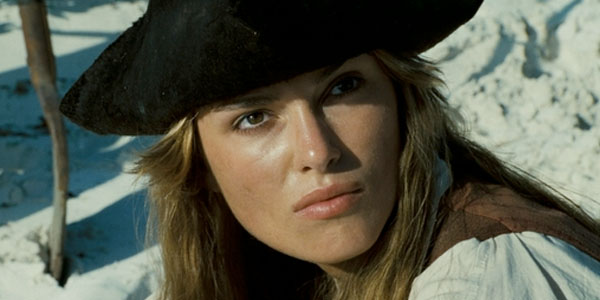
Anyone who has read my articles on overly long films and terrible sequels will know by now that I don't much care for the Pirates sequels. While I do have a certain soft spot for the first Pirates film, as a piece of no-nonsense, often funny popcorn cinema, the sequels are bloated, self-important, poorly acted and horribly directed by Gore Verbinski. I'm including them together on this list since they were filmed back-to-back, and because Knightley is pretty terrible in both of them. Dead Man's Chest begins with Swann's marriage to Will Turner (Orlando Bloom) being interrupted by Lord Cutler Beckett of the East India Company; he arrests them for helping Jack Sparrow (Johnny Depp) to escape and sends Will off to find the Dead Man's Chest. What follows over this and At World's End is an extremely convoluted plot involving a love triangle with Sparrow, The Flying Dutchman and her character becoming king of the pirates. If it sounds like I'm making it up as I go along, that's a good indication of how the films feel. Knightley's performance in the first film was by no means great, but it was decent considering the material she was given and she ended up being a lot of fun. Here, however, she's brittle, wooden and very irritating for the vast majority of her screen time. Her tryst with Depp is unbelievable, she looks completely lost during the action scenes, and her attempts at being a fearsome leader in the third film are about as intimidating as a sixth form netball captain. Her performances may not be the worst thing about these films, but they sure as hell don't help things go any faster.
1. Domino Harvey - Domino (2005)
Most of Knightley's success in her career has come in period drama, and whenever she has left this comfort zone she has tended to come a cropper, either critically or commercially. But while her work in Pirates was bad, and her contribution to The Jacket was disappointing, she has never failed quite so spectacularly as she did on Domino. Scripted by Richard Kelly (Donnie Darko) and directed by the late Tony Scott (Top Gun), it is a catastrophe on every conceivable level. Domino is based loosely on the life of Domino Harvey, the daughter of actor Laurence Harvey who became a professional bounty hunter in Los Angeles. At the beginning of the film, Domino is being questioned by the FBI over her possible involvement in the theft of $10m from an armoured car. Domino answers her questions while explaining through flashbacks how she became a bounty hunter, including her modelling career, her expulsion from college and her relationship with fellow bounty hunter Ed Moseby (Mickey Rourke). Domino is an all-round terrible film. Even by Scott's standards it is far too flashy and shallow for its own good, and unlike Silk it doesn't have much to fall back on in terms of its visuals. Kelly's script is incoherent, as is Scott's direction, and right in the centre of it all is Knightley at her most wooden and disinterested. She doesn't so much play Domino as slouch from scene to scene, believing that all one needs to look tough is to curl one's lips and carry a gun. It's a performance with no depth, believability or commitment, and it's therefore a shoe-in for the low point of her career. --- Disagree with my choices? Drop me a comment below or visit Mumby at the Movies for more film reviews.
Freelance copywriter, film buff, community radio presenter. Former host of The Movie Hour podcast (http://www.lionheartradio.com/ and click 'Interviews'), currently presenting on Phonic FM in Exeter (http://www.phonic.fm/). Other loves include theatre, music and test cricket.