Oscars 2014: Predicting 10 Best Original Screenplay Nominees
 The typical take on Best Original Screenplay is that it is the weaker of the two writing categories. Particularly before any precursor awards are handed out, pundits usually struggle to scrounge up a roster of even thirty viable candidates for the category. I guess this shouldn't come as a surprise given originality's placement on the endangered species list in Hollywood these days, but it's a shame, because the category has often served as an outlet for the Academy to recognize innovative and daring films that would not be able to call themselves "Oscar nominees" otherwise. Someone with as a distinct artistic voice as Terry Gilliam, for example, would not be able to declare himself an Oscar nominee had his masterpiece, Brazil, not been nominated for Best Original Screenplay back in 1985. That same year, in the exact same category, another 80's Sci-Fi classic, Back to the Future, got to claim some credibility beyond its inevitable technical nominations with its spot in that year's Best Original Screenplay lineup. In 2001, while Best Picture honored typical Oscar fare such as A Beautiful Mind, Moulin Rouge!, and In the Bedroom, Best Original Screenplay was busy make first time Oscar nominees out of Christopher and Jonathan Nolan, as well as Wes Anderson and Owen Wilson for their work on the scripts of Memento and The Royal Tenebaums, respectively. Perhaps my favorite example of the Writers branch showing off their relatively enlightened forward thinking on what constitutes great cinema came in 1959. The Writers branch, in their capacity to ordain their five favorite original pieces of screenwriting, chose that year to venerate two of the masters of world cinema (doing some of their finest work) in nominating Francois Truffaut and Ingmar Bergman for their respective scripts, The 400 Blows and Wild Strawberries. If that's not enough for you to gain some respect for the Writers branch's taste, along with the two classics of world cinema, the writers also stuck up for the now legendary Hitchcock suspense thriller, North by Northwest, the only above-the-line nomination the prodigious film received. Of course, unsurprisingly, the larger body of voters in the Academy went with the meat and potatoes choice of the Doris Day-Rock Hudson rom com, Pillow Talk, when it came time to actually crowning a winner in the category, but nevertheless, the writers did their part. You can see then I am very sympathetic to this category and its vaunted past. Some of the single greatest nominations in the history of the Academy, the ones that were most off-beat, courageous, and artistically-minded, come from this category, and some of the first recognition of developing voices in cinema often occurs in Best Original Screenplay. This is why I count myself as a keen observer of this category, and 2014 is no exception. Already this year, we have a surfeit of sterling original screenplay candidates ranging from Noah Baumbach and Greta Gerwig's French New Wave/Woody Allen/zeitgeist amalgamation, Francis Ha, to Derek Cianfrance, Ben Coccio, and Darius Marder's epic Upstate New York father-son tragedy, The Place Beyond the Pines, to Scott Z. Burns' terse, psychotropic brain-twister, Side Effects, to Harmony Kornine's atmospheric, ambiguous morality tale, Spring Breakers. Unfortunately, none of these are likely to be nominated and thus failed to make my list. Even looking out further into the future, there are a number of films I am personally quite excited for that were not able to make it on this list either. For example, Spike Jonze's first foray into writing a feature film, Her, about a man who falls in love with his new operating system, and Terry Gilliam's similar sounding The Zero Theorem, about a computer hacker determined to discover the purpose of human existence, and Scott Cooper's Out of the Furnace, a gangster film centered in America's Rust Belt, were all persona non grata when all the shifting settled. All this essentially serves as pretext to make the point that I think this will be a strong year for original screenplays. It will be interesting to see how it all plays out, but here now is my current estimate of the ten strongest candidates for the award. Be sure to check out my assessment of this category's twin brother, Best Adapted Screenplay, in the coming days as well.
10. David O. Russell & Eric Singer - American Hustle
 I thought David O. Russell might swoop in and snatch the Best Adapted Screenplay award at last year's Oscar ceremony for his delightful adaptation of the Matthew Quick novel, Silver Linings Playbook, but it turned out the Academy's love for Argo was absolute enough to hand that film's scribe, Chris Terrio, the Oscar. Don't pity Russell too much though, because he may very well take a writing Oscar home in 2014 (along with co-writer Eric Singer) for his latest effort, American Hustle. If you haven't heard of the upcoming film yet (and if you haven't then clearly you have not read any of my other 2014 Oscar category previews, as the film has seemingly come up in about every article), American Hustle chronicle's the FBI's fascinating Abscam operation that took place in the late-1970s/early 1980's. The scheme ended up taking down numerous corrupt politicians who fell for con artists posed as rich Arab investors offering politicians bribe money per the FBI's sting setup. Despite the fact that the film's story derives from actual occurrences, the film's script is not wholly based off of any previously written or published material, which is why it will fall under the Best Original Screenplay category. This "based a on true story" blurb will likely only help the chances of American Hustle's screenplay to receive some Oscar recognition, as the Academy historically has a hankering for hidden history (a la Argo). This fact is something that can not often be said of most Original Screenplay nominees, so it should give American Hustle a slight edge over some of its competitors. Beyond this material advantage though, I also expect the movie to be expertly crafted when it comes to the film's script. David O. Russell's kinetic, screwball-esque style of dark humor sounds pitch perfect given the subject matter of the film, and considering the original title of the movie was American Bullshit, I expect there to be at least slight satirical overtones about the corruptness of the American government as well. With a huge ensemble cast made up of contemporary A-listers (Christian Bale, Bradley Cooper, Amy Adams, Jennifer Lawrence, Jeremy Renner, and Robert De Niro), this is likely to be a film with a lot of moving parts, which typically spells "writer-y" to Academy voters (yet another good sign for the screenplay). I expect American Hustle to play significantly in the 2014 awards season, and there is no reason to suspect the film's script won't be apart of that too.
9. Coen Brothers - Inside Llewyn Davis
 As soon as countless critics on the Croisette began breathlessly typing away on their personal electronic devises professing their practically universal approval of the Coens' newest venture, Inside Llewyn Davis, their nomination for Best Original Screenplay was etched in stone. No, nix that, as soon as the projector fired up (or maybe a DVD or Blu-ray player, sadly enough) and the credit "Written by Joel and Ethan Coen" appeared on screen, the brothers were assured of yet another writing nomination. Regardless of whether Oscar Issac's campaign in the lead acting category is ultimately successful, or whether John Goodman manages to snag his long-overdue first Oscar nomination, or if Inside Llewyn Davis gives the Coens' their third Best Picture nomination in a row, one thing I would be willing to stake my fate and fortunes on (which are admittedly small) is that the Coen Brothers will be nominated for Best Original Screenplay. Even the Coens' fiercest critics must concede that, if nothing else, the Brothers Coen make for one hell of a writing duo. Maybe you have issues with their aesthetic approach from time to time, or maybe you don't like the way in which they construct performances from their actors, but if individuals do have an essence in life, then Joel and Ethan Coen are essentially screenplay writers before anything else. The Academy seems to concur with my view as well, as both Coen Brothers have received five nominations between the two writing categories. Remarkably, this excludes such vaunted Coen classics as The Big Lebowski, Barton Fink, and Raising Arizona, which have since been coronated as cinematic royalty by contemporary cineastes. The Coens still have a way to go to catch up to the all-time leader of writing Oscar nominations, the prolific Woody Allen who has had an astounding fifteen Oscar nominations as a writer in his career (and maybe a sixteenth in the works, but more on that momentarily), but the Coens are inarguably a writing institution unto themselves at this point. Now even though some admirers of the film have pegged the Coens' most recent effort as "slight," in this category that line of criticism is utterly superfluous. Smaller films with the more "personal" touch are often most appreciated by writers, and a film about a struggling folk artist in the early 1960's New York folk scene honestly sounds like the wet dream of at least a few writers out there, so you can go to Vegas and lay your money down on this one.
8. Craig Borten, Melissa Wallack - Dallas Buyers Club
 In some of my previous preview articles, I asserted my gut instinct that Dallas Buyers Club will likely serve only as a vehicle for nominations for its two primary actors, Matthew McConaughey and Jared Leto, but if the film does find favor beyond the Actors branch, I expect the first category it might venture into is Best Original Screenplay. As I mentioned with American Hustle, the Academy often favors films and screenplays that have some basis in true events. The Academy also typically honors "issue films," especially issues that personally intersect with the lives of Hollywoodians such as the AIDS epidemic did in the 1980's. The plot of Dallas Buyers Club is loosely based in the life of Ron Woodruff. Woodruff was a heterosexual homophobe who contracted the AIDS virus through his habitual drug use in 1986. Given only thirty days to live, Woodruff, with the help of a transsexual business partner, starting illegally smuggling in non-FDA approved, but comparatively effective, drugs into the country and selling them to suffering AIDS patients through what became known as the "Dallas Buyers Club" (hence the name of the movie). The film is written by relative newbies Craig Borten and Melissa Wallack (who co-directed the Aaron Eckhart-starring comedy, Meet Bill), but this lack of experience is rarely an issue with the Writers branch, as evidenced by Agro screenwriter Chris Terrio's Oscar victory. What does tend to matter to the branch is: 1. How cleverly something is written and 2. How personal a story is. This second factor is what I believe led to Flight's Best Original Screenplay nomination last year (a lot was made in the Oscar blogosphere of writer John Gatins' personal battle with alcohol addiction), and it what I believe Dallas Buyers Club has most going for it. While the deceased Ron Woodruff obviously didn't write the story, the nature of the film's plot can't help but make the film feel very personal, which is what I believe the writers are likely to respond to. I'm kind of going out on a limb on this one, but don't be surprised (even if the pundits are) if Dallas Buyers Club sneaks into the Original Screenplay lineup come Oscar nomination morning.
7. Bob Wilson - Nebraska
 Before its mixed-to-positive reception at the Cannes Film Festival, I initially had this ranked a little higher on my list. Since that time, I have knocked it down a peg or two, but I still see this as a serious contender in the category. Many pundits and critics were eager to declare Nebraska DOA in terms of its awards chances after a collective response of "Eh..." from the elites on the Croisette. After the Cannes jury slightly surprised astute analysts by handing the Best Actor award to Bruce Dern (most had Michael Douglas taking the award for his portrayal of Liberace in Steven Soderbergh's supposed swan song, Behind the Candelabra), many experts began backtracking a bit. Now the adroit consensus on the film's Oscar prospects is that Bruce Dern will most definitely be a contender for Best Actor, while Will Forte and June Squibb remain dark horse candidates in the supporting categories, but beyond that, anything else is wishful thinking. I, on the other hand, am not so quick to write the film off as a potential major player. As I posited in my Cannes post-mortem, I don't think Nebraska is the type of film that was necessarily meant for the Cannes audience, but that does not mean it will not play well for members of the Academy (whose taste often severely differ from those at Cannes anyway). We also have to consider Payne's track record. Only two of his films have failed to receive nominations for their screenplays (his debut feature, Citizen Ruth, and the Jack Nicholson-starrer, About Schmidt), and his last two films, The Descendants and Sideways, won Payne Oscars for Best Adapted Screenplay. While it is true that Payne himself actually sat out on writing duties for Nebraska (the film was written by feature film rookie Bob Nelson), many are likely to see Payne's hand in the work and vicariously credit him regardless. The film's plot centers on a senile odd man and his son who take a road trip to Nebraska in order to claim a fictitious sweepstakes prize. This is the type original setup that is looked kindly upon by the writers branch, as is the mix of comedy and drama that Payne has become so well known for. Throw in a bunch of eccentric, sassy peripheral players into the mix (as is said to populate the film), and I don't see how you could not consider Nebraska to be a strong contender in the Best Original Screenplay race.
6. Asghar Farhadi, Massoumeh Lahidji - The Past
 On the other side of the Cannes coin is The Past. This is a film that I initially had much lower on my list (it didn't even crack the top ten) until its enthusiastic reception at the prestigious film festival. There were pundits out there who were high on the film's chances in this category even before its premiere, but given the Academy's reticence to nominate films from other countries (although as illustrated earlier, the Writers branch has often been a welcomed exception to this rule), I remained skeptical. While Iranian director/writer Asghar Farhadi did manage to secure a writing nod from the Academy for his Best Foreign Film-winning movie, A Separation, it seemed akin to catching lightning in a bottle for a second time if Farhadi managed to score another Oscar nomination. Whether the analogy is apt or not, I now believe this is a very real possibility. Of course, it is still extremely early in the game and if shiner, more mainstream films turn out to be more than mere mirages, The Past is likely to be dismissed as, "some obscure French film directed by an Iranian." The response to the film was too genuine and universal for it's chance to be totally ignored though, which is why at the moment, The Past sits on this list. The film is said to be yet another marriage-focused feature from Farhadi. It centers on a French woman who is seeking a divorce from her Iranian husband, a man who abandoned her and their two kids in order to return to his home country, in order so she can start a new marriage with her current lover. The film purportedly has that high-stakes melodrama, with a traditional plot but contemporary sensibilities, that proved so appealing to the Writers branch in A Separation. If it doesn't feel like too much of a retread, than there is no reason to suspect the writers won't be eager to reward Farhadi again. The fact that this film, unlike A Separation, may have a contender in an acting category, can only help as well. French-Argentine actress Berenice Bejo, who was recently nominated for her pantomime performance in 2011 Best Picture winner, The Artist, is said to give a hell of a performance in this film. Whether she will be a legitimate contender will largely depend on how big the field becomes, much as with The Past's screenplay chances, but if one breaks through in their category, it may help the other to contend in its respective category.
5. Cormac McCarthy - The Counselor
 Author Cormac McCarthy (No Country for Old Men, The Road) is more or less the Crowned Prince of contemporary American literature. He won the National Book Award in 1992 for his novel, All the Pretty Horses, and received the Pulitzer Prize for Fiction for his post-apocalyptic tale, The Road (both of which were subsequently turned into films). He was also declared by literary critic Harold Bloom to be one of the four major American writers of his time (the other three being Thomas Pynchon, Don DeLillo, and Phillip Roth, just in case you were wondering). You would suspect then, writers likely being avid fans of literature, that the Academy's Writers branch would be only all too eager to reward an Oscar nomination to a literary giant such as Cormac McCarthy for his first foray into original screenwriting. What then would prevent them from doing so? I have one good reason and his name is Ridley Scott. I hate to be so sensationally hyperbolic when it comes to a director as well respected as Mr. Scott, lest we forget he was the man behind such classics as Alien, Blade Runner, Gladiator, and Black Hawk Down, but he hasn't been on the best of streaks lately. Now I'm sure there may be many of you who will want to defend this or that film is his recent oeuvre, and that's fine, I thought a few of them were okay myself (although no one should defend the atrocity that was Robin Hood), but even avid Scott fanatics have to admit his films haven't quite lived up to their potential. Particularly in terms of awards season traction, Scott has been absent for quite some time. This is then what makes me nervous about The Counselor and its chances at a Best Original Screenplay nomination. If Scott's direction comes off as too hokey, forgoing the stark nature of say the Coens' adaptation of McCarthy's No Country for Old Men, I'm afraid the Academy may overlook whatever brilliance may lie within the script itself. McCarthy's tale is reportedly about a lawyer who gets caught up in a drug trafficking scheme, which sounds like Grade-A Oscar material to me, but as they say, it's all in the presentation, which has me fretting.
4. Neill Blomkamp - Elysium
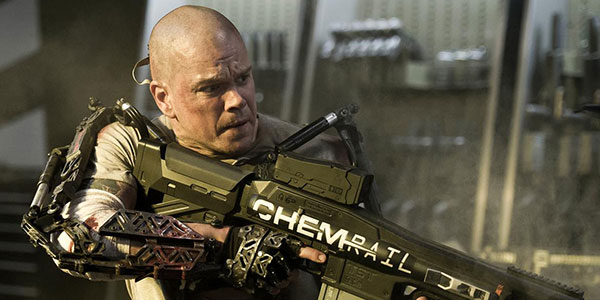
Science fiction has not lived a charmed life when it comes to the Oscars. Despite the genre's enthusiastic fanbase, the Academy has been disinclined to give it any credit beyond technical awards in fields such as special effects, but the one above-the-line branch that has shown some sympathy to the cause on occasion is the writers. As mentioned in the outset of this article, both Back to the Future and Brazil managed Original Screenplay nominations in 1985, and prior to that, such penultimate Sci-Fi classics as Star Wars and 2001: A Space Odyssey also garnered enough support from Academy scribes to merit a nomination. The most recent example of Sci-Fi success with the Academy though is that of Neill Blomkamp's District 9. A surprise late-summer hit back in 2009, the film not only managed to be a smash at the box office, but perhaps more stunningly, also put on quite the show with the Academy, earning a total of four Oscar nominations, including a Best Picture nomination for the film and a Best Adapted Screenplay nomination for Mr. Blomkamp and his writing partner Terri Tatchell. Blomkamp, who at one time was in line to bring the world of Halo to the big screen before the finances on that film fell apart, is set to follow up his debut feature with a new film by the name of Elysium. The premise of the film is that in the year 2154, the extremely affluent have created a luxurious space station above Earth known as Elysium, while the majority of wretched souls endure a painful existence on the polluted and ruinous remnants of civilization down below. The status quo gets quite the jolt though when one individual (Matt Damon) takes it upon himself to equalize the existence between the worlds. With the film's not-so-subtle overtones to the Occupy Movement and their grievances against the "one-percent", the more liberal voters of the Academy's writers branch are likely to eat this script up. A bigger obstacle for the film though will come in its box office prospects. While District 9 proved quite the surprise hit among audiences a few years ago, that film's political subtext was not as obvious for non-astute American audiences unaware of South Africa's history and it will be interesting to see how Elysium's class warfare angle goes over with general audiences. If the film ends up bombing monetarily, voters who might be convinced to vote for the film's screenplay may lack the confidence to do so, which is why, in this humble prognosticators view, Elysium's Oscar chances largely depend on its reception with the public.
3. Woody Allen - Blue Jasmine
 As previously mentioned in this article, Woody Allen has more Oscar nominations as a writer than any other human being in the history of the Academy, an achievement that is unlikely to matter to Allen himself given his disdain for the Oscars. Still, writing fifteen screenplays that was recognized by any awards body, much less the Academy, is astoundingly impressive. Even with Allen's copious rate of output, he has managed to get a screenplay nomination for about every third film he does, and as any baseball player will tell you, a career batting average of .333 is nothing to sneeze at. This is why, despite the increasingly probabilistic quality of his films, every Oscar pundit is wise to include Woody Allen in their lineup of potential writing nominees. For every To Rome with Love and Whatever Works, there is a Midnight in Paris, shaming those who dared write-off Allen as "yesterday's news". Undeniably though, you are always playing a roulette wheel by including Allen in any future predictions, but I am slightly more optimistic than average that this year's "new Allen" may go over well with the writers branch. While the film's plot hasn't been fully disclosed, it is said to be loosely based on the events of the Bernie Madoff fraud case. Cate Blanchett apparently stars as the wife of a big time stock broker who, when her husband is thrown in jail for fraud, loses everything and is forced to pack up her bags and move from New York to San Francisco. The film also has a terrific cast of supporting players in the likes of Alec Baldwin, Peter Sarsgaard, Michael Stuhlbarg, Sally Hawkins, comedian Andrew Dice Clay, and the 21st Century Woody Allen himself, Louis C.K. Early buzz from those that have seen the film say it is quite good, on par with such Allen classics as Crimes and Misdemeanors. If this is true, you can chalk up Allen's sixteenth writing nomination right now, but even if it's only three-quarters of the way true, I still like Allen's chances at yet another Oscar nod.
2. Kelly Marcel - Saving Mr. Banks
 Hollywood, being populated by extremely severe narcissists, is endlessly fascinated with movies dealing with its own legend and lore. Films such as Sunset Boulevard, The Player, and The Aviator, movies that at least tangentially deal with inside Hollywood baseball, all did enormously well with the Oscars, and each film was a recipient of a writing nomination as well. This is why, at a minimum, we have to consider the possibility of Saving Mr. Banks receiving a Best Original Screenplay nomination. The film, which is co-written by Kelly Marcel and Sue Smith (who don't have much of note in their resumes), tells the hereto untold story of how iconic animator and film mogul Walt Disney courted author P.L. Travers to let him adapt her book, Mary Poppins, into a feature film. The film will reportedly give us a glimpse into the making of the movie as well considering that B.J. Novak and Jason Schwartzman play the classic musical's composers, the Sherman Brothers, Victoria Summers and Kristopher Kyer appear respectively as Julie Andrews and Dick Van Dyke, and, of course, Tom Hanks and Emma Thompson portray Walt Disney and P.L. Travers in the film's primary roles. Mary Poppins being the legendary classic that it is, perhaps the most highly thought of live-action film in the Disney catalog, any movie chronicling its journey to fruition will obviously receive a fair amount of attention. What worries me about the film though is that Disney is producing the film itself. This pretty much guarantees anything that might be construed as the least bit controversial, especially when it comes to the image of the corporation's Holy Father himself, will surely be whitewashed out and stamped with the bleached-white sparking smile Disney had patented years ago. Personally, I tend to think this approach will lead to a boring film, but beyond my own personal taste, I suspect manufactured "drama" won't sit so well with the Writers branch either, even if the film as a whole plays well with the Academy. As we saw with last year's Hitchcock, "behind-the-scenes" films of cinematic classics don't always pan out so well. If Saving Mr. Banks turns out to be little more than, "Oh look, it's that famous person playing that other famous person," or, "Isn't that an interesting anecdote about that great scene in that classic movie," then I wouldn't bet on the film being anything more significant than a humorous footnote in the history of cinema.
1. Aflonso Cuaron, Jonas Cuaron - Gravity
 Mexican director Alfonso Cuaron has had an interesting filmography to say the least. From children's fantasies like The Little Princess to dystopian visions of the future as in Children of Men, any director who follows up the R-rated Y Tu Mama Tambien with the third film in the Harry Potter franchise is bound to raise some eyebrows. Along this zig-zag course of his career though, Mr. Cuaron has developed a group of avid followers, all of who are eagerly anticipating his first feature film since 2006's Children of Men, Gravity. The film, with a reported budget of $80 million, has been in production for some time, which partly accounts for the long break between films for Mr. Cuaron. Another rumored reason for Cuaron's lengthy absence is that the studio behind the film, Warner Brothers, isn't quite sure what to do with the film. Gravity, which stars George Clooney and Sandra Bullock, tells the tale of two astronauts working on a space station many miles above Earth. When a terrible accident befalls the space station while the astronauts are working on the outside of the station, tethered together by a rope, the space explorers end up floating endlessly adrift in outer space. The majority of the film was shot against a green screen (because actually filming in space is a bit problematic), which might give you the notion that Gravity is an effects driven film, but don't fool yourself. While the film's plot is unquestionably high-concept, the film is likely to be geared toward the high-art crowd as well, which puts the studio in a pickle. While I am stumped as to what to make of its box office prospects (although Cloud Atlas' performance isn't a good omen), I do think the film may receive some recognition from the Academy irrespective of its final box office haul. After all, Children of Men didn't do so hot monetarily, but it still managed to get its screenplay a nomination, and as I have said now numerous times in this article, if there is one branch of the Academy that is going to be sympathetic to a high-brow science fiction film, it's going to be the writers. It may be a long shot, but at least it's one with some precedence. As I stated at the top of this article, I expect 2013 to be a strong year for original screenplays, so if there are other films with original stories that you think are more likely to end up with a Best Original Screenplay nomination, let me know in the comments section below.