Transcendence Review: 10 Reasons It Sucks

Or, why Johnny Depp becoming an iPad isn't as much fun as it sounds.

Transcendence seems to have a lot going for it on paper €“ directed by a Christopher Nolan-backed Wally Pfister, it wrestles with philosophical quandaries like human nature, self-aware AI, the relentless march of technology and the philosophy of the mind. It's acted out by an all-star cast featuring Johnny Depp, the perennially underrated Rebecca Hall, Cillian Murphy, Paul Bettany, Kate Mara and Morgan goddamn Freeman. The Jack Paglen-written script had featured on the Hollywood Black List, cementing its place as one of the hottest un-produced properties in Tinseltown, then Warner Bros. swooped in and threw $100 million at it. It's as close to a sure thing as any film's going to get, right? Sadly, no. So what went wrong? Well, Transcendence isn't the film you want it to be. In fact, it's nowhere close €“ what we wanted was a cerebral epic, and what we've been left with is a hodgepodge of barely-fleshed philosophical ideas being badly debated by characters you don't really care about, all presided over by a lacklustre Johnny Depp and a director with an eye for visual flair, but unable to translate the human drama and philosophical head-scratching on-screen. Believe us €“ we didn't want this. Nobody did. But sadly, Transcendence has to stack up as one of 2014's biggest disappointments €“ it simply fumbles more balls than a blind Octopus, wastes everything it had going for it and plunges deep into mediocrity. Read on to find out how, but clearly, after this point, SPOILERS apply.

10. It Wastes The Main Star

Despite some questionable career choices and an arguably past-it creative relationship with Tim Burton, Johnny Depp remains one of Hollywood's most impressive and eclectic talents. Not long ago he was one of Tinseltown's most bankable stars, and despite potentially souring audience goodwill by consistently rehashing Jack Sparrow and featuring in the Lone Ranger debacle, he's still an A-lister of the highest order. So seeing him prise his considerable talents away from Burton/Disney and hitch his wagon to such interestingly premised work certainly excited movie fans. However, the end result of all this intrigue isn't the tour de force you were hoping for. Instead, Depp's Will Caster is a dull watch €“ you can tell that pre-download Caster is supposed to come off as an intense, odd individual, but he's less 'brooding' and more 'heavily sedated'. Things only get more difficult post-download €“ virtual Will is emotionally stunted by necessity, monotonous, cold and omniscient by definition. Needs must, but Depp's talents are better suited to chewing the scenery €“ by making Will so sure of himself, it robs the actor of any dramatic meat to chew on. Curiously, the film looked to be taking an interesting turn midway through the second act when Evelyn chides her virtual husband for pretending to eat dinner. AI Will is understandably confused by this, and remains confused when his wife tells him to stop analysing her hormones. There could've been plenty of dramatic mileage in Will not being able to understand the human condition or wanting to be corporeal, but sadly, and much like everything else, the film bungles this. Plus, when synthetic Will turns up at the end, it's something of a wasted twist the film should've done more with.

9. It Massively Simplifies The Debate

Whether you've only played Deus Ex: Human Revolution or plowed headlong into a world of academic discourse, you'll know that Transhumanism is at the heart of an incredibly interesting debate which has become increasingly prescient with the advancement of technology. It has the potential to impact us all levels €“ the social, the economic, political and biological €“ and is something of a argument minefield, with what we should do and how far we should go to achieve these aims still being thrashed out by the finest academic minds of the generation. But the film shows no real willingness to wrestle with the minutiae behind the issues, and instead just throws out signposted moments and broad strokes where you're supposed to flit from one side to another. Caster gets shot? Pillory RIFT and all the neo-luddites. Virtual Caster lobotomises the site foreman? Maybe he has gone too far. There's very little room for interpretation, and instead the director appears content to take us on a theme park ride through the debate's flash-points. There's very little room for interpretation, which is precisely what a film about such weighty issues needs. Remember, audiences don't always need everything spelled out for them €“ there's a reason people didn't like the original, unambiguous cut of Blade Runner, after all. We should've been trusted to come to our own conclusions without a Pfister whistle-stop tour, but sadly, this wasn't a luxury we were allowed.

8. It's Weirdly Sexist

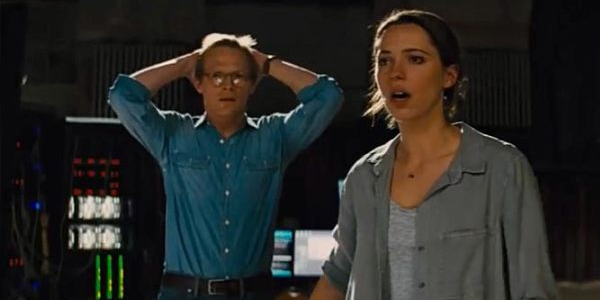
If you've ever seen Parade's End, you'll know Rebecca Hall is a good actress. But off Transcendence's evidence, you wouldn't think so. This obviously isn't all her own fault €“ even the most talented actors stumble with a poor script, and Hall's script is poor indeed. She's given no motivation beyond loving her husband, and even then goes to utterly irrational extremes using the writer's shorthand for strange actions and motivations €“ love. If Hall's Evelyn Caster was a layman, you could possibly understand. However, she isn't €“ she's one of the finest minds of her generation, a supremely rational person regarded by her husband as smarter than Paul Bettany's similarly brilliant scientist. In the opening scenes, she's up on-stage presenting her own thesis, not just standing as a cheerleader for her husband's amazingly lofty ambitions, and carries this intellectual promise later into the film by downloading his brain onto a cannibalised, home-made AI. Such accomplishments are far beyond the cream of the intellectual crop, never mind laymen. But then the wheels start to fall off, and pretty spectacularly to boot. Clearly flabbergasted that she's managed to upload her husband's consciousness into a computer, she doesn't bat an eyelid at his instant demands to be uploaded into the internet to access Wall Street, because apparently this incredibly clever person can't seem to get beyond her feelings. Hell, it's only when he starts lobotomising people that she realises things might be wrong. This leads to a bafflingly flat scene when she gets upset because he's reading her hormones/feelings, and she once again flies off the handle. The implicit message seems to be that women's emotions spoil anything no matter how accomplished they are, and that's a really odd thing to take away. In hindsight, maybe Hall should've chosen a different role to showcase her talents, and not something that just required her to be hysterical and upset in equal measure.

7. It's Punishingly Slow

Transcendence is two hours long, and you can feel every minute of it. Granted, this is around quarter of an hour less that Captain America: The Winter Soldier, but whereas its box office competitor always has something to keep the audience's attention €“ whether that's an intriguing set-piece, funny character-building asides or Sam Jackson Pirate-Shafting his way around the place €“ for long spells of Transcendence, very little appears to be happening very slowly indeed, and then it just kind of ends. The worst offender is probably the first act, which takes far too long setting up all the pieces before following through on the film's premise. Clearly, Caster being shot with polonium bullets exist as a plot device €“ there's no way Evelyn Caster could re-build PINN for the human mind if her husband only had six hours to live. Yet unfortunately, it achieves its goal a little too well, padding out the run-time so massively that you're left screaming at Caster to be downloaded into the machine already. You can take it for granted that this pre-death time is used to pull at the heart-strings, but the film's so oddly cold that you wish they'd get to the point. Of course, if the finale's a balls-to-the-walls affair, you can sign the meandering first and second act off as build-up to an amazing climax. However, Transcendence fails in this regard too, and bafflingly...

6. It Fudges The Conclusion

Even a bad film can be saved if it has an interesting enough conclusion, giving the audience something to think about on its way home from the cinema. Sadly, and as alluded to in the previous point, Transcendence drops this ball too. When we pile into the finale, we're of the opinion that A.I Craster has gone nuts, and is attempting to 'improve' things in such a way that will eradicated what it means to be human. To be fair, the film's been fairly explicit about this, showing him operating an army of drones that do everything from build his solar field to pour his wife wine. It's terrifying, and you think €“ with some justification €“ that the film's going down the computers-gone-wild route. That's fine €“ it's familiar narrative stomping ground, but at least it sets up all the pieces on the board for the showdown. However, the film simply doesn't stick to its guns and instead tries to be all things to all comers, blindsiding you with the reveal that cyber-Caster (who's now in his own organic body, also a rushed story beat that should've been explored further) never intended to kill anyone, and will gladly destroy himself to save a mortally-wounded Evelyn and stop Paul Bettany getting shot by Kate Mara. It's a volte-face of baffling proportions, and a weird attempt at a twist that couldn't have been fudged any worse if it tried. You'd probably respect the film more if it took a side, but now you're left scratching your head at this hash of a rug-pull. There's no room for interpretation, and nothing really to take away except that both sides of the conflict had valid points, but flaws as well. We knew this going in, and now we're back at square one, with the film having sort of circumvented it's own plot in the most bizarre fashion.

5. Where's The Army/Government In All This?

Following on from the previous point, a thought experiment. Let's imagine that you're the President, and a sentient machine smarter than every human who ever existed sets up their own personal fiefdom in your country. Sure, it's situated itself in the middle of godforsaken nowhere, but it's still creating an army of autonomous, regenerating synth-humans capable of lifting 800-pound apparatus without breaking a sweat. Atop this, the machine appears to be able to create an endless pile of money for itself to sustain the project. Isn't that slightly worrying, and worthy of a larger response than gingerly watching it from afar? You could probably argue that the machine is covering its tracks initially, but if the suspicious amount of contracting work going on in Brightwood doesn't tip them off, the fact the machine throws off its shackles of anonymity and offers free supersoldier upgrades to the sick would surely bring the army running. Remember that the machine doesn't really have an allegiance beyond itself €“ and maybe Evelyn €“ and is actively 'infecting' the planet with artificial rain. Regardless of its motives, that's a terrifying prospect, and worthy of a greater response force than Cillian Murphy and a small truckload of guys. Again, you could probably argue that the government wanted to keep the whole thing under wraps, but covert wars have been fought before, and they sure as hell featured more than about twelve blokes and a shifty alliance with a terrorist cell.

4. The Characters Are One-Dimensional
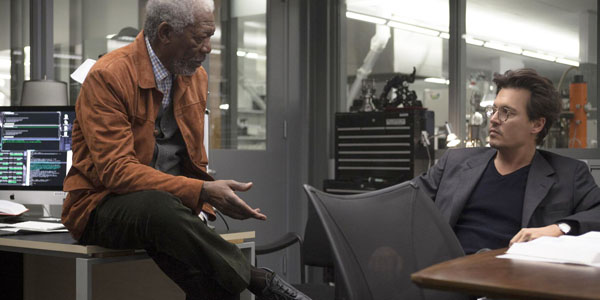
Morgan Freeman is always awesome, so it rankles to see him used as strangely as he is here. He's clearly meant to be some sort of wizened Lucius Fox-style brainiac figure full of wisdom and good advice, but it just doesn't come off the way Pfister intended. Instead, he's sidelined throughout, relegated to talking about the evils of artificial machinery with the also-subdued Cillian Murphy. He then turns up at the end, hands Rebecca Hall a note then is subdued is laughably easy fashion. That's about the sum of his parts here, and it's an utter waste of an actor. Also, Paul Bettany's a good scientist because he wears a cross and wrote some papers saying machines should be facilitators and technicians to humans, not vice-versa, Rebecca Hall seems to have no motivation other than standing by her man (or iPad, as the film progresses) and Johnny Depp outs himself as a mad scientist at the start by refusing to duck the 'are-you-creating-a-god' question, instead choosing to pump up his ego. No-one's ever developed beyond that, meaning that while these characters all appear to have interesting exteriors, there's really nothing underneath it all. That'd be fine if this was merely a film about themes, but it isn't €“ the writers are adamant to frame the overarching debate around these characters and their lives, as if they're interesting enough to spend time with. It all comes off like trying to play Beethoven's Fifth on the kazoo €“ impossible to do well, given the parts available.

3. RIFT's Motivation Is A Missed Opportunity
As already established, transhumanism is an incredibly interesting, nuanced debate with multiple camps espousing differing views on the ideological spectrum. To put it another way, it's complex, and possibly too complex for a Hollywood blockbuster to truly do it justice. Regardless, you've got to give Pfister and team credit for grappling the beast, even if they've had to simplify it to a conflict between two trenchant sides, represented by Will Caster and the scientific community, and RIFT, the film's opening antagonists. RIFT €“ or Revolutionary Independence From Technology, to give them their full title €“ represent the film's animus, shooting Dr. Caster and setting the plot's chain of events into motion. On paper, they're an intriguing prospect €“ a group of neo-luddites on the radical edge of the fight against technology. Yet truly, what is their motivation? It appears to be simple €“ that transhumanism is an abomination. But aside from a Kate Mara monologue about a replicated monkey brain, RIFT's ideology is never further explored. There's all sorts of interesting reasons why we could be against the existence of an organising, sentient super-computer €“ questions of free will, for one €“ but RIFT's motivation doesn't seem to go beyond one-note maxims, and this is a waste. When you're putting down a flag in one of the more intriguing debates of our time, it just smacks of missed opportunity when you won't explore the theme further. Also, they're using polonium bullets, which is strangely advanced for a group of neo-Luddites. The poisoned cake they could get away with, but this? Not so much. It's like trying to have your poisoned cake and eat it (really, really sorry).

2. Distracting Visuals

Wally Pfister is an amazing cinematographer, and prettied up the Dark Knight trilogy a treat. Outside of Batman, he's also partly responsible for the mind-bending aesthetics on display in Inception (for which he nabbed the Academy Award), and deftly captured the faded glamour of baseball's Oakland A's in Moneyball. That's all well and good, but he's not the cinematographer here €“ he's the director, and there's more to a film than just visuals. Plot, for example. But unfortunately for Pfister old habits die hard, and he 'treats' us to multiple lovingly-framed vignettes including (but not limited to) continual shots of the Casters' garden. There's no doubting they're obviously pretty €“ again, Pfister's an Academy Award winner €“ and some of them are appropriately symbolic, but others are a little too on-the-nose and superfluous. It only serves to further bloat an already bloated film, and provides an already slow-moving plot with even more dead weight. After all, once you've seen those synthetic particles rise from the Earth once, you've them all, regardless of how pretty they are.

1. It Could've Been So Much More

Remember why we were so psyched about this film? Beyond the fact it was Wally Pfister's directorial debut, it was that rarest of films €“ an expensive blockbuster willing to engage with larger themes. Obviously, large budgets aren't a guarantee of success, but from the synopsis to the trailer, this had so much going for it €“ a stellar cast, an interesting premise, unique visuals and interesting set-pieces. Yet out of this winning hand, the finished product pulled a bust. Honestly, that's just sad €“ like Inception before it, Transcendence could've been a standard-bearer for more intellectually stimulating films with blockbuster appeal. Indeed, the team behind it €“ alongside Pfister, Christopher Nolan and Emma Thomas were producers €“ seemed to further point to this fact, telling us that it was in fact possible for mentally-taxing films to exist outside cult and indie film purgatory. Unfortunately it just couldn't follow through, and might end up having a reverse effect €“ if Transcendence manages to tank based on its reviews (a distinct possibility, with the Rotten Tomatometer reading 19% at time of writing), studios might be less inclined to take gambles with more interesting premises in the future, leaving only the safe bets for the truly huge pictures. Clearly, there's nothing wrong with big dumb fun, but if we miss out on the next Inception because of Transcendence's flop, the film world would be poorer for it. Agree? Disagree? Feel free to comment below!

Contributor
Contributor

Durham University graduate and qualified sports journalist. Very good at sitting down and watching things. Can multi-task this with playing computer games. Football Manager addict who has taken Shrewsbury Town to the summit of the Premier League. You can follow me at @Ed_OwenUK, if you like ramblings about Newcastle United and A Place in the Sun. If you don't, I don't know what I can do for you.