8 Retro Mechanics We Need In Modern Video Games
We need these retro gaming mechanics back already.

Modern video games have delivered massive technical leaps far beyond mere visual fidelity.
New games tend to favour convenience and offering as frictionless an experience as possible, and yet for all of modern gaming's innovation and advancement, sometimes there's no beating the old ways.
The medium's progression has caused many once-popular mechanics to fall out of favour with developers, even though they're still fondly recalled and asked-for by many players.
And that's absolutely true of these eight classic, retro gameplay features which should absolutely make a comeback in the contemporary gaming sphere.
These mechanics generally gave players a little more credit, offering them greater freedom to explore and experiment, whereas so many modern games are deathly afraid of players getting stuck and bouncing off entirely.
While some of these mechanics declined in popularity for more understandable technical or business reasons, there are still the great many who would love to see them all make a spirited comeback.
You probably shouldn't count on it happening of course, but it sure would be nice. Until then, we'll just fondly remember that they used to be a thing...
8. Cheat Codes

Let's kick things off with one of the greatest casualties of modern gaming - the death of cheat codes.
Once upon a time, it was basically expected that a new game would release with a ton of hidden cheats for players to seek out or, more likely, discover in a gaming magazine.
These cheats could range from the practical likes of infinite health and ammo to silly nonsense such as Big Head Mode and everything else in-between.
Cheat codes often added genuine value to a game and, above all else, allowed players to progress through problematic sections.
But with the rise of achievements, DLC, and microtransactions in the modern era, cheats have been largely phased out in the traditional sense, lest they undermine a publisher's ability to wring every last penny out of their investment.
Obviously cheats do still exist for some games, and if you're playing on PC it's relatively easy to use Cheat Engine to your heart's content, but the golden era of cheats being baked into most of your favourite games is sadly long gone.
7. Unlimited Inventory
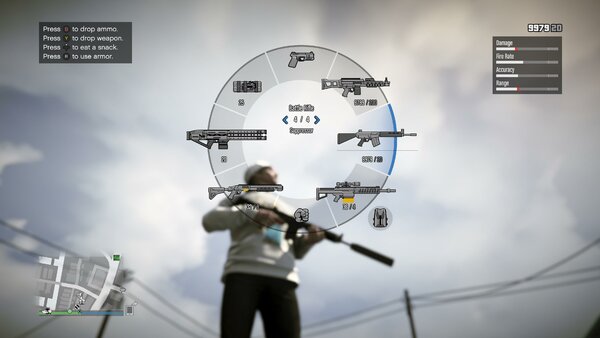
Contemporary games are far more concerned with "realism," amid the belief that visuals and gameplay mechanics hewing closer to our own tangible reality will be more immersive.
But look, are we really playing games so we can only wield the exact number of weapons we could actually fit on our person in real life? Of course not.
Older action games generally didn't give much of a hoot about limiting your inventory - you could have a dozen large weapons stored in hammerspace, just waiting to be pulled out at any given moment.
But Halo: Combat Evolved is probably the game most responsible for popularising a limited arsenal, with its mere two-weapon system requiring players to strategically select their loadout as they progress through a level.
Yet the strategy aspect of a weapon limit isn't nearly as fun or interesting as the potential to whip out a rocket launcher at any errant moment and go to town.
Again, most of us aren't here for a realistic experience - we're here because we want to raise hell and light up the sky. Let us do it.
6. Loading Screen Mini-Games

Decades ago, it wasn't uncommon for games to include mini-games during loading screens - simple games to help players pass the time while they waited for the main game to do its thing.
But because we can't have nice things, Namco - who helped popularise the loading screen mini-game in 1995's Ridge Racer - filed a patent that very same year, effectively preventing other developers from using loading screen mini-games.
The patent finally expired in 2015, and yet, we didn't see a sudden influx of the mini-games, perhaps in part because loading times are generally considerably shorter than they were decades ago, aided by the increasing use of SSDs in consoles.
Yet while loading times are generally far less of an imposition these days, they certainly haven't gone away entirely, and so it'd still be neat for developers to adorn them with something to take our mind off the tedium.
5. Non-Regenerating Health
Here's another one we can thank Halo for, along with the Call of Duty franchise. Regenerating health is incredibly common in modern action games, whereby taking cover for a few moments will allow some if not all of your health to replenish.
It's basically an easy way to give struggling players a leg-up and makes balancing the game simpler for developers, as players will always have an in-built way to get more health.
Except, isn't it a bit boring?
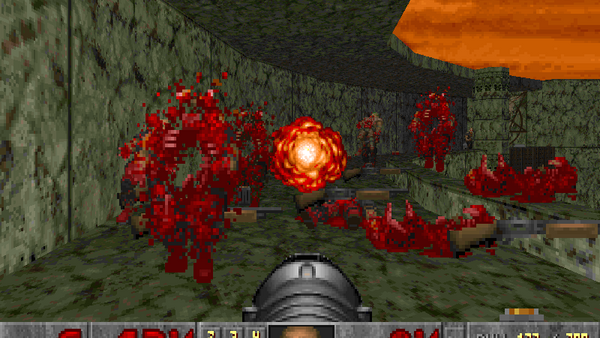
In classic shooters like Doom, your health was your health - damage taken wouldn't be magically repaired by cowering or doing nothing, and the only way to get more health was to find a medikit.
Knowing that you can't just wait out the danger makes combat considerably more tense and suspenseful, even if it requires developers to delicately balance the distribution of resources.
It'd be neat to see non-regenerating health come back into fashion, then, at least as an optional feature.
4. Split-Screen Multiplayer
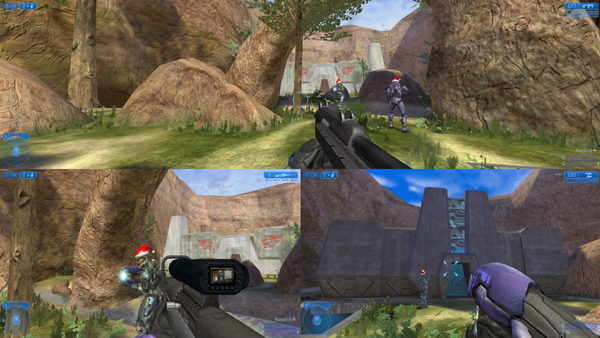
Who among us hasn't got childhood memories of playing split-screen couch co-op with a bunch of friends?
Getting together to play, say, GoldenEye 007, arguing over whether Oddjob is fair game, and pretending you're not looking at each other's screens - it was absolute bliss.
But with online multiplayer becoming immensely popular by the mid 2000s, developers began to decrease their support for local multiplayer options, to the extent that it's basically a rarity nowadays, even an outright novelty when it is occasionally included.
It also doesn't help that, in the ever ongoing performance arms race, split-screen multiplayer is incredibly hardware intensive, requiring the system to run multiple versions of the same level in tandem, as so often causes massively framerate drops.
Even so, for those who still regularly meet up with their friends to play games in person, a slightly choppy framerate every now and then is a small price to pay for easily booting up a game and playing together on a single piece of hardware.
3. No Tutorial

Alright, time to rustle some feathers now.
Though tutorials have been around in video games for decades, they were decidedly less common in the past, where developers were far more inclined to let players figure out the finer details for themselves.
There's something to be said for the thrill of discovery, of getting of grips with a game's central mechanics in your own way, rather than having your hand aggressively held through the early stages, as is so often the case these days.
Now to be fair, you can certainly argue that tutorials are an accessibility feature to a point, and there's absolutely nothing wrong with including a tutorial which players can toggle on or off at the start of the game.
But at the same time, so many modern tutorials merely offer a bland, unimaginative, time-consuming walkthrough of the control scheme and general mechanics, rather than providing players with organic opportunities to orient themselves from the jump.
Just set us free to explore the game world and figure it out as we go along.
2. Destructible Environments

One of the greatest and most exciting gaming fads of the early 2000s was the increasing implementation of highly destructible environments, as was most famously popularised by Red Faction and its Geo-Mod tech.
The series became renowned for the player's ability to deform the environment with heavy weaponry, and even blast new entry and exit points for themselves where necessary.
Other notable games with extensive destruction mechanics include Battlefield: Bad Company 2, Teardown, and Crysis, to name just a few. And yet over the last decade-or-so, destructible environments have largely gone away.
Now, it goes without saying that allowing the player to wreck most or even all of the game world presents some massive technical challenges, given the resource-intensive nature of making every piece of land deformable, and the potential for players to skip large swaths of a level in doing so.
But it also makes games feel so alive, like there aren't any limitations and the world truly is our sandbox in the most ultimate sense.
Given that graphical fidelity seems to be reaching a plateau, why not spend some more of those precious resources on stuff like this instead?
1. Server Browsers

And finally, long before matchmaking was a thing in most online multiplayer games, players were typically given access to a server browser, where they could sort potential matches by player count, match type, map and so on.
It was a brilliant utility if you were seeking out a specific map or mode, yet as multiplayer became more popular on consoles, matchmaking was quickly cemented as the default method for finding matches - another feat of "progress" we can attribute largely to the Halo franchise.
While matchmaking has its benefits for players who just want to be thrown into any random match, if you want to do anything specific it's generally a bust.
If you're lucky, you might get a few filters for match types, but generally it's far more restrictive than a traditional server browser.
Sure, not everyone wants to sort through servers to find a game, but the death of the server browser severely limits the player's options. And as we all know, options are almost always a good thing.