20 Horror Movie Endings That Are Practically Perfect
The best endings horror has to offer...
Horror movie endings are a tricky business. When an entire feature film builds up all that fear and tension, it can be challenging to pay all of that off in a satisfying way, and sure enough, so many horror flicks out there have been let down by unsatisfying conclusions - even ones which are otherwise great, such as It Follows or Insidious.
That's the main reason why conclusions such as the following 20 are so joyous to watch... well, 'joyous' might be the wrong word, as most of them are very dark, but you'll still love them because they are absolutely fantastic endings that finished their stories in exactly the right way. That isn't always guaranteed in this genre.
While by no means an exhaustive list, these 20 movies have some of the best horror finales out there. They range from cracking needle-drops to bruising plot twists, from haunting cliff-hangers to nerve-shredding outbreaks of violence; what they all have in common is that they are cinematic gelignite, and totally avoid the genre's common issue with unsatisfying anti-climaxes.
Kicking off with a trip down memory lane to one of horror's earliest works...
20. The Cabinet Of Dr. Caligari - The First Twist Ending

The 1920 German Expressionist classic The Cabinet of Dr. Caligari is often regarded as the first true horror film, and it's also noteworthy for having what has often been described as cinema's first twist ending - and it's a great one at that.
For most of its runtime, this fantastic piece of cinema appears to be about Francis (Friedrich Feher) investigating a series of murders. These are being committed by a somnambulist named Cesare (Conrad Veidt), who's under the control of a wicked showman named Dr. Caligari (Werner Krauss).
The majority of it is a gripping murder mystery, then the rug is pulled out from underneath at the very end: none of it is real.
The final scene shows Francis, his love interest, and even Cesare as inmates in an asylum, while Dr. Caligari is actually the asylum's director. It would appear everything that just unfolded was imaginary, a result of Francis' delusions.
Usually, the "It was all a dream" ending is a cardinal storytelling sin, but here? It actually works really well and adds a gripping new layer to the story. Furthermore, with its unusual visuals and expressionistic design, this whole movie plays like a dream, so it's actually fitting in this particular case.
19. Beetlejuice - Jump In The Line

Not all of the best horror endings are downbeat and scary - this particular one is an absolute gem, and it's euphorically happy.
In Tim Burton's awesome horror comedy Beetlejuice, Adam and Barbara Maitland (Alec Baldwin and Geena Davis) die in a car accident shortly after moving into a new house and become ghosts. Unfortunately for them, the Deetz family - consisting of Charles (Jeffrey Jones), his wife Delia (the late, great Catherine O'Hara), and Charles' goth daughter Lydia (Winona Ryder) - move in, so the Maitlands enlist a poltergeist named Betelgeuse (Michael Keaton) to get rid of them. Unfortunately, things soon go pear-shaped as Betelgeuse starts wreaking havoc.
Though a comedy, Beetlejuice is also very dark, and as such, its effusively positive closing scene totally hits the spot. At the end, the Maitlands banish Betulgeuse and prevent him from marrying Lydia, and the Deetzes and Maitlands agree to harmoniously share the house.
We then get one of the best needle-drops in horror history as Lydia and the Maitlands dance to Harry Belafonte's 'Jump in the Line (Shake, Senora)'. The previously depressed Lydia literally floats into the air and joyously dances, backed by a line of ghost Football players on the stairs behind her. It's so infectiously happy, not to mention an epitomizing example of the giddy creativity and clever mix of light and darkness that has made Tim Burton such a beloved filmmaker.
Just like Lydia Deetz, you'll be floating.
18. Martyrs - A Whisper From Beyond

Martyrs' ending is one of those conclusions that will completely break you, but that's in a good way.
Conceived by writer-director Pascal Laugier during a time when he was severely depressed, Martyrs is all about pain. When Anna (Morjana Alaoui) comes to help her friend Lucie (Mylene Jampanoi) clean up a crime scene, she discovers a horrific secret society who have made it their mission to subject their victims to such pain that they see into the afterlife.
Eventually, Anna becomes their latest subject and, after a while, she is revealed to have been surgically flayed alive in what is surely one of the most disturbing scenes in any 21st-century horror flick. She has apparently achieved transcendence, and she whispers what she sees into the ear of Mademoiselle (Catherine Begin). What did she say? We'll never know, as it's not revealed and Laugier has kept it appropriately ambiguous.
After this exchange, Mademoiselle shoots herself, just after telling her assistant to keep doubting what lies ahead after death. So, what did any of this mean? Was Mademoiselle so disillusioned with Anna's visions that she wanted to die? Did Anna lie to her in order to drive her to suicide? Or did Mademoiselle kill herself in order to experience the afterlife Anna described? Every viewer can take a different meaning away, reaffirming this as an undeniably powerful and uniquely devastating piece of horror storytelling.
17. The Devil's Rejects - Free Bird

Two years after his absolutely dire directorial debut, House of 1000 Corpses, rockstar-turned-horror-director Rob Zombie's sophomore feature continued the story of the Firefly family, a family of serial killers.
The Devil's Rejects, though certainly not to all tastes, is a vastly superior beast to its predecessor and sees Rob Zombie come into his own as a director while giving these frightening, well-played villains a proper chance to shine. This time around, they're on the road and on the run from a vengeful sheriff who's just as ruthless as they are.
The influence of killers-on-the-run films like Bonnie & Clyde and Badlands is evident from the off, and the former is particularly significant in this regard. Just like Bonnie & Clyde, The Devil's Rejects has a crazy ending in which the main characters are finally gunned down by the authorities.
The Devil's Rejects ends with the Firefly family driving at a road blockade, guns blazing, as Lynyrd Skynyrd's Free Bird blares over the scene. A decade before it was immortalized in Kingsman's church fight, that Southern Rock classic was beautifully deployed to represent a final explosion of defiant rage from these murderous southerners.
It's also excellently shot and edited, with the blurred, slow-motion camerawork giving this sequence a heightened, surrealistic feeling that captures the bitter desperation of these grotesque characters in their last moments. This was a fabulous slice of pure cinema, and perhaps the single best achievement of Rob Zombie's entire career as a director.
16. The Silence Of The Lambs - One Last Chat

The Silence of the Lambs is so damn iconic, and its ending is just as quotable and legendary as the rest of it.
Following Clarice Starling's (Jodie Foster) terrifying near-death battle with a deranged serial killer, we jump to Starling graduating from the FBI Academy, now fully qualified and having overcome the childhood trauma stemming from her father's death. Starling is congratulated by her boss, Jack Crawford (Scott Glenn), who tells her how proud her father would be, concluding this wonderful character arc in the best way.
Starling is informed she has a call waiting and goes to answer: "Well, Clarisse? Have the lambs stopped screaming?" rings out the unmistakable voice of Hannibal Lecter (Anthony Hopkins), now hiding out on a tropical island.
Lecter congratulates her and reassures her that he won't come after her as the world is more interesting with her in it, a final reminder of their strange, complicated bond. Then, Lecter drops one of the best closing lines in film history: "I do wish we could chat for longer but... I'm having an old friend for dinner. Bye."
That old friend turns out to be Dr. Chilton (Anthony Heald), the insufferable director of the institution where Lecter was locked up; it's likely that some audience members discreetly celebrated when this next victim was revealed. The movie ends as Lecter follows Chilton into the crowd, beautifully paying off Starling's journey but leaving things on a tantalizing cliff-hanger for arguably the best horror villain of all time.
15. The Borderlands - In The Belly Of The Beast

The Borderlands is a much-underrated British found-footage horror that rises far above most entries in this largely dire subgenre, thanks in no small part to its knockout ending. Appropriately, said finale features its two leads - religious brother Deacon (Gordon Kennedy) and tech expert Gray Parker (Robin Hill) - descending into a network of strange tunnels, which is an apt representation of how this one goes deeper and deeper into total insanity.
In this one, Deacon and Gray investigate strange happenings at a Devon church, where the local priest commits suicide. They eventually learn that the church is built on the site of a former Pagan temple and go there with two Catholic priests to exorcize the church. Big mistake.
Firstly, two of the group are killed, and then Deacon and Gray end up journeying into a series of tunnels below the church, where they discover evidence of human sacrifice, the apparent ghost of one of their allies, and, finally, they end up in a cramped tunnel... which isn't a tunnel.
Remember The Empire Strikes Back, when Han Solo landed the Millennium Falcon in a 'cave' that turned out to be the stomach of a space worm? Well, that's basically what happens here. The two men turn out to be inside the digestive tract of a living creature, but they don't escape. They are last seen screaming as they're gruesomely dissolved, with the found-footage cinematography immersing us fully in this absolute nightmare fuel.
Horrible, but brilliant.
14. Rosemary's Baby - The Antichrist

Rosemary's Baby triumphs as an exemplary psychological horror, and one of the key things that makes it so successful is its ambiguity. Are the people around the pregnant Rosemary (Mia Farrow) actually trying to steal her baby, or is she going insane? Well, as we only learn at the end, she most definitely isn't. This cold, hard truth is conveyed in the most brutal way by its ruthless ending that confirms Rosemary's suspicions while also shattering her world forever.
Some time after being told that she gave birth to a stillborn baby, Rosemary hears an infant crying and makes her way into a hidden room where she finds the members of the coven surrounding a cradle containing her child. She's horrified when she looks at her child; we never see him, but Farrow's amazing acting tells us all we need to know. As it turns out, all of her suspicions about her neighbours were completely correct, and when she had a 'nightmare' about being impregnated by a demon, that was actually real. According to the coven, she has just given birth to the Antichrist.
As if this wasn't already grim enough, it also turns out that her own husband (John Cassavetes) had sold her out to the coven in exchange for them helping his acting career; what a scumbag. It's the perfect payoff to this story, and even though it'll probably ruin your day, it's hard not to love this conclusion wholeheartedly.
13. The Thing - Waiting

At the end of John Carpenter's horror classic The Thing, the titular shapeshifting alien has wreaked havoc on an Antarctic research station, killing nearly everyone there, and while the survivors have blown the station up, is the creature actually dead? Neither the viewers nor the characters can be sure.
Protagonist RJ MacReady sits by the burning remnants of the station. Childs (Keith David), the chief mechanic at the station, emerges out of the snow and sits with him, claiming to have gotten lost in the storm. MacReady isn't sure if he believes him or not. The pair agree that their mutual mistrust is futile since both are too weak to do anything much, and they're aware that they'll soon freeze to death. Eventually, MacReady delivers one of horror's best lines: "Why don't we just wait here for a little while? See what happens."
We leave the two men sitting quietly and sharing a bottle of scotch, as Ennio Morricone's terrifying score pulses away in the background, and that's the end of the story. We don't know if the creature was destroyed, and we don't know if the last two survivors are actually human or not.
John Carpenter refuses to give audiences any kind of closure, and while many will have found this conclusion frustrating, that's precisely the point. It's haunting in its ambiguity, with the creature's presence having destroyed any semblance of trust among the scientists. This is the terrible effect of paranoia, rendered in the most chilling of ways.
12. Shutter - A Weight Around Your Shoulders

Throughout this awesome Thai horror flick, protagonist Tun (Ananda Everingham) has been suffering from neck pains and visions of a mysterious ghost. More mysteriously still, his body weight was double when he weighed himself. What is going on? Well, the answers to these questions are more depraved than anyone could've reasonably expected.
It turns out that the ghost Tun is seeing is that of Natre, his ex-girlfriend. After they broke up, she was sexually assaulted by Tun's friends, and he failed to stop them, even taking pictures of the event. This led to her suicide. When Tun's current girlfriend Jane (Natthaweeranuch Thongmee) discovers the negatives of these photos, she understandably breaks up with Tun immediately.
However, it gets even bleaker. When Tun accidentally photographs himself, he discovers that the ghost of Natre... is sitting on his shoulders. This explains his neck pains and increased weight, for the full weight of his unforgivable actions was weighing down on him in a very literal manner. So shocked is he that he falls out of the window and is hospitalized. The final scene shows Jane visiting Tun, and it can be seen that Natre is still sitting on him.
Well, Tun did deserve it, let's be honest. As a scream-inducing final scare and a dramatically rich payoff to a story of ghoulish karma, this ending succeeds on every conceivable level.
11. The Texas Chainsaw Massacre - Sally Escapes

In The Texas Chainsaw Massacre - controversial upon release, but now deservedly acclaimed - five youths journey into the darkest underbelly of American society imaginable and encounter a grotesque family of serial killers in rural Texas. By the end, only one has escaped, and she'll never be the same again.
Once we reach the closing scenes, Sally Hardesty (Marilyn Burns) is the only one still alive, and she's brutalized and tormented throughout an obscene dinner, as the Sawyers - who are all like a gruesome parody of a traditional American sitcom family - prepare to murder her.
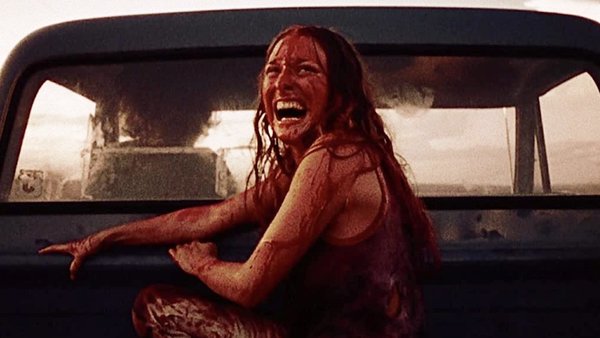
Eventually, Sally does escape from the house and, after several harrowingly close calls, she gets onto the back of a pick-up truck, drenched in blood and screaming. Those screams quickly transition into maniacal laughter as she escapes while the pursuing Leatherface (Gunnar Hanson) impotently swings his chainsaw around in frustration.
Simply put, this is one of the scariest horror finales ever. The family's sadistic psychological torment of Sally and the excruciatingly suspenseful chase that follows are vividly conveyed through the deranged acting and Tobe Hooper's intelligently grounded, documentary-style camerawork that immerses audience members completely in the nightmare. These closing scenes are a scream of pure, primal terror that's impossible to forget, and it is only when the credits start to roll that viewers will feel able to breathe again.
10. Nosferatu (2024) - Ellen's Sacrifice
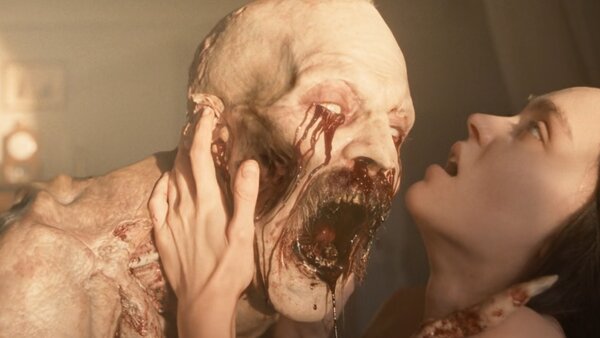
This here is an ending that will crush your soul, as well as a reminder that horror remakes aren't always a bad idea.
The 1922 Nosferatu is a masterpiece that didn't necessarily need a remake, but Robert Eggers' 2024 version was fantastic all the same. While not quite as good as the old one, there is one scene that is notably better, and that's the story's tragic finish where Ellen Harker (Lily Rose-Depp) sacrifices herself to destroy Count Orlok (Bill Skarsgard).
With a longer run-time, 2024's edition vividly develops Ellen and makes her an immensely sympathetic, believable character who's brilliantly played by Lily-Rose Depp, so her death will break you. Better still, in today's more permissive era, Eggers is able to deploy some gnarly gore effects and also brings out the sexual undertones in the connection between Orlok and Ellen which were, understandably, played down in the 1920s version.
Factor in the stunning visuals and Robin Carolan's sublime musical score, and you've got one of the very best closing scenes to any 21st-century horror, not to mention one of the most moving.
9. Eraserhead - What Just Happened?!

It's been over a year since the world lost David Lynch, but it still hurts. He is one of the greatest artists in the history of the medium, and no one could do it like him. He created surreal, insane films and shows that were so damn weird yet so affecting, captivating, and emotionally truthful. To talk about whether or not you understand a David Lynch joint is perhaps beside the point, for he seemed to want everyone to take their own conclusions away. You don't necessarily understand the story of Lynch's movies, but you feel them.
Take Eraserhead, his debut. This psychological horror, in which Henry (Jack Nance) looks after his mutant baby in a horrible industrial landscape, is crazy, and the stuff that happens at the end will have everyone scratching their heads.
Jack stabs his mutant baby, which then grows to terrifying proportions before the child's supersized head is... replaced by a planet, seen in the movie's opening, that has a man working levels inside it... the planet then bursts open and then.... in a white void, Jack embraces the lady who lives in his radiator.
What?!
Yeah, it's utterly bats**t, and that's fine. Even if the plot is hard to unravel, you feel the anxiety, the paranoia, the trauma, and Jack's crippling fear of parenthood radiating through every flawlessly constructed frame, while the Oscar-worthy sound design makes this even more nightmarish. Therefore, as barmy as it undeniably is, this ending works like a charm.
8. The Lighthouse - Prometheus

The Lighthouse, a horror masterpiece from the great Robert Eggers, is a glorious slice of insanity. This story of two lighthouse-keepers - Thomas Howard (Robert Pattinson) and Thomas Wake (Willem Dafoe) - descending into insanity while isolated in their lighthouse is an unhinged fever-dream of a movie that's similar to Eraserhead. It's another ambiguous, vibes-led work with an ending we could debate until the cows come home.
By the end, Howard has completely lost it, and he's also become obsessed with the lighthouse's mysterious light, which Wake obsessively guards. In a final, blisteringly intense confrontation, Howard - who's implied to have murdered someone before coming to the island - kills Wake and then goes up to the top of the tower, where he looks into the light at last. Whatever he sees, it completely overcomes him, and he falls down to the bottom of the tower. We then cut to him naked on the rocks with his innards being eaten by gulls, a horrible image no viewer will forget in a hurry.
You can interpret this how you like; many have pointed towards the clear allusions to the story of Prometheus from Greek Mythology. Anyhow, regardless of what each viewer takes away, this is a visually-perfect and gut-punchingly uncomfortable denouement that burrows into your brain like one of Khan Singh's mind worms, and audience members will feel the paranoia, the anxiety, the madness right in their veins. With such masterful filmmaking, a clear explanation isn't needed.
7. Saint Maud - A Harrowing Cut

2020's Saint Maud, one of the decade's first great horror films, features a particular cut that, quite arguably, should be listed among the finest in cinematic history. Seriously, it's up there with Lawrence of Arabia's match cut and the bone/spaceship cut in 2001: A Space Odyssey.
It also happens to be the final cut of the movie, with the last shot lasting about a second at the most. Nonetheless, one second is all it needed to traumatize you.
This one tells the story of a pious, mentally unstable nurse named Maud (Morfydd Clark) who becomes obsessed with saving the soul of her terminally ill patient, Amanda (Jennifer Ehle). Their relationship and Maud's psyche deteriorate more and more until a hallucinating Maud ends up killing her patient, before deciding to commit suicide by self-immolation.
She does this on a beach, surrounded by onlookers, and hallucinates herself ascending to Heaven as an angel while the spectators kneel in awe. And then... it briefly smash-cuts to the reality: Maud being burned alive and screaming in agony.
Once again, it's only a brief shot, but that makes no difference. It's a harrowing second of film you'll never forget, as well as a faultless conclusion to this horror tragedy.
Maud's instability and delusions finally destroy her, and it's a testament to the strength of the picture's writing and Morfydd Clark's outstanding performance that Maud still feels like the story's true victim even after all the terrible things she's done.
6. Jaws - Killing The Shark

Steven Spielberg's Jaws is an unparalleled horror masterpiece that launched the summer blockbuster, and is that rare movie where pretty much every single scene of it is amazing. That includes, of course, its finale: the final battle between Police Chief Martin Brody (Roy Scheider) and a fearsome Great White Shark.
Fine, the shark model looks fake, but in every other way, this is a masterpiece of a climax in which a relatable, human hero battles a lethal force of nature in a tripwire-tense duel that's crafted to absolute perfection by a young Spielberg. Brody is nearly killed multiple times, but he ultimately destroys the shark through one of the smartest choices in all of horror cinema: he places an explosive gas canister in the creature's mouth and eventually manages to shoot it, destroying the beast in a shower of gore.
"Smile, you son of a b***h!" *Boom* That'll always have you punching the air.
After this, anxiety gives way to joy as, in a departure from the (very terrible) source novel, it's revealed that Brody's ally Matt Hooper (Richard Dreyfuss) is still alive. The two men celebrate their victory and, merrily joking, begin to swim back to shore, the black cloud of fear finally lifted.
The triumph of good over evil, the substitution of fraught anxiety with overwhelming joy; this is what we go to the movies for. Few other summer blockbusters have successfully replicated this sense of euphoria, but then again, Jaws is a class of its own.
5. Halloween - The Boogeyman Attacks
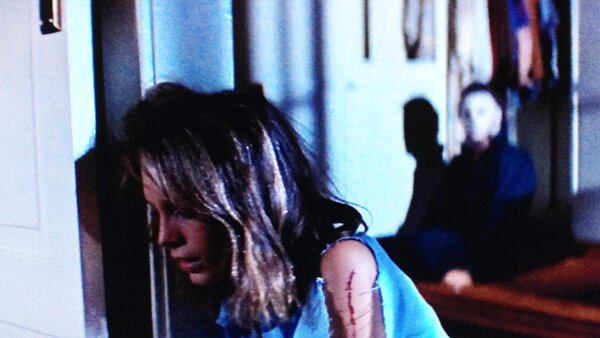
On a technical level, John Carpenter's Halloween is a horror masterpiece that eclipses every single one of its many imitators, and these closing scenes alone display this. The final showdown between Michael Myers and Laurie Strode contains some of the most elite directing in the history of the horror genre.
The excruciating long takes, sharp editing, atmospheric lighting, and consummate mastery of suspense make this truly terrifying cinema, and, unlike most of the slasher flicks that followed Halloween, it's devoid of gore or jump scares. Instead, it's all atmosphere and suspense, and this is all that was needed to get entire cinemas hiding behind their popcorn. Put it this way, any aspiring filmmaker who wants to make a horror movie owes it to themselves to watch Halloween, for they'll learn so much from Carpenter's bravura directing.
Halloween ends on a cliff-hanger. Michael is shot and falls from a balcony, but when his psychiatrist, Sam Loomis (Donald Pleasance), checks down below, he finds that Michael's body has vanished. It finishes with a series of shots of the neighbourhood, accompanied by Michael's sinister breathing. He could be anywhere.
This story of an inexplicable evil invading suburban America ends on a disturbingly enigmatic note and denies its audience any sort of closure, although this would eventually come in the form of a staggering twelve further instalments over the years. Interestingly, Halloween wasn't made with a sequel in mind at all, but such was its brilliance that audiences were thirsty for more.
4. Saw - Jigsaw Rises

Like Halloween, Saw launched one of the most successful horror franchises in history... quite by accident. It was designed to be standalone, yet it was so successful that many sequels have followed. Well, with such an amazing ending, of course viewers wanted more.
Saw centres around two men, Lawrence (Cary Elwes) and Adam (Leigh Whannell), who wake up chained in a bathroom with a corpse between them. It emerges they are victims of the Jigsaw Killer, who forces people he deems unworthy of life to play deadly games, hoping their experiences will make them grateful to be alive. Eventually, it appears that Zepp (Michael Emerson), a creepy hospital orderly, is Jigsaw, but Adam manages to kill him.
Lawrence leaves the bathroom to get help... and Adam then discovers a tape in Zepp's pocket, and the iconic "Hello Zepp" theme begins to play. Zepp was actually being blackmailed by the real killer, and a rapid-fire montage of the film's events plays, showing the clues to the twist and displaying that none of the characters were ever in control.
And finally, the 'corpse' in the bathroom stands up, revealing himself as the real Jigsaw (Tobin Bell), and locks the bathroom, leaving Adam to die with one last, cold line: "Game over!"
Viewers will still be picking their jaws off the floor as the credits roll. This was an evil genius rug-pull worthy of Keyser Soze, and it masterfully introduced John Kramer/Jigsaw, a true horror icon.
3. The Wicker Man - A Human Sacrifice

Even after that horrendous Nic Cage remake became a meme, the true Wicker Man is still a devastating horror film. It's an upsetting and potent warning as to the dangers of cult-like groups and societal breakdown, and it hammers these themes home with the Pagan cult that now occupies Summerisle, an island in the Scottish Hebrides, carrying out perhaps the most disturbing human sacrifice in cinematic history.
From early on in this story, it's clear that a sacrifice is planned. When Sgt. Neil Howie (Edward Woodward) starts investigating the disappearance of a little girl on the island, he soon deduces that she'll be sacrificed to the Pagan gods in order to revive the island's failing harvest. Unfortunately, he's only half-right.
As Howie realizes all too late, he is to be the sacrifice. As a figure of the law who came willingly and is virginal (he's a Christian saving himself for marriage), he fits the criteria for their sacrifice, and the little girl's disappearance was an elaborate ruse to bring him to the island.
Now surrounded by fanatical islanders and unable to escape, Howie is captured, dressed in ceremonial robes and then placed inside a giant wicker man statue, which is then set on fire while the cultists dance and sing merrily before the flames. It's seriously nasty stuff, and will leave many audience members feeling like they've been punched in the gut with a knuckleduster.
2. Don't Look Now - John's Death

Nicolas Roeg's Don't Look Now revolves around John and Laura Baxter (Donald Sutherland and Julie Christie), whose daughter recently drowned. The grieving parents go to Venice to renovate an old church, and they meet a clairvoyant who warns them they're in danger, a warning John firmly dismisses. However, he soon begins to experience mysterious visions of his own.
The picture culminates with a final scene that will genuinely traumatize you; not just because it comes right out of left-field, but because it is, in fact, heavily foreshadowed. Tragically, all of that foreshadowing only makes sense right before John is murdered.
A childlike figure in red wandering the canals, blood staining a photograph, a premonition of Laura in a funeral procession, the hints are there. Unfortunately, John's rigid rationality and failure to process his own grief spell his doom, and when he sees the little figure in red heading into an abandoned building, he excitedly follows her, believing it's his daughter. In fact, it's a hideous female dwarf (Adelina Poerio) who's evidently the serial killer that has been stalking Venice throughout John's time there.
With a horrible smile, she approaches the bewildered John and slices his throat open, closing the loop and concluding his story the only way it was ever going to end, all while Roeg deploys the same brilliant visuals and ingenious, Oscar-worthy editing he uses throughout the rest of this masterpiece. He crafts this death scene as a beautiful, haunting nightmare that'll shatter your nerves and break your heart.
1. Seven - John Doe's Masterpiece

And finally, we've got the denouement to Seven, a finale so exceptional that you'll wish you could forget it so that you could experience it for the first time anew.
David Fincher's masterpiece sees veteran detective William Somerset (Morgan Freeman) and brash rookie David Mills (Brad Pitt) hunting for a monstrous serial killer who's basing his killings on the Seven Deadly Sins. After several days, John Doe (Kevin Spacey) inexplicably hands himself in and offers to take Somerset and Mills out into the desert, where they'll find the bodies of his last two victims. They find something more terrible than they - or the audience, for that matter - could've imagined.
Once they arrive, the severed head of Mills' wife Tracy (Gwyneth Paltrow) is delivered to them, and Doe successfully goads Mills into shooting him dead, with this final death representing 'Wrath', destroying an innocent man and completing John's masterpiece of murder. Still, his victory is not absolute, for Somerset decides to stay with the police after all and says in voiceover: "Ernest Hemingway once wrote: 'The world is a fine place, and worth fighting for.' I agree with the second part."
Everything about this sequence is amazing. The harrowing twists, David Fincher's note-perfect directing, the superb performances, and, of course, that goosebump-inducing music from Howard Shore. Horrifying and chill-inducing yet counterbalanced by that gentle undercurrent of hope, this might just be the best horror movie ending of all freaking time.