Radiohead: Every Album Ranked From Worst To Best
Down really is the new up.
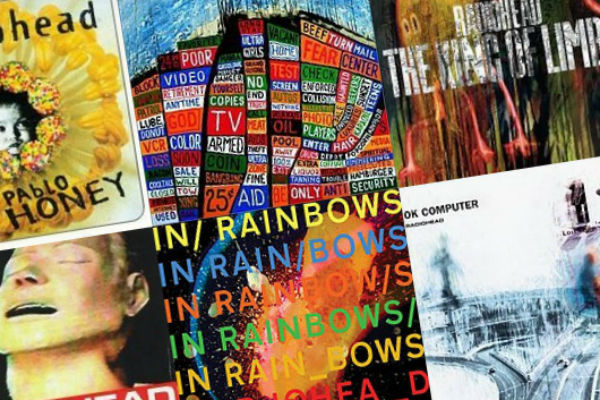
There are three things that should not be discussed late at night, when everyone in your group is tired, emotional, and has had a drink or three. The first of these is politics, the second religion, and the third is which album by Radiohead is their best. Because for many, the Oxford band are like a religion, and any criticism of them - constructive or otherwise - can be treated like you've just nailed a heretical tract to a church door.
Choosing their worst work is a pretty thankless task too, because even a bad Radiohead album is far superior to most other bands good ones. Not to mention the fact that theyre so enigmatic, a new album could literally be announced any minute, meaning this article could in theory be redundant by the time you've finished reading it.
But ever the gamblers we're willing to risk the potential double-whammy of fans fury and being gazumped by Thom Yorke and co, to bring you the definitive ranking of Radiohead's eight studio albums, from worst to best.
8. Pablo Honey
Lets get this out of the way. Just about every Radiohead fan is going to tell you that their 1993 debut Pablo Honey is their worst record. Its not that its necessarily a bad album per se in fact the BBC called it one of rocks most impressive debuts - but it suffers massively from what followed later. Though it birthed one of the bands most famous songs in Creep, even that ended up being so despised that it was dropped it from live sets completely in the late 90s, and they havent played it since 2009. That songs self-pitying lyrics have become one of its most loved aspects, but these same traits crop up time and time again throughout the album, and it starts to grate. All in all, it sounds like its trying too hard to come across as depressing. Pablo Honey is also formulaic, with very little of the innovation that Radiohead would later become famed for. Anyone new to the band listening to it for the first time would be amazed they became anything beyond one-hit wonders.7. Hail To The Thief

6. The King Of Limbs
Radioheads most recent effort, 2011s The King Of Limbs was announced five days before it was released, and even then it arrived a day early. This brevity took fans by surprise, but a bigger shock was in store for them when they started to actually listen to it. Its comfortably Radioheads weirdest album, featuring two drummers throughout, one playing in a conventional way, and one trying to mimic a drum machine. In fact, it could be argued the whole album is one long showcase of Radioheads under-appreciated yet exceptional rhythm section. Ed OBrien told an interviewer that on The King Of Limbs rhythm dictates the record. It's very importantthe rhythm is king." Heavily influenced by dubstep and jazz, its a very impersonal record, and there is an eerie malevolence that lies just beneath the surface throughout much of it. The lighter moments, songs like Codex and Separator, almost come as a relief after the chilly and syncopated Bloom, or Feral. Overall, it demands the attention of the listener this is not an album to be played in the background while doing other tasks.5. The Bends

4. Amnesiac
Largely recorded at the same time as Kid A, 2001s Amnesiac was seen by some as an outtakes album, but that assessment falls short of doing it justice. For one it features the bands greatest single achievement, the charmingly simplistic and stunningly gorgeous Pyramid Song, which Ed OBrien called the best song we've recorded." It is also notable for its moments of clear anger from Yorkes lyrics. Dollars And Cents is inspired by Naomi Kleins No Logo, and is a tirade against peoples powerlessness in the face of capitalism. You And Whose Army? meanwhile is a 1940s doo-wop inspired critique of Tony Blair. It even features the late, great trumpeter Humphrey Lyttelton and his band on meandering album closer Life In A Glasshouse. Despite its initial assessment, the fact it didnt sound much like Kid A was a positive for many, and while that album has grown in stature, Amnesiac is a great record in its own right. Its highs are as good as any in the bands career, and this was reflected when Amnesiac became Radioheads second album to gain a Mercury Prize nomination, and their fourth nominated for a Grammy.3. Kid A

2. OK Computer
Now recognised as one of the greatest albums of all time, 1997s OK Computer was a sonic leap compared to the album it followed. Where The Bends was full of guitar anthems, its follow-up was endlessly experimental, imbued with brooding pre-millennium tension. OK Computers jumping off point was what Yorke called the "incredibly dense and terrifying sound" of Miles Davis Bitches Brew, but the myriad touchstones and subtle influences throughout come together to make something utterly unique. Opener Airbag for example was heavily influenced by DJ Shadow, and its drums in particular were cut up and pasted back together in an attempt to emulate his distinctive sound. Climbing Up the Walls took its cue from modern classical composer Krzysztof Penderecki, Let Down tried to emulate Phil Spectors wall of sound, while Lucky was an attempt to put the horror of the Bosnian conflict to music. Its only through repeated listens that all these small details of OK Computer really come to the fore. For example, the screaming underneath the solo at the end of Paranoid Android can only really be heard with headphones, and even then its not obvious. The album even features a plate reverberator previously owned by Jona Lewie, famous for being the one-hit wonder behind the Christmas song Stop The Cavalry.1. In Rainbows
