11 Scientific Discoveries That Were Total Accidents
2. Pulsars
Jocelyn Bell was working at Mullard Radio Astronomy Observatory outside Cambridge in the 1960s. Her job was to analyse the hundreds of feet of readout that spewed from the telescope each day.
The observatory was pointed out into space, listening hard for any signals coming our way from stars, galaxies or even aliens. One day in 1967, Bell noticed a little pulse hidden amongst the data, beating like clockwork every 1.3 seconds. She circled the anomaly and labeled it "LGM-1", which stood for "Little Green Men", because the pulse was so regular that it seemed logical that it was being made by some form of intelligent life.
Soon after, another pulse was discovered, beating regularly at 1.6-second intervals. Was there an incoming fleet of alien spaceships heading our way, or were the signals coming from a different source?
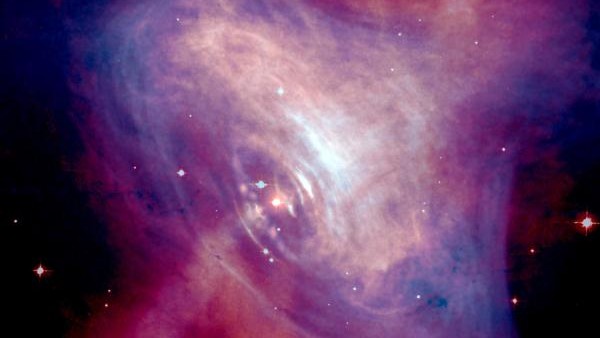
It turned out to be the latter. Jocelyn Bell and her colleagues had accidentally stumbled upon pulsars. These are the impossibly dense husks left over after a star goes supernova. These city-sized clusters of neutrons emit a beam of electromagnetic radiation and spin at phenomenal speeds with pinpoint regularity. When the beam passes over the earth, we see it as a pulse, like a lighthouse.
The pulses are so consistently regular that they rival even the most accurate atomic clocks, so there's no wonder the team at the observatory thought they might be coming from advance intelligent life, rather than a long dead, distant star.